
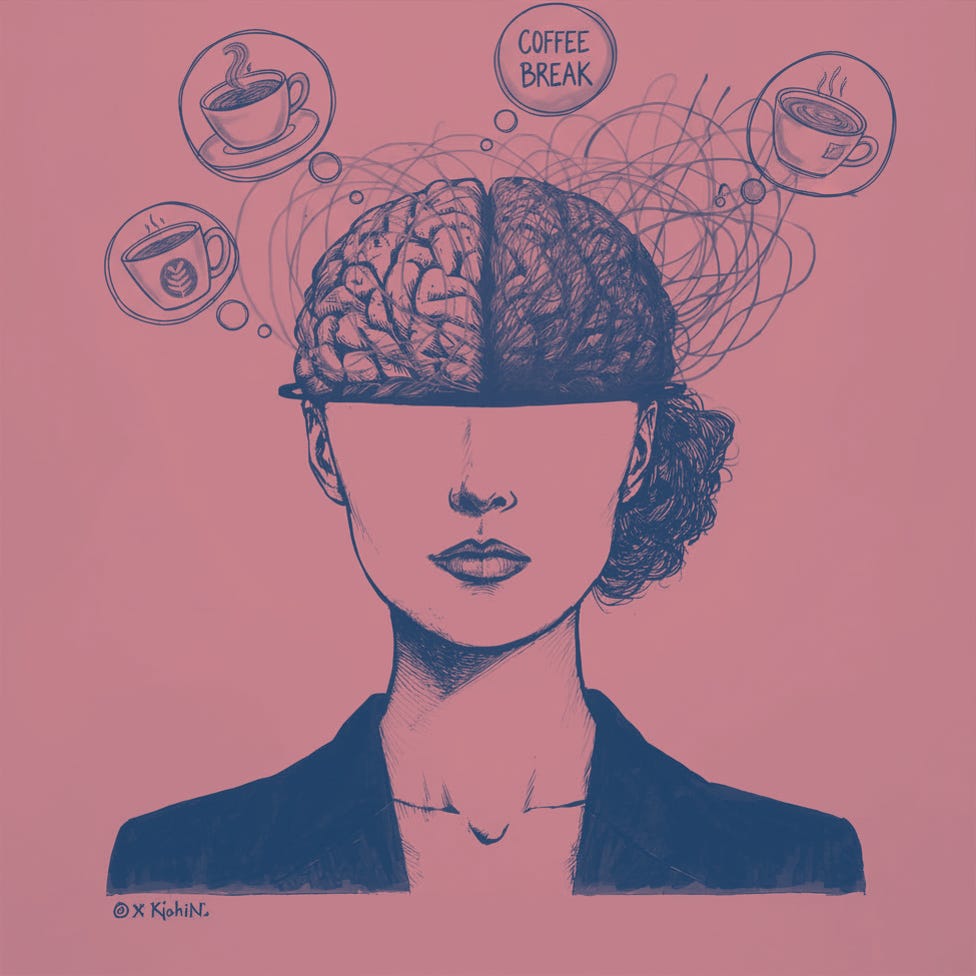
I’m a caffeine addict. Let’s be clear: this Substack would not exist were it not for drip coffee, espresso, cortados, lattes, and matcha. All variations of the delicious, brain-activating, word-stimulating liquid substance.
So, to tell me that I might need to wean off or scale back — my brain goes on full-scale red alert at any message like that.
We can’t function! It’s NOT possible!
Becoming a mother set this in stone. Through my season of 4 a.m. shifts, I had a nightly ritual of pre-preparing my morning espresso shot the night before and warming it for thirty seconds in the microwave as soon as I got up. If that doesn’t sound like dependency, I don’t know what is.
Now in my forties, I’ve started to experience all the things — the brain fog, the morning fatigue that doesn’t relent until I have coffee or a workout. As a physician, I have recently been advising as many of my patients as possible to get a continuous glucose monitor (CGM) to better tailor their individual eating plans and activity to regulating their blood sugar. You don’t have to be diabetic to benefit from data about your own personal metabolics. So, my husband and I started the blood glucose monitoring thing ourselves.
While wearing a CGM the last two weeks, I discovered I have persistent overnight hypoglycemia. So I fed my blood sugar data into Claude when (Disclaimer: I am not medically recommending you do that — this was just my attempt to get answers.) One of the suggestions it gave me was to delay my first caffeine intake by 60 to 90 minutes.
I was like — no way, Claude!!
It triggered that absolute, black-and-white thinking: There is NO way I can get my day started without coffee. But I’m grateful for learning to leave a fundamentalist mindset, because anytime a thought now enters my mind as an absolute, that little voice in my head that challenged me out of previously tightly held beliefs steps in. It asks: Is that really true? Could the opposite be true? And with that self-challenge, I have been starting my days with a decaf espresso for nine days.
I’ve defeated chemical dependencies before, like when I quit alcohol 10+ years ago, (detailed in my book in a painstakingly embarassing scene that I dread having colleagues and patients read…) So, based on my success with quitting wine, I know I can quit my immediate morning coffee habit if I really have to.
But it’s been really hard, so I decided to look under the hood of Claude’s advice in order to decide if I should keep going with this experiment.
The popular wellness claim is that you must delay caffeine to “protect” your Cortisol Awakening Response (CAR). The CAR is a rapid rise in cortisol that occurs within the first 30 to 45 minutes after waking up, typically increasing by 38% to 75% above waking levels to mobilize your resources for the day ahead.¹
But when I dug into the primary literature, I found evidence that directly contradicts Claude’s advice and complicates the current wellness narrative.
It turns out there is absolutely no direct clinical evidence that caffeine consumed within 60 to 90 minutes of waking “interferes with” or blunts the Cortisol Awakening Response.²
What the evidence actually shows is that caffeine is a well-established stimulator of the hypothalamic-pituitary-adrenal (HPA) axis.³ Rather than suppressing your morning cortisol, coffee adds to it.⁴ In a placebo-controlled crossover study, a dose of caffeine equivalent to two or three cups of coffee increased cortisol by about 30% at the 60-minute mark.⁵ Another crossover trial found that caffeinated coffee entirely prevented the normal post-morning decline in serum cortisol, keeping levels significantly elevated from 60 minutes onward compared to water or decaf.⁶
Here is the kicker: if you are a habitual caffeine consumer (drinking 300 to 600 mg a day for at least 5 days), your morning cortisol response to caffeine is largely abolished anyway due to tolerance.⁷ You might get a blunted additive effect, but you are absolutely not interfering with your endogenous CAR.⁸
The scientific community is actively rethinking the CAR itself. A fascinating 2025 study using ambulatory microdialysis in 201 healthy volunteers found no evidence that awakening itself increases the rate of cortisol secretion compared to the hour before waking.⁹ This suggests the morning cortisol rise may largely reflect the underlying circadian rhythm, rather than a fragile, awakening-triggered event that your espresso is going to break.¹⁰
If you are experiencing morning fatigue, the factors that genuinely affect your CAR are sleep duration, awakening time, physical activity, and underlying health.¹¹ Caffeine isn’t even listed among established confounders in expert consensus guidelines.¹²
Before doing the deep research dive in the first place, I took Claude’s advice at face-value and begrudgingly delayed my morning cup to see if I would wake up more ‘refreshed.’ It was at an extremely inconvenient time (as if there is a convenient one to stop drinking coffee), I had evening shifts and it felt a unique torture. It physically felt terrible in my body transitioning out of my routine. I felt like I had removed one of the greatest joys in my life: the smell of those delicious arabica beans freshly ground, and the hot liquid hitting my throat.
More importantly, it’s a miracle my children’s lunches made it into their lunchbags. I can say that they were late for school on more than one in occasion during these nine days.
I also had a very specific, very personal worry — one I wasn’t sure I’d write about publicly, but if you have read this far, you are used to my degree of over-sharing… So, I was convinced my morning bowel routine wouldn’t happen without coffee. This is the part where I confess I asked Claude about that too, and was reassured that the gastrocolic reflex (the natural increase in colonic activity triggered by eating or drinking anything in the morning) would do the job just fine on its own. I won’t tell you the outcome of that experiment but I’ll allow you to discover on your own if that’s true for your own body.
This recent CGM experiment nudged me to finally open 5 month old personal data came from a Brain DNA test I’d taken in December. Here are my results on two of the relevant genes:
CYP1A2: AA — the fast-metabolizer genotype. About 46% of people, including me, have it.
AHR: CC — the upstream regulator that decides how strongly CYP1A2 actually gets switched on. Net effect: somewhere between a true fast metabolizer and an intermediate one. Still favorable, but not maximally so.
What the test did not include is my ADORA2A status — the gene that codes for caffeine’s receptor in the brain. CYP1A2 tells you how fast caffeine leaves your body. ADORA2A tells you how hard it hits in the first place.
The two are completely independent. You can be a fast metabolizer with high receptor sensitivity and still have caffeine wreck your sleep and spike your anxiety. That gene is on my list to check next winter after the fall book launch, when I hope my life goes back to normal again…
The evidence says we shouldn’t be drinking coffee leading up to 8.8 hours before bedtime — caffeine delays the circadian melatonin rhythm by about 40 minutes and can reduce total sleep time by 45 minutes.¹³
So while my immediate morning cup isn’t destroying my hormones, trying to power through work in the evening may require some reconfiguration.
My overall impression is that it's probably healthier to give up caffeine altogether — but I’m just not ready for that. (Maybe a brain health project for after my first book is launched.) On that topic….:
A digital advanced reader version of Rise After Silence will be up on a platform called NetGalley soon, and I would be so grateful for any advance reader reviews on Goodreads once my author page is enabled. If you want to be an early reader, I would be delighted (well, except for when you read that alcohol scene…)
Please feel free to share with family and friends. The website for my book just went live: www.riseaftersilence.com
The official book launch day for hard copies is Tuesday, October 6th, (I may be reaching out to some of you directly to ask for a Goodreads and Amazon reviews — huge thanks in advance.) I’ve heard Amazon reviews now account for up to 80% of book sales, which is wild. I don’t love endorsing Amazon, but just like I’d do anything to support my children, I’ll do whatever it takes to launch this book.
Still surviving and word-producing thanks to Caffeine,
xo
Dr. Anne
Ps. I’m always open to covering any topic related to brain health, so feel free to send me your requests anytime and I’ll be pivoting back to more brain science content after the October book launch. In the meantime, I hope, courtesy of my words and brain caffeine research, you can now enjoy your morning fix guilt-free.
Stalder T, Oster H, Abelson JL, et al. The Cortisol Awakening Response: Regulation and Functional Significance. Endocrine Reviews. 2025.
Elder GJ, Wetherell MA, Barclay NL, Ellis JG. The Cortisol Awakening Response--Applications and Implications for Sleep Medicine. Sleep Medicine Reviews. 2014.
Lovallo WR, Al’Absi M, Blick K, Whitsett TL, Wilson MF. Stress-Like Adrenocorticotropin Responses to Caffeine in Young Healthy Men. Pharmacology, Biochemistry, and Behavior. 1996.
Gavrieli A, Yannakoulia M, Fragopoulou E, et al. Caffeinated Coffee Does Not Acutely Affect Energy Intake, Appetite, or Inflammation but Prevents Serum Cortisol Concentrations From Falling in Healthy Men. The Journal of Nutrition. 2011.
Lovallo WR, Whitsett TL, al’Absi M, et al. Caffeine Stimulation of Cortisol Secretion Across the Waking Hours in Relation to Caffeine Intake Levels. Psychosomatic Medicine. 2005.
Klaas S, Upton TJ, Zavala E, et al. Awakening Not Associated With an Increased Rate of Cortisol Secretion. Proceedings. Biological Sciences. 2025.
Stalder T, Kirschbaum C, Kudielka BM, et al. Assessment of the Cortisol Awakening Response: Expert Consensus Guidelines. Psychoneuroendocrinology. 2016.
Vreeburg SA, Kruijtzer BP, van Pelt J, et al. Associations Between Sociodemographic, Sampling and Health Factors and Various Salivary Cortisol Indicators in a Large Sample Without Psychopathology. Psychoneuroendocrinology. 2009.
Anderson T, Corneau G, Wideman L, Eddington K, Vrshek-Schallhorn S. The Impact of Prior Day Sleep and Physical Activity on the Cortisol Awakening Response. Psychoneuroendocrinology. 2021.
Gardiner C, Weakley J, Burke LM, et al. The Effect of Caffeine on Subsequent Sleep: A Systematic Review and Meta-Analysis. Sleep Medicine Reviews. 2023.
Burke TM, Markwald RR, McHill AW, et al. Effects of Caffeine on the Human Circadian Clock in Vivo and in Vitro. Science Translational Medicine. 2015.
Chang YH, Cheng YC, Cheng WJ. Age- And Dose-Specific Effects of Caffeine on Sleep: A Meta-Analysis of Controlled Crossover Trials. Sleep Medicine. 2025.
Weibel J, Lin YS, Landolt HP, et al. The Impact of Daily Caffeine Intake on Nighttime Sleep in Young Adult Men. Scientific Reports. 2021.
No posts
Comments
Nothing yet. Say the first thing.
Sign in to join the conversation.