
Text within this block will maintain its original spacing when published
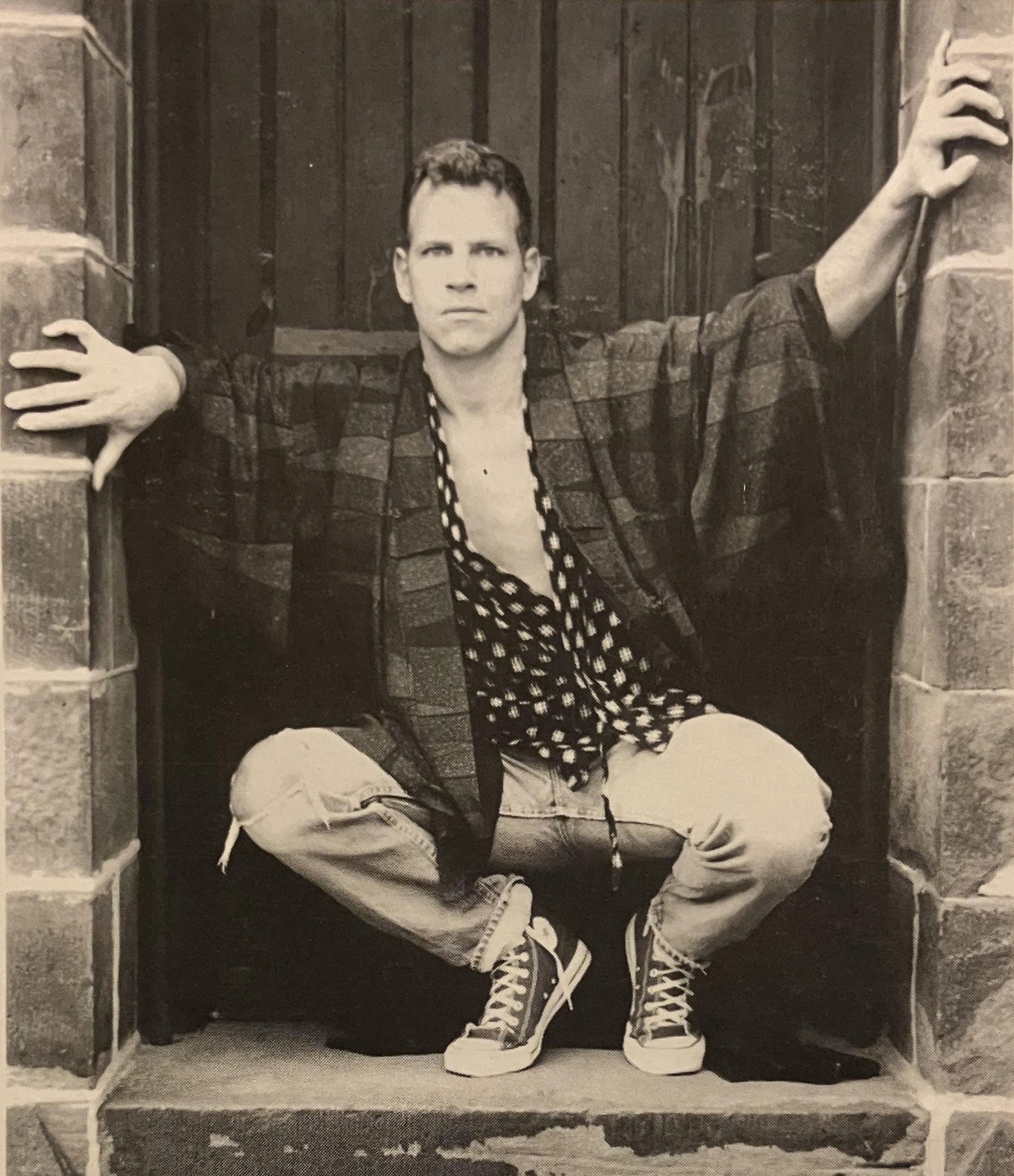
Here is the first of a new monthly feature from Radiator Press, GAS BILL (no charge). We're starting with four poems (previously unpublished) by the late great Jim Cory, and a poem each from Cort Day and Stephen Potter, who are editing a book of selected poems by Cory to be published next year by Radiator. We hope you enjoy.
Note: Best read on desktop or with phone turned to landscape view — line breaks etc.
Text within this block will maintain its original spacing when published
cory is a faggot
anonymity confers a certain daring
on secret undertakers of the spirit
who smile offering pleasantries
at the candy machine   hearty messengers
w/ breath of formaldehyde
& guile acquired on vacations
to prepackaged gambling dens, all this
betrayed
in the way they chew:
you may encounter their truest feelings
on the walls of 6th floor lavatory stalls
where they scrawl
the carnal equivalent of nose pickings:
what they write is (technically speaking)
correct tho it’s not exactly
clever nor interesting nor even
News to most
so...forgive them
forgive their want
of couth mirth style insight or
decency   they exist
as bundles of thwarted instinct
combined w/ infinities of dimly remembered soul mishaps
reduced to cell-clusters
afloat in the ether
of what a certain Swiss physician dubbed “the unconscious”:
bowing & gloved
satin-tongued, w/ their eyes
full of scalpels
they go on living in underworld gameshow imaginations
of what they can’t have
or don’t have or won’t have
& who cares?
stray/horn
to depart from the garden of Eden, obedient as shade, having
                                                               bitten
                                                               forbidden fruit
                                  & tasted
                                                                           wax
wrapp’d in paisley ascot
wearing the bemused half-smile
                                        of a quiet bitterness
massive glasses behind which
                                                               childish eyes
                                                               peer
                   from the undergrowth
                                                 of a well-composed hell
ears tuned to hear
                           the river
                                         celebrate its own melancholy
while the notes of a Steinway drift blithely thru
               afternoons of ungiven
                                                                 love
(shirt pocket stuffed w/sapphires
                                                                 in his pants
                           fate’s raincheck
                                                        securely tuckt)
cigarettes...gardens of gin flowering
                                                               toxic & eternal
solitary confinements of the spirit
New York...Paris...Isfahan
                      (carrying a caged owl a bladeless sword)
                                                                       *
in copasetic nocturnes waving cocktails at tap dancers
on the subway all the way from Penn Station up to Harlem
                                        (labyrinth w/o exit)
at the far end of the bar where the clock in the mirror
                                                      rears dentures
                           of disappearing minutes
or on a park bench sorting stars
a last chorus of saxophones
                                                                   distant
      dim
                  a rose unseen
                                               floating down the Hudson...
Night in Tunisia
the forms of approved cruelty depend
on endlessly shifting variables such as time & place
while the sociology of class race & gender
determine who it’s safe to sneer at at the moment
I remember once in the 80s Dizzy Gillespie
enacting a lisping fag joke between numbers
on stage at the Academy of Music he must’ve
convinced himself it was still 1943 or something as he
finished this mincing mimicry & grinned, awaiting
the requisite burst of warm mirth but instead
a run of stunned silence ensued a sound
like the brain slowly drowning in formaldehyde & after
a few small eternities of this he pointed his horn toward
the ceiling & began playing “Night in Tunisia”
In New Orleans
It was in New Orleans, at the Cafe LaFitte no less
that late one evening I met a swarthy pirate
named Jacques, w/ whom
on the 14th floor of the Sheraton
I spent the tenderest night of my life.
He had earthblack hair, this Jacques, ears
pink as worms, amberbrown eyes
where my image swam in a pool of warm regard. While
the howls & cries of Bourbon Street drifted below
he lifted a chapbook
lying on the nightstand & leafed thru it. Oh, he said
you’re a poet? Read me your poems. And of course
swelling w/a poet’s vanity, I did.
From outside the door a passerby might’ve heard
furniture mumbling
but w/in 1410 Jacques & I spoke
with our hands. How quickly
we pulled & peeled, unzipped & let slip
away those ridiculous clothes.
We were neither young nor old. Each of us
had made love many times or more than
many times. Still, I fell
for the way he laid his head on my side
& lost himself in an unwashed underarm.
About his body I recall several things:
that it was slender & small w/
fist-sized nipples of cranberry. These I could
easily have caressed all night
(gasps! goosebumps…) making my fingertips
crayfish & scuttling deviant antennae
except that then, in that zone of floating noise
that tapwater click of relentlessness
we found each other’s lips. Our mouths became
portals of silent squeals & blind puppy
feeling. Kisses deepened & grew
while on the nightstand dots & digits blinked
& ran toward morning.
I don’t know when we fell asleep or what time we awoke
except that we did so tangled trunk & vine.
All I knew about him was his name
which, he’d informed me, was mine
in another language.
And then, minus the perfunctory exchange
of data promising some rendezvous not to be
the door closed. In a minute or 2 I rose
to watch that bluejeaned figure loping
down Royal toward Bienville, pause before storeglass
to adjust his shirt & disappear
into that ragged casbah where so many such loves & nights
have declared their right to exist.
Jim Cory (1953-2024) was a poet, essayist, editor, and activist who studied birds, buildings, and a wide range of history. Born in Oklahoma, he moved to Philadelphia in the late 1970s and became an influential part of the poetry scene. The author of Why Is That Goddamned Radio On? (Radiator Press, 2024) and numerous chapbooks, including WIFE (1993), The Redheads (1997), Facts in the Case of E.A.P. (or) Low Road to El Dorado (2003), and No Brainer Variations (2011), Cory also edited books of poetry by James Broughton, Jonathan Williams, and Karl Tierney. Next year, a book of Jim Cory's selected poems, edited by Cort Day and Stephen Potter, will be published by Radiator Press.
Text within this block will maintain its original spacing when published
Redstart

Then I was a solid lyric body
and you were picking berries
in a blueshift cemetery, saying
I’ll never fill this container.
You were a mind experiment
in denim shorts,
and I saw you hitching:
an odd behavior of eros and grief
with slender green stems and pale florets,
each of them
a line.
I’m a working hypothesis of sand.
You’re a hillside of witchgrass and thought,
a rhizome, everywhere growing.
If I make this declaration now
it's because I’m a redstart in a wheatfield,
lost, and you’re some rain about to fall,
and –
                       evening clouds
above the river darkened,
timelapse streetlights
wandered the empty park,
a quicksilver touched the face
of the library –
and you were the transient past,
and I was the irreparable future,
on whose edge you quivered
with a ghost creature’s weight
I was the sensation of bearing.
Cort Day lives in Philadelphia, where he is involved in a fortuitous collaboration with Radiator Press to publish more of the work of Jim Cory. He is the author of The Chime (Alice James Books). He is working on another book of poems.
Text within this block will maintain its original spacing when published
Pasolini Elegy
He was a corpse that wasn’t a corpse
before they ran him over/ repeatedly/ then set him on fire.
Those were the days when poets held power enough to attract cross-hairs.
Or was it the movies he made that made waves,
his leftist eye a flashlight penetrating the sordid
reservoirs on which the social veneer floats scum-like.
How thin the skin that holds together power,
its cancerous bones, its putrefying organs. So
don’t poke the rotting Roman bear. Don’t make it
projectile vomit upon you. The beloved poor
are easily bought and have no time
between work and television for Marxist critiques.
The powers-that-be long ago inculcated them
in their catechism, defining the thimble
that contains patriotism and the pinhead
on which all angels dance. They have no room
for faggots, not even their own, swishy pets.
Backs are made for tire tracks; faces, for mud.
A native Philadelphian, Stephen Potter is also fortuitously collaborating with Radiator Press to publish more of the work of Jim Cory. His work has appeared sporadically over the years in various places, including Assaracus, bedfellows magazine, and American Poetry Review.
Text within this block will maintain its original spacing when published
More Jim Cory in prose and print can be found here:
Text within this block will maintain its original spacing when published
Stay tuned for news on his collected works, out next year. All our thanks to Cort Day and Stephen Potter for their editorial and archival efforts.
Comments
Nothing yet. Say the first thing.
Sign in to join the conversation.