
I’m not doing easy stuff anymore. AI is.
For 25 years, I was in the trenches running a web hosting and managed services company. Jumping in when needed to write a script, update an Ansible playbook, or reboot a server — stuff I’ve done thousands of times before.
AI now handles the easy work, and I spend my day on high-value tasks.
Just this week, I wrapped up a proposal for a 12-month modernization strategy for an e-commerce site with 45,000 products. I finished a survey of 300 content sites merging from a tangled mix of hosting providers to a single vendor. This morning, before writing this post, I discussed a proof-of-concept for an AI-driven competitive intelligence tool for a coffee roastery.
I feel both productive and wiped out.
Those routine tasks weren’t wasting my time. They were giving my brain a break.
Muscle memory kicks in, and I don’t have to think. My mind coasts for a bit before the next hard problem.
AI removed that layer. Now my days are harder, not easier.
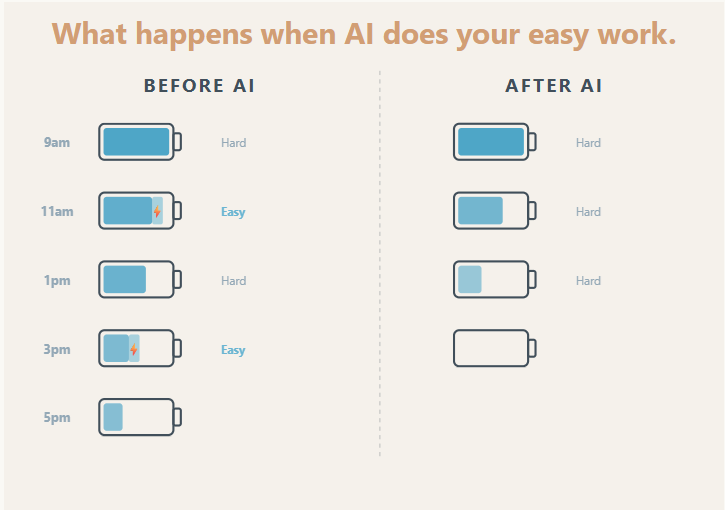
I call it cognitive debt.
You gain capacity in the short term by offloading easy tasks. But you’re borrowing against your brain’s ability to recover during the workday. By 3 pm, the debt is due. You’re making worse decisions than you would have if you’d done some of the easy stuff yourself.
I went looking to see if others noticed this. I found academic research and plenty of anecdotal accounts that matched what I was seeing. Studies on AI-assisted work show people shift from producing things to supervising AI output. That’s not less work. It’s different work, and it’s all high-cognitive-load.
Other research shows short breaks help with fatigue, but they don’t replace what low-demand tasks do for your brain. A 10-minute coffee break isn’t the same as 30 minutes of work that your hands can do on autopilot.
There’s a subtler cost, too.
When AI handles the easy tasks, you stop practicing the fundamentals.
I catch myself asking AI for command syntax I used to know. In the past, I would have paused, read the manual page, and refreshed my memory. Small thing. But those small things kept core skills sharp without costing me anything. Now they’re gone.
The boring stuff was practice in disguise. A cognitive buffer that absorbed time and energy at low cost. Built-in recovery between hard problems.
My brain had a system that worked for 25 years. I automated it away and called it progress.
What did you call it?
I’m Jeff Huckaby, founder of rackAID. I help established businesses make sound technology decisions — connecting technical activity to business outcomes.
No posts
Comments
Nothing yet. Say the first thing.
Sign in to join the conversation.