
Poet Coleman Barks passed away on the 23rd of February. I’ll forever be grateful to his good friend, the late Robert Bly, whose own writing turned me towards Barks’ whirling and wondrous personal output; likewise it persuaded a first dipped toe into his -and others’- interpretations of the poems of Sufi mystic, Rumi. Holly Haworth wrote a gentle piece in Barks’ memory, and it served as a reminder to me that, although I never had the chance to meet this big-hearted American poet-artist, I can still feel blessed by the legacy of words he left behind, and of those whose lives he intertwined with.
In August of 2025, The Bitter Southerner shared ‘Six Poems By Coleman Barks’, new works, and, poignantly, they may well have been his final works.
Text within this block will maintain its original spacing when published
October 7th 1955
Buckminster Fuller says about the past.
Keep it. Times Square for example.
Put a dome over it. Set up tables and chairs,
so people can feel what was there, not just read about it.
Ramakrishna said if you gave people a choice
between going to heaven & hearing a lecture
about it, most people would choose the lecture.
How about enlightenment?
How about ecstatic poetry?
Actually experiencing what it’s talking about & talking about it.
Rumi said that poetry is pointing towards something & walking away from it.
-- Coleman Barks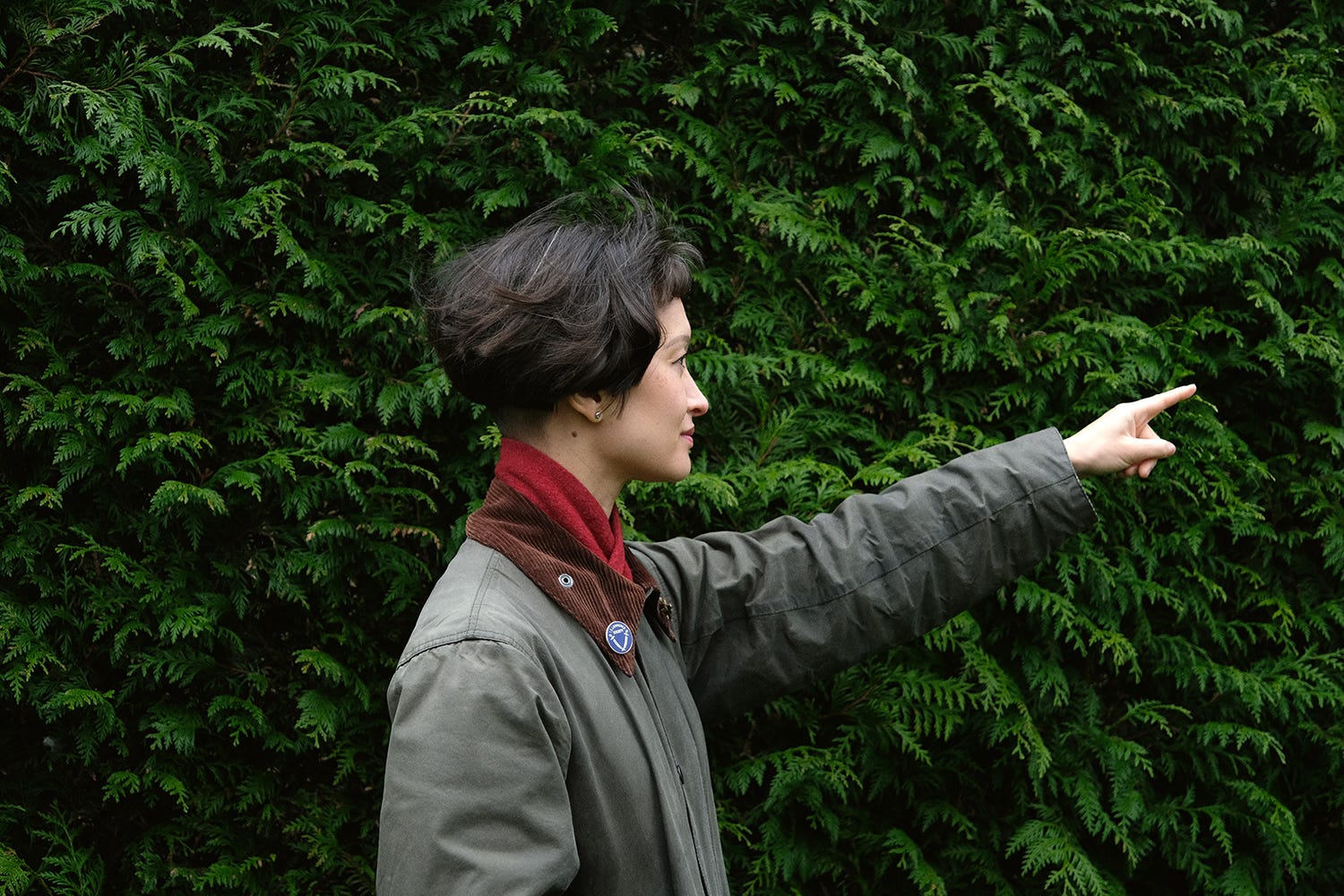
‘Rumi said poetry is like pointing towards something & walking away from it’, unceasingly echoed in my mind after reading October 7th 1955, the second poem in the collection.
So intensely did this line stare me in the face that I searched intermittently for several days to find an original source or inspiration for it, another translation, even. But to no avail. Eventually I decided that it did not matter at the moment; what mattered was how I chose to nurture the kernel of curiosity this sentence had sown for me. If, as I first thought, this excerpt could apply to all forms of creative practice, then, as an artist first (cloistered writer second), could my understanding of it teach me a lesson about my own visual language?
During a long lunchtime walk, I hastily dictated a few jumbled thoughts in an attempt to placate my preoccupation with this one passage. Forgive me that it is by no means anything complete, but nonetheless it still feels like a springboard into further study and discussion for the future.
‘Rumi said poetry is like pointing towards something…’
To point ‘towards something’ is to declare it a sight worthy of attention: Look! This is beautiful/terrible [insert adjective of choice], and so on. To point towards something is compass-like, ordinal and cardinal, and every direction in-between; it is also to render it place-marked in one’s physical or emotional landscape, a beacon or thought to return to later, perhaps. It’s the intention before action. To point both communicates and divides the energy and materiality of the object, person, space; a sort of Heideggerian ‘thingness of things’ in one simple, gestural swoop.
‘…& walking away from it.’
It is not only the literal repetition of one foot before another; it is participating in anarchy against the status quo, the breakneck pace of life. Frédéric Gros suggests that: ‘Reality when you are walking is not only the solidarity of the earth underfoot, but a test of your own firmness.’1 So if we consider the walk as an act of creative (poetic, artistic) rebellion, walking away is, in part, a stubbornness of will. A thanks, but no thanks approach to mark-making; where one can appreciate the merits and talents of peers -and rivals!- but have the courage, even arrogance, to forge a brand new path - or at least to consider the one less-trodden.
Whilst pondering how to even begin this short piece, I came across Destabilizing Marcel Duchamp, a 2017 article by Miklos Legrady in The New Art Examiner, in which Duchamp is considered as self-sabotaging (‘what else is nihilism but self-destruction?’) and as one who has ‘forced myself to contradict myself in order to avoid conforming to my own taste.’ Later, I was reminded of a quote often attributed to Pablo Picasso: ‘Every act of creation is first an act of destruction.’ Indeed, John Berger’s interpretation of Les Demoiselles d’Avignon, suggested that ‘[Picasso’s] fury in painting it was so great that it destroyed his gifts…’2
For me, these examples seem kindred to the enigmatic Rumi-Barks closing line. The profound desire to walk away from (to destroy) the old, the commercialised, the comfortable and quotidian. Even if these elements feel safe and established; even if they keep you in notebooks and inks and -if you’re very fortunate- help pay the mortgage, sometimes the itch to throw that (pointy-fingered!) gauntlet at all that is expected of you, is too strong to be ignored.
But as the seasons shift springwards, I admit to feeling hesitant in leaving ‘The Expected’ behind. This time, for me, its omnipresent form enveloped the whole month of February. After a soft, slow emergence into the hopes and promises of January, there was still enough of a quietness to February to ease back into work or ease into regular routines; even now I am currently guilty of still picking up the final dropped threads of my December schedule! Then there is the shedding of winter coats as the sun (we hope) emerges; simultaneously there’s the assumption one will shrug off those cocoon-like defenses: it’s dry today, get out there and socialise, for goodness’ sake! Yet, right now, my February-into-March feels liminal, caught between excitedly getting started on all those plans for the rest of this year; simultaneously fearing the loss of the norm I had known from last year.
When caught in a creative rut, one of the first questions I usually ask myself is: ‘Where am I going with this?’ By that, where are my illustrations physically going to take me? Towards an exhibition or a print fair? Towards an ever more mature collection of prints and greater understanding of the medium? Or will they languish in a box under the printing press, or wallpaper the recycling bin once more? And what are my ideas emblematic of? What’s their fuller meaning beyond something merely decorative or skillful? Is what I’m doing representative of (actual) me, or (predicted) me? And what does it even matter, anyway, when AI will take my job when I’m dust?
Text within this block will maintain its original spacing when published
Looking At The Last Page
One of these notebooks,
One of these pages,
Will be the last that gets written on/in, by me.
So my archive gets consolidated and put somewhere. Maybe to be looked at,
Ever again, maybe not. (In the University of Georgia Library)
Maybe to be destroyed by a fire.
Or flood: It could be, unlikeliest of cases, covered over by earth
Or blown off in a tornadic (gale-force) wind
(Or) destroyed by some combination all those elements,
Or other ripping & tearing forces/beings/big
bobcats/peevish children
-- Coleman Barks
Artists and poets have long bucked the trends, and built cities of creativity on unpredictable foundations. The element of risk and of failure that comes with forging this existence is a vital part of that lifelong learning process. At school, it was always drilled into me that the art is a vocation, not a job. Not a nine-to-five, nor a steady pay-cheque, but a calling: a summoning from within to just make, and to make by all means necessary. To fiercely fight against those ceaseless self-doubts. To keep questioning that vocation even when it feels akin to cruelty. To feel in every sinew the ecstatic strain of crafting the thing, even if all it ever becomes is firewood.
If there’s truth in Barks’ sixth, and final, poem from The Bitter Southerner that: ‘One of these pages / Will be the last that gets written on’, then surely even more reason to stop playing safe. There’s no time like now to choose the unexpected direction.
‘Rumi said poetry is like pointing towards something & walking away.’
And, perhaps that ‘something’ is also ourselves. It’s not merely the where am I going? It’s the who am I?, and the what am I doing? And am I willing to rebel against myself?
‘And (then) you will leap away from the bonds of a thousand traps. / Come, at last, to the Source of the source of your own self!’3
Yes, I am willing.
Are you?
Thank you for reading Artist’s Proof. This post is public, and I would so appreciate it if you shared it. This will help reach a wider audience, and be of much encouragement. You can also hit that ‘heart’ button or leave a comment. I’d love to hear from you.
Frédéric Gros. A Philosophy of Walking (London: Verso, 2023), p. 135.
John Berger. The Success and Failure of Picasso (Penguin Books Ltd, 1965), pp. 73–77.
Jalaluddin Rumi. “Ghazal 120: Come to the Source of Your Own Self,” in The Dîwân-é Kabîr, translated from the Persian by Ibrahim Gamard, 2003. <http://www.dar-al-masnavi.org/gh-0120.html> [accessed 26 February 2026].
Comments
Nothing yet. Say the first thing.
Sign in to join the conversation.