
I’m of mixed heritage: Hong Kong Chinese, British, and Ashkenazi (from Latvia). And I cannot recall a time where finding my ‘place’ hasn’t been both a personal and creative uphill struggle. In particular, attempts to accept the most dominant of my genes have floundered since moving from London to a tiny homogeneous town in the West Country, and the almond-shaped eyes, the dark, poker-straight hair, the warmer toned skin —that’s right, I look more Asian than anything else— often prompt curious folks into asking, ‘No, where are you really from?’ or (and this is my favourite) speaking excruciatingly slowly to me, lest I be incapable of understanding English. Good thing it is my first —and only— language, then!
Othering and egging aside (the former mostly ignored; the latter always missed by miles!), the realisation that 2024 was going to herald the last birthday of my thirties was the push I finally needed to engage with my Chinese roots, instead of metaphorically burying them somewhere in the compost heap (hint: like potatoes, they’ll just keep sprouting to the surface).
And so the work began. The first —hopefully not the last— foray into wanting to represent, in printmaking and as a printmaker, people whom I can identify with; Asian or multi-ethnic folks who have so-often just been placed, whether intentionally or not, under the banner or veil of a single race (in my case, usually Japanese).
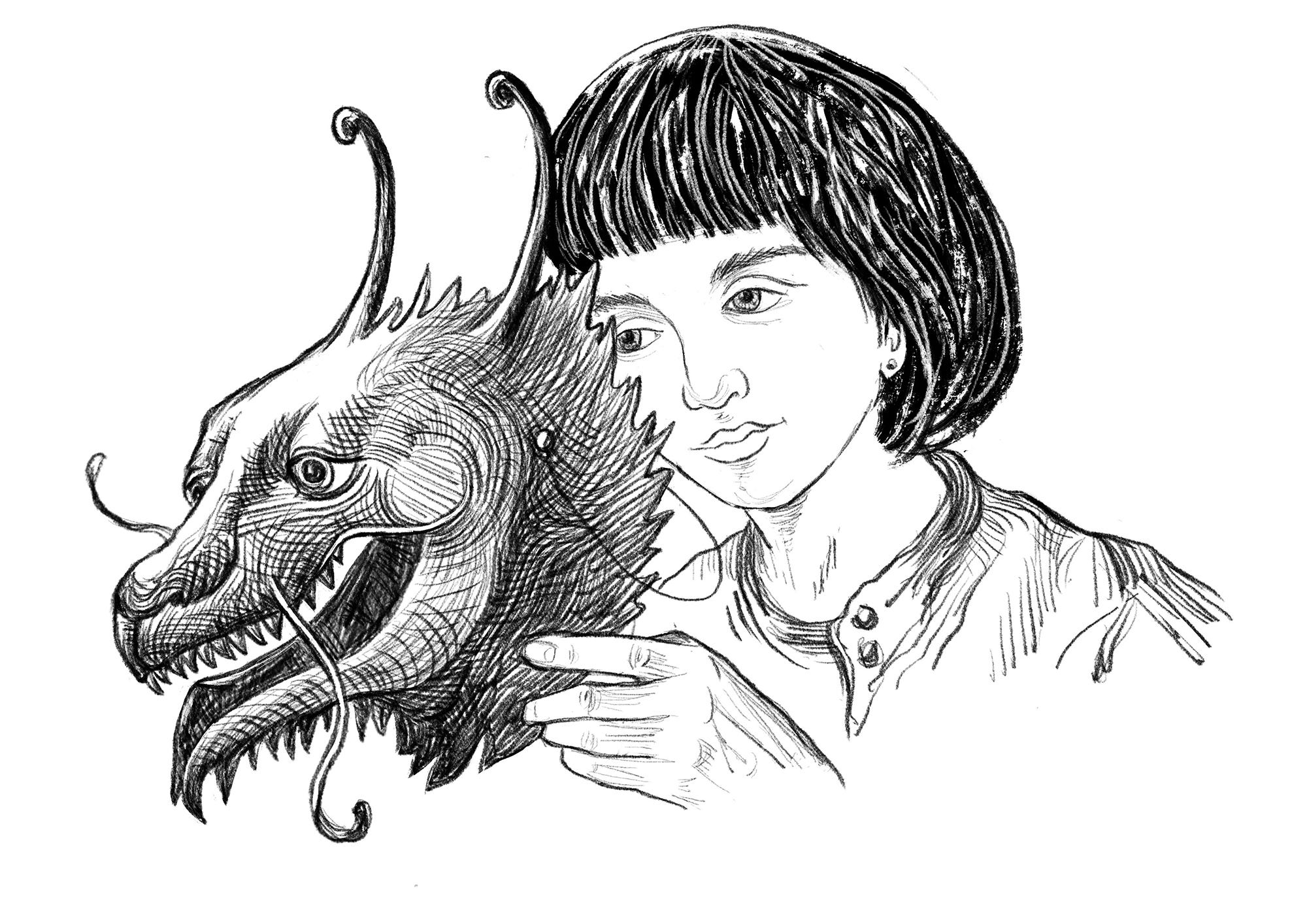
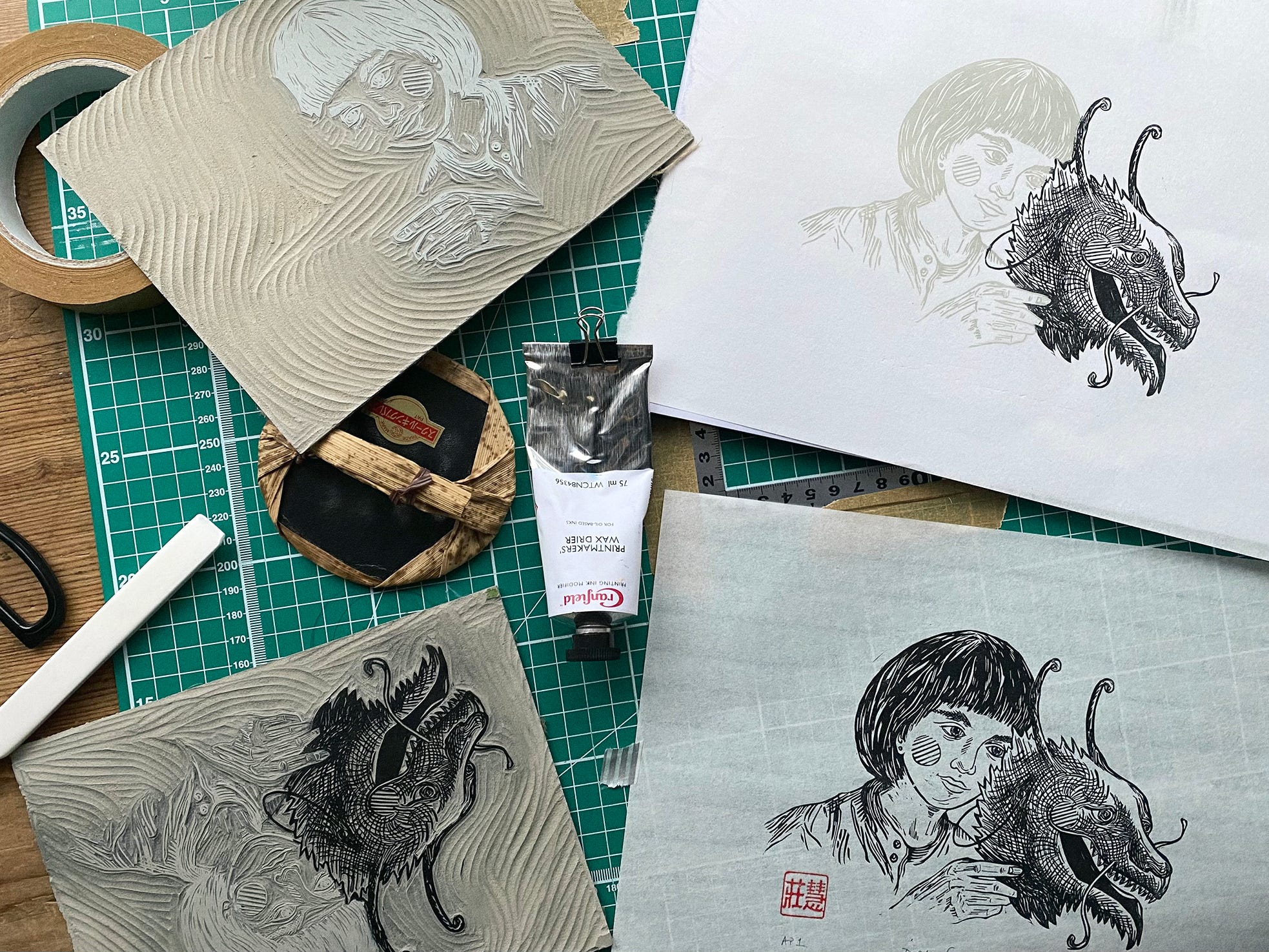
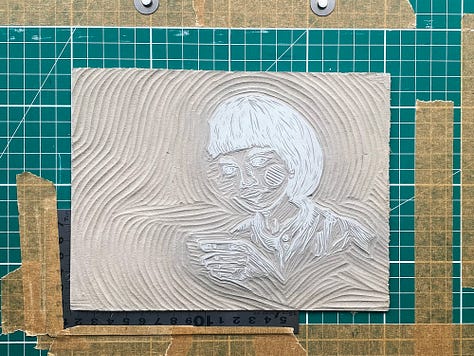
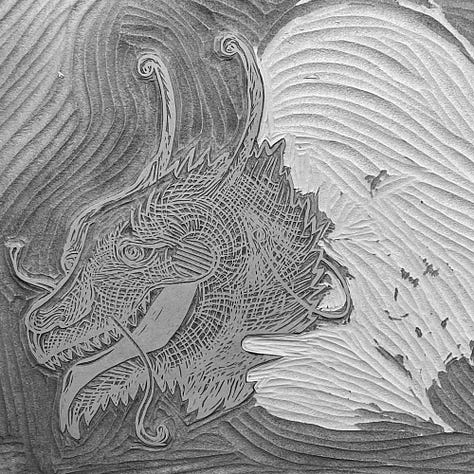
Dragon Lady is a three colour*, multi-block lino print. The idea was conceived in early January, and after convincing myself that it was also a good idea to make an ‘occasion’ print [future Rachel here: it is not a good idea, but well done for trying], this occasion being the run-up to the Lunar New Year of the Dragon.
The ‘Dragon Lady’ has always been considered a derogatory stereotype of Asian women, branding them as deceitful, controlling, sexually powerful. The term has been around since at least the 1930s, via Western mainstream media (Anna May Wong’s 1931 film Daughter of the Dragon being one such example), but which in itself was borne at least in part from the so-called ‘Yellow Peril’ propaganda of the 19th century, that sought to depict peoples of East and Southeast Asia as existential threats to Western imperialist ideologies & anxieties.
In short: awful term, don’t use it.
But use it I have. Because Dragon Lady the lino-print is an attempt remove the ‘mask’ of negative connotations that were placed upon us by those who attempted to dominate our narrative. In the Sichuan dramatic art of Bian Lian, interchangeable masks are worn to denote differing personalities and characters; even the skill it takes to seamlessly switch ‘faces’ during a performance is a closely guarded secret, passed between generations. Historically, the use of a painted face was to scare off wild animals from attacking; thus the mask became a form of protection. As long as one hid one’s true identity, one could feel safe.
(I certainly took hiding to an extreme, yet no tweed jacket, or fish & chip supper, or received pronunciation —courtesy of dad’s home-schooling attempts— can cover the features that stare back at me in the mirror.)
The finished print, with its figure in an almost imperceptible light grey, is also a commentary on the ghost-like qualities that I (and perhaps others of a similar heritage, and especially women) feel on a daily basis: that sense of always having to remain in the shadows; always in that state of limbo about one’s identity or value in this world.
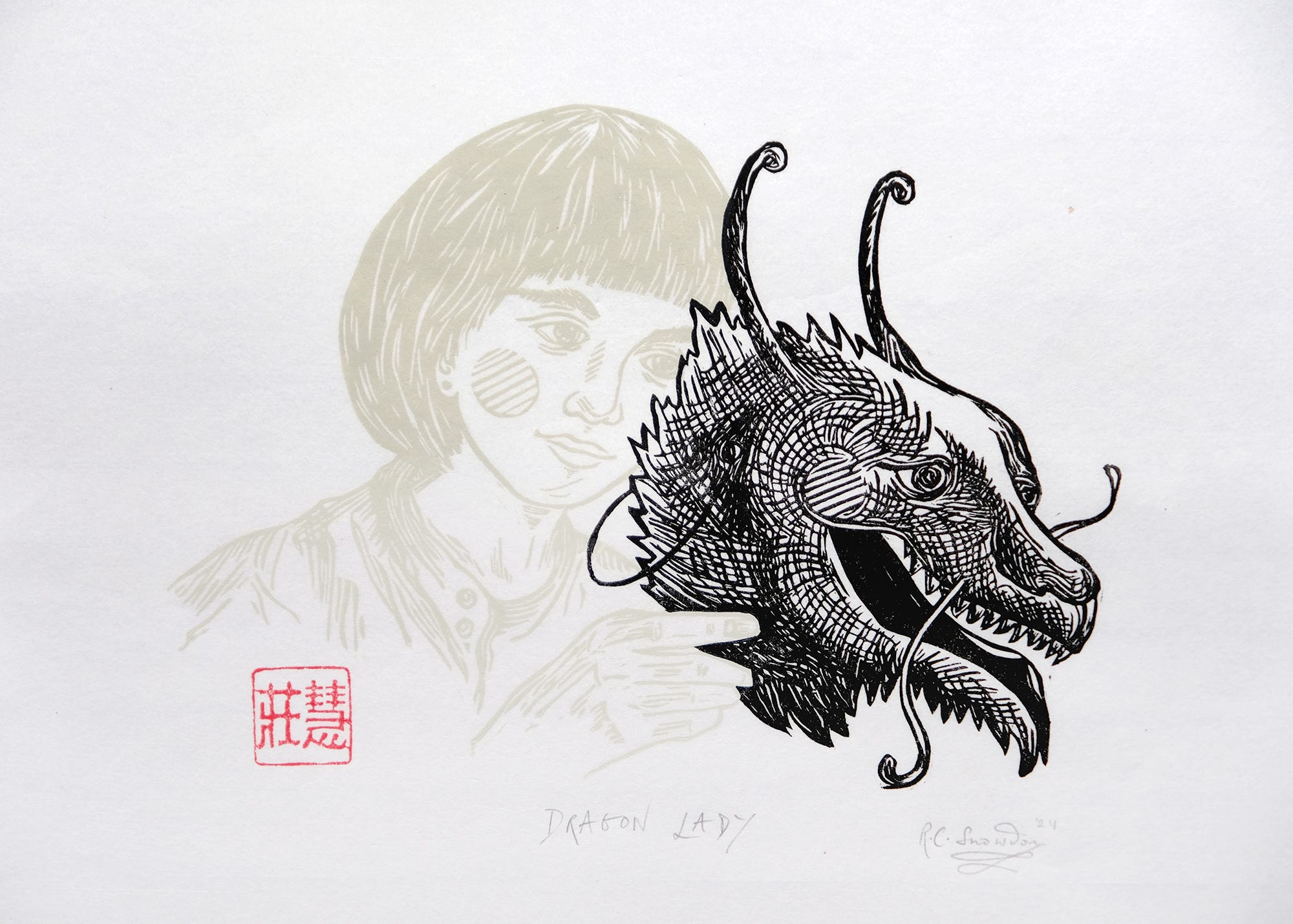
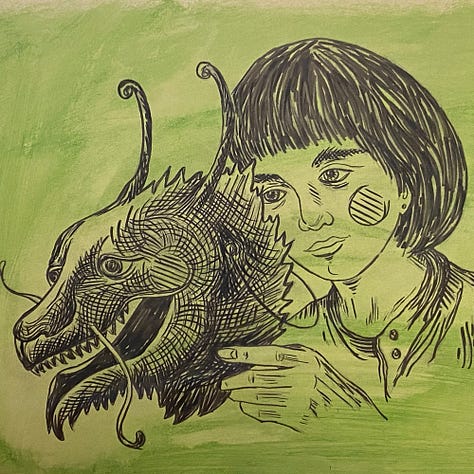
And, what of the figure itself? Most of the feedback I’ve received remarks upon how much she looks like her multi-ethnic maker(!) — a shy, bob-haired soul somewhat unsure of where to set her gaze. She was never intended to mimic me, yet I can certainly see that the resemblance is quite uncanny. In some fortuitous way, this pale and inky doppelgänger has saved me from courting the cross-race effect of crafting a face that could be seen as generically, or even just vaguely, Asian. (There’s that banner-veil-mask trope again: we mask so as not to stand out; ah - but some say we all look the same anyway.)
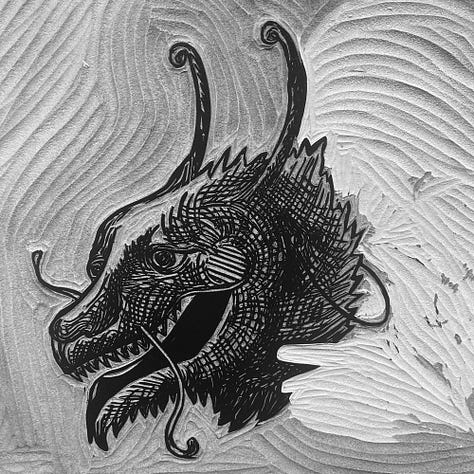
The design came so easily and fluidly. My interest in whimsical and nostalgic turn-of-the-century illustration lent itself well to the ageless quality of the face and the vintage-style collarless shirt, but it’s the curiously anthropomorphic dragon mask (complete with matching circular cheeks) that I love the most. It also took the most time; hours upon hours of painstakingly carving out each tiny crosshatch detail. I wanted to replicate, as far as possible, some of the energy of the original sketch, but without taking away the detail.
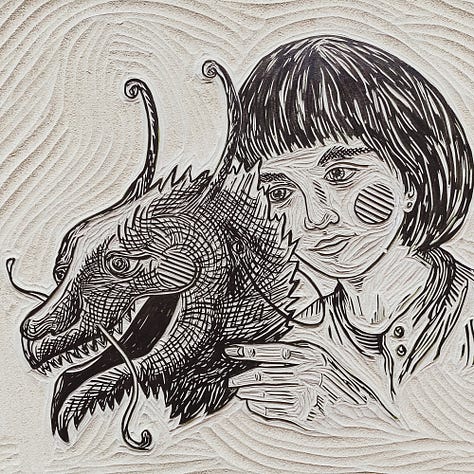
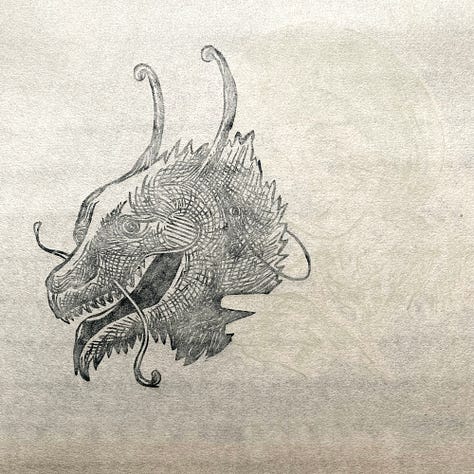
When it came to printing, I chose traditional Chinese rice paper, often used for calligraphy. With unsized sheets of an extroardinarily gossamer-like weight of 35gsm, I could hand burnish it with ease and the image materialised softly and slowly, as if emerging from a mist.
And an interesting note on the red seal (also known as a ‘chop mark’): in the mid-90s, the first time I visited Hong Kong to see my grandparents, my mother took my brother and I to a tiny side street peppered with engraving shops, and I distinctly recall her discussing —in Cantonese— plans to get my Chinese name immortalised on a little peach-coloured rectangle of marble. I chose to have a Buddha carved on the handle (after a similar-looking one that still sits in our family home to this day), and, several hours later, we returned to pick it up - complete with a velvet-lined box and mushy stamp paste the colour of cinnabar. At that age, I wasn’t grateful enough to think much more of it, and, though it travelled with me as I grew up and moved homes, it nonetheless mostly languished in a drawer, or under the bed, entirely untouched.
Fast forward to 2024, to Dragon Lady, and to using this seal for the first time in 27 years.
After proudly sending my mother a photograph of how that little red square finally had its first outing, her reply was not what I expected:
‘It’s backwards.’
Turns out the master seal engraver, who had only one job to do, had somehow forgotten to reverse the characters of my name prior to carving! My mother never noticed, and, because I had never tested it until now, neither had I.
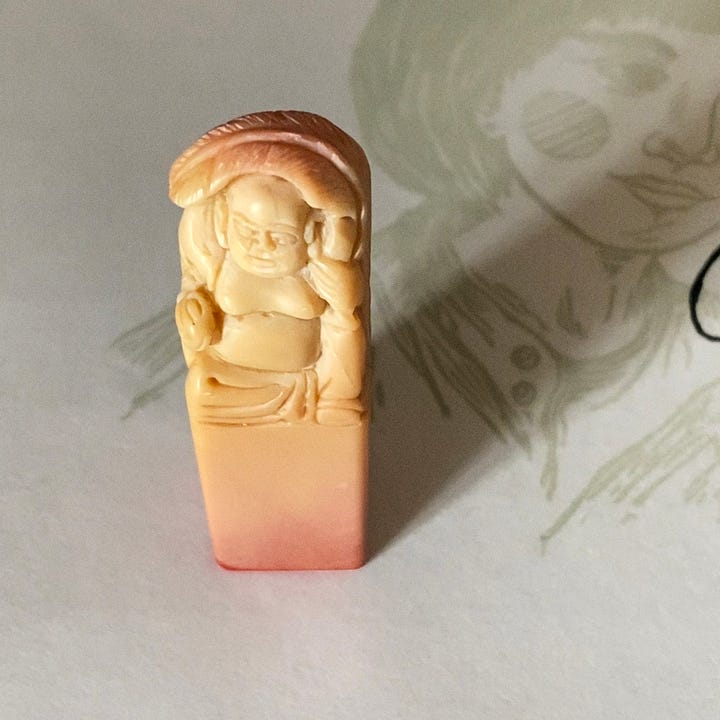
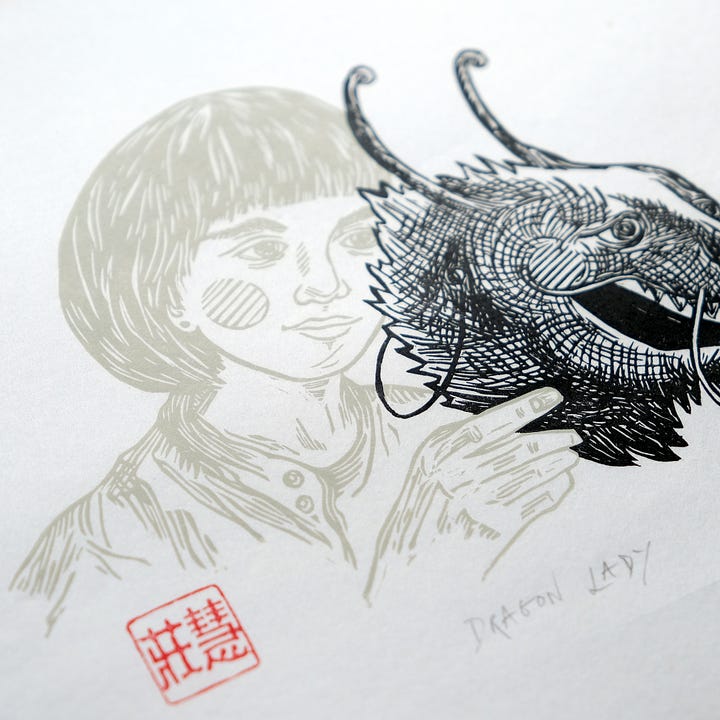
As a printmaker, I could easily re-carve my own seal in lino or rubber. But there’s something utterly charming and ridiculous about stamping an incorrect name onto each Dragon Lady print; the irony of creating an image to reclaim some of my Asianness, only to render me partly anonymous again as soon as I ‘sign’ them off. It’s brilliant.
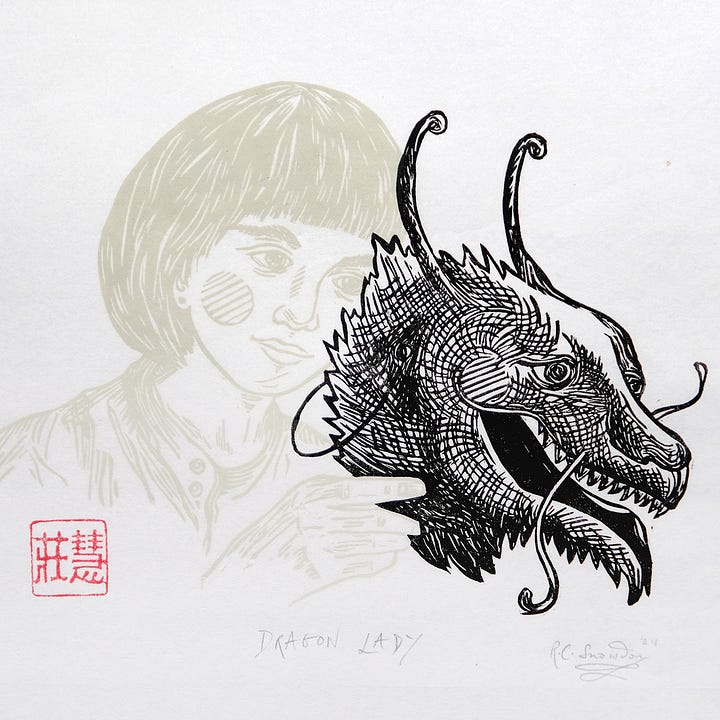
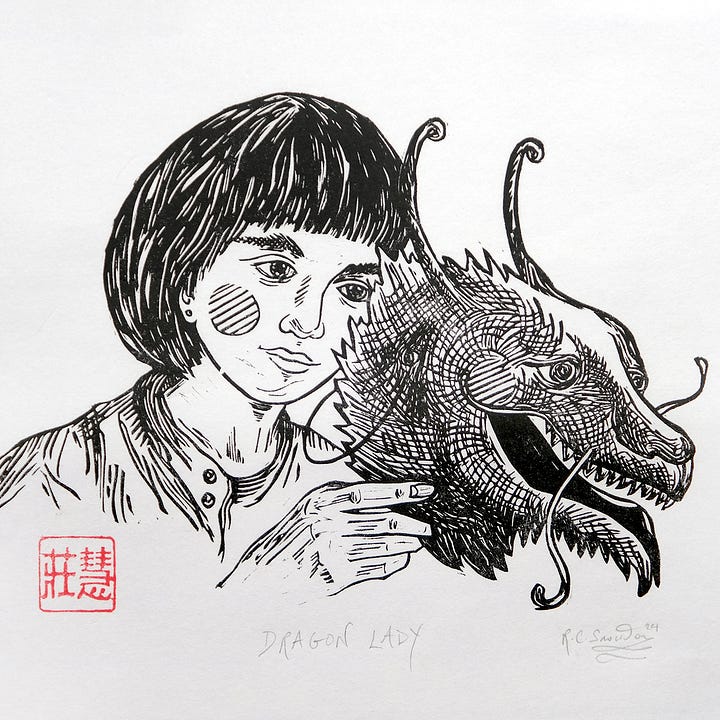
There are just 20 of Dragon Lady available: ten each in grey/black or all black. And, if you’d like one, they’re available here.
At the start of this project, I firmly told myself that the only expectation I must have was that I needed to love the finished lino-print. Little did I know how far I would have to delve into the darker recesses of my own creativity and insecurity — but I am so very thankful that I did, and that I (and this image) developed.
It might not be a print that resonates with everyone; nor might it be a print that ever sells. But it is a print that I so badly needed and wanted to make, and I hope that if you chose to read this blog until the end, you can understand why.
I am Dragon Lady, hear me roar.
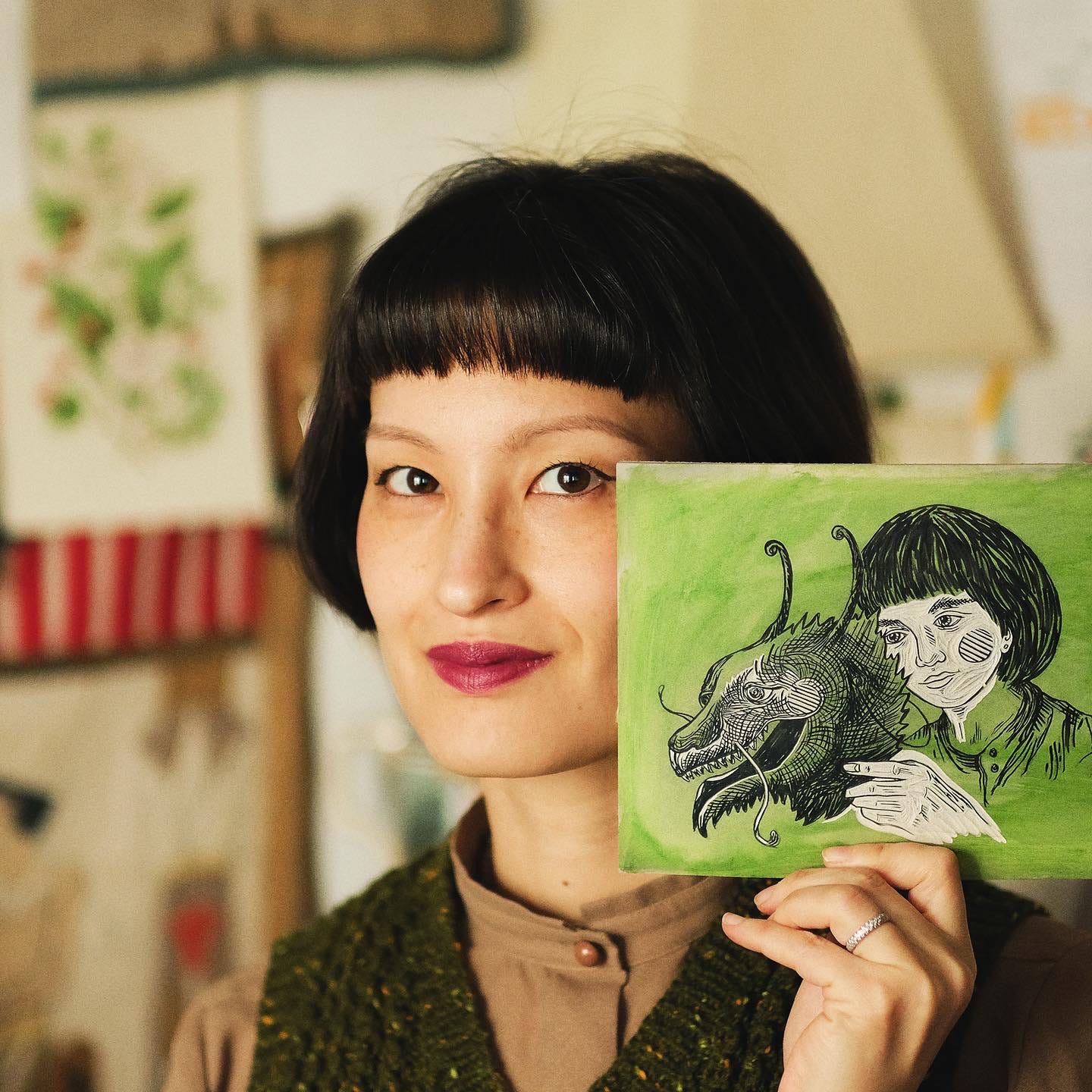
* The third colour is considered the colour of the paper.
Thank you for reading Artist's Proof. This post is public, and I would so appreciate it if you shared it. This will help reach a wider audience, and encourage me to continue to write with more frequency and variety! You can also hit that ‘heart’ button or leave me your thoughts in a comment (I’d love to chat with you there.)
Comments
Nothing yet. Say the first thing.
Sign in to join the conversation.