
So here’s an aspect of getting published that I hadn’t thought of before, and that’s how to pitch your book - I don’t mean just to literary agents and other professionals, but to everyone, from journalists and audiences at book festivals and customers thinking of buying it in a bookshop, to the guy behind the counter in the corner shop and the woman I got talking to on a park bench the other day, each of whom might buy my book if only I could pitch it right.
Because the truth is, first you write a book and then you have to sell it, and that’s the deal.
At first when asked what my book was about I used to answer, ‘Renaissance philosophy and magic,’ because for me, behind those four words, stands an entire, glittering edifice of ideas. The trouble was that my listener, who was not privy to all those glittering ideas, heard only a couple of abstract nouns - ‘philosophy and magic’ - and, as everybody knows, abstract nouns don’t cut it, not even intrinsically sparkly ones like ‘magic’.
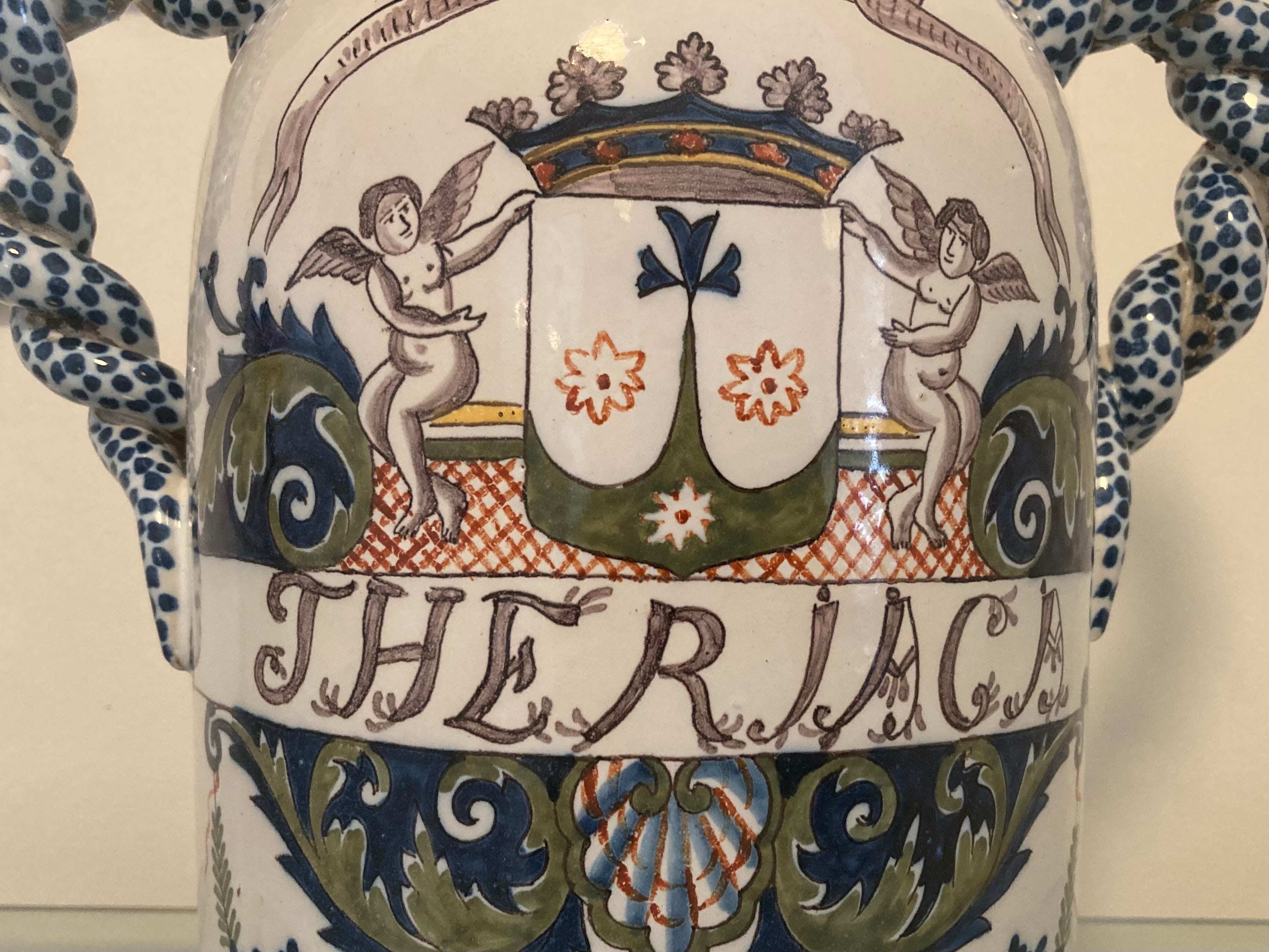
(The pic is a Renaissance pharmacy jar from the Museum of Pharmacy in Basel. Back then medicine, alchemy and magic were tangled up together. The jar would have held a magical antidote to all poisons.)
So instead I have been learning a different way to talk about my book, to introduce it through its extraordinary cast of characters. ‘Have you heard of John Dee?’ I ask. ‘No,’ is the usual answer, to which I say, ‘He was a 16th century philosopher and mathematician with a strongly magical bent, who lived at a time when everybody believed in magic and when Dee himself was believed to be a wizard and a magician.’
‘But he was only one character in my story,’ I say, warming to my subject. ‘There was also Dee’s scryer, Edward Kelley, as well as John Dee’s wife Jane and Kelley’s wife Joanna, and the seven or eight Dee children. There were also other alchemists, men like Thomas Charnock, a poor English alchemist, much haunted by the need to feed his children when all he wanted was pursue his alchemy in peace. There was the Italian Giordano Bruno who came to England and lectured in Oxford and caused such an uproar he had to be smuggled out of Oxford - he was not a scientist exactly, more like a philosopher of science, though at a time when science was decidedly magical. And then there were the young women like the German Anna Maria Zieglerin, who dared to become an alchemist and paid a heavy price for it.
And now, if I still have my audience with me, I add that right across Europe this was a time of wayward, charismatic, trouble-making intellectuals, although, I add, it is often the women and children’s stories, the stories of the wives and sisters and daughters and girlfriends of the magicians, that I found the most fascinating. (And I love the way that sometimes the past is very strange but other times it feels so familiar. I have known many men like John Dee in my life - but that’s the subject for another post.)
But there is something else going on as well, because selling books is very hard work these days - we all have so many distractions - but one tried and tested method is the principle of making as much focused noise as possible, ‘noise’ being talks, articles, podcasts, social media - everything - whilst ‘focused’ is the principle that you direct the noise in the direction of likely readers. What this means in practice is that the writer turns every bit of the book-writing process - where, when, how, why you wrote it - into words. (There must be a verb for this - maybe to ‘word-ify’ it?)
Luckily I quite enjoy this process, though it requires some thoughtfulness and introspection - is that really how it felt? Is that really why I wrote it? - and out of respect for the god of writing you try to be honest.
It’s also a very different kind of writing to writing the book itself, which - in my experience - is quite a dreamy process.
(The book is called ‘The Years of the Wizard’ and it’s being published by Duckworth on 9th October 2025.)
Learning to pitch your book is part of being a writer, and if you’re shy (I am) you just have to learn to charge ahead regardless. It is also a work in progress - it never ends - so if we bump into each other and you get the feeling that I am looking at you quizzically and trying out these ideas on you - well, the chances are that you are exactly right, and trying out the pitch on you is exactly what I am doing.
Meanwhile out on the street all week it has felt like the Mediterranean and people have been dragging their chairs out on to the pavement to catch the evening sun and when I was coming home the other night a couple on their cycles went past me, riding slowly side by side, their conversation floating out behind them.
I won’t be posting next Sunday but I’ll definitely be back here the Sunday after.
See you then,
Rachel
No posts
Comments
Nothing yet. Say the first thing.
Sign in to join the conversation.