
What happens to interdisciplinary research when research funding becomes scarce? This living literature review has tracked how, despite growing calls to increase the interdisciplinary research, growth rates in interdisciplinary research are often slow. This is despite growing demand for interdisciplinary research, including among public funders. But interdisciplinary research can be notoriously difficult to foster and grow, especially in light of the incentives, cultures, and institutions that continue to divide research based on traditional disciplines.
So, if researchers and funders agree that interdisciplinary research is important for joint goals, what happens if funds begin to wane?
On the one hand, the potential benefit multiplier that can come from strong interdisciplinary research collaborations might incentivize funders to support these collaborations when funds are limited. Funders increasingly prioritize interdisciplinary approaches in their work, and researchers variously report benefits from these collaborations for the quality, reach, and impact of research. A few studies suggest that these incentives may strengthen under resource scarcity.
On the other hand, research on the roadblocks to funding these collaborations and some tracking to model what happens when research competition increases suggests interdisciplinary research could become harder to fund when overall resources dip. This post reviews evidence on each side, finding that there is reason to raise concern that interdisciplinarity may dip with funding reductions, but that other factors may shape outcomes in environments of increased competition for funds.
Why Funding Dips May Reduce Interdisciplinary Research

Image: NanoTemper
Foundational work from Bromham, Dinnage and Hua (2016) corroborates qualitative studies that have found interdisciplinary research can be harder to fund in general than disciplinary forms. Their study finds a negative relationship between funding proposal success and the interdisciplinarity of the proposed research. This could suggest these collaborations may be harder to gain funding for, a dynamic that could exacerbate with increased competition from reduced funds. Using bibliometric data of a large sample set to test funding success, they find the more interdisciplinary the research, the less likely it is to be funded.
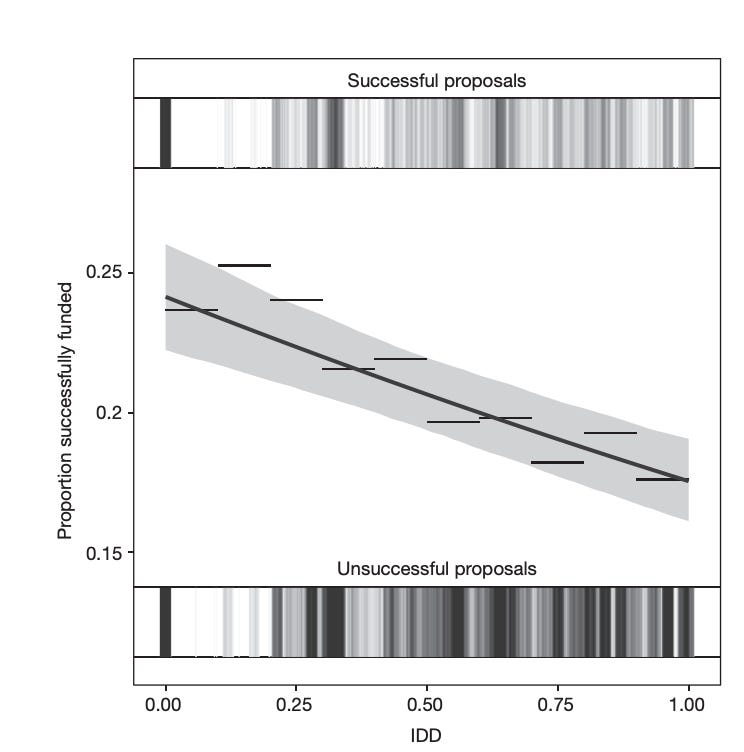
Bromham, Dinnage and Hua (2016), p. 685
Bronham attribute the relationship between disciplinary focus and funding success to biases towards disciplines implicit in funders’ decision-making and/or insufficient evaluation systems and review norms that under-recognize the potential of interdisciplinary research.
Do these dynamics worsen, or make interdisciplinary research less likely to win funds when resources reduce?
Schweiger et al (2024) examine scarcity in research funding directly, empirically testing and modeling outcomes to find that high competition for research funding and increase biases, and can disadvantage projects that are harder to evaluate like interdisciplinary research. They highlight that the increased difficulties in identifying and selecting reviewers for interdisciplinary research can aggravate structural biases that could make these collaborations hardest hit when competition amplifies funding allocation problems.
These findings are corroborated by Miermans (2024) who finds using survey and qualitative research that researchers perceive that intense competition can narrow research agendas towards “safer” disciplinary research, and can increase the perceived costs of higher-risk interdisciplinary research.
Making more with less?
Why the Merits of Interdisciplinary Research May Increase With Fewer Resources
A broader review of available research nuances these findings, providing critical additional context. Some studies that explore various features of these questions could indicate that funding cuts may not directly reduce interdisciplinary collaboration and that certain strategies may help incentivize these collaborations when resources become scarce. Brown et al (2015) offer contrasting research to Bronham et al’s findings on the low success rate of interdisciplinary research funding, finding instead that these collaborations can sometimes be more successful at gaining grant funding than single discipline research given increased funder and public calls for interdisciplinarity. And a study of Australian researchers and university leaders by Newman (2023) found that cultural influences can matter more than material or financial factors (including time and research funding) in promoting or reducing the likelihood of interdisciplinary research.
Another factor that may influence funder- and researcher decision-making in resource scarcity relates to the perceived potential impact of potential research approaches. Abramo et al (2017) and Millar (2013) find that some forms of interdisciplinary research, such as certain social science and bio science collaborations and some early career research practices can result in higher impact publications than single disciplinary endeavors. While studies including Spence et al (2024) underline that early career researchers often lack effective and sufficiently adaptable support systems, resources, and training to optimize their work outside of disciplinary structures inside universities, a desire to pursue socially impactful research sometimes drew early career researchers and funders towards interdisciplinary research.
If funders and researchers identify these potential gains from interdisciplinary collaboration to include potential for more impactful work, these incentives could conceivably convince funders to prioritize interdisciplinary research when resources wane.
Predicting the Cutting Room Floor
Studies indicate that tracking rates of interdisciplinary research when resources wane will be important.
There is evidence to suggest interdisciplinary research could become less attractive for scholars, and harder for funders to allocate funds towards, when competition increases. At the same time, the perceived public value of interdisciplinary research - visible in the practices of many top research funders today - may help funders and scholars prioritize these collaborations when funds diminish, if effectively communicated and nurtured through institutional prioritization and support.
But overall research suggests that other factors beyond funding, particularly cultural ones, may play a significant role in the likelihood of interdisciplinary research. This indicates the imperative of a broader understanding of the intersection of funding dynamics with the wider ecosystem of practices, attitudes and institutions that can foster or hinder future trajectories for interdisciplinary research.
Interdisciplinary research will be impacted by increases in competition for research funds, just as disciplinary approaches face impacts too. Further work to track these impacts, and to understand how interdisciplinary collaborations may be uniquely affected, will be critical to ensure the benefits of these collaborations for researchers and funders are sustained and expanded.
No posts
Comments
Nothing yet. Say the first thing.
Sign in to join the conversation.