
If there is one moment when disciplinary boundaries should dissolve, it is during a crisis. When a hurricane makes landfall on a conflict-affected coastline, or when a pandemic collides with food insecurity and economic collapse, no single field has the tools to understand what is happening — let alone to respond to it. Complex emergencies are, almost by definition, problems that exceed the limits of any one discipline. They are the test case for interdisciplinarity.
And yet, the evidence suggests that emergencies consistently produce exactly the opposite: fragmented, siloed, and discipline-bound responses. This post examines what the research tells us about why that happens and what, if anything, might change it.

The term complex emergency has a specific meaning in humanitarian and disaster studies, referring to crises involving multiple, interacting causes such as conflict, displacement, disease outbreak, food insecurity, infrastructure collapse, issues that unfold simultaneously and require coordinated responses across sectors. Kruczkiewicz et al (2021) discuss how “increasingly, we face compounding and interrelated environmental, socioeconomic, and political crises. Yet our approaches to these problems are often siloed, fragmented, and inadequate.” COVID-19 was their central case study — a pandemic that, during its peak, was colliding with violent conflicts, drought, displacement, and structural racial and gender inequality around the world.
The problem is not a lack of awareness that these crises are interconnected. The problem is that the institutions and knowledge systems we mobilize in response were not built for that interconnection.
Kruczkiewicz et al call for a number of pathways to for funding to help enable deeper interdisciplinary collaboration to bridge disaster-related sectoral siloes:
1) combined natural and social scientific core research on dynamics of compound disasters, especially in complex emergency settings,
2) urgent and/or short-term technical assistance for governments and other frontline actors, and
3) longer-term secondments for researchers to work in operational settings, as well as for decision makers to contribute to research agendas and projects that address pressing problems on the ground.
The pandemic was, among other things, a stress test for the disciplinary architecture of emergency response. Herrick et al (2022) describe how COVID-19 “straddles and challenges the boundaries between humanitarianism, development, and global health, three fields with distinct institutional cultures, funding streams, and conceptual vocabularies that have historically operated in parallel rather than together.” The pandemic did not respect those distinctions; the response did.
Meanwhile, Haldane et al (2021) in a 28-country study published in Nature Medicine, found that in country after country, “public health and health service delivery systems are siloed: their coordination is limited or ineffective, and they have separate referral processes and reporting systems.” This systemic fragmentation, they argue, was associated with weaker health systems resilience. Countries that managed COVID-19 more effectively tended to be those that had already developed mechanisms for cross-sectoral coordination — not those that scrambled to build them in real time.
At the governance level, a decade of 2015-2030 Sendai Framework for Disaster Risk Reduction’s implementation tells a similar story. The Sendai Framework was the first major agreement of the post-2015 development agenda of UN Member States on disaster risk reduction. Okunola (2025)’s recent analysis found that across five African countries, disaster risk governance remains characterized by “fragmented or overlapping frameworks that weaken coordination” and “parallel structures at the national level” that produce institutional inefficiency. Despite explicit calls in the Sendai Framework for integrated, multi-sectoral approaches to disaster risk reduction, institutional siloes have proven remarkably durable.
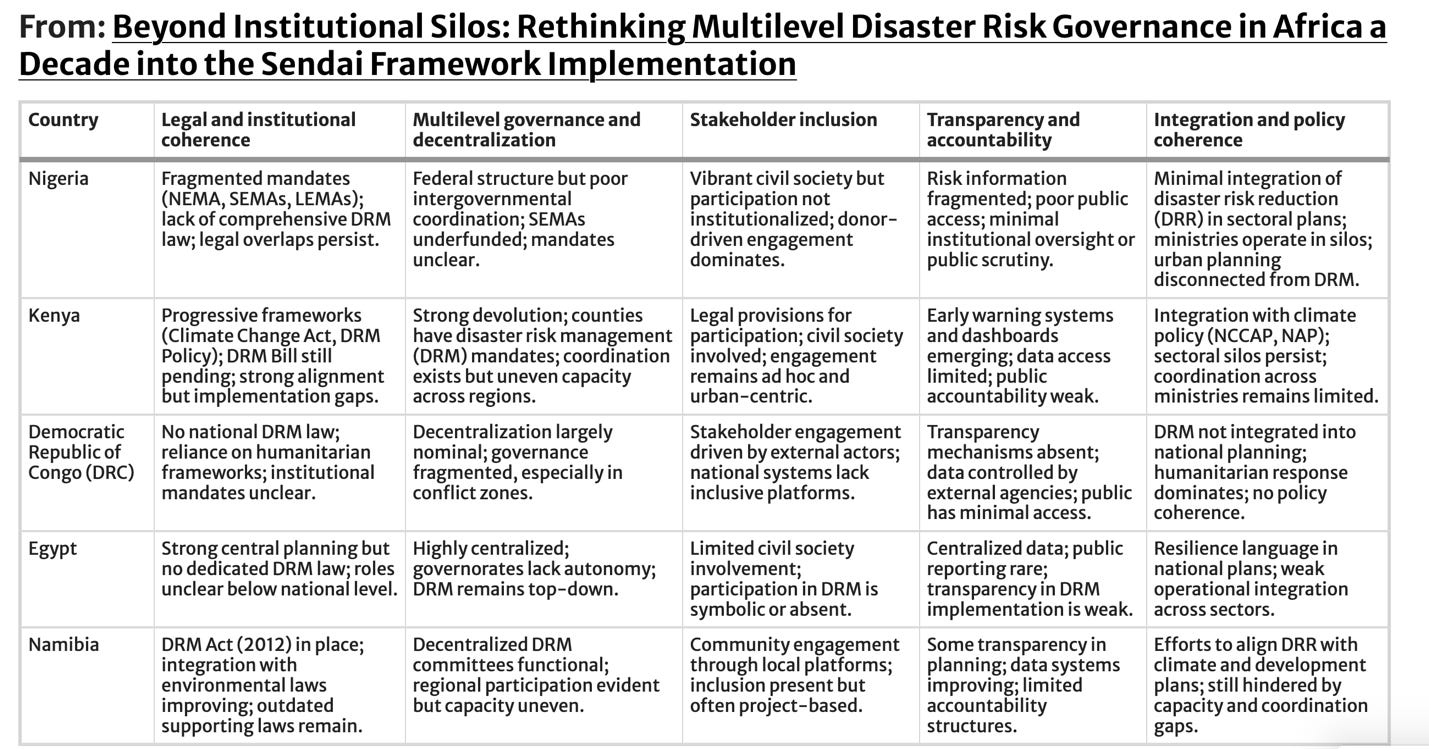
Source: Okunola 2025.
The disaster research field itself suffers from disciplinary siloes. Wolbers, Kuipers and Boin (2021) find in their systematic review of 20 years of crisis and disaster research that the field has remained remarkably static over two decades: single case studies dominate, methodological diversity is limited, and the focus has shifted from preparedness toward response. The authors call for the community to put more effort into drawing lessons across individual events, to uncover the patterns that connect them.
Their review suggests that the academic community tasked with understanding crisis is itself producing knowledge in silos, making it harder to identify patterns across events, develop generalizable theory, or inform more integrated policy responses. This knowledge fragmentation is embedded in the research and reflected in practice.
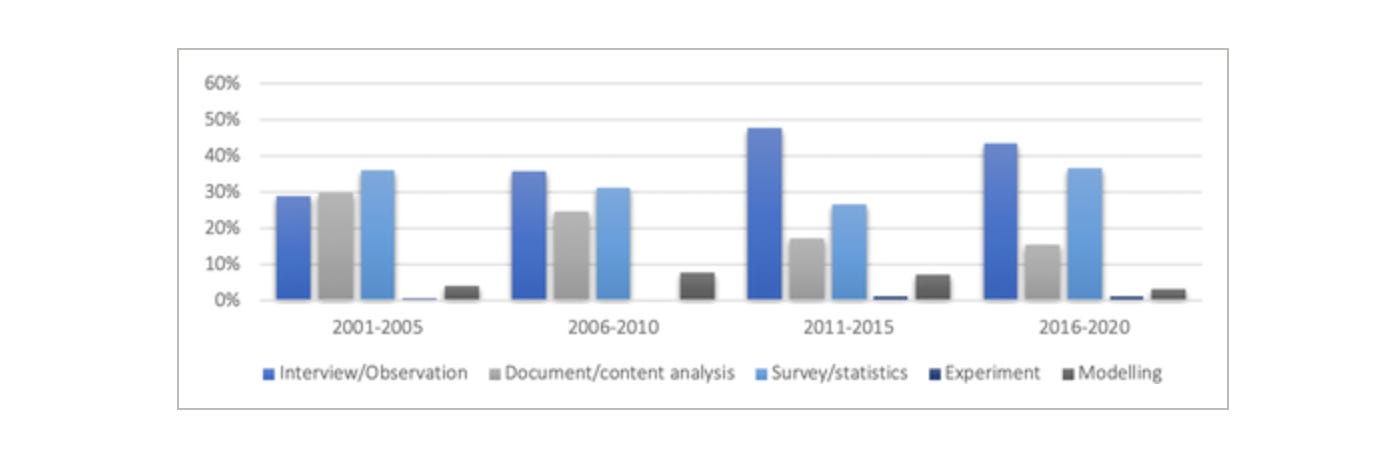
Figure: Methods in disaster research. Source: Wolbers 2021.
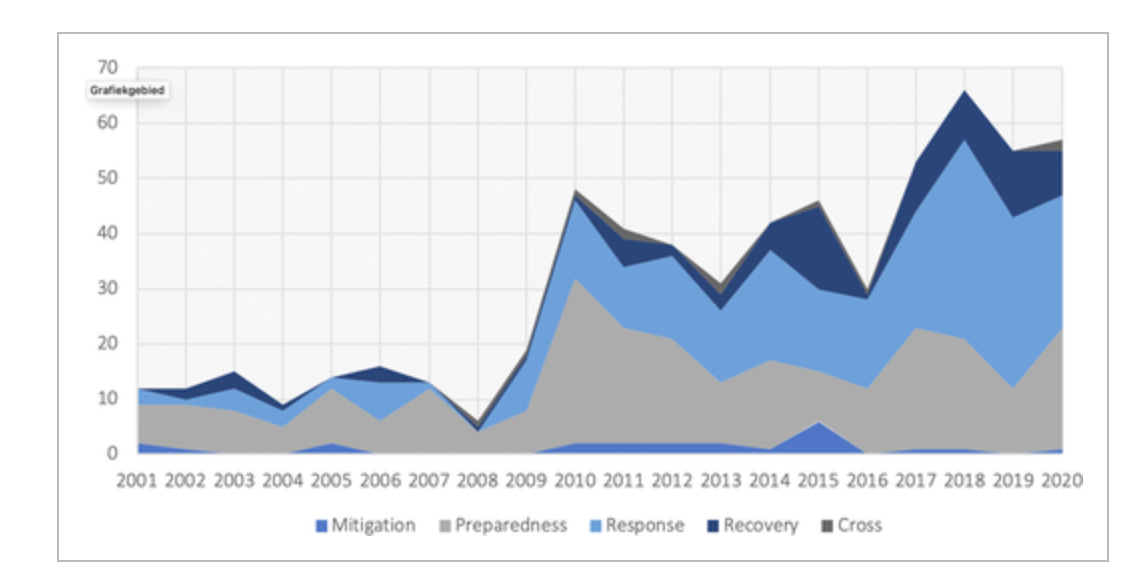
Figure: Thematic analysis in crisis management literature. Source: Wolbers 2021.
A recurring temptation in this literature is to attribute the persistence of siloes to culture — to a kind of disciplinary tribalism that could be overcome with better goodwill, more workshops, or smarter convening. But the evidence increasingly points to structural drivers that are harder to address.
Pimentel et al (2023) argue that despite decades of calls for interdisciplinarity, “research communities continue to become more siloed and less impactful.” As discussed in another post, Berkes et al (2024) track over 150,000 biomedical researchers and find that the most interdisciplinary researchers are also the most likely to exit academia early. Highly interdisciplinary early-career researchers stopped publishing far sooner than their more conventional peers: roughly half of the most interdisciplinary researchers had stopped publishing within eight years, compared to more than twenty years for moderately interdisciplinary ones. And those who remained in academia tended to become less interdisciplinary over time, apparently in response to career pressures. Interdisciplinary researchers, in their phrase, “fall through disciplinary divides.”
Xiang, Romero, and Teplitskiy (2025), analyzing nearly 129,000 manuscripts across 62 STEM journals, found that papers high in topic interdisciplinarity — those bridging multiple subject areas — face lower acceptance rates in peer review, even when their underlying knowledge base is broad. The incentive structure, in other words, actively penalizes the kind of work that complex crises most urgently demand.
Taken together, this body of research points to a troubling mismatch. Complex emergencies are, by definition, interdisciplinary problems: they require the integration of epidemiology, political science, logistics, economics, climate science, and local knowledge, among other domains. But the academic and institutional systems that generate and deploy knowledge in response to those emergencies are organized around disciplinary specialization, rewarded for disciplinary depth, and penalized — structurally, not just culturally — for crossing those lines.
Kruczkiewicz and colleagues call for redesigning “the institutional rules and administrative structures of response organizations and research institutions” — a formidable agenda. The Sendai Framework’s own mid-term review process has acknowledged that integrated, interdisciplinary approaches to complex risks remain an aspiration rather than a reality, with progress slow across most countries. Neither diagnosis nor prescription is new.
What is perhaps underappreciated is the degree to which the problem is self-reinforcing. If interdisciplinary researchers leave academia early, the next generation of emergency scholars is trained in narrower silos. If topic-bridging papers face peer review penalties, the literature on complex emergencies remains fragmented. If institutional frameworks for disaster governance continue to operate in parallel rather than together, the response to the next compounding crisis will look much like the last.
This post is part of a living literature review on interdisciplinarity, supported by Coefficient Giving (formerly, Open Philanthropy). Have a paper you think belongs here? Get in touch.
No posts
Comments
Nothing yet. Say the first thing.
Sign in to join the conversation.