
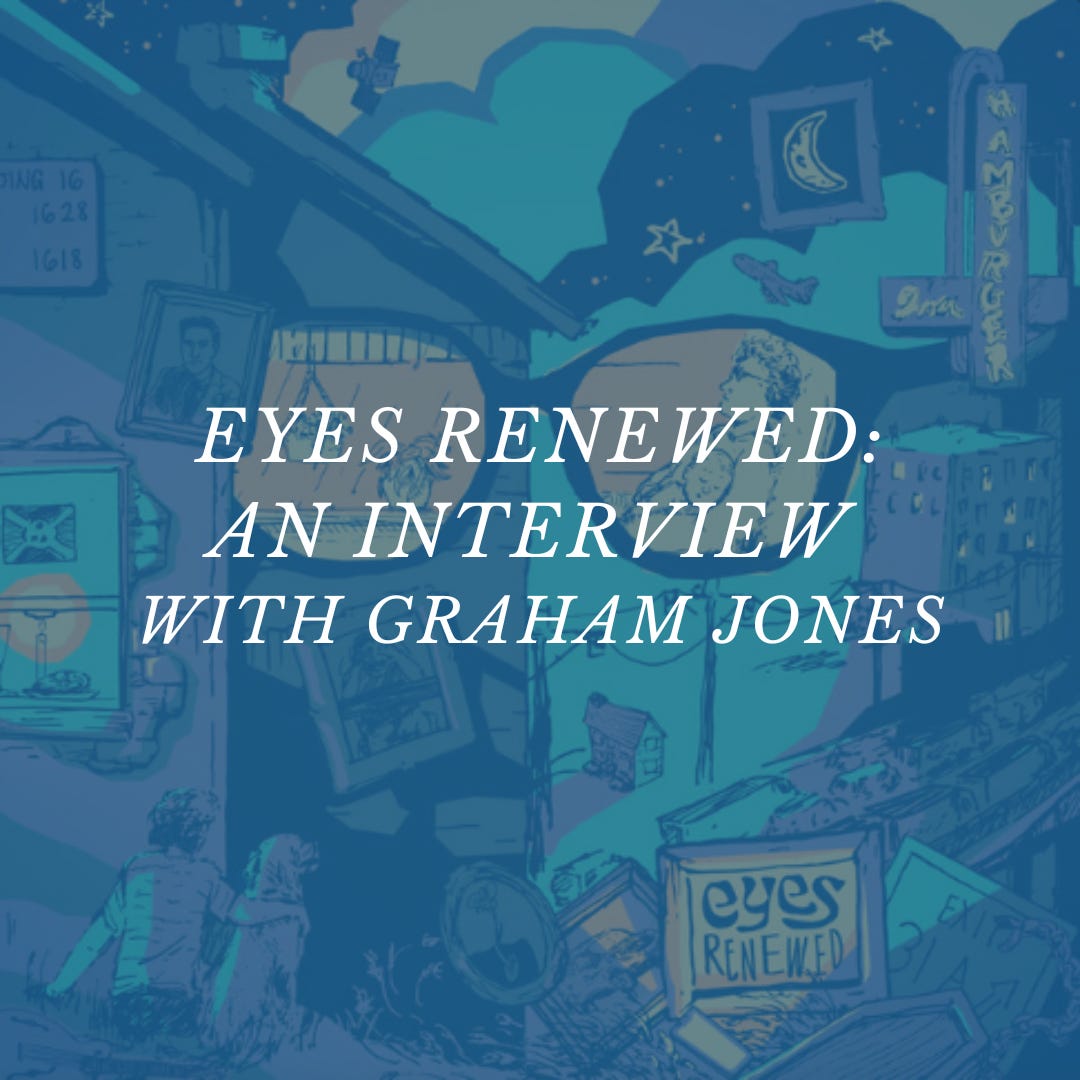
Graham Jones is a Texan worship pastor and singer-songwriter who traces the story of the gospel with thoughtful lyrics and rich melodies. Inspired by six-string storytellers like Andrew Peterson, Jon Foreman, and John Mayer, his music is honest, joyful, and contagious with longing. His latest album, Eyes Renewed, was released one year ago. In this interview with Chris Badeker and Ashlyn Ohm from The Rabbit Room, Graham reflects on the past year of this project, sharing the heart behind the album and the process of offering these songs to the world as well as broader thoughts on relationship, creativity, and faith.
CB: Graham, welcome! Eyes Renewed has been out for a year now. What’s the last year been like for you since having this record out in the world?
GJ: There have been some difficult things in the last year. And even though those moments themselves have been hard, it’s been sweet to be able to hold on to some of the wrestling and the truths that are in these songs and find them really applicable. In the grief, trying to find a sense of both valuing what was behind and still having hope for what was ahead, I just found that those songs became more relevant than I thought they would be.
CB: Yeah, sometimes it does feel like the songs we’re writing are written for us a little later, when we don’t even realize it yet. Eyes Renewed to me feels like a record where you had an idea and intentionally explored it. Is that true, or is it just a natural happy accident that these songs all really feel like they should live together?
GJ: This was a weird both-and, where there was a sense in which when I wrote that title track, “Eyes Renewed,” I could see about five or six songs that I’d already written, and it gathered those underneath that theme. But then there were a few other songs that were either partially or fully written after “Eyes Renewed,” and that helped me see a theme: I would love to say that great faith and hope change circumstances, but so often things don’t happen on that timetable. And more often it is about the need to change perspective and endure in faithfulness, knowing that in the long trajectory things do have redemption. But today, I’m just not fully there, and I need to be honest and okay with that.
I’m both responding to, at times, a perceived beauty and order in the world around me. But the reality is there’s just as many, if not sometimes more, times where I’m actually responding to my inability to see all of the beauty and order that I do believe is there. And in the wrestling of that, whatever I’m creating is now trying to lean forward in hope in some way.
CB: You talked about change and the way the songs change context, but you’ve changed too. How has Graham Jones changed through the process of working on this piece of art that’s now in the world?
GJ: I wrote a song called “Grateful” a while back. We were wrestling with being stuck in our apartment, and the housing market far outpaced us. I’m actually more proud of the song today than I was when I first wrote it, because the need to grow in gratitude in the midst of suffering or wrestling is greater today than it was then. And I’m happy to have songs that, maybe I didn’t quite live up to them then, but I’m getting a little bit closer now to needing and practicing better.
CB: As an artist, as a singer, you know there’s an immense amount of time and effort and financial resources that goes into creating a project on the scale of an album. How do you get to something like a full album release, and how do you get to the other side of that a year out? What lens are you looking at that whole endeavor through?
GJ: The business-savvy people in my community, I’ll just say, are not trying to make records. For me, it’s the existence of a really dear community of patrons on Patreon, just taking it slow and trying to use the resources that are available to me, working with friends, and working with those who I can help, and they can help me, and we can work together to make beautiful things in different projects. I am definitely learning not to trust that what’s true about one project or one season is always true. And instead, I’m just saying, ‘I’m glad that seemed to have worked. All right, what’s the next season look like? How am I going to use this? What am I going to create next?’
CB: Graham, I know every time we go back into the studio, the recording process ends up not looking the same. What were the sessions of recording this looking like for you? Was this kind of uncharted territory for you?
GJ: I remember specifically recording the title track sitting with Paul Demer, who’s a dear friend, excellent songwriter, and excellent producer. He’s so good. “Eyes Renewed” as a track really pulls on some pop and indie and electronic and a couple other weird elements in it. And I totally attribute pushing the envelope to Paul. And then Sam, on the other side, was leaning more in a folky kind of direction. It was fun to see us triangulate, and I’m very thankful for those moments in the studio that got me out of my comfort zone. I hope to continue in that direction, making music that continues to make the song the most important thing, even if it pushes me in a sonic space that’s kind of new.
CB: What sort of benefit does that bring to a song when you let other people have their hands in the mud, so to speak?
GJ: It reminds you that you’re not the only person in the room. It’s an immense privilege to be able to work with other artists and friends who brought their own talents to the table and lifted the quality so far beyond what I could do. I’m glad I’m not the only one making music by myself, in a vacuum. We’re better for it as people, and the song is better for it too. Not to nod too much to the whole AI elephant in the room, but that is an area where the lack of collaboration and the lack of authenticity is only going to make that more difficult. But if we’ll lean into those collaborative moments, even when they are uncomfortable, they actually will increase the value of it immensely, and we’ll keep our humanity in the things that we’re making.
CB: There’s healthy disagreement within a real situation where people are in a studio together talking through something. And when you are using these large language models to create something, they are hardwired to agree with you. But I think creation can involve healthy tension and healthy conflict and healthy resolutions.
GJ: There’s a great irony that we are now in such a time of tension where we’re struggling to find out how to have this helpful tool, but make sure that it itself is a tool along the way to creating something human, not something that will better or change or alter human things as they are right now. Whatever different ways we are creating something, we need to do the best we can to keep authentic humanity at the center so that we’re being transparent, having integrity, and actually making something and not just being a conduit for some other algorithm or process making something through us, which is really difficult.
One of the things that I do think is so valuable about video games, particularly as an art form, is that it is necessarily going to be tied to the experience of the player. You can make a game, but the experience of that as a piece of art is going to be what happened when you sat down to play it. I can’t just watch it or click through it; I am interacting with it. That’s very human. It forces us to recognize that our experience of it is a part of the thing itself in a way.
As in the game, to a certain degree, so in life. There are puzzles, there are challenges, there are real monsters, and there are real problems. But there are also moments of beauty where it’s not a puzzle to solve or monster to beat today; it’s just to be in this world and to interact with it in a meaningful way and to trust sometimes that that’s enough.
AO: How do you see worship fitting into this? And I don’t mean worship music. I mean, in what way is the process of writing worship for you? Is that a spiritual discipline?
GJ: I’m on staff as a worship pastor at my church. I love the place of music in the gathering of Christians, but what’s formative and life-changing is more about how I’m being made as a person in the context of this church community around the gospel, way more than anything that I could make as a contributive effort into that. If I go a year and I don’t make something that contributes to that, I’m quite glad that real faces around me singing those songs and hearing the Word preached and walking in community together are forming me. I find my work individually, of enjoying songwriting, as a practice of my own personal worship to God, as valuable as my friend Daniel, who’s a really good carpenter and woodworker, as valuable as my wife’s gardening and creating beauty in our backyard. All of those things are immensely personally worshipful, and they all fit into us as a community doing the normal things of worship that we all share and then being scattered out into the world around us to also worship in those ways. And so to me, songwriting is just one of those little scattered ways that the light’s refracting here in north Texas. And it’s a joy to be a part of.
AO: I keep going back to your title track, “Eyes Renewed.” You could take that as, ‘This is a statement that my eyes have been renewed and I have seen, and here’s what I have seen.’ Or as a prayer: ‘Lord, renew my eyes, renew my vision, help me to see in the midst of these circumstances.’ And based on what you’re saying, I’m thinking there’s some of both, but more perhaps of the second. So what are you hoping that people find in that, or how are you hoping their eyes are renewed? What would you hope that they would see when they walk away from this album?
GJ: I want that song and this project to remind all of us who claim to follow Jesus that the presence of suffering and uncertainty in our circumstances is not just part of the story; it might just be the story. It’s okay if today is just not quite right, internally or externally, because Jesus still is. Our value is not equal to the accomplishment or the productivity of particular things, but the faithfulness in a particular space for a time that is rooted in and connected to the overall trajectory of the gospel of Jesus. That death-to-life transformation is something that is both an experience now, through faith, and a hoped-for thing. I’m still holding onto that thread and waiting for the whole storyline to be developed. We get gospel storyline amnesia a lot, and that’s why we need good, beautiful, true things to continue to put forward that idea in front of us. And I need that daily.
CB: What are you feeling steered towards as an artist for moving forward?
GJ: Sam and I actually just finished a little hymns EP. It was really fun to get to revisit a combination of some classic old hymns, and a few with older lyrics but a tune written by a more recent composer. I’ve still been writing several more personal songs and even have started recording some of those. But this next season, I’m excited to get to work with Sam again and to do a few more hymns that we sing as a church and get to share those.
CB: Thanks for taking the time today, Graham. Where can we find what you’re working on?
GJ: I really enjoyed this conversation. It’s so fun to get to talk through this project and these songs again. You can find me at grahamjonesmusic.com, Graham Jones Music on social media. Eyes Renewed is out on Spotify, Apple Music, all the places. I’m thankful for all those who’ve already listened and engaged with these songs. And if you’re new, I hope that they connect with you and are helpful wherever you’re at. So thanks for listening.
Comments
Nothing yet. Say the first thing.
Sign in to join the conversation.