
I have done many things and had many experiences in the eighteen years I lived in New York, but attending the ballet—up until this past week!—had not been one of them. Going to the ballet, in my mind, feels like a quintessential New York City experience, in the most quintessential New York City borough1, at a storied New York City institution. And as my departure became more real, it felt like an omission that needed correcting. In a lucky coincidence of interests and availability, one of my last nights in town marked the beginning of a run of Swan Lake, put on by the American Ballet Theatre.2
So on a beautiful Wednesday evening, I took the subway to Columbus Circle and ate my first soft-serve of the season (vanilla with rainbow sprinkles, obviously; in a cup for practicality's sake, unfortunately) before meeting up with Lily in front of the Metropolitan Opera House at Lincoln Center. We climbed all the way up to the balcony level (still a great view!) and settled into our red velvet seats, looking down at the stage three (four?!) stories below. If I had been attending the ballet to understand the story of Swan Lake, I would have found it sorely lacking, but of course, that wasn’t the point (and to be clear, I didn’t find it lacking at all). The point of the ballet is the emotion—conveyed through a massive amount of effort.
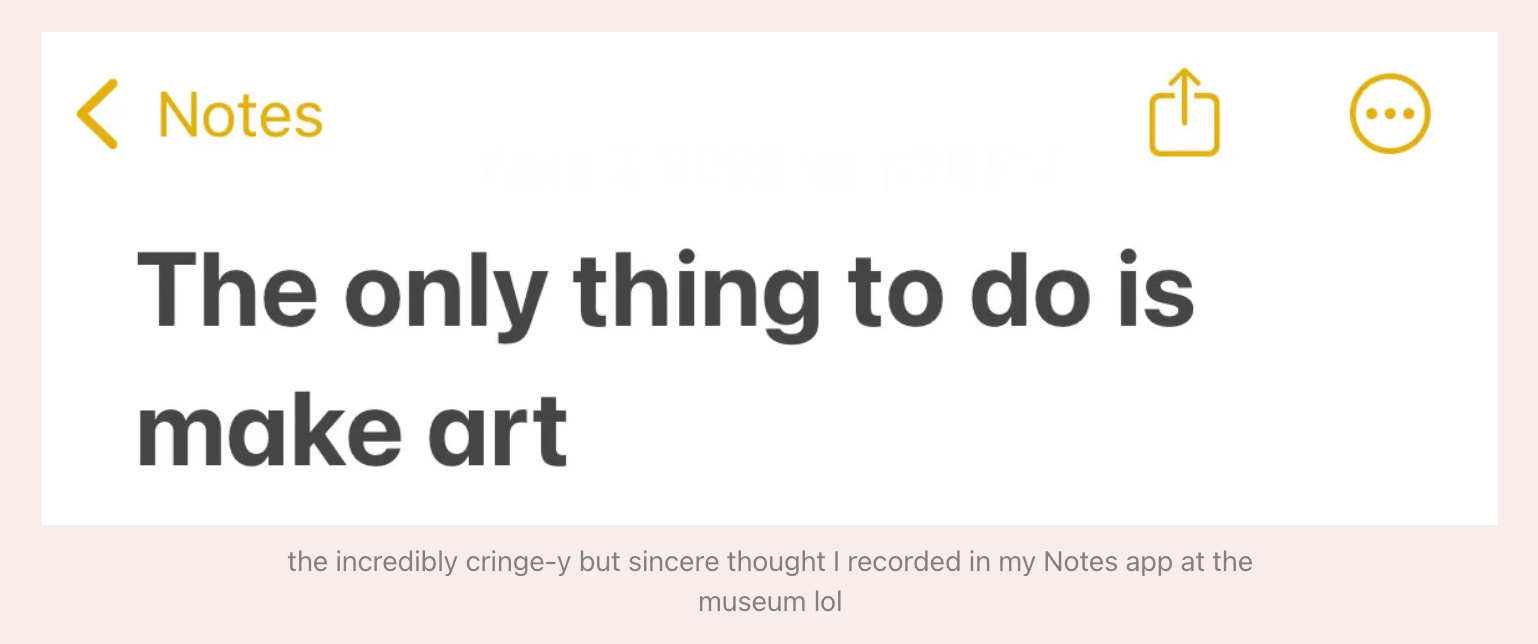
The mildly embarrassing refrain of “The only thing to do is make art” (from this previous post on effort) was on repeat in the back of my mind as I admired how much labor had gone into every single aspect of this performance: the synchronized movements of the dancers, the live orchestra in the pit below, the stagehands moving scenery in darkness… the sheer amount of work that had to happen for me to sit in a darkened theater and enjoy a couple hours of exertion and beauty in equal amounts.3

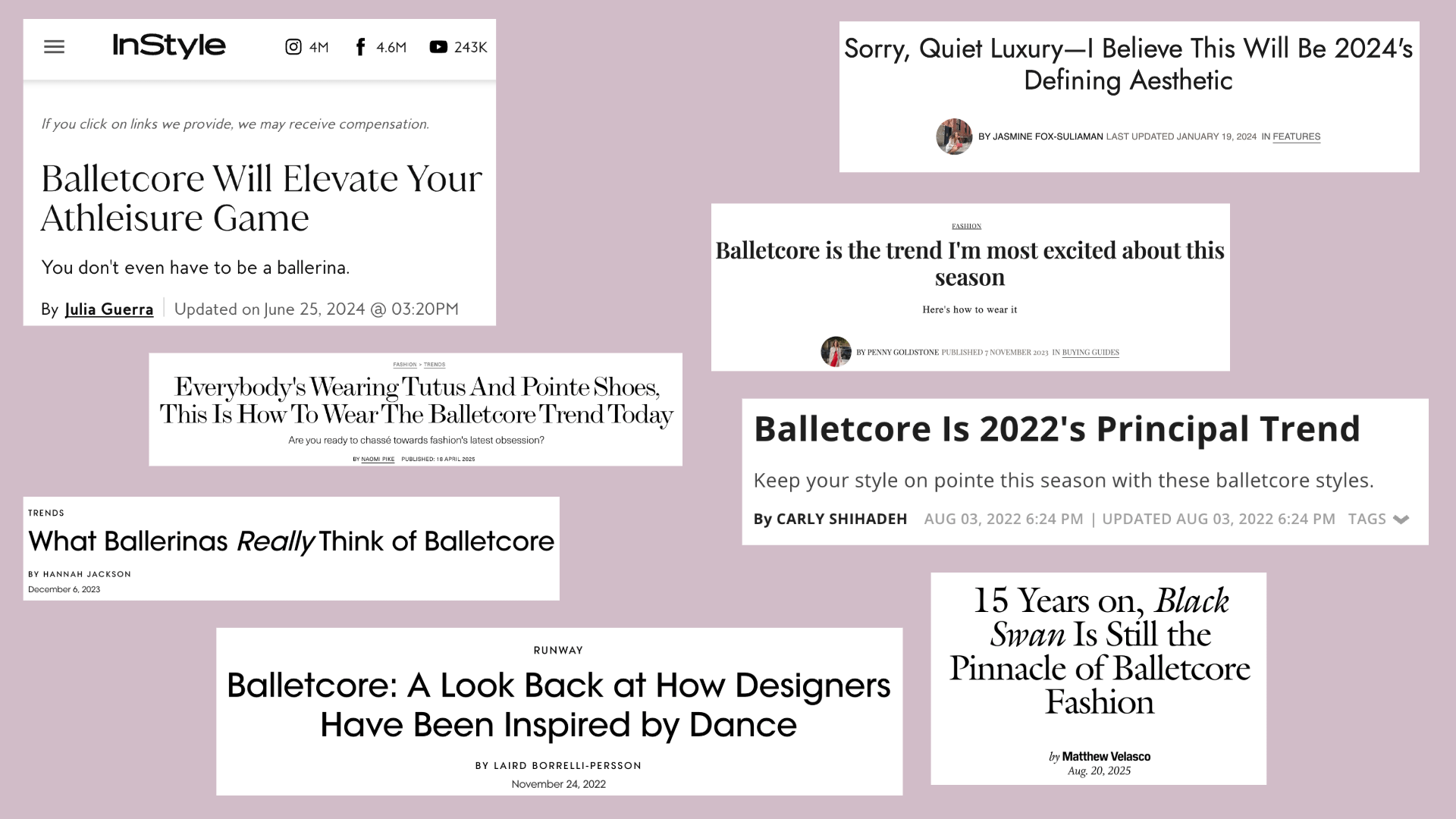
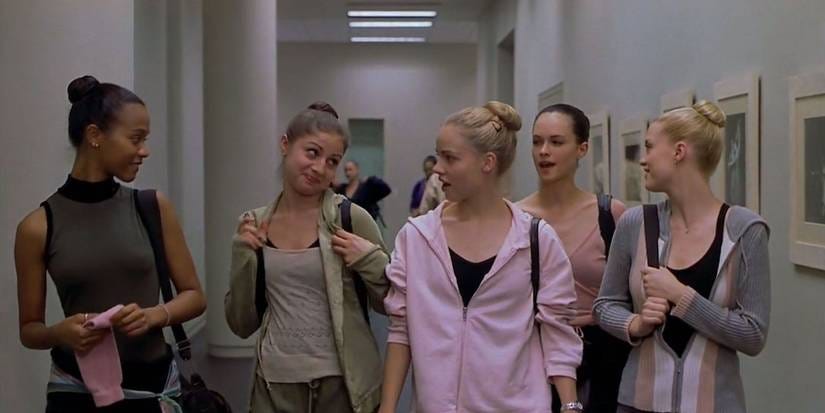
According to various fashion and culture media outlets (Vogue, Who What Wear, InStyle, among others), balletcore has been ‘trending’ for at least the last five years. It’s also been in the cultural zeitgeist for decades longer (remember Center Stage? Step Up? Black Swan?). At a certain point, I think we can acknowledge that balletcore has earned its place in the canon of wardrobe basics.
Once you start looking for balletcore in contemporary fashion, it's actually difficult to stop seeing it. At Los Angeles Apparel (which, in its earlier iteration as American Apparel in the late 2010s, was no stranger to balletcore-inspired imagery and clothing… refer to the ad below featuring that infamous leotard and leg warmers combo), you’ll find a ballet-inspired wrap top—and near identical iterations from Negative Underwear, Aritzia, and other brands. Sandy Liang’s Mary Jane Pointe flats (first released in her spring 2023 collection) with their dulled satin finish and boxy toe were an explicit nod to the art form. (Liang has spoken frequently about her love of ballet as a child, and about taking inspiration from Isabella Boylston, a principal dancer with the American Ballet Theatre.) The New York City Ballet itself has even collaborated with multiple brands, including J. Crew, Zara, and Reformation, over the last few years.
Even when the garments themselves aren't overtly ballet-inspired, fashion brands frequently borrow from ballet's visual language: a muted palette of greys, beiges, and pinks, minimal silhouettes, photographed in a stripped down practice space. (Baserange is the first brand I thought of, but Gil Rodriguez or even Maryam Nassir Zadeh come to mind as well.)
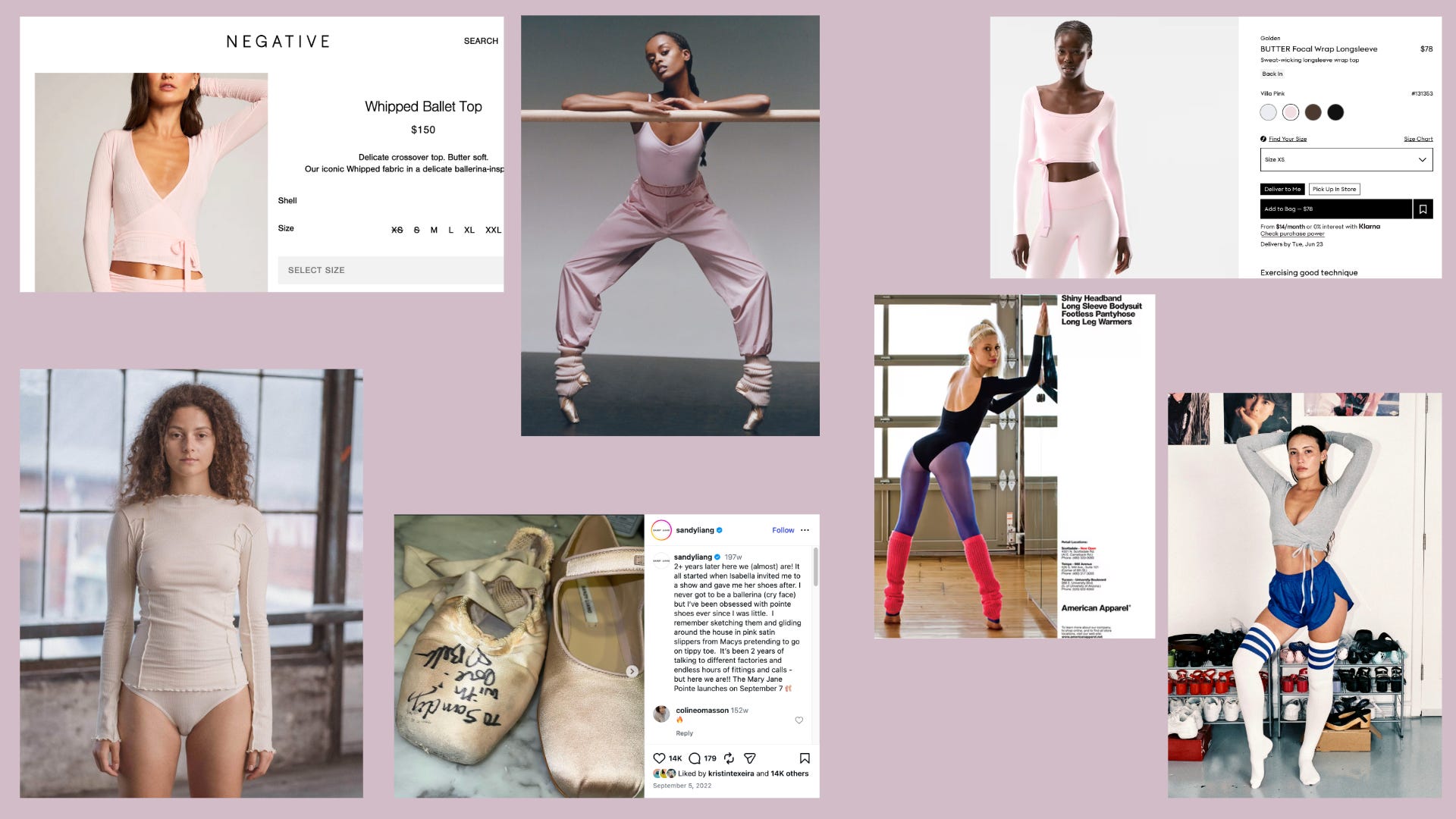
What strikes me about balletcore is that fashion didn't borrow the beauty and artifice of a final performance as much as it did those elements of exertion and effort. The clothing we think of as balletcore is4 the garments associated with repetition, correction, and practice: ballet flats, cover-ups, footless tights, cutoff sweatshirts, leggings, leotards. It’s the warm-up wear!
Watching Swan Lake reminded me, yet again, that effort has its own satisfaction. What fashion has borrowed from ballet isn’t the sheen of the final product, but rather what it its practitioners wear as they work to perfect it. As a large swath of culture moves excitedly towards frictionlessness and optimization, balletcore’s enduring popularity makes me hopeful that our collective drive to show our work will persist. (Putting a nickel in the AI jar now even though I didn’t mention it by name...)
Like any good student of culture, I had hoped to buy some merch after the show, but the store on the first floor of the theatre was closed for the evening by the time it let out. But that’s probably a good thing, despite the perfect imaginary t-shirt I’ve now envisioned (Comfort Colors brand, of course, in some muted shade of blue with a haunting line drawing of a swan). What I actually want to remember from the performance is the effort that made it all possible.


Sorry, Brooklyn, I love you more, but it’s true!
There are two main ballet companies in New York City: the American Ballet Theatre and the New York City Ballet. I don’t know enough to speak on the differences between them (the only thing I knew going in was that ABT leans more classic/storied, and NYCB more modern/abstract), but I was up against a deadline here—I didn’t have a whole season to choose from!
I took not a single photograph from my seat—in fact, you’re not allowed to for the duration of the performance, thankfully. You’ll have to take my word for how beautiful it was (or watch one of the (surprisingly few!) videos of the performance that the American Ballet Theatre has shared recently on Instagram). You’ll have to take my word for how wonderful it was!
I think this is technically correct but I still want to say ‘are’…
Comments
Nothing yet. Say the first thing.
Sign in to join the conversation.