
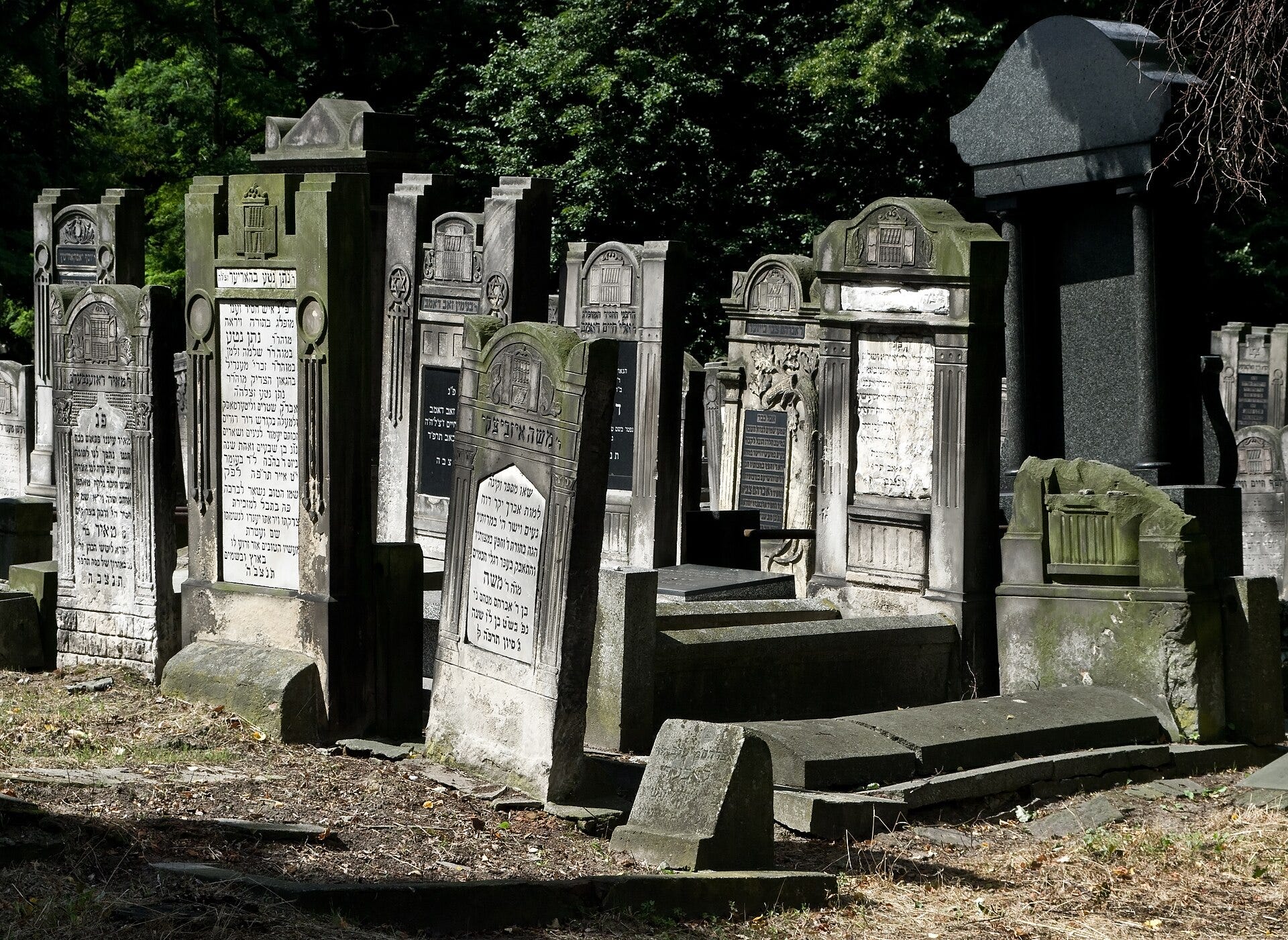
There is a moment in the burial liturgy, just after the aron is lowered into the earth, when the mourners are handed a shovel. Not asked. Handed. And for a beat, sometimes a very long beat, almost everyone hesitates. I have stood in that cemetery silence more times than I can count, watching grown men and women who run companies, raise children, argue cases before judges, and make consequential decisions every day freeze at the simple, ancient instruction to move dirt with their own hands onto the box containing someone they loved. I used to think the hesitation was about the physical act, or perhaps the finality of the sound. That first scattering of earth against wood is a sound you do not forget. But I have come to believe it is something else. It is the moment when people who have spent most of their lives inside a culture organized around the avoidance of death are asked to touch it directly. And touching it, even for thirty seconds, undoes something.
We do not talk about death enough. Not really. We talk around it. We speak in euphemisms. We lower our voices. We wait until someone is sick, until the diagnosis is terminal, until a doctor asks whether there is a healthcare directive, until the family is standing in a hospital hallway trying to determine what Dad would have wanted. We wait until the funeral, and then suddenly everyone wants to talk about what mattered. What did she believe? Did he know how much we loved him? What would she have wanted? What did he regret? What did we never get around to saying? Perhaps we are asking these questions too late.
Ernest Becker famously called this the denial of death. His argument, crudely summarized, was that much of human culture functions as an elaborate defense mechanism against the terror of mortality. Human beings possess enormous symbolic aspirations while inhabiting bodies that decay, and we build, acquire, achieve, conquer, accumulate, and memorialize in part because some piece of us refuses to accept that eventually we disappear. Modern American culture has refined this denial remarkably well. We have moved dying out of the home and into institutions. We have moved care of the dead out of the family’s hands and into professional hands. We speak of people passing rather than dying, of the departed rather than the dead. Each euphemism may be a small mercy, but taken together they reflect a culture with very little fluency in the one experience every single human being will eventually have.
Judaism has traditionally been far less squeamish, and it makes an astonishing claim in the process. Thinking about death is not primarily about preparing to die. It is about learning how to live. Kohelet says it plainly: it is better to go to the house of mourning than to the house of feasting, for that is the end of every person, and the living should take it to heart. Vehachai yiten el libo. That last phrase changes everything. Kohelet does not simply tell us to enter the house of mourning because the mourner needs us, though of course the mourner does, and comforting mourners is one of Judaism’s most elemental acts of hesed. Kohelet says that the living need the house of mourning too. There are things we learn there that the house of feasting cannot teach. Eventually, this is us.
The rabbis make the point even more explicitly. In Berakhot, Reish Lakish describes what a person should do when overcome by the yetzer hara, the impulse pulling us away from who we ought to be. Study Torah, he says. And if that does not work, recite the Shema. And if that does not work? Yizkor lo yom hamitah. Remember the day of death. It is an extraordinary spiritual psychology. Torah may not awaken you. Prayer may not awaken you. Mortality might, not because death makes life meaningless but because death makes our choices matter. Rabbi Eliezer makes a related point in Pirkei Avot: repent one day before your death. His students immediately identify the problem. Does anyone know which day he will die? Exactly. Therefore, repent today. This is not morbidity. It is clarity. The rabbis understood that one of the great dangers of human existence is the fantasy of unlimited time. Someday I will make the phone call. Someday I will apologize. Someday I will repair the relationship. Someday I will study more Torah. Someday I will stop wasting so much time on things I already know do not matter. Mortality asks a devastatingly simple question: how many somedays do you think you have?
Maimonides goes even further. In Hilkhot Avel, the laws of mourning, Rambam writes that one who refuses to mourn as the sages prescribed exhibits a kind of cruelty, because mourning is not merely an emotional response to the person who has died. It is supposed to do something to the living. When mortality enters our lives, Rambam says, we are supposed to examine our deeds and return. Teshuvah. That means the funeral is not only about the dead. Shiva is not only about the dead. The cemetery is not only about the dead. Death addresses a question to everyone who walks away from the grave: you are still here, what are you going to do with that?
Seen this way, the Jewish mourning system is not simply a collection of customs. It is a curriculum. Aninut, the raw period between death and burial, when the mourner is exempted from many positive commandments because there are moments when grief itself occupies the whole person. Keriah, the tearing of a garment, because something has actually been torn. Burial, where we do not merely witness the body entering the earth but participate in filling the grave. Shiva, seven days when ordinary life is interrupted and the community comes to the mourner rather than the reverse. Then shloshim, then Kaddish, then yahrzeit, then Yizkor, returning again and again across a lifetime. Again and again, Judaism returns us to death, not so that we become trapped there but so that we do not forget. We cover mirrors so vanity cannot compete with grief. We sit low. We speak the name of the person who died. We say Kaddish, a prayer that famously does not mention death at all, because even from within the rupture of grief we insist upon placing ourselves inside something larger than the self. Traditionally, we do not disguise the dead as though they were still living. The body is washed, dressed simply, and returned to the earth. Rabban Gamliel himself chose simple burial garments in a world where elaborate funerals had become financially burdensome, and even in death Judaism strips away another illusion. Status disappears. Titles disappear. Wealth disappears. The distinctions around which we spend so much of life organizing ourselves begin to look rather ridiculous when viewed from inside a grave.
Pirkei Avot makes the point with characteristic bluntness. Akavya ben Mahalalel tells us to consider three things: where we came from, where we are going, and before whom we will ultimately give an accounting. Where are we going? To a place of dust, worm, and maggot. The Mishnah is not being macabre for entertainment. It is puncturing fantasy. The billionaire and the janitor are going to the same place, the rabbi and the congregant, the powerful and the forgotten. Dust is not especially impressed by our resumes.
Perhaps this is why Buddhist teachers have found such a receptive audience among Jews in recent decades. Pema Chödrön writes and teaches relentlessly about impermanence, about the suffering created not merely by change itself but by our frantic resistance to it. Our bodies change. Our parents age. Our children grow up. Relationships change. Institutions disappear. The things we own eventually belong to other people. We are not staying. Sharon Salzberg, Sylvia Boorstein, Alan Lew, Rodger Kamenetz, and an entire generation of Jewish seekers found in Buddhist practice a vocabulary for presence, impermanence, and suffering that sometimes helped them rediscover elements already present within their own tradition. Kamenetz’s account of a delegation of rabbis meeting the Dalai Lama in 1990 is instructive here. What struck him most was not what the rabbis had to teach the Buddhists about exile and survival, but what the rabbis, quietly, began to learn about presence and the direct gaze at suffering that Jewish practice had, in his view, somewhat lost. Alan Lew, who trained for years as a Zen practitioner before his ordination, understood this with particular force. His book This Is Real and You Are Completely Unprepared is ostensibly about the High Holy Days, but underneath it is a meditation on mortality. Rosh Hashanah and Yom Kippur become incomprehensible if we turn Unetaneh Tokef into religious theater. Who shall live and who shall die is not there because our liturgy has a flair for drama. It is there because teshuvah only becomes urgent when time is finite. Once a year, the Jewish calendar forces us to rehearse the fact we spend much of the rest of the year avoiding. You will die. Now what?
The Buddhist encounter can help modern Jews hear this again, but we do not need to become Buddhists to learn it. Kohelet already knew. The rabbis already knew. Rambam already knew. The Chevra Kadisha knows. The person holding the shovel at the grave knows. And Judaism adds something crucial to the contemplative insight: the awareness of impermanence is not supposed to make us love this world less. It should make us love it more. Because your parents will not always be here, call them. Because your children will not always be children, look up from your phone. Because friendships can end, tend to them. Because your body is temporary, care for it. Because words cannot always be retrieved, speak carefully. Because there may not always be another opportunity to apologize, apologize now. Because there will be a final Shabbat dinner with every person we love, and almost none of us will know it is the final one, perhaps we should stop treating so many of them as ordinary. Psalm 90 asks God, limnot yameinu ken hoda, venavi levav chokhmah, teach us to number our days, that we may acquire a heart of wisdom. The Psalmist does not ask God to tell us the number. That would be unbearable. The prayer is that we learn to understand that our days can be numbered, that there is an end, and therefore this day matters.
This is why we need to talk about death long before someone is dying. We need to tell our spouses what we want. We need healthcare directives and wills. We need to talk about funerals. We need to tell our children what we believe happens after death, even if what we believe is that we are unsure. We need to ask our parents questions while they can still answer them. What were you afraid of when you were young? What are you proudest of? What do you regret? What did your parents teach you? What do you want your grandchildren to know? Most of all, we should stop saving our deepest words for eulogies. This is one of the strangest things we do. At funerals, people say magnificent things. They speak about generosity, humor, loyalty, kindness, courage. They describe the ways a person shaped them. They tell stories they have carried for decades. And sometimes, listening to these eulogies, I find myself wondering whether the person ever knew, whether anyone said these things while they were still alive to hear them. Give the eulogy early. Tell your parents what they taught you. Tell your teacher what she changed in you. Tell your children why you are proud of them. Make the phone call. Have the uncomfortable conversation. Write the ethical will. Make the apology. Forgive when you can. None of this is an obsession with death. It is an obsession with life.
There is a communal dimension to this as well. A community that cannot speak honestly about death eventually loses its ability to grieve honestly. We rush toward closure. We search for explanations. We insist that people move forward. But Jewish mourning has never demanded that grief resolve neatly. In the years since October 7, 2023, American Jews have carried an enormous amount of grief, some personal, some communal, some political, some almost impossible to name. We have mourned people we knew and people we did not. We have discovered fractures in communities we thought were solid, and many of us have experienced a kind of dislocation from institutions, friendships, and assumptions we once trusted. We have needed a language for grief, and fortunately we already possess one. Shiva. Kaddish. Yizkor. Tzidduk HaDin. Memory. Presence. Silence. A Jewish community fluent in mourning is not a community obsessed with death. It is a community capable of surviving loss without lying about what has been lost.
Which brings me back to the shovel. It is still there at the edge of every Jewish grave. Someone hands it to the mourner, and almost always there is that hesitation, and then the shovel enters the earth, and the dirt falls, and the sound comes, and for a moment there is nowhere to hide. This ends. All of it. Not today, we hope. Not soon. But someday. The question is whether that knowledge frightens us into silence or awakens us into living. Kohelet already told us what to do. Vehachai yiten el libo. The living should take it to heart. Talking about death does not invite death into the room. Death was already in the room. Talking about it reminds us that life is there too.
Comments
Nothing yet. Say the first thing.
Sign in to join the conversation.