
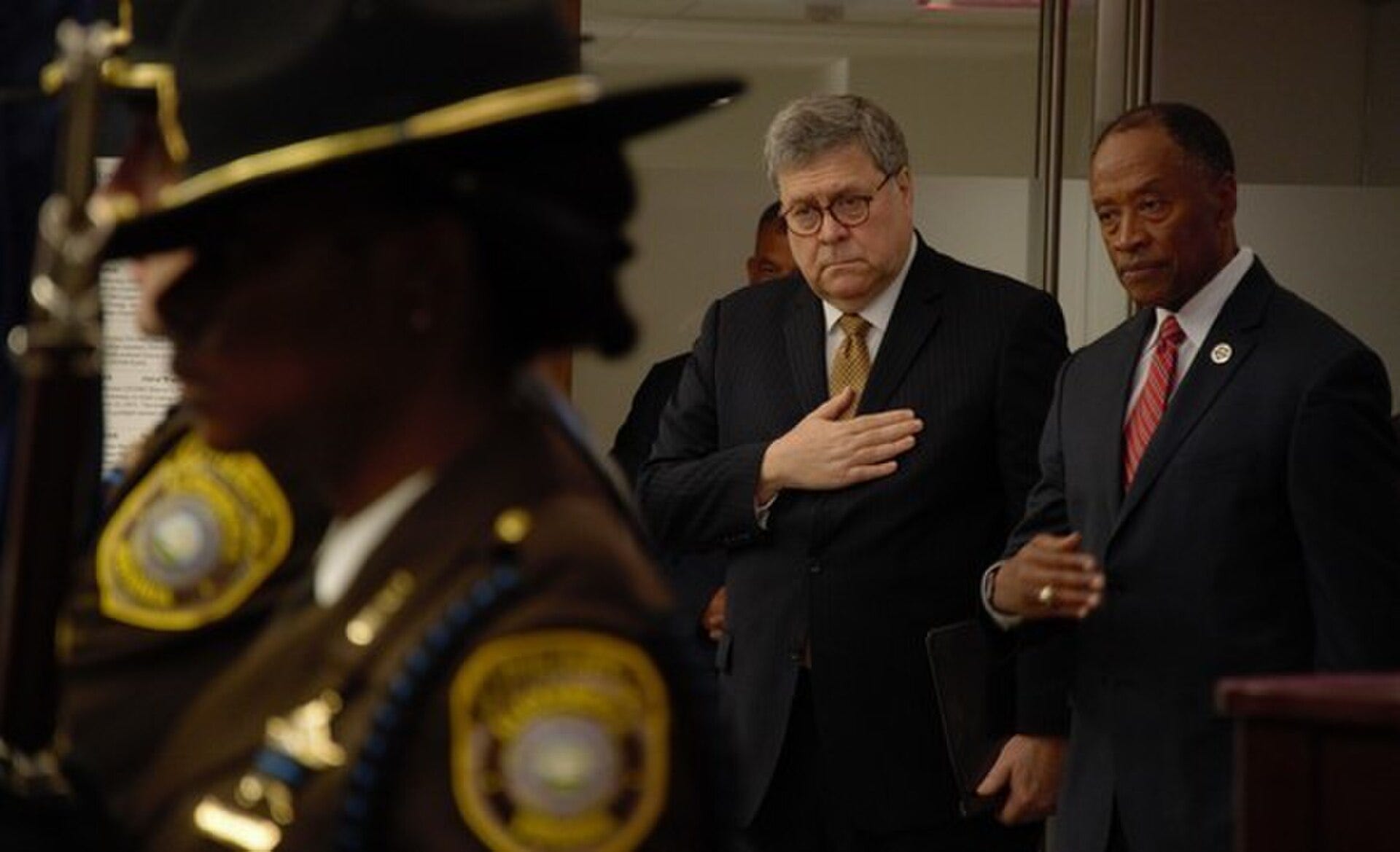
There was a time not particularly long ago when I would have found it genuinely shocking to discover myself reading an essay by William Barr and nodding along.
Barr was not merely a Republican attorney general. For many of us who came of political age as center-left American Jews, he became emblematic of a political world we regarded with deep suspicion: Donald Trump, expansive executive power, the transformation of conservatism, and a Republican Party whose instincts often seemed profoundly distant from our own. I disagreed with Barr on plenty, sometimes vigorously. I certainly never imagined him becoming a writer whose diagnosis of American antisemitism I would find more convincing than that offered by prominent Democrats.
And yet here we are.
Barr has written in The Free Press that Democrats are “in denial” about campus antisemitism. His immediate target is Representative Jamie Raskin, the ranking Democrat on the House Judiciary Committee, who announced an investigation into what he calls the Justice Department’s “sham investigation” of antisemitism at Harvard, Columbia, Brown, and Cornell. According to Barr, Raskin’s account does something more troubling than merely criticize the Trump administration’s tactics: it rewrites the history of what happened on American campuses after October 7.
What surprised me while reading Barr was not simply that I agreed with him.
It was how unsurprising agreeing with him has become.
That is, for me, one of the stranger political developments of the years since October 7. The old categories have become unreliable. People whose politics I once broadly shared sometimes describe a Jewish reality that I barely recognize, while people with whom I once shared almost nothing politically occasionally describe that reality with startling clarity.
This is not a confession of conversion. I have not suddenly become a Barr Republican, whatever that might mean in 2026. Nor do I believe that every action taken by the Trump administration in the name of combating antisemitism has been wise, proportionate, or constitutionally sound. Power requires scrutiny precisely when we sympathize with the purpose for which it is being exercised.
If Justice Department investigations were conducted improperly, that matters. If conclusions were predetermined, that matters. If antisemitism became a convenient pretext for settling unrelated political scores with universities, that matters too. The Jewish response to government overreach cannot simply be: this time the government claims to be doing it for us.
But scrutiny of the remedy is not the same thing as denial of the disease.
And this is where Barr’s argument lands.
There is something extraordinary about treating campus antisemitism after October 7 as though it were essentially an invention of the Trump administration. One need not accept every conservative characterization of campus protests to remember what Jewish students themselves were saying. One need not believe that every anti-Zionist protester is an antisemite to acknowledge the harassment, exclusion, intimidation, social ostracism, and occasionally violence that Jewish and Israeli students experienced.
Nor were these claims concocted in a Republican opposition-research office. Universities themselves formed task forces, commissioned reports, changed policies, negotiated settlements, and acknowledged institutional failures.
The argument cannot seriously be that nothing happened.
The more defensible argument is that government may have responded badly to something that really did happen.
Those are very different propositions.
And yet parts of the American left have spent nearly three years blurring them.
That blurring has become especially painful for American Jews because the intellectual tools required to recognize what happened were developed largely by liberals themselves.
For much of my adult life, the center-left taught Americans to think seriously about the experience of minorities within institutions. We learned that discrimination does not always arrive carrying a sign announcing itself as discrimination. We learned that hostile environments matter. We learned that exclusion can operate through supposedly neutral categories. We learned that members of minority communities should be listened to when they describe patterns invisible to the majority.
We learned that the person committing an offense does not possess unilateral authority to determine whether the recipient experienced it as prejudice.
These principles became embedded in American institutional life.
Then Jews began invoking them.
And suddenly there were qualifications.
A Jewish student could say that she was excluded because of Zionism, and we were told Zionism was merely a political ideology.
A Jewish student could say that chants about globalizing the intifada frightened him, and we were told that fear reflected ignorance of Palestinian liberation discourse.
Jewish students could describe the transformation of classrooms, dormitories, and student organizations into places where their relationship with Israel rendered them morally suspect, and sophisticated people suddenly became remarkably literal-minded about what counted as antisemitism.
Unless someone had shouted “I hate Jews,” apparently there was room for doubt.
It was difficult not to notice the asymmetry.
Imagine applying that standard elsewhere.
Imagine telling another minority community that the prejudice it experiences does not count because the aggressor has developed a semantic distinction between disliking the people themselves and disliking some supposedly objectionable feature of their communal identity.
We would recognize the maneuver instantly.
When Jews object, however, we are often invited into a seminar on definitions.
There is a Jewish language for this problem.
The Torah repeatedly warns against eifah v’eifah—different weights and measures. The original context is commercial fraud: one weight for buying, another for selling. But the moral principle is much larger. A society cannot claim justice while adjusting its standards according to whose claim is before it.
If we believe minority communities deserve protection from hostile environments, Jews do too.
If we believe identity can be attacked indirectly through euphemism, Jewish identity can be attacked indirectly too.
If we believe prejudice sometimes disguises itself as moral argument, antisemitism is not mysteriously exempt.
Not a special standard for Jews.
The same standard.
That should be an almost embarrassingly modest demand.
And yet October 7 revealed how difficult even that demand had become.
For many American Jews, this was among the deeper shocks of the period. The horror of October 7 itself was one trauma. The subsequent realization that many people and institutions with whom Jews had felt politically and culturally aligned viewed Jewish vulnerability through an entirely different lens was another.
It is difficult to explain that experience without sounding as though one is making an argument about partisan betrayal. I am not sure betrayal is even the right word.
Disorientation may be closer.
I grew up believing I understood the American political map. There was a Democratic Party with which I did not always agree but whose fundamental moral instincts seemed familiar. There was a Republican Party that occasionally made arguments I respected but whose coalition often felt foreign to me. One could locate oneself somewhere between them and more or less predict where the lines would fall.
October 7 scrambled that map.
Some progressives who had spent years insisting that language itself could create unsafe environments became suddenly maximalist defenders of speech when Jews complained.
Some people who taught us that silence in the presence of hatred constituted complicity became remarkably patient with antisemitic rhetoric when it emerged from movements they supported.
And some conservatives whom many Jews had long regarded as political antagonists simply looked at what was happening and said: this is antisemitism.
That does not make conservatism correct about everything.
It means conservatives were sometimes correct about this.
The inability to say so is itself part of the problem.
Politics encourages us to reverse the traditional intellectual process. Instead of asking whether a proposition is true and then deciding what we think about the person saying it, we identify the speaker and allow that identity to determine whether the proposition can possibly be true.
If William Barr says it, liberals suspect it.
If Donald Trump says it, many liberals feel morally compelled to deny it.
And of course the same pathology exists on the right. Conservatives routinely defend claims they would ridicule if they came from Democrats. Tribalism is wonderfully bipartisan.
But antisemitism is too serious a subject to be handled this way.
There is a rabbinic principle, kabel et ha-emet mi-mi she’amaro: accept the truth from whoever says it. The formulation is most famously associated with Maimonides, and its wisdom is bracing precisely because it demands intellectual humility. Truth does not become false because the speaker annoys us. Nor does falsehood become truth because the speaker belongs to our camp.
There may be no more necessary political discipline at the moment.
Barr can have been wrong about other things and right about this.
Jamie Raskin can have been right about other things and wrong about this.
No contradiction is involved.
What troubles me is that saying this now feels politically significant.
There was a time when publicly agreeing with William Barr would have felt, to me, almost transgressive. I would have imagined some dramatic ideological journey must have taken place before I could arrive there.
Today I read his argument and think: yes, obviously.
Not because Barr has changed so dramatically.
Perhaps because the political terrain around him has.
I suspect this experience is increasingly common among politically moderate American Jews. There is a temptation to describe it simply as Jews “moving right.” Pollsters will undoubtedly spend years trying to measure whether that is happening and by how much.
But I am not convinced that “moving right” adequately captures the experience.
Sometimes you remain standing where you were and discover that the people around you have moved.
Sometimes the vocabulary through which you understood political morality changes its meaning.
Sometimes an issue arrives that reveals priorities and assumptions that were previously hidden.
And sometimes you look across an old ideological divide and discover that a person you once regarded primarily as an opponent is describing something you see more clearly than people who once stood beside you.
That does not mean the old opponent has become your ally in every respect.
It means the categories have failed.
For Jews, there is another reason this matters. Jewish history should make us exceptionally wary of outsourcing our moral perception to political parties.
No party will ever love the Jews as much as Jews imagine during moments when its interests align with ours. Neither party is immune from antisemitism. Neither right nor left possesses a monopoly on it. The right has its conspiracists, ethno-nationalists, and ancient fantasies about Jewish power. The left has developed its own increasingly elaborate mechanisms for turning Jews into avatars of colonialism, whiteness, capitalism, imperialism, and whatever else the political moment requires.
Jews who convince themselves that antisemitism lives exclusively on the other side will eventually be disappointed.
That lesson is hardly new.
The Psalmist warns, Al tivtechu vindivim—do not put your trust in princes.
We might translate the verse for contemporary America: do not put your trust in parties either.
A healthy Jewish politics should therefore be capable of saying two things simultaneously.
Donald Trump and his administration can misuse power.
And elite American institutions can have a serious antisemitism problem.
William Barr can be a deeply controversial political figure.
And William Barr can be right that Democrats are engaging in denial when they pretend campus antisemitism was fabricated as a Republican pretext.
One proposition need not cancel the other.
Indeed, the capacity to hold both may be precisely what political maturity requires.
What I increasingly resist is the demand that Jews subordinate what they have seen with their own eyes to the requirements of partisan consistency.
I know what Jewish students have told us.
I know what happened in the weeks and months after October 7.
I know how quickly “Zionist” became, in certain spaces, a category to which almost any accusation could attach.
I know how many Jews discovered that their acceptance within progressive spaces depended upon amputating the part of their Jewish identity connected to Israel and the Jewish people.
And I know that none of this became real only when Donald Trump noticed it.
That is Barr’s strongest point.
Whatever one thinks of the administration’s response, the chronology matters. The antisemitism came first. The federal reaction came afterward. To reverse that sequence is not oversight. It is historical revision.
Perhaps that is why agreeing with Barr no longer feels particularly strange.
The truly strange thing is that recognizing antisemitism has become a partisan act at all.
I did not expect to reach a point in American political life when I would read Bill Barr on antisemitism and find myself thinking that he is describing reality more faithfully than Jamie Raskin.
I also did not expect to watch so many institutions that spent decades teaching Americans how to recognize prejudice suddenly become helplessly confused when Jews asked them to apply their own lessons.
There was a time when agreeing with William Barr would have shocked me.
Today it feels almost normal.
And that may be less an indication that I have changed than an indication of how profoundly the world around American Jews has changed.
The political homelessness many Jews now feel is not necessarily a failure to choose sides.
Perhaps it is a refusal to surrender our judgment to either one.
There are things the American right understands about this moment that the left refuses to see. There are things the left understands that the right routinely ignores. Jews should be mature enough and historically sober enough to take truth where we find it.
Even when it comes from William Barr.
Especially when our surprise at its source tells us something important about ourselves, our politics, and the strange new country in which American Jews now find ourselves.
No posts
Comments
Nothing yet. Say the first thing.
Sign in to join the conversation.