
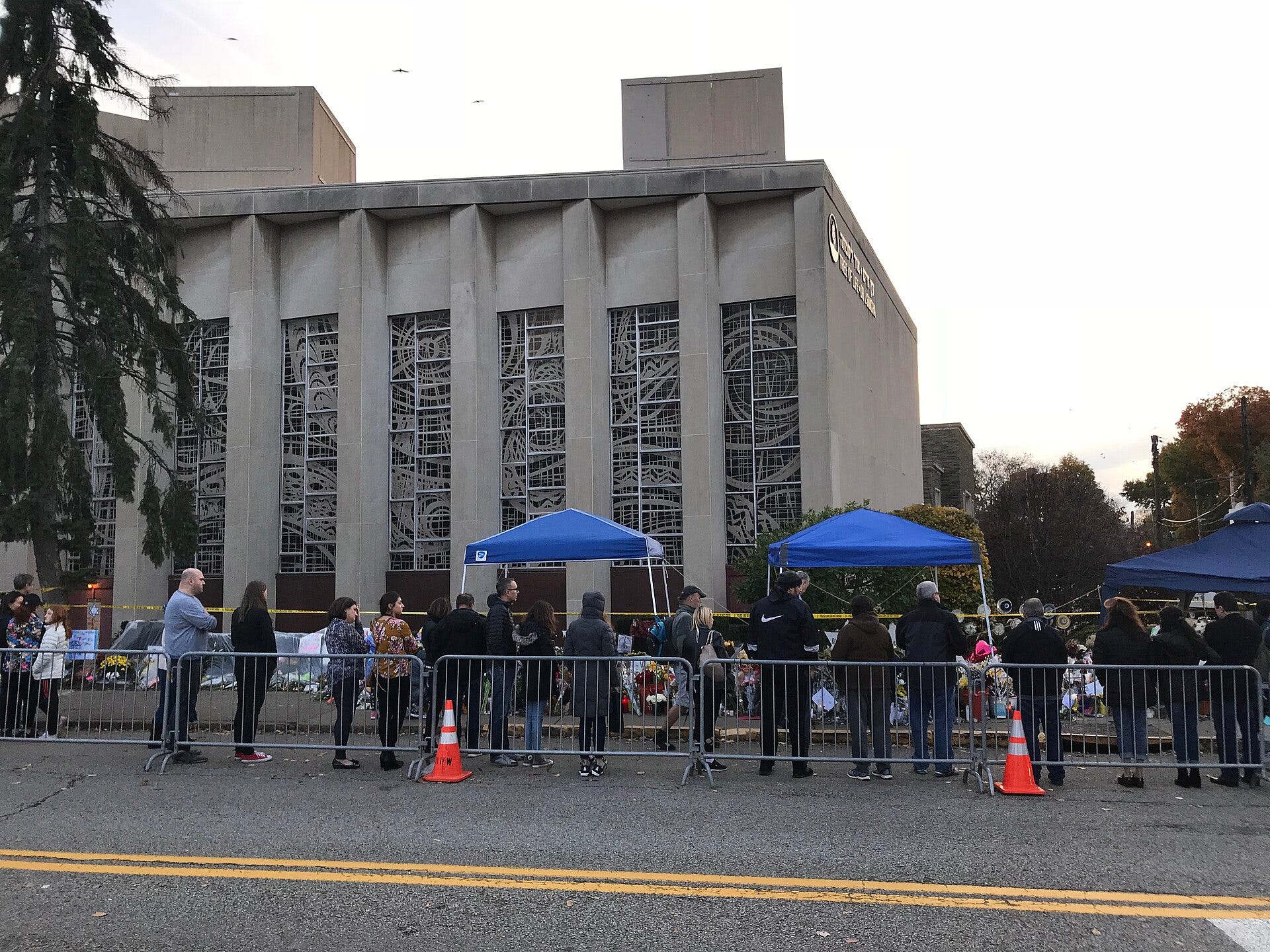
There are moments when the weekly Torah portion seems less read than enacted.
This past Shabbat we read Parashat Shoftim. It begins with one of the Torah’s great instructions for building a society:
“Shoftim v’shotrim titen lecha b’chol she’arecha” — “You shall appoint judges and officers in all your gates.”
Judges and officers.
At the gates.
And on that very Shabbat, at Central Synagogue in Manhattan, a man disrupted Friday night services, assaulted a congregant, damaged synagogue property, and attacked a member of the security team attempting to remove him. He was arrested by an NYPD officer working a security detail and subsequently charged with assault and criminal mischief as hate crimes. (eJewishPhilanthropy)
The coincidence was hard for me to ignore.
Because we are living through a moment when every American synagogue is being forced to think about its gates.
Who stands there?
Who gets in?
How quickly?
How warmly?
And what do we do when the person approaching the gate intends not to pray with us, but to harm us?
The traditional conversation about synagogue security has often been framed as a tension between two competing values: safety and hospitality. Either we become fortresses, the argument goes, or we remain the warm, open Jewish communities we want to be.
I no longer think that is the right way to understand the problem.
We are not choosing between security and welcome.
We are learning how to practice both.
And we had better learn, because I suspect the security culture that has developed around American Jewish life is not temporary.
This is the new normal.
We may wish desperately that it were not. We should work politically, communally and morally toward an America in which it is unnecessary. We should never normalize antisemitism itself.
But I do not believe we are going back to the synagogue world many of us remember.
There will be guards.
There will be cameras.
There will be locked doors and controlled entrances and security assessments and panic buttons and training exercises.
There will be significant portions of synagogue budgets spent on protecting Jews so that Jews can do something as radical as sit together on a Friday night and sing Lecha Dodi.
That is a loss.
We should say so.
But nostalgia is not a security plan.
Later in Shoftim, the Torah introduces the arei miklat, the cities of refuge. A person who has caused a death unintentionally is given somewhere to flee from the blood avenger. The Torah commands Israel to establish roads leading to these cities so that refuge is not merely an ideal but something actually accessible.
Think about that juxtaposition.
Shoftim gives us officers at the gates.
And Shoftim gives us cities of refuge.
Protection and sanctuary.
The controlled entrance and the safe interior.
The Torah apparently understands something we are still struggling to understand: a place can be guarded precisely because what happens inside is precious.
Security and sanctuary are not opposites.
Sometimes security is what makes sanctuary possible.
That is what I saw in Central Synagogue this weekend.
Rabbi Rick Jacobs, president of the Union for Reform Judaism, responded to the attack by insisting that Jewish communities would not retreat behind locked doors. “Our welcoming communities are where we find our strength and our purpose,” he said, adding that Jewish life must remain “proud and unafraid.” He later described the task as a “dual act”: securing Jewish communities while preserving joy, belonging and resilience. (eJewishPhilanthropy)
That formulation is exactly right.
But perhaps we need to think differently about what an “open synagogue” actually means.
An open synagogue is not necessarily a synagogue with an unlocked door.
An open synagogue is one in which the person who arrives at the locked door is greeted with warmth.
Those are different things.
For too long, I think some of our communal conversation has confused physical accessibility with spiritual hospitality. We worry, legitimately, that guards and barriers communicate suspicion. We fear becoming the “fortress synagogue,” a distinctly European model that many American Jews once believed belonged to a different Jewish reality.
That distinction is disappearing.
After the attack on Temple Israel in West Bloomfield earlier this year, security experts warned that American Jewish institutions may be moving toward what Mitchell Silber called a “Europeanization of security”: multiple armed guards, layered protection and increased screening before entry. (eJewishPhilanthropy)
That should trouble us.
It should also sober us.
Because the question is no longer whether we like that reality.
The question is what kind of Jewish community we will create inside it.
The financial cost alone is enormous. Rabbi Jacobs told eJewishPhilanthropy that heightened security has become one of the largest budget items for many synagogues and Jewish institutions. Money that might otherwise support teachers, scholarships, youth programs, adult learning, music, social services or additional clergy is increasingly spent on keeping the people participating in those programs alive and safe. (eJewishPhilanthropy)
Every synagogue leader knows the obscenity of that calculation.
How many preschool scholarships equal an armed guard?
How many hours of Jewish education equal reinforced glass?
How many teenagers could we send to Israel for what we spend ensuring that no one attacks them while they are standing in our social hall?
These are not choices the Jewish community asked to make.
But wishing we did not have to make them does not relieve us of the obligation to make them responsibly.
Richard Priem, CEO of Community Security Service, told eJewishPhilanthropy after the Central Synagogue attack that the very fact that Jewish communities require security is “shameful” and “something that we should not accept as the new normal.” (eJewishPhilanthropy)
Morally, I agree with him.
Practically, I am less certain.
We must never accept as normal the hatred that makes security necessary.
But I think we have to accept that serious security itself is now a permanent responsibility of synagogue leadership.
After Pittsburgh.
After Poway.
After Colleyville.
After October 7 and the explosion of antisemitism that followed.
After West Bloomfield.
And now, after what happened in one of America’s most prominent synagogues in the middle of Manhattan.
At some point, temporary precautions become part of responsible governance.
A synagogue that refuses to prepare because preparation seems inconsistent with its values has misunderstood its values.
The Torah does not tell us merely to have ideals at our gates.
It tells us to put shoftim and shotrim there.
Judges and officers.
People capable of discernment and people capable of action.
That distinction matters too.
The best security is not simply more intimidating security.
It is intelligent security.
Priem makes an important suggestion in this regard: trained synagogue volunteers can stand alongside professional security personnel. Members of a congregation know the rhythms of their community. They recognize faces. They understand what a first-time visitor looks like, what a delivery looks like, what confusion looks like, and, with appropriate training, what behavior should genuinely raise concern. (eJewishPhilanthropy)
That may offer us a model.
Perhaps there should be two people at the synagogue door.
Metaphorically, if not literally.
One is asking:
Is there danger here?
The other is asking:
How can I welcome you?
Neither question cancels the other.
Because we must also remember that Jews do not look one particular way.
A person is not suspicious because they are Black or Asian or Arab.
A person is not suspicious because they have tattoos, because they are dressed differently from our regulars, because they do not know where the sanctuary is, or because they cannot pronounce the name of the congregation.
The Jew who walks through the door may be a Jew by birth, a Jew by choice, a prospective Jew, someone dating a Jew, someone mourning a Jew, someone curious about Judaism, or someone who has spent twenty years trying to gather the courage to walk into a synagogue.
If our security protects Jewish bodies while humiliating Jewish souls, we have solved only half the problem.
The answer is not less security.
It is better security.
Security trained not merely to detect threats but to understand the community it exists to protect.
And communities trained not merely in evacuation and emergency response, but in hospitality.
The research is worth taking seriously here. A recent study cited by eJewishPhilanthropy found that while European Jewish communities largely accepted some measures such as CCTV, visible security measures could themselves increase feelings of insecurity. Armed guards, in particular, sometimes reminded worshippers that they were entering a place considered vulnerable enough to require armed protection. (eJewishPhilanthropy)
That paradox will not disappear.
The guard who makes me safer may also remind me why I need a guard.
The police car outside the synagogue can provide reassurance while simultaneously telling my child that our building requires a police car.
We cannot solve that psychological tension by removing the police car.
Our job is to build a Jewish life inside the building compelling enough that security remains the frame and never becomes the picture.
Which brings me back to Central Synagogue.
Friday night was frightening.
Saturday morning, Rabbi Andrew Kaplan Mandel and Cantor Jenna Pearsall came back to lead the community in prayer.
Pearsall acknowledged that they had been through something “really hard and scary” and offered a healing prayer for the congregation. Rabbi Mandel told those gathered that they were safe, expressed gratitude for the synagogue’s security team, and said they would not allow anyone to rob them of their attention on Shabbat. (Local News 8)
That, to me, was the most important thing that happened this weekend.
They davened.
The next morning, they davened.
Not because nothing had happened.
Precisely because something had happened.
There was more security. There was awareness. There was undoubtedly fear.
And there was prayer.
That is the model.
Our enemies do not win when we hire a guard.
They win when the guard is standing outside an empty synagogue.
They do not win when we lock a door.
They win when Jews decide there is nothing inside worth unlocking it for.
Perhaps this is the lesson of Shoftim for American Jews in 2026.
We need officers at our gates.
We also need cities of refuge.
We need places where Jews can enter from a world that increasingly feels hostile and discover that Jewish life is still joyful, serious, learned, noisy, argumentative, musical, sacred and alive.
We need synagogues in which children run through hallways while trained guards stand twenty yards away.
We need teenagers complaining about services while someone watches the security cameras.
We need mourners saying Kaddish, babies receiving Hebrew names, converts standing before the ark, Torah being argued over, Kiddush being spilled, and old men complaining that the rabbi spoke too long.
We need all of it.
The security is there so that the Judaism can happen.
That order can never be reversed.
The American synagogue of the future may have a different front door from the synagogue of our childhood.
I am increasingly convinced there is no going back.
But what happens after we walk through that door remains ours to determine.
Shoftim v’shotrim titen lecha b’chol she’arecha.
Place judges and officers at all your gates.
Guard the gate.
And then create something inside worth guarding.
Comments
Nothing yet. Say the first thing.
Sign in to join the conversation.