
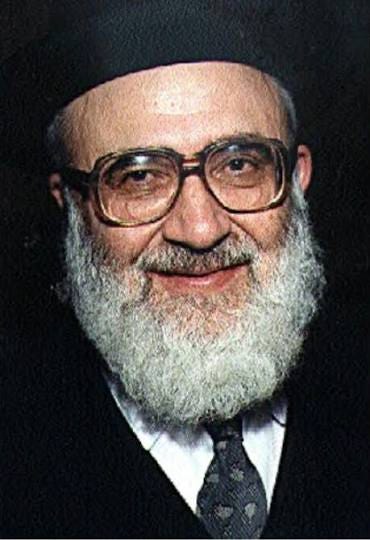
Two years into my study at Ner Israel Rabbinical College in Baltimore, back in the 1970s, I came to consider Rav Yaakov Weinberg my personal rebbe, or rabbinic guide. He was not only tremendously knowledgeable in Torah, but also in myriad other areas.
Impressively eloquent and deeply principled, Rav Weinberg, whose yahrtzeit, or anniversary of passing, was last week, was always fascinating to listen to, and seemed to always be available to field questions of any sort, with which I peppered him often. Only years later, after his passing, did I discover that many other of his students shared the same assumption I had – that his ready availability meant that no one else appreciated him (or was appreciated by him) as I. How he always was available and had the time to speak at length with all the others who regularly consulted him remains a mystery to me.
Several essays that I wrote decades later that quote or characterize him, slightly edited, follow here:
––––––––––––––––
QUESTIONS AREN’T FATAL
When, as a teenager, I first read about the Code of Hammurabi, the ancient set of social laws dating from the time of our forefather Avraham, I was greatly troubled.
Elements of the code, instituted by a king of the First Babylonian Dynasty, bear clear similarities to various of the Torah’s laws. What, I asked myself, were laws that would only be given to the Jewish People at Sinai doing inscribed on stones centuries earlier?
So naturally, I brought my question, like countless others about science, history and other things, to my rebbe, Rabbi Yaakov Weinberg, the late Rosh Yeshiva of Yeshivas Ner Yisroel in Baltimore. He just looked at me in his inimitable, sympathetic way, and posed a question of his own. “And Avi,” he said thoughtfully, “just what do you think our forefather Avraham spent his entire life doing?”
My question, I immediately realized, wasn’t much of one. A fundamental datum about Avraham, which I had known but hadn’t considered, is that he spent his days tirelessly spreading the word about the Creator of all, and sharing elements of His Torah (whose laws, the Midrash teaches us, were known to, and studied by, our forefathers).
Did I really think, Rabbi Weinberg was saying to me, that Avraham’s efforts had had no effect on the society of his day, or on laws enacted by leaders of the time?
Young (and not so young) Jews will always have questions about our religious tradition, and asking questions is the only way to find and internalize truths. There are some who claim that teachers of Torah today don’t allow certain issues to be raised. If that is true (and I hope it’s not), it is lamentable. Because no question, honestly asked, is a bad question. And if a teacher doesn’t feel up to the task of correctly answering one, that’s also fine. In such cases, both teacher and student can—and should—go to someone more knowledgeable to learn more.
Many even seemingly formidable questions are easily toppled. Before Rabbi Weinberg pointed me in the right direction, Hammurabi’s Code seemed a terrible challenge, although it wasn’t one at all. And many other questions I had in my youth about Torah met similar fates.
That’s not to say, though, that all questions are answerable.
As important as it is to be able to pose queries, it is equally vital to recognize that there are questions whose answers are simply beyond human ken. For instance, when we ponder the limits of time or of space, comprehension eludes us entirely. It is more than mildly intriguing that a single Hebrew word serves as the translation of both “the universe” and “forever.” And that the word – olam – is itself, significantly, rooted in the word for “hidden.”
Human minds are hard-wired to go haywire when they try to wrap themselves around concepts like infinity or eternity. And science comes up punch drunk, too, when it tries to comprehend the very small (sub-atomic physics reads like wild fantasy) or the very large (cosmology, like mysticism).
And then there are many matters even here in our own macroscopic lives that likewise befuddle us, questions seemingly without answers. Not only “big” ones like how to reconcile free will with G-d’s omniscience (about which Rabbi Akiva starkly, defiantly states in Avos [3:19]: “Everything is foreseen, but permission [to choose] is granted”) but “smaller” ones as well, like “Why did I have to be born [fill in the blank]?” or “Why did [ditto] have to happen to me?”
Part of maturity, in fact, is accepting that there are answers that, trapped as we are with limited brains in a physical world, are off-limits to us. Recognizing, that is, the import of a wise Yiddish expression: “Fun a kashya shtarbt men nisht” – loosely translated, “questions aren’t fatal.”
When I have the opportunity to address a group of young people and there is time for questions, I always offer as a preface words that my own children have often heard. “I can accurately answer any question you may have” I boast. “As long, as you realize that ‘I don’t know’ is a perfectly valid answer.”
© 2011 AMI MAGAZINE
––––––––––––––––––––––––––––––––
THE ESSENCE OF A GODOL
Rabbi Yaakov Weinberg was once invited to speak about Judaism to a group of non-observant psychologists and their spouses, and, about fifteen minutes into his speech, one of those present stood up and interrupted the speaker.
“Rabbi, if you keep talking,” he said, “I am going to have to change the way I live and I like the way I live.”
Everyone present was taken aback but urged the rabbi to resume his talk. The man who had interrupted him got up and exited the house – leaving his wife behind.
After he finished his lecture, Rabbi Weinberg went over to the woman and asked her for her name, but she refused to tell him. The host of the gathering was equally unwilling to compromise his invitee’s privacy. Rabbi Weinberg was disappointed. He wanted to speak to the man, whom he considered worthy of great respect for his honesty. So many people, he later mused, manage to hear things that should change their lives but just blithely ignore the words’ implications.
What a remarkable man was Rabbi Weinberg, of blessed memory, who later became the Rosh Yeshiva, or dean, of Ner Israel Rabbinical College in Baltimore, and my rebbe.
As an 18-year-old studying in the Baltimore yeshiva in 1972, I watched him from afar. His father-in-law, Rav Yaakov Yitzchok Ruderman, was the Rosh Yeshiva then; Rav Weinberg headed the married students’ program and also delivered general lectures. The depth of his knowledge, the power of his critical analyses of Talmudic issues and worldly topics, his eloquence and his knowledge of history and the sciences, left a deep impression on me.
But what I came to realize was that his brilliance and erudition were mere tools with which he was gifted. His essence was his dedication to Torah and to his students – indeed, to all Jews. And his humility.
When I think back on the many times I telephoned him from wherever I was living at the time to ask him a question about Jewish law or theology, or for advice, I am struck by something I never gave much thought to at those times: He was always available. And, I have discovered over the years, not only to me. As I came to recognize all the others – among them greatly accomplished rabbis, scholars and communal leaders today – who had also enjoyed a close relationship with Rav Weinberg, I marveled. In my youthful self-centeredness, I had imagined him as my rebbe alone. Who knew?
And his ongoing interactions with his students somehow didn’t prevent him from traveling wherever his services were desired. A sought-after speaker and arbitrator for individuals and communities alike, he somehow found time and energy for it all.
More telling, he felt responsible to undertake it all. He and his wife, Rebbetzin Chana Weinberg, of blessed memory, gave so very much to others. That, I long ago concluded, is the defining characteristic of a true godol, or Torah giant: selflessness.
It wasn’t just in his public life, in his service to students and Jewish communities that Rav Weinberg’s self-effacement was evident. It was in little things too.
In the early 1980s, he was asked to temporarily take the helm of a small yeshiva in Northern California that had fallen on hard times. Although not a young man, he agreed to leave his home and position in Baltimore and become interim Rosh Yeshiva.
My wife and I and our three daughters lived in the community; I taught in the yeshiva and served as principal of the affiliated Jewish girls’ high school. And so I was fortunate to have ample opportunity to assist Rabbi Weinberg, and to witness much that I will always remember. One small episode, though, remains particularly poignant to me.
The rabbi was housed in a bedroom of a rented house. In the house’s other bedroom lived the yeshiva’s cooks at the time – a middle-aged couple, recently immigrated from the Soviet Union.
Though Northern California has a temperate climate, its winters can be a bit chilly, and the house’s heating system was not working. The yeshiva administrator made sure that extra blankets were supplied to the house’s residents, and an electric heater was procured for Rabbi Weinberg. (The cooks, it was figured, had been toughened by their native land’s cold clime).
After a week or two of cold, rainy weather, it was evident that Rabbi Weinberg had caught a bad cold. Suspecting that perhaps the electric heater was not working, someone went to his room to check it. It wasn’t there.
Where it was, it turned out, was in the cooks’ room. Confronted with the discovery, Rabbi Weinberg sheepishly admitted to having moved the heater. “I thought they would be cold” was all he said.
Another heater was bought. And a lesson, once again, learned, about the essence of a godol.
© 2009 AM ECHAD RESOURCES
======================================
“Mr.” To Us
A Chief Justice channels my Rebbe
Something reminded me of one of the many lessons I was privileged to be taught by Rav Yaakov Weinberg, who served as Rosh Yeshivah of the Ner Israel yeshiva in Baltimore.
When he was “acting Rosh Yeshiva” of a small yeshiva in northern California, in which I taught, a young black man served as custodian/janitor. I don’t recall if we knew his first name but we referred to him by his surname. “Hey, Barnett, how’s it going?” “Yo, Barnett, can you take care of this mess?” “Barnett, you working tomorrow?”
Once, Rabbi Weinberg heard one of us call out to the worker. Fixing his eyes on us, the Rosh Yeshivah said, quietly but firmly, “Mr. Barnett,” pointedly emphasizing the “Mr.”
What reminded me of that incident was a report about a commencement speech Supreme Court Justice John Roberts made at his son’s ninth-grade graduation from a prestigious New Hampshire school. He had much of worth to share with the boys, warning them, for instance, that their privileged lives will not insulate them from adversity, and suggesting that they take ten minutes a week to update and thank one of their former teachers with a written note (“Talk to an adult, let them tell you what a stamp is. You can put the stamp on the envelope”).
He also told them that, when they get to their new school, each of them should “walk up and introduce yourself to the person who is raking the leaves, shoveling the snow or emptying the trash. Learn their name and call them by their name during your time at the school.”
And so I was naturally reminded by that advice of Rav Weinberg’s “Barnett lesson” – that “respect for others” extends to every rung of the social ladder.
May his memory be a source of blessing to us all.
© Hamodia 2017
Comments
Nothing yet. Say the first thing.
Sign in to join the conversation.