
Everyone knows what the problem is. There’s too much carbon dioxide in the air, and the weather has gone wrong. There isn’t too much of anything.
To see why, you have to start with the most important sentence in this whole essay, and it is one you already learned in school and were probably allowed to forget.
Plants make food out of air and water, using sunlight.
That’s it. That’s the whole trick. A plant pulls a gas out of the air called carbon dioxide, which we write as CO2. It pulls water up out of the ground, which we write as H2O. Then sunlight hits the leaf and does something almost unbelievable: it snaps those two boring ingredients apart and glues them back together into sugar. And the leftover piece, the part the plant doesn’t need, is oxygen, which it pushes back out into the air. That’s the oxygen you are breathing right now, this second. It came out of a leaf as garbage.
If you want it written the way a scientist writes it, here it is:
6 CO2 + 6 H2O + sunlight → C6H12O2 + 6 O2
Now stop and think about what that means, because people say “photosynthesis” so fast and so often that they stop hearing it. Every single thing you have ever eaten was made by that reaction. The bread was wheat. The wheat was made of air and water and sunlight. The chicken ate corn, and the corn was made of air and water and sunlight. The fish ate something that ate something that ate a tiny green speck floating in the ocean, and that speck was made of air and water and sunlight. The wood in your pencil, the cotton in your shirt, the coal in an old power station, the fat on your bones. All of it. There is no second recipe. Everything alive on this planet, every animal, every person, every insect, is at the most primitive level basically air and water that got hit by sunlight and decided to stay together.
(And before anybody starts getting pedantic: yes, of course there's more in you than air and water. There's nitrogen in there, and phosphorus, and potassium, and calcium, and a few others besides. But look at where they come from. The nitrogen gets pulled down out of the sky by bacteria, because bacteria are alive and can do that, and a rock can't. The rest gets ground out of stone, slowly, over thousands of years, into soil. And it's a pinch, not the recipe: dry a plant right out and about nine tenths of what's left is still just air and water that got hit by sunlight.)
There is a much better objection than that one, though, and it opens up everything else in this essay.
Photosynthesis only makes sugar. That’s all it hands you. Sugar. But you are not made of sugar. You’re made of muscle and bone and fat and hair and blood, and not one of those things is sugar. So where does the rest of you actually come from?
You build it. That’s what your body is doing right now, this second, without asking you, and it has two halves. One half pulls things apart. The other half puts things together. The long words are catabolism and anabolism, which are just old Greek for breaking down and building up, and the two of them together are what people mean when they say metabolism.
Here’s the whole job. You eat the sugar. You take some of it and you burn it, using oxygen, to get energy. Then you take the broken pieces of the sugar you just pulled apart, add that pinch of nitrogen and phosphorus, and you glue them together into proteins and fats and the stuff your DNA is written on. That’s it. That’s you. You are, quite literally, a rearranged plant.
Now look again at what you burned it with.
Oxygen. The garbage. The bit the leaf threw out because it had no use for it.
And then look at what you breathed out afterwards. Carbon dioxide. And water. Which is exactly, precisely, atom for atom, what the leaf wanted in the first place. Put those two lines next to each other, because this is the whole essay in one go:
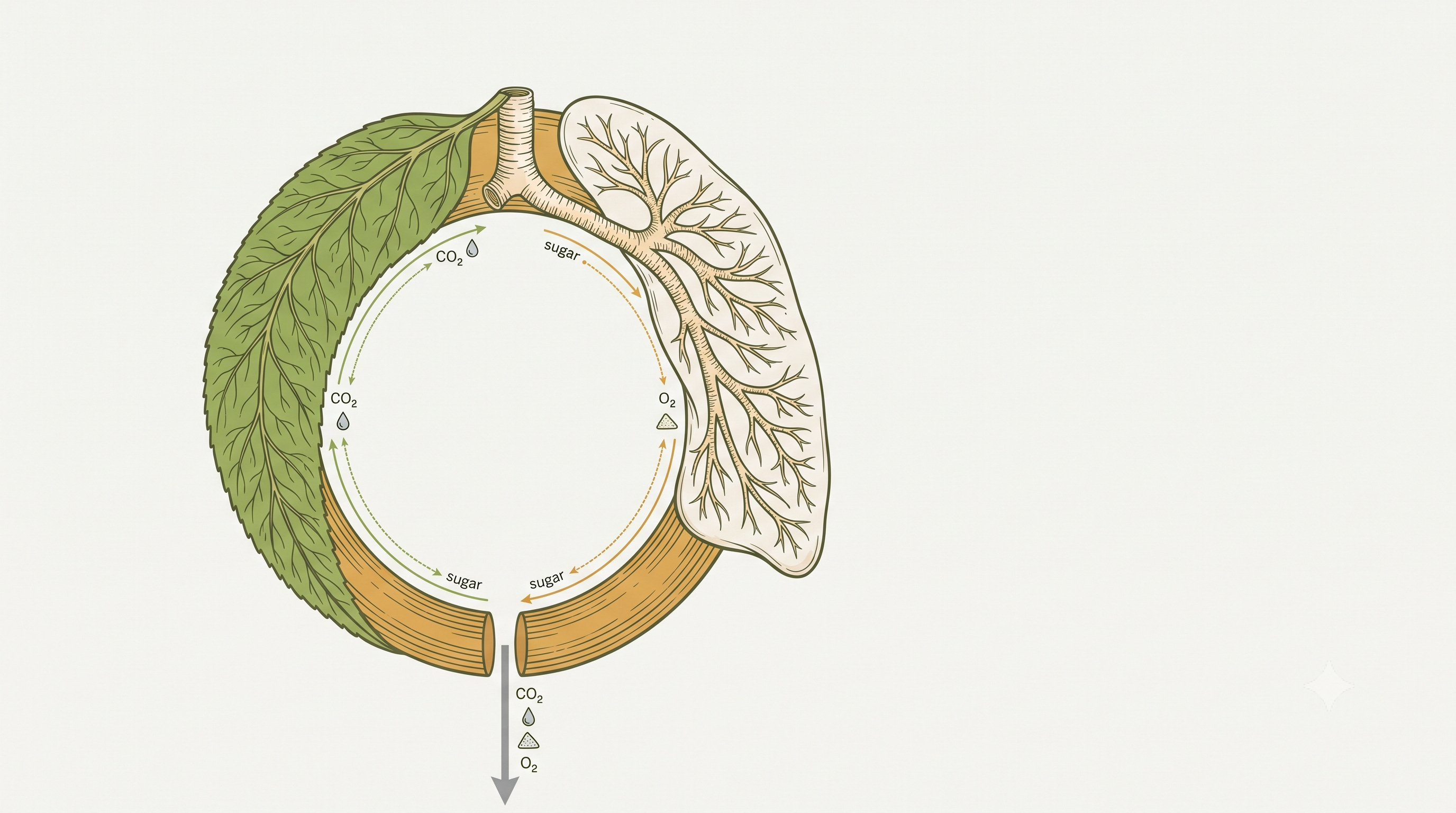
The plant takes carbon dioxide and water and sunlight, and makes sugar and oxygen. You take sugar and oxygen, and make carbon dioxide and water and energy.
It’s the same equation. One of you is running it forwards and the other one is running it backwards. The plant’s rubbish is your dinner. Your rubbish is the plant’s dinner. Neither of you is throwing anything away, because there is no away, and there never was. You and that leaf are two halves of one machine that has been running without stopping for about two and a half billion years, and the only reason you can breathe at all is that the other half has never once taken a day off.
And there’s one more thing about that garbage.
Strictly speaking, you don’t actually need oxygen to run a metabolism. Bacteria managed perfectly well without any at all, for well over a billion years. You can break sugar apart in the dark, with no air anywhere near it, and get energy out. It works.
It’s just terrible at it.
Burning sugar with oxygen gives you about fifteen times more energy than doing it without. Fifteen times. And that changes everything, because being big is expensive. Being complicated is expensive. Eyes are expensive. A brain is outrageously expensive. If the only energy you can get out of your dinner is the small number, then you cannot afford to be anything except tiny and simple, and for most of the history of this planet that is exactly what everything was. Slime. Just slime, everywhere, for two billion years. Nothing with eyes. Nothing with legs. Nothing that could chase anything else, because nothing could afford the legs.
So the leaves went to work, and they threw their rubbish out, and it started to pile up. Slowly. At first it didn’t even reach the sky: the oxygen poured into the sea and rusted it, and the iron in the water turned red and sank, and there are striped rocks all over the world today that are nothing but the rust from that first long exhale. Only once the ocean had finished rusting did the air begin to fill.
And it took about two billion years.
Two billion years of a planet quietly filling up with its own waste. And then, at last, when there was finally enough of it lying around, something could afford to be big.
So the leaf didn’t just feed the animals. The leaf made animals possible. Every single thing on this planet with eyes and legs and teeth and a brain exists because a green thing spent two billion years throwing something away. It wasn’t a gift. Nobody planned it. It was litter.
You are not a guest of the plants. You’re a side effect. And that’s the loop!!
(Now, you can read that exact same sequence the other way round, plants first, to build the conditions, so that we could arrive once the place was ready. Design, rather than accident. And that is what I believe. But I'm not going to argue it here, and this essay does not rest on it, and you do not have to agree with a word of it. Everything that follows works exactly the same either way. Either way the loop is real. Either way it took two billion years to build. Either way we are the ones pulling it apart. And if it was designed, then what comes next is worse, not better.)
Everything else in this essay is just about what happens when you break it.
So here is the first strange thing I want you to notice.
We have spent about forty years telling everybody that carbon dioxide is the enemy and that it is destroying the world. And carbon dioxide really does trap heat. I’m not going to lie to you about that, and I’ll come back to it. But look at the recipe again. Carbon dioxide is not the villain of the story. It’s one of the two ingredients that the entire living world is built out of. Calling CO2 the enemy is a bit like calling flour the enemy of bread. It’s in every loaf. It’s the loaf.
And it gets stranger. Because of how worried we are about heat, some very serious people have started proposing very serious plans to fix it, and almost all of those plans are the same plan wearing different hats. Spray dust high in the sky so it scatters sunlight. Make clouds whiter so they bounce sunlight away. Put mirrors in space. Paint things white. Every one of those ideas is about one thing: let less sunlight reach the ground, so the ground gets cooler.
So now go back and look at the name of the thing. Photosynthesis. It’s a long word, so nobody ever stops to take it apart. But it’s just two small words stuck together, and you already know both of them.
“Synthesis” means putting things together. Making one thing out of several things.
And “photo” means light. That’s it. That’s all it has ever meant. It’s the same “photo” as in photograph, which is a picture made out of light. It’s the same one as in photocopier, the machine that flashes a bright bar across the page. Photo means light.
So the word photosynthesis means: putting things together, using light.
Read that again, because it’s the answer to the whole question. Light is not one ingredient in the recipe. Light is in the name. The people who worked this out named the entire process after the light, because the light is the part that does the work.
Here is why. Carbon dioxide and water, by themselves, do nothing. Nothing at all. Put them in a sealed jar together and come back in a thousand years, and you will find a jar of carbon dioxide and water. They will not have become sugar. They will not have become a tree. They will sit there quietly forever, because they’re perfectly comfortable as they are and there is nothing telling them to change. They aren’t the engine. They’re just parts lying on the floor.
The light is what picks them up. The light is the only thing on this planet that can take dead air and dead water and force them into something alive. Scientists have a name for that moment, the making of the very first food, the food that everything else eats afterwards. They call it primary production. Primary, meaning first. And there is exactly one thing in the known universe that starts it, and it is a photon coming off the sun and landing on a leaf.
Think of a cake. The flour is on the counter. The eggs are on the counter. The butter, the sugar, all of it, sitting right there, all present, all correct. And they will sit on that counter until the end of time and never once become a cake. Nothing is missing. The ingredients are perfect. What’s missing is the oven. The heat is what makes the cake, and if you switch the oven off, everything is still there and there is no cake and there never will be.
Or think of a pile of Lego on the floor. Every brick for the castle is there. The castle does not build itself. Something has to do the work.
Sunlight is the oven for the whole planet. Sunlight is the hands on the Lego. It’s not an ingredient. It’s the thing that turns ingredients into life.
So when someone stands up and explains that the plan is to let a bit less sunlight reach the ground, hear what is actually being said out loud. The plan is to turn down the photo in photosynthesis.
And maybe it’s still worth doing one day. Honest scientists argue about this seriously, and there’s a real argument that scattered light actually spreads through a leafy canopy a little better than a straight beam does, so it might not be as bad as it sounds. I’m not telling you the answer, because I don’t have it. I’m telling you to notice something strange: we named this process after the light, we have known for a hundred years that the light is the part that matters, and we have somehow arrived at a plan to save the world by taking the light away, and almost nobody has said that sentence out loud.
Now let’s talk about the ingredient nobody argues about, which is water. Water has two jobs, and almost everybody only knows about the first one.
The first job is that water vapour, which is water floating in the air as invisible gas, traps heat. It traps more heat than CO2 does. That’s true and it’s not really controversial. Nobody puts it on a poster because you can’t tax a cloud.
The second job is the one I want you to actually remember, because it is the secret engine of the whole planet, and you already know it in your body.
Think about coming out of a swimming pool on a windy day. You’re soaking wet, and you are freezing, even though it’s summer and the air is warm. Why? Nothing is putting cold onto you. There’s no ice. What’s happening is that the water on your skin is drying, and here is the thing almost nobody stops to think about: drying takes energy. A lot of it. To turn liquid water into vapour you have to pay, and the water takes that payment out of the nearest thing it’s touching, which is you. So the water leaves, and it carries your heat away with it. It doesn’t just move the heat around. It picks it up and takes it upward, into the sky.
That’s why you sweat. That’s the whole reason your body invented sweating. It’s not that sweat is cold. It’s that leaving costs energy, and the water pays with your heat.
Now here’s the part that changes everything: plants do this too, constantly, in enormous amounts.
A tree pulls water up out of the ground with its roots and releases it out of its leaves into the air. A big tree can move hundreds of litres of water a day. A forest is not just a bunch of wood standing there being green. A forest is a gigantic sweating machine, running all day, every day, for free, pumping water up out of the soil and letting it evaporate off millions of leaves. And every drop that evaporates grabs a load of heat and carries it up. That’s why walking into a forest on a hot day feels like walking into a different country. It isn’t the shade. The shade is part of it, but the forest is actively cooling itself, the way you cool yourself, using the exact same trick.
And now watch how the two halves of the story snap together, because this is the beautiful bit.
Leaves have tiny doors on them. They’re called stomata, and they are so small that a single one is far thinner than one of your hairs. The plant has to open those doors to let the carbon dioxide in, because it can’t make food without it. But the instant it opens the door to let CO2 in, water escapes out the same door. It cannot have one without the other. Eating and sweating happen through the same hole.
So the plant spends its whole life making a decision, all day, every day: open up and eat, but lose water. Close up and save water, but starve.
Which means the carbon and the water are not two separate stories that scientists study in two separate buildings. They are one story, joined at one tiny door. You cannot touch one without moving the other. Take away the plants and you have not just removed something that eats CO2. You have switched off the air conditioning.
Which brings us to us.
For about ten thousand years, humans have wanted more farmland, and to farm you need flat, dry, drainable ground. So everywhere people went, they did the same set of things. They cut the forest. They drained the swamp. They flattened the bumps. They straightened the wiggly river so the water would leave faster. They packed the soil hard so a plough and then a tractor could cross it.
And for a very long time, that was slow. It sucked the life out of the land, but it sucked slowly, at about the speed of a person with an axe. One field, one lifetime.
Then we invented the thing that made it fast. We invented debt.
Debt sounds complicated and it isn’t. Debt is a promise. It means: give me the thing now, and I’ll pay you back later, and I’ll pay back a bit more than you gave me, to thank you for waiting.
That’s all. It’s a way of buying time. You want the bike today, but the money for the bike is sitting in a future that hasn’t happened yet. So you reach forward, take a piece of that future, and drag it back into today. Then you spend the next while paying for the drag.
The idea is good. It genuinely works, and it’s one of the cleverest things people have ever done, until it doesn’t. Nobody could ever save up enough to build a hospital, or a railway, or a harbour, by waiting patiently. With debt, you build it now, and then the thing you built helps pay for itself. Whole cities exist because of this. Almost every meal you have ever eaten travelled to you along a road that somebody borrowed to build. It worked. That is exactly why nobody stopped.
Then we did one more thing, and this is the part that’s hard to see even for grown-ups. We made the money itself out of debt. Nearly every pound and every dollar in the world came into existence at the moment somebody borrowed it. The money isn’t gold sitting in a vault. The money is the promises. So the system doesn’t just have debt inside it. It’s built out of debt, and it only stays standing while the promises keep getting bigger.
Now go back to the “bit more.” The extra you pay back on top.
Where does the bit more actually come from?
It has to come from something real. You cannot eat a promise. You cannot build a house out of a promise. Somebody, somewhere, has to genuinely make an extra thing.
Now, somebody clever is about to catch me out here, so let me catch myself first. Not everything is made of leaves. A knife is iron, dug out of a hill. A nuclear power station is splitting a rock in half. A solar panel is a slab of glass that turns light straight into electricity. None of those are alive and none of them are leaves. So am I cheating?
No. And the reason is the most important thing in this essay.
A leaf does a whole pile of jobs at the same time. It makes food out of air and water. It takes carbon dioxide out of the sky and locks it away into wood and roots and soil. It sweats water, which lifts heat off the ground and builds clouds. It shades the ground it’s standing on, so the soil underneath stays cool and damp and alive. Working together with a few billion other leaves, it helps drag moisture off the sea and carry it inland, so that places a thousand miles from any coast get rain at all. And it does all of that on sunlight, for free, without being asked and without stopping.
And that isn’t the finished list. People are still arguing about how long the list actually is, and still finding new things to put on it. Which is worth noticing all by itself, so stop and notice it: nobody is still discovering new things that a knife does.
Now go down the list again and ask it about the others. Does a lump of iron pull carbon out of the air? Does a nuclear station sweat? Does a solar panel build soil? Does a knife make rain?
No. Not one of them. Not once. Every one of them can give you power, and power is genuinely useful and I’m not sneering at it. But not one of them puts anything back.
That is the whole difference, and it isn’t a small one. A leaf is a loop. It takes, and it gives back, and it goes round again, and it has been going round for three billion years. Everything else we have ever built is a line. A line only goes one way.
And that is exactly why we have the problem we have. Which means it’s time I made good on the thing I said right at the start, the one that couldn’t possibly be true.
Listen to what people actually say is wrong. They say there is too much carbon dioxide in the air. They say the water has gone wrong: floods where there shouldn’t be floods, droughts where there shouldn’t be droughts, too much in the wrong month and none at all in the right one.
But there is no extra carbon. Not one single atom of new carbon has ever arrived on this planet. It’s the same carbon that has always been here. It used to be underground, locked inside old dead leaves, and now it’s in the sky. It didn’t multiply. It moved.
And there is no extra water either. Same water. The same drops, going round and round for billions of years, and you have almost certainly drunk some that a dinosaur drank first. It didn’t multiply either. It moved. It used to be in the soil and the swamp and the deep ground, and now it’s in the sea and in the flood.
Nothing is too much. Everything is in the wrong place.
And the only thing that has ever moved any of it back where it belongs was alive.
So here is the true version, and it’s worse than the one I nearly told you. Every single thing you have ever eaten is a leaf, with no exceptions, ever. And almost every scrap of energy we have ever burned, to dig the iron and melt it and carry it around the world, was an old leaf, right up until about ten minutes ago. But the part that actually matters isn’t what leaves make. It’s that leaves are the only thing on Earth that puts anything back.
So every promise anyone has ever made is, underneath, a promise about leaves.
And here is where it breaks, and it’s just arithmetic, so you can check me.
Debt grows by multiplying. A bit more this year. Then a bit more on top of the bit more. Then a bit more on top of that. It’s a snowball rolling downhill. It has no ceiling, and it never gets tired, because it isn’t a real thing that has to eat or sleep. It’s a number, and numbers can do this forever.
Photosynthesis cannot do that. Not “won’t.” Cannot. A leaf works only as fast as the sunlight arrives, and the sun does not send extra because we asked nicely. You cannot make a leaf try harder by promising it something. The Earth catches what it catches. It’s a bucket, filling as fast as it rains.
A snowball and a bucket. One of them wins, and it isn’t close. So what do you do when you’ve sold more future than the leaves can make?
You go and get faster leaves. You cut a new field out of the forest.
Now hold on, because that sounds backwards, and it is, and this is the part that takes the longest to see. A forest catches more sunlight than a wheat field does. Far more. A rainforest is about the most productive thing on the entire surface of this planet: more leaves, stacked in more layers, working more months of the year, over deeper roots than any field will ever have. If all you wanted was to catch sunlight and make stuff, you would never in a million years cut down a forest to plant wheat. You’d be swapping a cathedral for a shed.
So why does it happen anyway? Every single time, everywhere, for centuries?
Because of when it pays.
Ask what a forest does with its sugar. It builds a trunk, and that trunk takes two hundred years. And most of what a forest makes never leaves the forest at all. It goes into roots, and fungi, and beetles, and fallen leaves, and soil, round and round the loop, feeding itself. Which is precisely why it’s still standing after all this time.
Now ask what a wheat field does with its sugar. It puts almost all of it into seeds, sitting up on a stalk at chest height, ready to be carried away. In one summer.
So the forest makes more. The wheat pays sooner.
And debt does not care about more. Debt cares about sooner. The payment is due this year, not in two hundred years. You cannot walk into a bank and explain that the oak will be absolutely magnificent in the year 2225. They won’t accept it, and honestly they can’t, because they’ve got a payment due of their own.
So the forest doesn’t come down because it’s worthless. It comes down because it’s slow.
That’s the thing I want you to see in this whole essay. The forest isn’t unproductive. It’s not on the schedule. And once there’s a promise with a date on it, anything that isn’t on the schedule has to go, no matter how magnificent it is, no matter how much it was quietly doing for everybody. The clock doesn’t know what it’s destroying. The clock only knows what’s late.
Or you dig up old leaves. Because that is what coal and oil actually are, and almost nobody say this : they are photosynthesis from three hundred million years ago. Ancient forests. Ancient sunlight. Squashed and stored underground since before the dinosaurs. When today’s sunshine can’t cover the promises, we burn yesterday’s sunshine to make up the difference. The entire modern world runs on light that fell on a swamp before there was anything alive big enough to notice.
Or, and this is the worst one, you sell the sponge.
Because a wetland, an aquifer, a deep root system, a soil packed full of living things, those are not income. They’re savings. That’s the Earth’s bank account, filled up drop by drop over thousands of years. And when you drain the swamp and pump the water up and sell the crop, it looks like earning. It goes in the books as a good year. But you didn’t earn it. You withdrew it. You were spending the savings and writing it down as wages, and there is nothing anywhere in the accounts that can tell the difference.
And then there’s one last turn of the screw. When you borrow, you have to promise something real that can be taken from you if you don’t pay. That’s called collateral. It’s your bike.
But how do you borrow against a swamp that belongs to nobody? A river that belongs to nobody? Water under the ground that belongs to nobody? Things that belong to everybody and to no one have a name. They’re called the commons, and for most of human history, most of the world was commons.
You cannot pledge something that’s nobody’s. So first it has to be made somebody’s. Fenced. Named. Mapped. Titled. Owned. And the moment it’s owned it can be borrowed against, and the moment it’s borrowed against it has to pay, every year, from now on, because now it owes.
A swamp that belongs to nobody is allowed to just be a swamp.
A swamp with a loan against it has to become a field.
That’s the machine. That’s how a promise made in an office reaches down through a hundred years and puts a drain in a marsh two thousand miles away. And notice that nobody in this story hates the swamp. There’s no villain anywhere in it. Everyone involved is just paying what they owe.
And it can’t stop. That’s the trap. A snowball rolling downhill cannot choose to be smaller. If the promises stop growing the whole thing falls over, so the promises are not allowed to stop growing, so the leaves are never, ever allowed to be enough..
And none of this is new. This is the oldest problem we have.
Four thousand years ago, in Mesopotamia, the kings worked it out. The debts grew faster than the barley did. Every time. Without fail. Until half the country belonged to the other half, and the farmers who actually grew the food had sold their own children into slavery to cover the interest, and there was nobody left with any reason to plant anything or defend anything. So those kings did something we would find completely unthinkable today.
Every so often, they cancelled it. All of it. The debts were wiped, the land went back to whoever actually farmed it, the slaves walked home, and everybody started again owing nothing. They weren’t being nice. They were being practical. They had noticed that a country whose debts have eaten it cannot feed itself or defend itself, and that the only way to stop a snowball is to stop it.
And here’s how old this is. The oldest written word for “freedom” that anybody has ever dug up, in any language, anywhere on Earth, is Sumerian. The word is amargi. It is about four and a half thousand years old, and it does not mean freedom from a king, or freedom from an army, or freedom to say what you like. It literally means “return to the mother.” And what it actually meant, in practice, when somebody carved it into wet clay, was this: your debts are cancelled, go home.
That is what freedom meant the very first time a human being bothered to write the word down.
They knew. They wrote it on clay, and we dug the clay up, and we can still read it. And then we stopped doing it. That is the only real difference between them and us. We kept the snowball, and we threw away the thing that stopped it.
So the forest came down faster. The swamps drained faster. The rivers got straighter. Not because anyone woke up hating trees, but because the trees had been borrowed against.
Think about what all of those have in common. Every single one of them was a way of getting water off the land faster.
Here is what land used to be: a sponge. Rain falls, the sponge soaks it up, holds it, and lets it out slowly for months. Plants drink from it all summer and sweat it back into the sky, cooling the ground and building clouds, and those clouds drift inland and rain again. Slow in, slow out. Water stayed in the neighbourhood and went around and around.
Here is what a lot of land is now: a countertop. Rain falls, and it goes. Straight off, into the straightened river, into the sea, gone by Tuesday.
Now pour a glass of water on a sponge. Then pour the same glass on a kitchen counter. Same water. Completely different day. And this is exactly what people see all over the world now and blame entirely on the weather: the rain arrives all at once and floods, because nothing soaks it up, and then three months later it’s a drought, because nothing stored it. Then the ground bakes, because there’s no water left to sweat, so all that sunlight has nowhere to go except straight into heating the dirt and the air above it.
The water didn’t necessarily stop coming. The sponge stopped being a sponge. And we did that on purpose, one field at a time, for a very good reason at the time, and we mostly never wrote it down as a thing that would change the weather.
So now the obvious question. We have giant supercomputers and thousands of brilliant people. Don’t the climate models see all this?
Let me explain what a climate model actually is, because it’s less mysterious and more interesting than people think.
Imagine you wrapped the whole Earth in a grid of blocks, like Minecraft, except each block is about a hundred kilometres across. That’s bigger than a city. In some places one block would cover a whole small country. Now, inside the computer, you teach it the real rules of air and heat. How wind pushes on wind. How warm air rises. How heat spreads. These rules are genuinely known, properly worked out with real physics, tested in labs, and they’re good. Then you press go, and the computer works out what each block does to the block next to it, over and over, millions of times, and out the other end comes a fake planet you can run forwards into the future.
And a lot of that is honest, solid work. I want to be really clear, because there are people who will tell you the whole thing is a hoax, and they’re wrong, and being wrong makes them useless. The air part is real physics.
But now ask the question that breaks it.
What is smaller than a hundred kilometres?
A thunderstorm. A cloud. A hill. A river. A field. A tree. A leaf. A stoma, that tiny door, which is thinner than a hair.
All of it. Every single thing we just spent this whole essay talking about is smaller than one block. The computer cannot see any of it. Not because the scientists are lazy or dishonest, but because you cannot see something smaller than your smallest pixel. It’s like a photo made of gigantic squares. You can make out a mountain. You will never find a person in it.
So what do the modellers do? They can’t just ignore clouds. Clouds are obviously important. They can’t ignore the land drying out. So they do the only thing anyone could do: they make up a rule. A stand-in. A little formula that says “when the block looks roughly like this, assume roughly this much cloud, roughly this much water leaves the ground.”
That made-up rule has a proper name. It's called a parameterization, and the numbers you have to choose inside it are called parameters. Learn those two words, because they sound like physics and they are not physics. They are the place where the machine stops knowing and starts being told.
And then, crucially, they have to pick the numbers in the made-up rule. Where do those numbers come from? They come from looking at what already happened, and adjusting the rule until the fake planet matches the real past.
Now here is the thing I need you to understand, and it’s the centre of the whole argument, so read it twice.
Imagine you want a rule for how long it takes you to walk to school. There is no law of physics for “kid walking to school.” So you do the sensible thing: you time yourself every day for a month, and you find it’s about twelve minutes. Great. That’s your rule. And it works! It’s accurate! You can use it every morning.
But that twelve minutes was never a fact about the universe. It was a summary of last month. It quietly contains your legs at their current length, that particular route, the crossing guard being there, the weather being normal, and the fence not being built yet. Now it snows. Or you get a bike. Or they close the shortcut. Your beautiful, tested, accurate rule is now just a number that used to be true.
That’s what those made-up rules in the climate model are. They’re not laws. They’re twelve-minutes.
And now the real problem, which is the sharpest idea in this essay.
There’s a farmer’s rooster. Every morning, the rooster crows, and then the sun comes up. Every single morning of your entire life. The record is perfect. Nothing has ever broken it. If all you ever did was watch, you would have the strongest rule anyone has ever measured: rooster, then sunrise.
Now take the rooster away.
The sun comes up.
The rule was perfect at describing and completely worthless at doing. And this is the difference that almost nobody keeps straight, and it’s the whole ballgame: watching what goes together is a totally different thing from knowing what causes what. You only find out which one you have when you try to change something.
Those made-up rules in the climate model are built entirely out of watching. They’re rooster rules. They were made by looking at how the land behaved back when it behaved that way, and writing down the pattern.
So when someone asks the model “what happens if we bring the wetland back,” the model cannot answer. Not “answers badly.” Cannot. Because the number it would have to use to answer was worked out by watching a world where the wetland was already gone. There’s no rooster in there. There’s just a rule that matched.
And notice, this is not true of everything in the model. Why do we trust that CO2 traps heat? Because it isn’t a rooster rule. Somebody put the gas in a tube on a table with a light and measured it, and worked out exactly why it happens, down to how the molecule wiggles. That’s a doing answer, not a watching answer, so we can trust it in a new situation. Same for the wind and the air. That part is honest.
So the machine isn’t a liar. It’s something more awkward. It is genuinely excellent at the sky, which is made of things it can see, and it is guessing about the ground, which is made of things it cannot. And the guesses are made out of watching.
One more thing about those blocks, and then we can go home.
There’s a joke scientists tell: if you put one foot in a bucket of ice and the other in a bucket of boiling water, then on average, you’re comfortable.
That’s funny because it’s obviously stupid. But it is exactly what a hundred-kilometre block does. Inside one block there might be a wet green valley, a bone-dry stony ridge, an irrigated farm, and a bare hillside. The computer mushes them together into one number, “this block is medium damp,” and works out what medium-damp ground would do.
But nothing in that block is medium damp. And this matters enormously, because plants do not respond smoothly. There’s a tipping point. Above a certain wetness, plants keep their doors open and sweat freely and cool the place down. Below it, they slam the doors shut and stop, because they’re trying not to die. Wet ground sweats. Dry ground bakes. The real block does both of those things at once, in different corners.
So the model’s answer isn’t a slightly blurry version of the truth. It’s a sharp, confident answer about a place that does not exist. That’s why you can’t do this work in averages. The average isn’t the truth with the details rubbed off. It’s a different thing entirely.
And now we arrive at the cruel joke at the middle of this whole mess, and it goes like this.
The part of the problem we understand best, we can’t undo. Yesterday’s carbon dioxide is up there for centuries. There is no policy, no law, no protest, no invention that reaches back and takes it out again. It’s done.
The part we could actually fix, tomorrow, with shovels and seeds and simply leaving things alone, is the part the machine is guessing at. So it barely shows up in the numbers, and if it barely shows up in the numbers it barely shows up in the news, and if it barely shows up in the news then nobody does anything about it.
We understand what we cannot change, and we guess at what we can.
Now I have to be fair about my own side, because if I don’t, I’m doing the same thing I just complained about.
I can show you real places where this was measured. On the Loess Plateau in China, people replanted a colossal area of stripped land, and you can measure the water coming back into the soil compared to nearby land that was left alone. In the Vinalopó valley in Spain, they had pumped the water table down by about a hundred and seventy nine metres, which is roughly a fifty-storey building, and the rainfall there had barely changed at all in eighty years. It wasn’t the sky. It was us. And in the few years since they eased off the pumping, it has come back up about thirty metres already.
Look at that asymmetry, because it is the most hopeful fact I know. It took a hundred years to break and it started healing in a handful.
But here’s my honesty problem, and it’s exactly the same one. The Loess Plateau result is evidence about the Loess Plateau. If I take that number and wave it around and say it’ll work the same in Africa or Australia, then I am doing precisely what I just accused the models of: taking a number that came from one place and one time, and pretending it’s a law of nature. It isn’t. It’s my own twelve-minutes. So the honest thing to say is that we know this works where we measured it, we have good reason to think the mechanism is general, and anyone who tells you the exact worldwide total, including me, is guessing. The only way to fix that is to go and measure it in more places, one at a time. There’s no shortcut. And the fact that there’s no shortcut is itself the finding.
So let’s go back to where we started, because that’s where the answer was the whole time.
6 CO2 + 6 H2O + sunlight → sugar + oxygen
That equation is not homework. It is not a fact to memorise and forget. It is a repair crew, and it is already on site, and it has been on site for about three billion years, and it does not send an invoice.
Right now, this second, every leaf on Earth is doing two things at once. It is pulling carbon dioxide out of the air, the exact molecule everyone is frightened of, and locking it into wood and roots and soil. And through the same tiny doors, at the same moment, it is releasing water that lifts heat off the ground and carries it into the sky and builds the clouds that carry rain back inland to grow more leaves.
Taking carbon out of the air. Cooling the ground. Making the rain. One machine, doing all three, for free, everywhere, without being asked, without being invented, without a budget or a summit or a single press release.
We do not need to build that. We could not build that if we tried, and the ideas we have come up with instead are mostly plans to dim the sun, which is the one thing the machine cannot run without.
We just need to stop standing on it.
Because if we spend the next thirty years arguing about the one thing we cannot undo, while we quietly bulldoze, drain, pave and flatten the one thing that is actually trying to fix it, then we will lose. Not because the science was wrong. The science was mostly right about the piece it was looking at. We will lose because we were pointing the shovel at the wrong place, and because we mistook the parts we could measure for the parts that mattered.
The Earth is not the patient here. The Earth is the doctor, and it is already working, and it has been the whole time.
Let it. Feed it. Water it. Get off it.
Let the promises go, and let some of it belong to nobody again.
They had a word for that, and we dug it up out of the clay. It is four and a half thousand years old, and it means: go home.
Otherwise none of the rest of this is going to work.
Comments
Nothing yet. Say the first thing.
Sign in to join the conversation.