
The following piece represents my opinion only. Please read my full disclaimer below.
It’s tough timing bubbles bursting. Just ask any short seller or Austrian economist, including myself, who is constantly ridiculed for being a “broken clock” over and over until, of course, their thesis plays out…just never on the timetable that made it comfortable to hold. Today I’ll do what I rarely do, which is make a measured guess about the AI bubble and timing, hereinafter referred to as hanging my balls out there.
After years of euphoria, soaring valuations and trillions in increasingly circular investment, I think the end of 2026 and beginning of 2027 might finally mark the moment the AI boom begins to live up to next season’s name: the fall. I have five key reasons I believe this, which I will discuss below.
But first, let’s set the table. The most dangerous sentence in markets today is that artificial intelligence is real. It is real, of course, and it will almost certainly reshape enormous parts of the economy, but that fact has become the de facto answer by every lobotomized automaton that appears on CNBC daily to a completely different question: whether the trillions of dollars now being spent, borrowed, committed and capitalized around AI can possibly earn an adequate return.
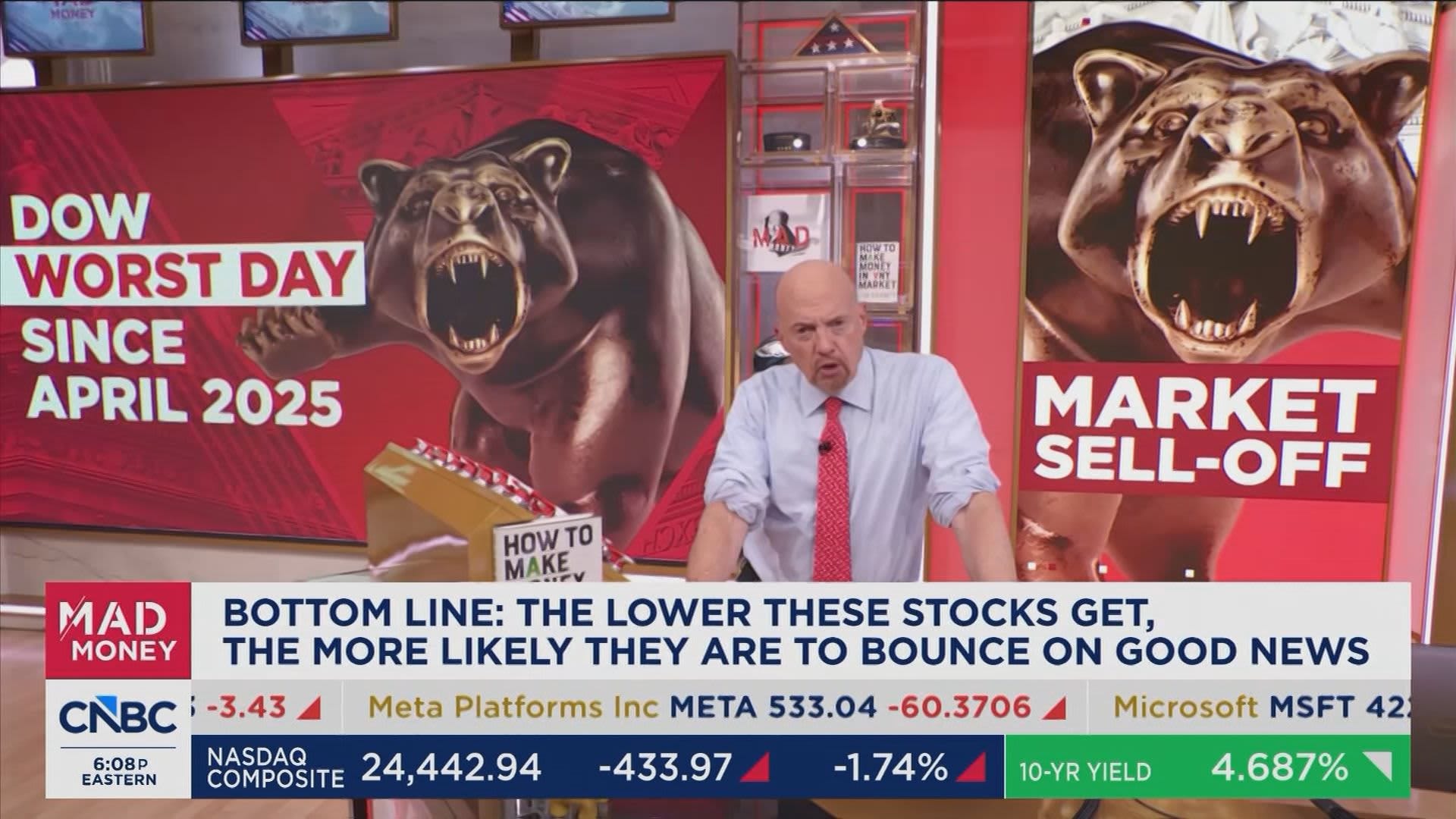
It’s a total non-sequitur. Most people know the basics of the “overshooting the mark on the buildout” thesis. I highlighted both Michael Burry and Jim Chanos’ excellent thoughts on this. Railroads changed America and destroyed fortunes. Fiber optic cable became the backbone of the internet after helping bankrupt the companies that laid too much of it. The internet itself exceeded almost every grand prediction made about its importance in 1999, while the Nasdaq still managed to fall roughly 80 percent.
So someone inform the next brilliant Series 63 holder on CNBC that transformative technology and catastrophic overinvestment have always been perfectly capable of occupying the same room.
That is increasingly the right framework for understanding AI right now. The technology is extraordinary, but the capital cycle built around it has gone much further than the economics can support, in my opinion. Investors have taken perhaps the most consequential technological development since the internet and done what investors reliably do with consequential technological developments: extrapolated the eventual destination backward into today’s valuation, financed the intervening decade (or even more) in advance, and then congratulated themselves on the resulting growth.
In other words…we are no longer merely betting that AI becomes enormous. We are betting that it becomes enormous quickly enough to justify an infrastructure buildout measured in trillions of dollars, while maintaining attractive returns on capital despite rapidly falling inference costs, intense competition and technological obsolescence that can make expensive hardware look old remarkably quickly.
The timing could hardly be worse. The AI capital boom is reaching its most aggressive phase after years of positive real interest rates have worked their way through the rest of the economy, as I have consistently written about.
Not only that, but bonds both in the U.S. and Japan are screaming that risk is underpriced. Bond yields are scorching higher on both sides of the Pacific. In the last 24 hours, Japan’s 10-year JGB touched 2.93%, its highest since 1996, while the U.S. 30-year Treasury recently hit 5.27%, a level not seen since 2007.
The simultaneous surge in long-term borrowing costs is striking given Japan’s weak growth backdrop, underscoring how inflation, currencies and fiscal concerns are increasingly driving global bond markets.
Monetary tightening and higher yields do not hit everything at once. Households spend savings before they miss payments, companies refinance gradually, commercial property owners extend loans before recognizing losses, and private equity firms possess the wonderfully convenient ability to discover that assets without daily market prices are much less volatile than assets with them.
The damage accumulates quietly…before appearing suddenly.
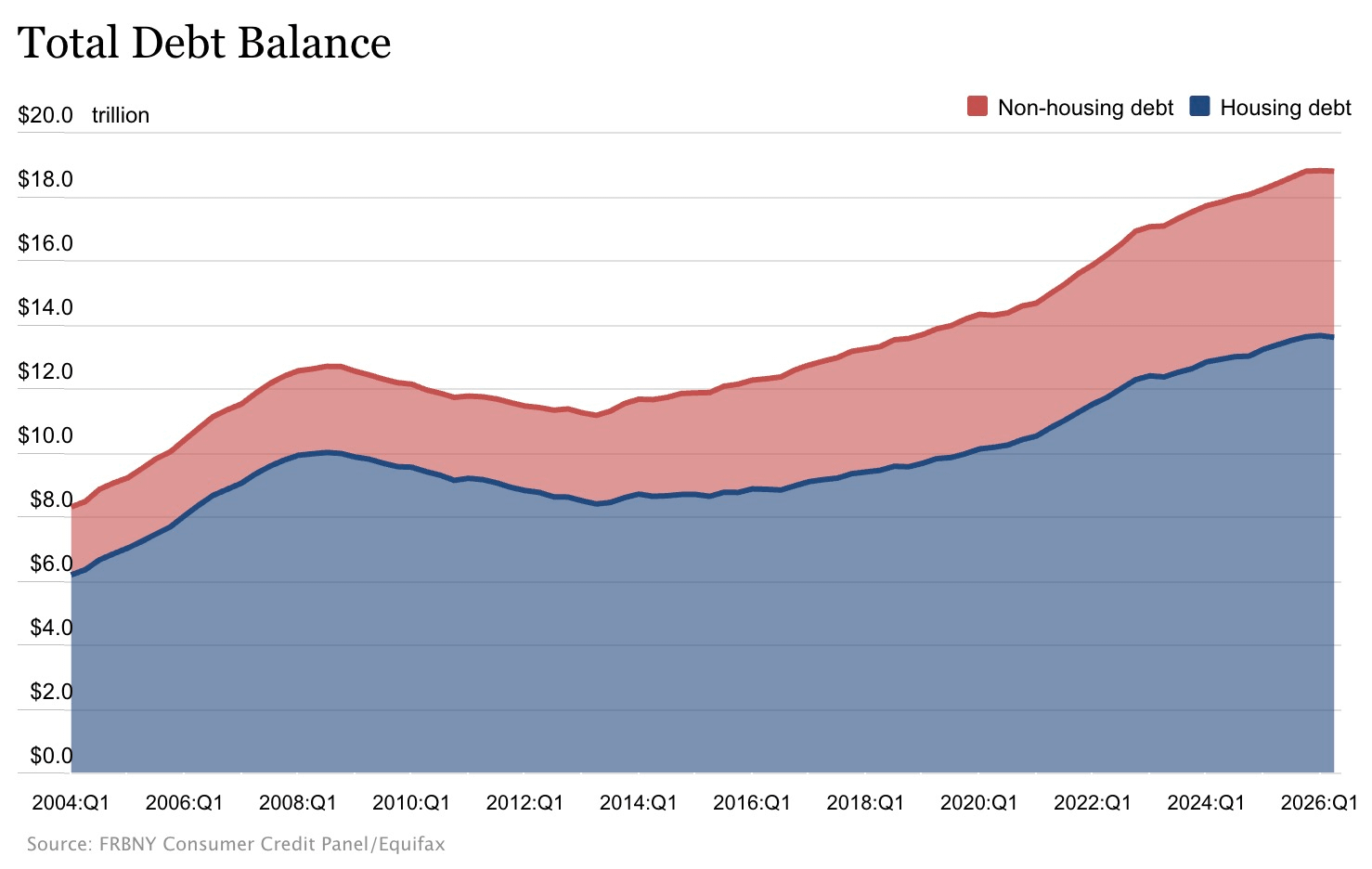
American households are now carrying roughly $18.8 trillion of debt as of the end of June 2026, up about $400 billion, or 2.2%, from $18.39 trillion a year earlier and at or near an all-time high.
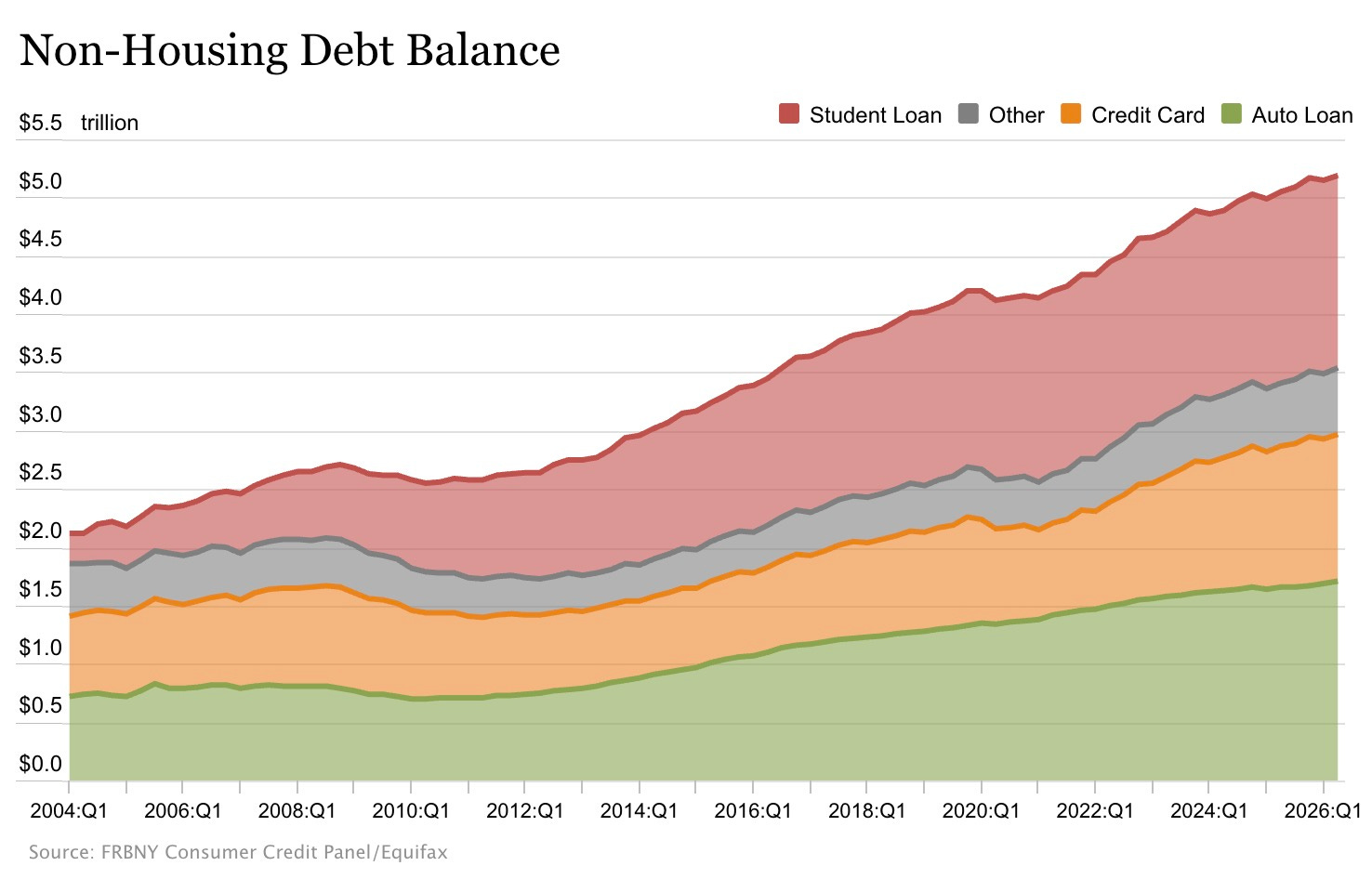
Credit card balances stood at $1.26 trillion as of the end of June 2026, up roughly $50 billion, or 4%, year over year and near record highs, while auto loan balances reached roughly $1.71 trillion as of the end of June 2026, up about $55 billion, or 3%, from a year earlier and at an all-time high.
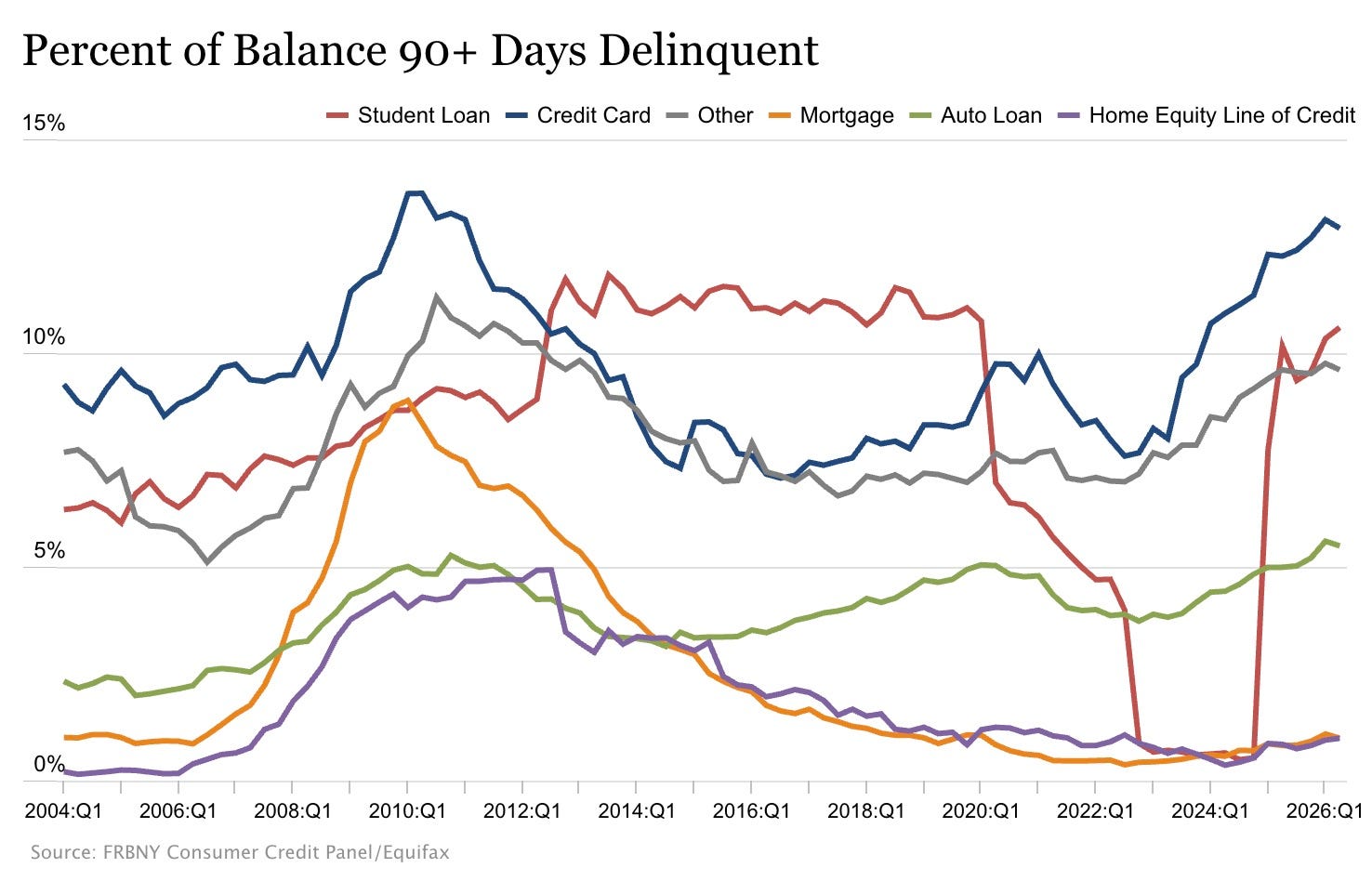
Delinquencies remain elevated. As of Q2 2026, 4.7% of all outstanding household debt was in some stage of delinquency. More importantly, credit-card and auto-loan serious delinquency rates remain elevated relative to their pre-pandemic norms.
None of this means the consumer has already collapsed, but households have nevertheless spent several years absorbing substantially higher financing costs while carrying record or near-record nominal debt loads. At the same time, rising stocks, home values and retirement accounts have helped support household balance sheets and consumption. That combination becomes considerably less comfortable if expensive credit persists while asset prices begin falling.
And as I’ve constantly reminded…the bigger the bubble, the more leverage people take on, the smaller the move has to be in the markets for everyone’s “cushion” (i.e. illusion of wealth) to simply go “POOF” into thin air.
Like I’ve reminded constantly, behind the consumer sits an even larger collection of assets whose prices have not really been tested. God only knows what is going on over the crypto/stablecoin world (my latest thoughts on that opacity here). Meanwhile, private equity marks are not necessarily fraudulent, nor is every commercial property secretly worthless, but neither market has experienced the sort of continuous clearing mechanism imposed on public equities.
A private company can remain valued at the price of its last financing round long after comparable public companies have fallen. A commercial building can remain marked to an appraisal until refinancing or a forced sale introduces the owner to someone willing to write an actual check. Private credit can appear remarkably stable when lenders amend, extend and avoid crystallizing losses. There is nothing mysterious about this. In fact we’re watching sociopaths literally repeat 2008 history while trying to figure out a way to move dogshit private credit assets that currently have near zero liquidity for a damn good reason. Assets without frequent transactions naturally adjust more slowly. The problem comes when investors mistake slow (or no) price discovery for economic stability.
This is why the experience of Michael Burry before the financial crisis is more relevant than the caricature of it. Burry did not discover the housing problem in October 2008 and short it the week before Lehman collapsed. He spent an extended period watching the underlying mortgage data deteriorate while the securities supposedly representing those mortgages refused to reflect reality.

His investors became furious, counterparties continued marking instruments at prices he believed were absurd, and for a meaningful period the market’s verdict was that Burry was wrong. Eventually prices caught up and Burry was proven right. That does not make Burry automatically correct about AI today, but it should permanently retire the argument that a bearish thesis is disproven because the market has continued rising for another 6 or 12 months.
The more troubling feature of the present boom is that AI has developed a financing structure in which the success of one participant increasingly helps finance the success of another. AI companies raise capital at enormous valuations and use that capital to buy compute. Compute purchases become revenue for semiconductor companies and commitments for data center operators. Those revenues and commitments support higher valuations, which make financing easier, which provides more capital to customers, which produces more orders, which supports still higher valuations.
Hyperscalers sign enormous long term capacity agreements because they expect AI demand to compound, infrastructure companies finance construction against those commitments, and investors treat the resulting construction boom as further evidence that AI demand must be enormous.
Think of a group of people sitting around a poker table using the same stack of chips to prove that everyone at the table is rich. As long as the chips keep circulating, everyone looks wealthy and every transaction seems to prove the chips are valuable. Nobody needs to be lying or doing anything irrational. The same money just keeps moving around the table and supporting higher bets. Everyone wants these chips, and there’s plenty to go around.
But eventually the rake takes some chips, a couple big players walk away and the money stops circulating. Suddenly everyone realizes there were never as many chips at the table as they thought. Those left without chips who were hoping to “win” their chips back are shit out of luck, as my mother would say.
This is where companies such as Nvidia become more complicated than a simple discussion of earnings multiples.
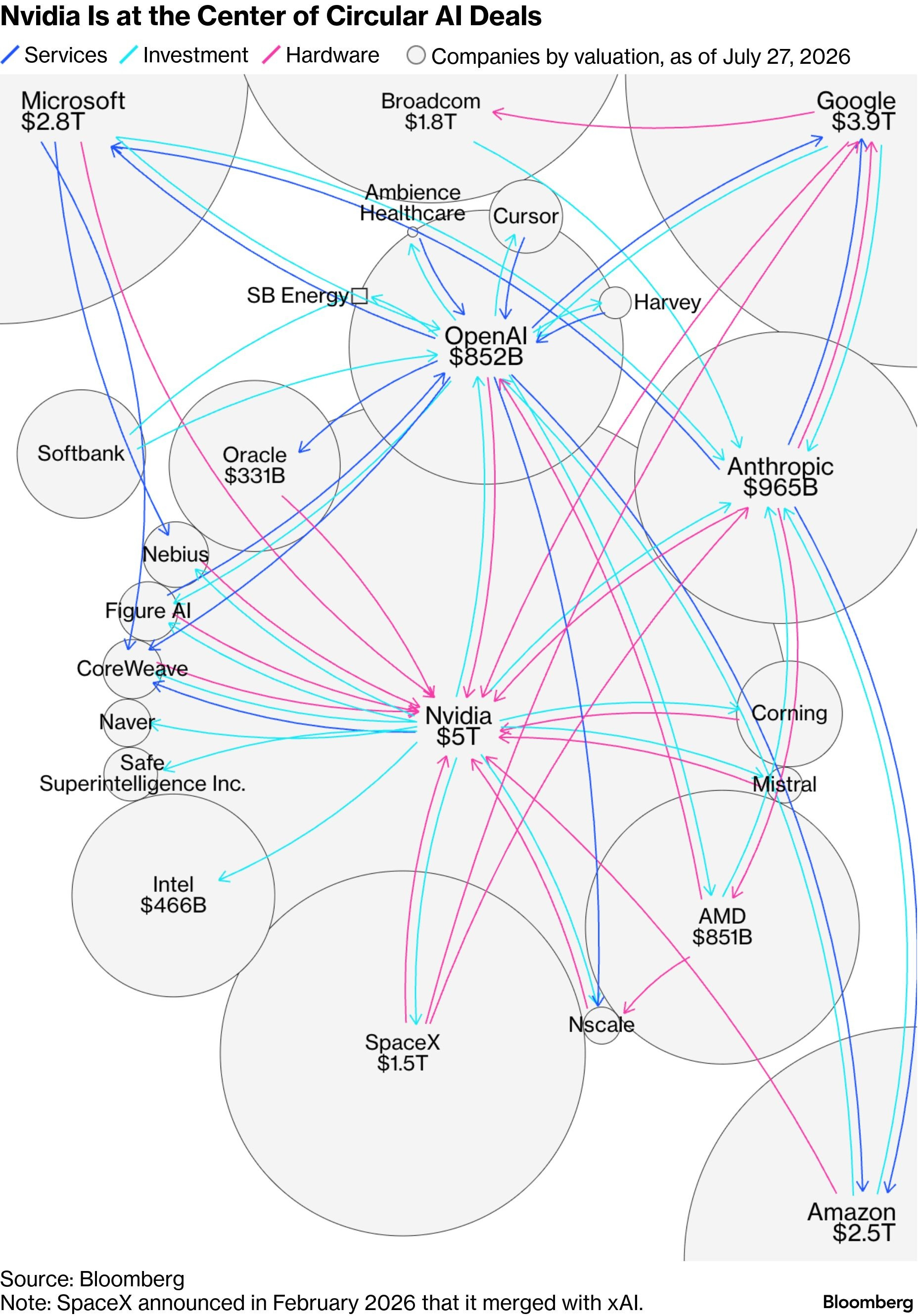
Nvidia may be the most important cog in AI’s circular financing machine because it increasingly sits on both sides of the transaction. It intends to invest up to $100 billion in OpenAI as OpenAI builds at least 10 gigawatts of Nvidia-powered infrastructure; it invested $2 billion in CoreWeave, one of its major GPU customers, while also agreeing to buy up to $6.3 billion of CoreWeave capacity that goes unsold.
And Nvidia is now working with Apollo, BlackRock, Blackstone, Brookfield, Goldman Sachs and KKR on platforms targeting more than $500 billion of AI-infrastructure financing, with Nvidia retaining the option to backstop up to $125 billion, according to Reuters.
The circularity is simple: Nvidia helps finance the companies buying Nvidia-powered compute, those purchases become Nvidia revenue, and that revenue gives Nvidia more firepower to finance the next round. Nothing about that is inherently improper, but it makes Nvidia not just AI’s dominant chip supplier, but one of the financial engines keeping the entire boom moving. If Nvidia were to…say…ever miss earnings, it’s not hyperbolic to say it could put a dent in the entire global economy overnight. US markets would get hit, as would overseas markets. Sentiment across millions of trading desks would change instantly.
That reflexivity works wonderfully on the way up and becomes vicious on the way down. If AI customers disappoint, their valuations fall and their cost of capital rises. If their cost of capital rises, they buy less compute. If compute purchases slow, expected semiconductor earnings decline at exactly the moment investors are compressing the multiple they are willing to pay for those earnings. Falling semiconductor valuations weaken confidence throughout the ecosystem, financing terms tighten for data center developers, weaker developers cut orders, lenders become more selective, private capital marks fall and suddenly the demand forecasts that justified the original infrastructure buildout are being revised because the financing that created part of that demand has disappeared.
The size of the commitments makes this especially dangerous. Goldman Sachs has predicted that hyperscaler AI capex could reach as much as $1.4 trillion in 2027, while Morgan Stanley estimates the same companies and Nvidia already have roughly $1.8 trillion of off balance sheet commitments, including about $982 billion in purchase obligations and $822 billion in leases that have not yet commenced, creating a massive pool of future cash obligations that could become a serious problem if AI revenues fail to materialize fast enough.
Not all of this is debt in the accounting sense, and calling every dollar of it hidden borrowing would be sloppy. Economically, however, these are claims on future cash flows, and the distinction between a contractual commitment, a lease obligation and funded debt becomes rather less comforting when the revenues expected to service all three are being revised downward.
During the boom, investors look at these obligations and see visibility. A ten year data center commitment proves future demand, a massive equipment order demonstrates confidence, and a long term lease signals strategic necessity. During a bust, precisely the same spreadsheet receives different labels. Visibility becomes rigidity, commitments become liabilities, capacity becomes overcapacity and strategic investment becomes sunk cost. Nothing about the underlying contract needs to change. Only the denominator in the expected return calculation does.

The larger danger is that an AI correction would not occur inside a sealed technology sector. The financial system is currently carrying trillions of dollars of assets whose apparent values depend to some degree on abundant liquidity and the absence of forced selling.
Private equity portfolios contain companies marked from financing rounds and valuation models rather than continuous transactions. Commercial real estate still contains properties financed under a radically different interest rate regime. Venture portfolios contain companies whose most recent marks assume future exits into receptive public markets. Crypto contains enormous quantities of nominal wealth that can disappear without anybody technically defaulting on anything. Public equities themselves embed assumptions about margins, growth and discount rates that have been extraordinarily generous to the winners of the AI trade.
The first meaningful break in AI could therefore trigger something much larger than a semiconductor selloff. A meaningful decline in the AI complex would reduce household and institutional wealth, create margin pressure and force investors to raise cash. The assets they can sell first are public equities, so those fall further while private marks initially remain unchanged. Institutions then discover that their allocation to private markets has mechanically increased because the public side of the portfolio declined, forcing secondary sales and creating pressure on private valuations. Lenders tighten standards, credit spreads widen, refinancing becomes more difficult and commercial property owners approaching maturities discover that an appraisal produced during better conditions is not the same thing as a bid.
Crypto would probably contribute its traditional public service of discovering the clearing price at three in the morning on a Sunday. Tokens that appeared to represent hundreds of billions of dollars of wealth would reveal that market capitalization is calculated using the price of the marginal transaction, not the price at which every holder can exit simultaneously. Private equity would experience the same lesson more slowly and with better PowerPoint presentations. Commercial real estate would experience it when loans mature. Venture capital would experience it when the next financing round fails to arrive. Different markets would discover reality at different speeds, but the direction of travel would be the same.
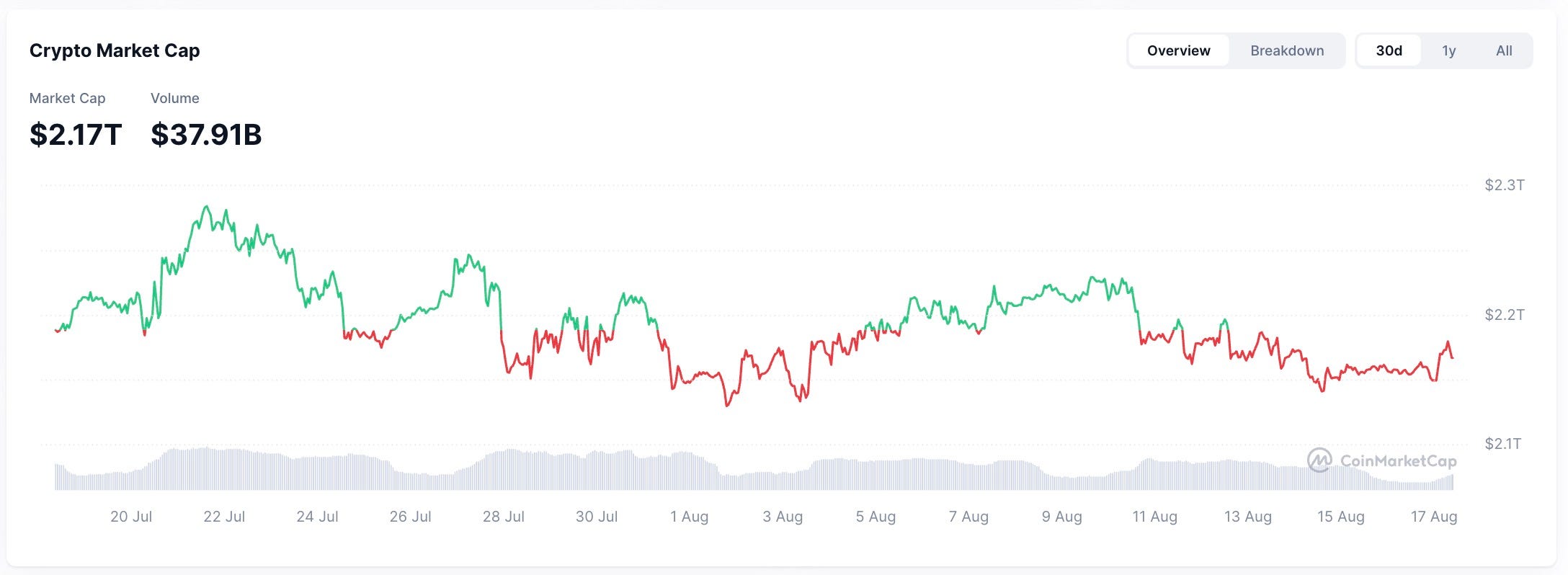
This is the part of a bubble that looks impossible until it becomes obvious. Before the break, investors can explain why every questionable valuation deserves special treatment. An office building is temporarily impaired. A private company is being held for the long term. A crypto network should be valued on future adoption. An AI company should be valued on the enormous total addressable market. A data center should be valued on contracted demand. After the break, people will explain with equal confidence that everyone knew these assets were worth a fraction of their marks. Financial history is full of risks that became common knowledge approximately forty eight hours after they became unavoidable.
The actual catalyst is almost impossible to predict and probably less important than people think. It could be a major AI laboratory missing revenue expectations, a hyperscaler cutting capital expenditure guidance, a data center developer restructuring, a private credit vehicle experiencing withdrawals, utilization rates disappointing, inference pricing falling faster than volumes rise or simply investors deciding that forty times earnings is too much to pay for something they were happy to buy at sixty times earnings.
In 2008, endless attention was devoted to identifying the institution or mortgage product that would finally break the system, but the decisive fact was that the system had accumulated enough leverage and bad assumptions that eventually something had to expose them. The catalyst was just…math and common sense. Imagine that…
The AI boom has similar characteristics because capital spending itself has become evidence supporting the investment thesis. Every new data center is presented as proof of future AI demand, even though the data center was financed because investors already believed in future AI demand. Every enormous chip order validates semiconductor forecasts, even though the purchaser could afford the order because capital markets assigned it a valuation based partly on expectations of AI growth.
Every financing round establishes a higher private valuation, which allows the company to raise more money, spend more on compute and generate more revenue for the infrastructure companies whose rising earnings help sustain enthusiasm for the sector. At some point the industry must graduate from capital circulating through the ecosystem to enormous quantities of cash arriving from customers outside it.
Not unlike how SpaceX just took an insane private valuation and converted it to a publicly held air pocket, that transition is the entire game. If AI generates enough incremental corporate profit, consumer willingness to pay and productivity growth quickly enough, the infrastructure can earn its return and today’s valuations may eventually look reasonable. If it does not, the market has financed years of demand before the demand actually exists. The technology can continue improving throughout the resulting crash. People can use more AI every month while AI securities collapse, just as internet traffic exploded while telecom companies went bankrupt after the dot com bubble.
And look. The Federal Reserve would eventually respond to a serious deleveraging because that is what the modern Fed does whenever politicians, the public and investors piss themselves. Rates would be slashed, liquidity facilities would materialize out of thin air and, if markets kept falling, the same institution that spends all this time lecturing about financial stability would quickly show the public its real mandate: making sure nobody important ever has to take a loss in the stock market. Exhibit A:
But even the Fed’s increasingly predictable cowardice cannot stop the initial liquidation. Monetary policy works with lags; margin calls, redemptions and maturities do not. An investor who needs cash on Tuesday doesn’t give a shit that the Fed might panic and cut rates three times by December.
Nor can lower rates instantly repair bad capital allocation. The Fed can reduce financing costs, but it cannot make an unnecessary data center necessary. It can support liquidity, but it cannot restore a private company’s previous valuation if the next buyer will pay half as much. It can make refinancing easier, but it cannot transform an office building purchased at a tiny cap rate into a wonderful investment after rents and occupancy disappoint. Most importantly, it cannot prevent investors from simultaneously deciding that the risk premiums they demanded yesterday were absurdly small.
This is why the initial move could be far sharper than conventional recession analysis suggests. Markets do not need GDP to collapse before they deleverage. They need expectations to change, collateral values to fall and lenders to become less willing to refinance yesterday’s assumptions. Once that begins, selling creates lower prices, lower prices create tighter financing conditions, tighter financing creates more selling and the system moves from reflexivity on the way up to reflexivity on the way down. And that makes traders make faces like they are passing kidney stones the size of Steve Liesman’s head:

None of this requires believing that artificial intelligence is a fraud. Quite the opposite. The strongest version of the bearish argument begins by assuming that AI is one of the most important technologies of the century. The internet was real, fiber was necessary and e commerce eventually conquered retail. That did not prevent investors from building too much fiber, funding too many internet companies and paying prices that required decades of future success to arrive almost immediately.
AI can transform medicine, programming, finance, education, manufacturing and knowledge work while today’s AI investment boom still proves to have been a historic misallocation of capital. The servers will remain, the models will improve, compute will become cheaper, usage will rise and some of the companies will become vastly larger than they are today. The awkward question is who owns the infrastructure and equity after the capital structures have been reorganized.
That is the distinction markets have increasingly forgotten. Technological importance does not guarantee investment returns, and enormous future demand does not justify any price paid to supply it. We have taken a genuine technological revolution, attached trillions of dollars of capital commitments to it, connected those commitments through an increasingly reflexive financing ecosystem and placed the entire structure on top of an economy already digesting years of restrictive real rates and questionable private asset marks.
So, to review, why I think the AI crash could start this year and early next year:
AI spending may be outrunning actual AI profits. Trillions are being committed to infrastructure before end-user demand has proven it can generate adequate returns.
The boom has become increasingly circular and reflexive. High valuations fund AI spending, which creates revenues that support still higher valuations and more spending.
The obligations are becoming enormous just as expectations peak. Massive chip orders, leases and data-center commitments could quickly turn from “visibility” into liabilities if demand disappoints.
The rest of the financial system is already vulnerable. High rates, consumer debt and questionable private-market and real-estate marks could amplify an AI-driven selloff.
It may only take one catalyst to change the narrative. A capex cut, earnings miss, credit event or simple multiple compression could flip the AI feedback loop from expansion into deleveraging.
The eventual irony may be that the AI bulls are completely right about the technology and spectacularly wrong about the trade. Artificial intelligence may change almost everything over the next twenty years. It simply does not follow that the infrastructure ordered today, the private valuations struck yesterday and the public market capitalizations celebrated this morning will survive the journey intact.
When that distinction finally matters, the market will probably discover it very quickly, and shortly thereafter everyone will remember that it had been obvious all along. Or, as I have been many times in the past, the market will prove me to be wrong. But no one will ever be able to say I didn’t make my best effort to call out the timing on this issue…
“That’s how you become great man. Hang your balls out there.” — Jerry Maguire


QTR’s Disclaimer: Please read my full legal disclaimer on my About page here. This post represents my opinions only. In addition, please understand I am an idiot and often get things wrong and lose money. I may own or transact in any names mentioned in this piece at any time without warning. Contributor posts and aggregated posts have been hand selected by me, have not been fact checked and are the opinions of their authors. They are either submitted to QTR by their author, reprinted under a Creative Commons license with my best effort to uphold what the license asks, or with the permission of the author. I cannot guarantee the accuracy of all facts and figures included in this article though I made my best effort to get them right. I have been wrong before and will be wrong again, and encourage you to always double check, do your own research and speak to a licensed financial professional.
This is not a recommendation to buy or sell any stocks or securities, just my opinions. I often lose money on positions I trade/invest in. I may add any name mentioned in this article and sell any name mentioned in this piece at any time, without further warning. None of this is a solicitation to buy or sell securities. I may or may not own names I write about and are watching. Sometimes I’m bullish without owning things, sometimes I’m bearish and do own things. Just assume my positions could be exactly the opposite of what you think they are just in case. If I’m long I could quickly be short and vice versa. I won’t update my positions.
As of May 20, 2026 I am attempting to no longer actively trade as much as I once did (read my story here). My eventual goal is for investing/saving to be mostly done by recurring contributions mostly to sector ETFs and a few select equities, trusted third parties who oversee my accounts, and advisors. Such advisors or funds, through individual equities, options, index funds, mutual funds, ETFs, or other securities, may have positions in, exposure to, or holdings of names mentioned herein that I know nothing about. Basically, via index funds, ETFs and individual equities it is possible I could own, have exposure to, or not own anything at any point. As of the same date, May 20, 2026, in an attempt to lead a healthier lifestyle, I’ve also excluded myself from fantasy sports, sports betting, online and in-person casinos and prediction markets.
And all positions can change immediately as soon as I publish this, with or without notice and at any point I can be long, short or neutral on any position. You are on your own. Do not make decisions based on my blog. I exist on the fringe. If you see numbers and calculations of any sort, assume they are wrong and double check them. I failed Algebra in 8th grade and topped off my high school math accolades by getting a D- in remedial Calculus my senior year, before becoming an English major in college so I could bullshit my way through things easier.
The publisher does not guarantee the accuracy or completeness of the information provided in this page. These are not the opinions of any of my employers, partners, or associates. I did my best to be honest about my disclosures but can’t guarantee I am right; I write these posts after a couple beers sometimes. I edit after my posts are published because I’m impatient and lazy, so if you see a typo, check back in a half hour. Also, I just straight up get shit wrong a lot. I mention it twice because it’s that important.
Comments
Nothing yet. Say the first thing.
Sign in to join the conversation.