
Well, that didn’t take long.
Less than 24 hours after I wrote that soaring bond yields in the United States and Japan were one of the major reasons I thought the AI bubble could finally begin breaking later this year and into 2027, global markets woke up Tuesday morning and decided to provide a helpful visual aid.
Japan got smoked, U.S. futures moved lower, bonds sold off across the developed world, oil pushed higher, and the 30 year U.S. Treasury yield punched above 5.3%, reaching its highest level since 2007.
The Nikkei fell roughly 2.5% Tuesday as investors dumped risk assets, while Japan’s benchmark 10 year government bond yield briefly touched 2.945%, its highest level since 1996. The selloff extended further out the Japanese curve as well, with the 30 year JGB yield reaching roughly 4.1%, it’s highest level in history.
Remember, this is Japan. The country that spent decades synonymous with zero interest rates, quantitative easing and essentially free money now has a 10 year government borrowing cost approaching 3%. This is the monetary policy equivalent of a hospice home community all waking up one morning and deciding to do CrossFit, then waiting to see how their bodies respond. The answer? It’s going to be ugly.
Across the Pacific, the same thing is happening in the world’s most important bond market. The U.S. 30 year Treasury yield reached roughly 5.32%, its highest level since June 2007. The 10 year was around 4.73%, while U.S. equity futures pointed lower Tuesday morning as investors digested the global bond selloff.
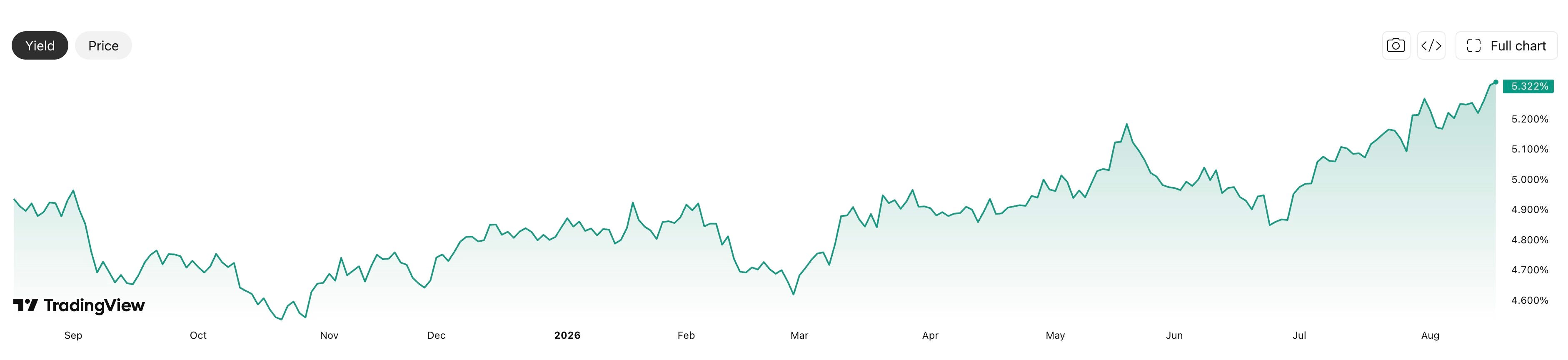
As CNBC pointed out this morning, recent U.S. retail sales and labor market data have been cooling, exactly the sort of information that would normally provide some relief to bonds. Instead, long yields are going the other direction, and that is what should scare the shit out of people.
When yields rise because the economy is booming, markets can at least tell themselves a pleasant story. Earnings will rise, consumers are healthy, growth will bail everybody out and, presumably, Nvidia will eventually manufacture enough GPUs to find a cure to male pattern baldness. When long term yields rise while growth data are weakening, the story becomes much less pleasant because now you’re potentially talking about inflation, fiscal credibility, sovereign supply, foreign demand and the term premium investors require simply to lend governments money for 20 or 30 years.
Right on cue, foreign holdings of Treasuries declined in June, with Japan, China and the United Kingdom all reducing their holdings, according to Treasury data cited by the above linked report. Meanwhile oil is throwing gasoline, literally, onto the problem, creating precisely the combination bond investors don’t want to see: softer growth accompanied by persistent inflation pressure.
This is why the move might not be merely a Treasury story. It could be a global duration revolt. Japanese yields are hitting multi decade highs, American long bonds are hitting multi decade highs, European borrowing costs are moving higher and stocks are beginning to notice. The bond market appears to be telling governments around the world that the price of capital they became accustomed to is no longer available. And that’s a problem fancy blue spectacles may not be able to fix right away.
Yesterday, I wrote that I believed the AI bubble could finally begin breaking toward the end of this year and into early 2027. I listed five reasons, but one of the most important wasn’t really about AI at all. It was about the price of money.
I wrote that bonds in both the U.S. and Japan were screaming that risk is underpriced. At the time, Japan’s 10 year was around 2.93% and the U.S. 30 year was around 5.27%. Twenty four hours later, both moved higher.
That matters because the entire AI boom I described yesterday exists inside a financial system whose assumptions were built during a completely different interest rate regime. The problem isn’t simply that Nvidia or an AI laboratory might disappoint. The problem is that the AI capital cycle has reached its most aggressive phase at precisely the moment the global risk free rate is threatening to reset higher. Markets are living Franz Ferdinand's wrong turn.
As I wrote about yesterday, the AI boom has required staggering quantities of capital. Data centers need financing, power infrastructure needs financing, semiconductor fabrication needs financing, hyperscalers are committing enormous amounts of future cash flow, private AI companies need repeated capital raises, infrastructure vehicles need lenders and venture investors need exits. The valuation of all of those assets ultimately depends, directly or indirectly, on the discount rate sitting underneath them.
Yesterday I described an AI ecosystem in which high valuations help finance spending, spending becomes somebody else’s revenue, that revenue supports higher valuations and those higher valuations make still more financing possible. That’s reflexivity, but reflexivity does not exist independently of the cost of capital.
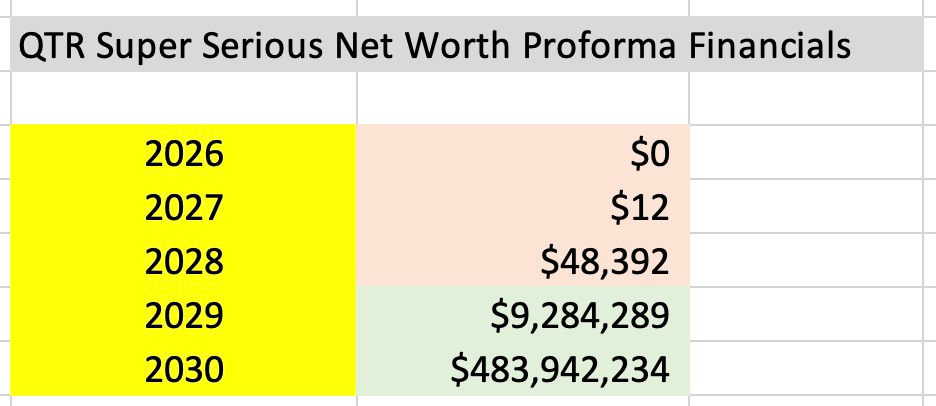
At 3%, an enormous amount of speculative investment can be made to look intelligent in Excel. At 5%, considerably less can. At 6%, the spreadsheet starts looking like it was prepared by someone who had been drinking heavily at an airport bar at 3AM (which admittedly has never prevented Wall Street from putting it in a pitch deck). Like these quick proformas of my net worth I just whipped up. Can’t wait for 2030 to come around, eh?
But back to rates. When the risk free rate moves higher quickly, investors don’t politely wait several years for the consequences to appear. They change the denominator. Every long duration asset is simply a claim on future cash flows, and the farther into the future those cash flows sit, the more sensitive their present value becomes to the rate used to discount them.
That means the same companies that benefited most from falling rates and abundant liquidity can become the most vulnerable when the process reverses. This is why the bond move we’re seeing now potentially matters far more to AI stocks than whatever the next chatbot benchmark says.
As I noted yesterday the market can believe at the same time that AI is revolutionary and still decide that paying today’s price for 2035’s cash flow is fucking insane. Those two ideas are not contradictory. In fact, as I argued yesterday, they’re probably going to wind up being the entire story.
The technology can work while the investment fails. Rising global yields are one of the cleanest mechanisms imaginable for forcing investors to finally recognize the difference.
This concern also didn’t begin yesterday. Back in May, I wrote a piece titled “The Bond Market Is About To Break Washington.” My argument then was that Washington could ignore almost everything else for surprisingly long periods of time. Politicians can ignore deficits, inflation, deteriorating private credit, commercial real estate, subprime auto delinquencies and God knows they can ignore geopolitical consequences when there’s a television camera nearby.
But there is one market Washington cannot ignore indefinitely: Treasuries.

I wrote at the time that the bond market does not give a shit about political narratives, gamma squeezes, meme stocks, retail investors or any other ticky tacky end around style loopholes that continue to push stocks higher. Bonds care about math, fiscal policy and monetary policy.
And that math hasn’t improved since May. If anything, the bond market appears increasingly interested in checking it, which is generally bad news for governments whose preferred accounting method appears to be hoping nobody ever opens the spreadsheet.
The reason Treasury yields matter so much isn’t merely that the federal government has to pay more interest. Treasuries are the foundation underneath essentially the entire global financial system. The 10 year Treasury influences mortgage rates, corporate borrowing costs, commercial real estate capitalization rates, private equity hurdle rates, venture valuations and equity multiples. The long end tells investors what compensation they require for parting with capital for decades.
When that rate suddenly reprices, everything sitting on top of it has to reprice eventually too. Maybe not today and maybe not tomorrow, but the arithmetic doesn’t disappear because the Nasdaq hasn’t noticed yet.
This is the central mistake investors repeatedly make late in tightening cycles. They assume that because higher rates haven’t broken something yet, higher rates therefore aren’t going to break anything. It’s like concluding that cigarettes are harmless because you made it through your lunchtime smoke break today without developing emphysema immediately.
Monetary tightening doesn’t work like flipping a light switch. It works through refinancing schedules, maturities, credit decisions and eventually forced transactions.
A homeowner doesn’t refinance every morning. Neither does a corporation, a private equity portfolio company or an office building. Debt gets rolled gradually, and until it does, yesterday’s financing conditions can survive on today’s balance sheet like a financial fossil.
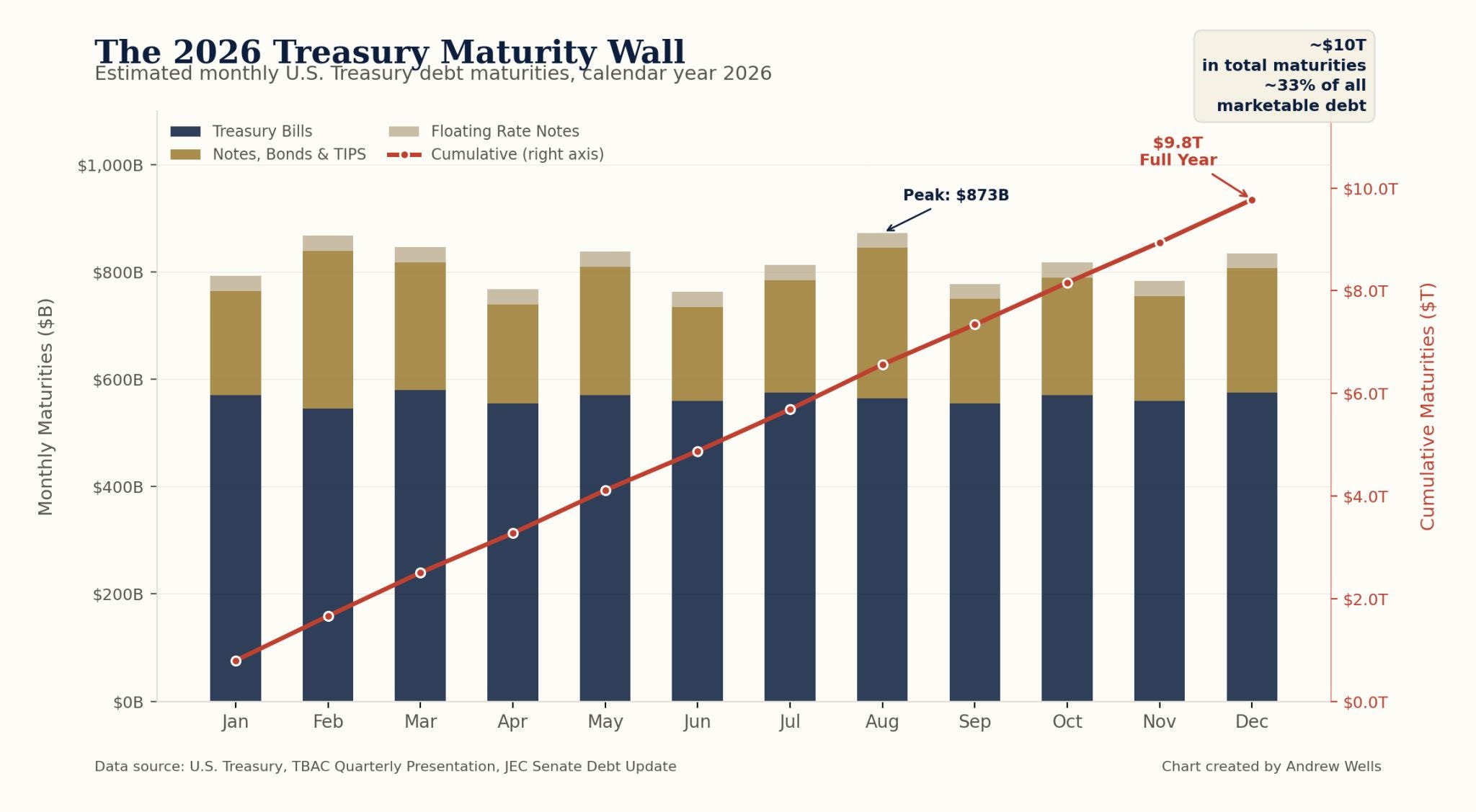
Then the “oh shit” moment. The maturity arrives. Suddenly a company that borrowed at 3% discovers its new cost of capital is 7%. A commercial building valued using a 4% cap rate discovers buyers now demand 7%. A leveraged acquisition underwritten on cheap refinancing discovers the refinancing doesn’t exist. A data center project built around heroic assumptions for AI utilization discovers lenders suddenly want substantially more compensation.
Nothing magical happened that morning. Reality simply reached the maturity date. That was the point of my May piece, and it remains the point today. The damage accumulates quietly before appearing suddenly. And reality eventually reaches its maturity date, both in treasuries and all other debt obligations.
The Japanese part of this equation may be the most underappreciated. For decades, Japan served as one of the world’s great reservoirs of cheap capital. Japanese institutions lived in a world of microscopic domestic yields, encouraging enormous amounts of capital to seek returns overseas.
That matters because global financial markets are interconnected through relative returns. If a Japanese investor can earn almost nothing at home, buying Treasuries, foreign credit or overseas equities becomes substantially more attractive. But what happens when Japanese government bonds suddenly offer meaningful yields again? What happens when currency hedging costs are included? What happens when the world’s largest pool of chronically yield starved capital is no longer quite so yield starved? I explained the yen carry trade with George Gammon back in 2024 here if you need a primer on how it works:
But this is why the surge in JGB yields matters beyond Tokyo. Capital has alternatives again, and once capital has alternatives, every asset competing for that capital has to offer a better return. That includes Treasuries, corporate debt, private credit and ultimately stocks.
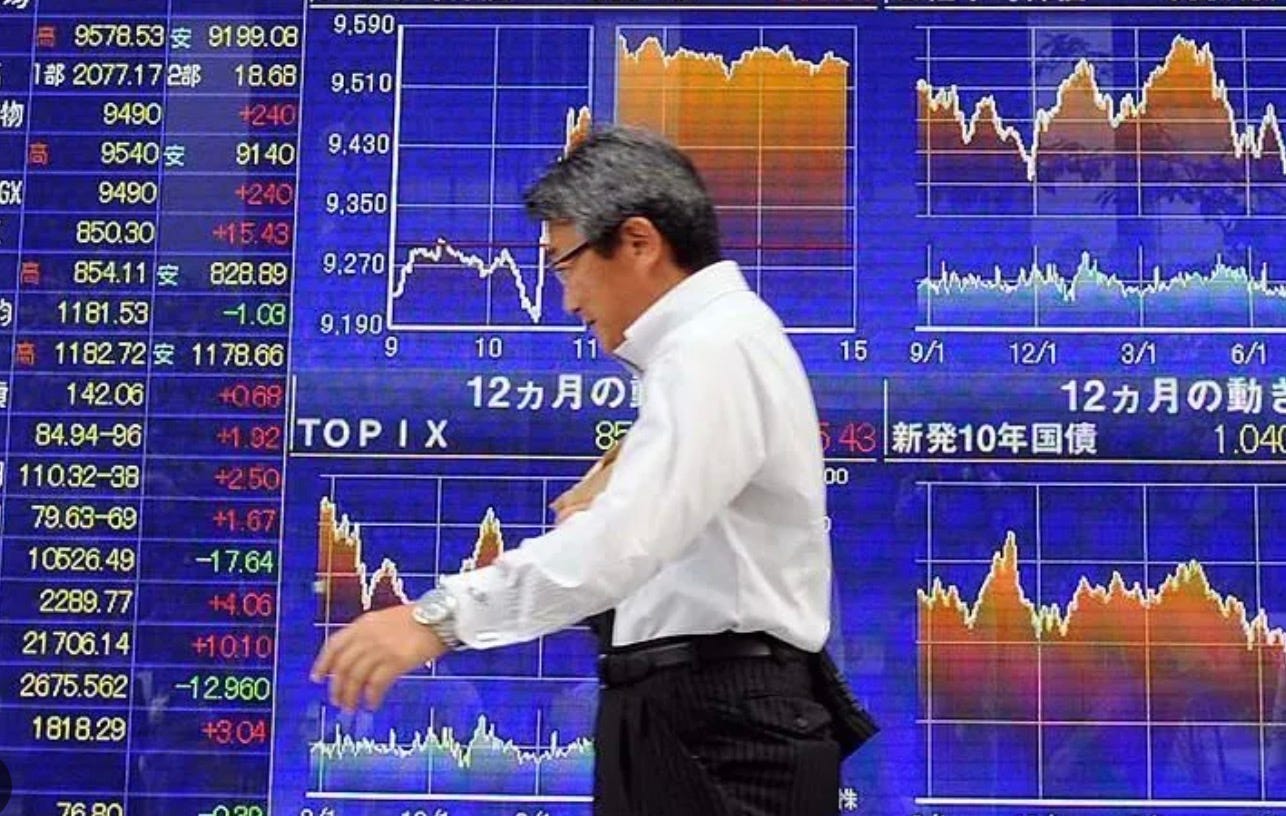
If yields across major developed markets keep climbing, investors may demand still more compensation to hold U.S. government debt. This is how a local bond problem becomes a global repricing, and this is how a global repricing eventually becomes an equity problem and an AI bubble pop.
For the last several years, risk markets have been priced around an extraordinarily convenient collection of assumptions. AI growth remains enormous, corporate earnings remain strong, the consumer bends but doesn’t break, inflation gradually disappears, the Fed eventually becomes easier, long term rates remain contained, the government can issue enormous quantities of debt without meaningfully disturbing markets, oil doesn’t create another inflation shock, Japan normalizes monetary policy without disrupting global capital flows and equity valuations can remain historically rich because, well, artificial intelligence is real.
It is a wonderful little menu of assumptions. The only slight inconvenience is that current asset prices increasingly require most of them to be true at the same time.
But the higher yields go, the smaller that margin for error becomes. At some point bonds stop merely being another flashing warning signal and start becoming the mechanism through which the rest of the system adjusts. Mortgage rates rise, corporate spreads widen, refinancing becomes harder, private equity returns get squeezed, real estate values fall, government interest expense climbs, equity multiples compress and leveraged investors reduce risk.
Suddenly assets that looked completely unrelated discover they were all dependent on the same thing people like Peter Schiff has been screaming for decades is making the problem worse, not better: cheap capital.
That’s why today’s move matters. I’m not arguing that one ugly session in Japan means the global financial system collapses tomorrow morning. Markets bounce, yields reverse, central bankers talk, politicians announce things, strategists discover new reasons why every dip is healthy and traders BTFD one more time.
But look at the direction of travel in bonds. People talk about the bond market as though it’s some mystical forecasting device. Sometimes it is, but bonds don’t merely predict financial conditions. They create them.
I’ve spent much of the last several years arguing that the modern financial system has become exceptionally good at postponing price discovery. Private assets don’t trade every day. Commercial real estate can rely on appraisals. Private credit can amend and extend. Venture companies can avoid financing rounds. Governments can issue more debt and central banks can provide liquidity. Wall Street has developed approximately 7,000 sophisticated ways of avoiding the unpleasant experience of admitting something is worth less than it used to be.
But none of those things abolish arithmetic. They postpone the meeting with it. If the world’s two most important developed bond markets are now simultaneously telling investors that long term capital deserves substantially greater compensation, that meeting may be getting closer.
If the bond selloff continues, we may eventually get the sequence I have been warning about for years: speculative assets crack, leverage accelerates the selling, broader financial assets come under pressure, retirement portfolios begin feeling it, policymakers panic and the Federal Reserve ultimately steps into the Treasury market to suppress yields and restore liquidity…a massively inflationary move that could eventually send gold well through all time highs and closer to $10,000 than $5,000 over time, in my opinion.
At which point everyone on CNBC will explain that nobody could possibly have seen it coming. Have a great start to your Tuesday.

QTR’s Disclaimer: Please read my full legal disclaimer on my About page here. This post represents my opinions only. In addition, please understand I am an idiot and often get things wrong and lose money. I may own or transact in any names mentioned in this piece at any time without warning. Contributor posts and aggregated posts have been hand selected by me, have not been fact checked and are the opinions of their authors. They are either submitted to QTR by their author, reprinted under a Creative Commons license with my best effort to uphold what the license asks, or with the permission of the author. I cannot guarantee the accuracy of all facts and figures included in this article though I made my best effort to get them right. I have been wrong before and will be wrong again, and encourage you to always double check, do your own research and speak to a licensed financial professional.
This is not a recommendation to buy or sell any stocks or securities, just my opinions. I often lose money on positions I trade/invest in. I may add any name mentioned in this article and sell any name mentioned in this piece at any time, without further warning. None of this is a solicitation to buy or sell securities. I may or may not own names I write about and are watching. Sometimes I’m bullish without owning things, sometimes I’m bearish and do own things. Just assume my positions could be exactly the opposite of what you think they are just in case. If I’m long I could quickly be short and vice versa. I won’t update my positions.
As of May 20, 2026 I am attempting to no longer actively trade as much as I once did (read my story here). My eventual goal is for investing/saving to be mostly done by recurring contributions mostly to sector ETFs and a few select equities, trusted third parties who oversee my accounts, and advisors. Such advisors or funds, through individual equities, options, index funds, mutual funds, ETFs, or other securities, may have positions in, exposure to, or holdings of names mentioned herein that I know nothing about. Basically, via index funds, ETFs and individual equities it is possible I could own, have exposure to, or not own anything at any point. As of the same date, May 20, 2026, in an attempt to lead a healthier lifestyle, I’ve also excluded myself from fantasy sports, sports betting, online and in-person casinos and prediction markets.
And all positions can change immediately as soon as I publish this, with or without notice and at any point I can be long, short or neutral on any position. You are on your own. Do not make decisions based on my blog. I exist on the fringe. If you see numbers and calculations of any sort, assume they are wrong and double check them. I failed Algebra in 8th grade and topped off my high school math accolades by getting a D- in remedial Calculus my senior year, before becoming an English major in college so I could bullshit my way through things easier.
The publisher does not guarantee the accuracy or completeness of the information provided in this page. These are not the opinions of any of my employers, partners, or associates. I did my best to be honest about my disclosures but can’t guarantee I am right; I write these posts after a couple beers sometimes. I edit after my posts are published because I’m impatient and lazy, so if you see a typo, check back in a half hour. Also, I just straight up get shit wrong a lot. I mention it twice because it’s that important.
Comments
Nothing yet. Say the first thing.
Sign in to join the conversation.