
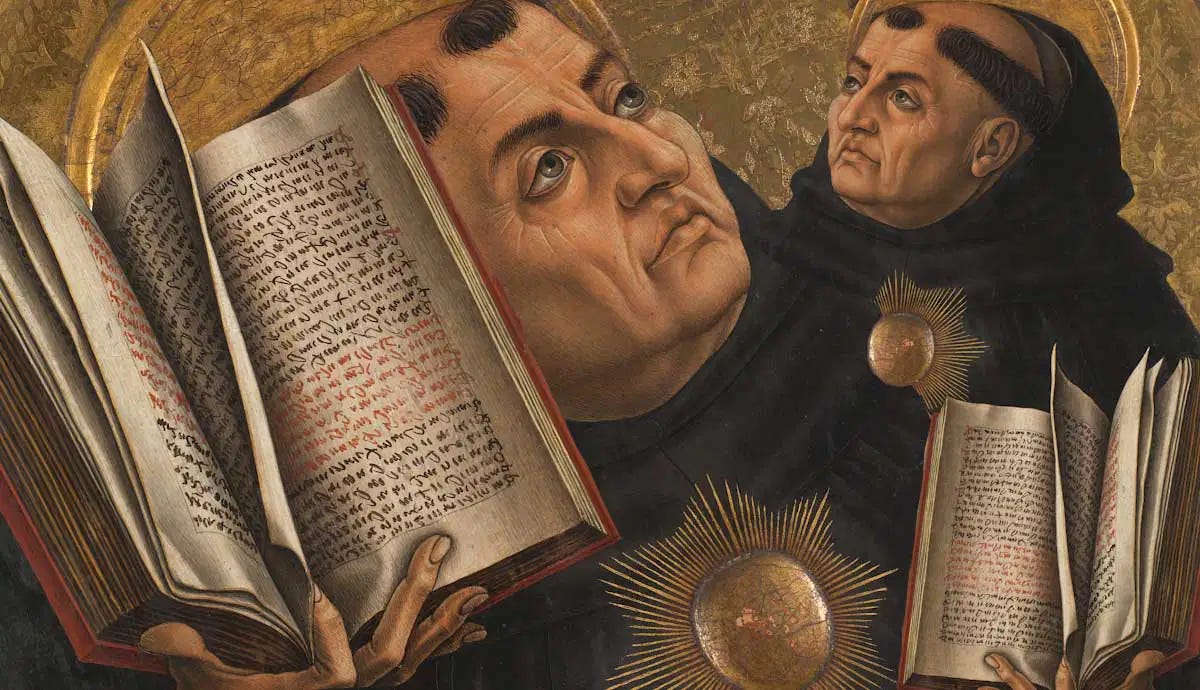
Ok, I’m going to shock more than a few of you today… I have been teaching a lot on Islam lately because of the rampant Islamaphobia and the misconceptions about what Muslims actually believe, but today I’m going to extol the Catholics and the immense amount of wisdom in Catholic moral teaching. I firmly believe that a return to this could save western civilization. Buckle up, here we go!
If you are feeling a crushing sense of modern economic whiplash—working harder than ever while watching housing prices soar, tech monopolies swallow the internet, and politicians insist the only solution is either more unbridled capitalism or total state control—you are not alone.
But your frustration isn't new. In fact, whether you happen to be Catholic or not, if you are living in a modern Western country, your entire framework for questioning these systems has been shaped more deeply than you could possibly understand by Catholic moral theology and philosophy. Long before modern political parties, secular constitutions, or global economic theories were drafted, the foundational DNA of Western thought was shaped by thinkers who dared to ask a radical question: What is an economy actually for?
Modern political discourse loves a clean binary. You are either a champion of unfettered free markets where capital reigns supreme, or an advocate for centralized state control where the collective manages everything. Both extremes promise a utopia of efficiency or equality. Both deliver a nightmare of exploitation or stagnation.
If you look beneath the noise of modern partisanship, a profound intellectual tradition argues that the healthiest economic and political models have always been a deliberate, moral balancing act. Long before modern political parties existed, a succession of brilliant thinkers—beginning with the medieval theologian Thomas Aquinas, echoed by twentieth-century essayists, and codified by the Vatican—diagnosed the fatal flaw of ideological fundamentalism.
They understood a fundamental truth: when you take either capitalism or socialism to its absolute extreme, you crush the human person. Pure capitalism builds a gilded cage where the market owns you; pure socialism builds an administrative cage where the state owns you. The "Third Way" isn't a weak compromise—it's an open door back to human-scale independence, where property serves the family rather than the family serving property.
Before we look at how Thomas Aquinas built his framework, it is vital to acknowledge a profound historical reality: Islam is not merely compatible with Western civilization; Islamic philosophers and their writings actively helped to shape it.
When the works of Aristotle were largely lost or forgotten in medieval Europe during centuries of intellectual stagnation, scholars in centers of learning like Córdoba, Cairo, and Baghdad spent centuries translating, preserving, commenting on, and radically expanding upon them.
Thomas Aquinas did not build his monumental philosophy in a vacuum. He stood squarely on the shoulders of towering Muslim philosophers like Ibn Sina (Avicenna) and Ibn Rushd (Averroes), studying them not as outsiders, but as the premier intellectual masters of their field.
Avicenna provided the foundational metaphysical distinction between essence and existence, which Aquinas adopted wholesale as the bedrock of his worldview.
Averroes championed the fierce harmony between reason and revelation, establishing the intellectual precedent that logic and faith are dual paths to the same truth—a principle Aquinas utilized to construct the rigorous rational framework of the Summa Theologiae.
When we trace the lineage of Western moral and political thought, we are looking at a brilliant cross-civilizational dialogue where the preservation and advancement of knowledge by the Islamic world directly laid the groundwork for European scholasticism.
Building on this rich synthesis of reason, faith, and cross-civilizational philosophy, Thomas Aquinas tackled the question of property and survival with astonishing nuance.
He defended private property as a practical necessity for human peace and order, arguing that people naturally care better for what is their own. But he added a massive moral catch: private property is not absolute.
Aquinas argued that the goods of the earth are ultimately meant to sustain all of humanity. Therefore, private wealth carries a "social mortgage."
If someone hoards massive surplus while neighbors starve, the hoarder is violating the moral order. In fact, Aquinas famously noted that a destitute person taking what is strictly necessary to survive from someone's abundance is not committing mortal theft, because natural law overrides human property laws in a crisis.
Aquinas separated his thought from both extremes: he rejected the total collectivization of property, but he completely dismantled the idea that an owner can do whatever they want with their wealth. For Aquinas, economic life is subordinate to human flourishing, virtue, and the common good.
Fast forward to the early twentieth century. The Industrial Revolution had fully matured, turning cities into smoke-choked factories where human beings were treated as disposable cogs.
Writers like G.K. Chesterton and Hilaire Belloc looked around at the wreckage of industrial capitalism and saw that it had committed the very sin Aquinas warned against. Instead of spreading property and independence, capitalism had concentrated wealth into the hands of a tiny corporate elite, reducing the vast majority of citizens to wage-slaves.
Rather than turning to Marxism—which they viewed as another authoritarian trap—they looked backward to medieval principles. They championed a framework known as Distributism: the idea that the means of production should be widely owned, monopolies should be broken up, and the dignity of the family and local community should override corporate profit. They argued that pure capitalism, left unchecked, devours its own people.
By 1891, the crisis had grown too loud for the Vatican to ignore. Pope Leo XIII stepped into the ring with his landmark encyclical, Rerum Novarum (On Capital and Labor).
Leo faced the exact same ideological crossfire we see today. On one side, savage, unregulated capitalism was crushing the working class. On the other side, revolutionary socialism was promising liberation by abolishing private property entirely.
Drawing directly on Thomistic philosophy, Leo charted a brilliant middle course:
Against Socialism: He forcefully defended the natural right to private property, warning that state control robs workers of the fruits of their labor.
Against Capitalism: He unleashed a fierce critique of the idea that the market is a moral vacuum, insisting that human beings cannot be treated as mere economic inputs.
The Living Wage and State Duty: He declared that a fair wage must support a family, and that the government has an active, positive duty to step in and protect the vulnerable when corporations exploit them.
Leo proved that you can fiercely defend private enterprise while drawing a hard moral line against what the market is allowed to do to human beings.
When we look at our current crises through this lens—such as modern tech monopolies or the housing market—the wisdom of these thinkers becomes starkly obvious.
Today, a handful of trillion-dollar tech conglomerates control the digital infrastructure where human beings work, communicate, and build communities. Under a pure capitalist framework, this is viewed simply as a victory of market efficiency.
Under a Thomistic and Distributist framework, it is a digital feudalism that destroys independent ownership and turns human attention into an extracted resource.
Similarly, when housing is treated purely as a speculative financial asset class for hedge funds rather than a basic human necessity, we see the modern equivalent of hoarding. Institutional investors buying up entire neighborhoods to rent them back to permanently priced-out families turn the roof over a family's head into an instrument of extraction.
The solution to both crises is neither state-run control nor leaving the free market to swallow human shelter and communication whole. The answer is aggressive antitrust enforcement, breaking up corporate concentration, penalizing real estate hoarding, and returning ownership to everyday people.
If you want proof that the "Third Way" is not just a medieval theory, look no further than everyday life in the United States. Americans love to wrap themselves in the flag of rugged, free-market capitalism, but the reality is that the U.S. economy has always operated as a deliberate, pragmatic hybrid of both worlds.
We live in a system constantly swinging between private enterprise and public stewardship:
The Capitalist Side (The Engine): When you start a small business, invest in the stock market, buy private property, or negotiate your salary in a competitive job market, you are running on pure capitalist energy. It rewards innovation, personal drive, and individual risk-taking.
The Socialist Elements (The Guardrails): Yet, the moment you drive on an interstate highway, call the fire department, send your kids to public school, collect Social Security, rely on Medicare, or depend on the FDA to make sure your food isn't poisoned, you are utilizing collective, publicly owned and managed systems. These are fundamentally socialist structures embedded directly inside a capitalist superpower.
When politicians or pundits scream that any government regulation or social safety net is the path to "full-blown socialism," or that any private enterprise is "exploitation," they are ignoring reality. The most resilient parts of the American experiment have always relied on both: the private market provides the engine, while public infrastructure, labor laws, and social safety nets provide the brakes and the steering wheel.
The wisdom running from Islamic philosophical transmission through Aquinas, Chesterton, Belloc, and Leo XIII offers a vital warning for our current political climate: absolutism is ruinous.
When you run 100 percent capitalism, you get a system that values profit over people. Monopolies form, social safety nets erode, and wealth concentrates at the top while communities hollow out. Property rights become idols, and the vulnerable are left to fend for themselves in a brutal Darwinian race.
When you run 100 percent socialism, you get a system that crushes personal initiative, stifles innovation, and hands totalitarian control over the means of survival to a bloated state bureaucracy. Human liberty is sacrificed on the altar of centralized planning.
The giants of moral teaching never sought a utopian blueprint; they sought a human one.
History shows that the most stable, prosperous, and humane societies are those that embrace the tension of a mixed model. We need the energy, innovation, and personal responsibility fostered by private property and market enterprise. But we also need the moral guardrails, regulatory protections, and communal safety nets that ensure the economy serves the people, rather than the people serving the economy.
When we abandon the false gods of ideological purity and return to this architecture of dignity anchored in human wellbeing, we finally build an economy worthy of human beings.
What is one area in your life—whether in housing, digital life, or labor—where you see the "100 percent rule" failing everyday people? Let’s talk about it in the comments.
I make my living by selling books and I now have 5 for sale on my website. These books will all challenge you and inspire you and I would particularly like you to check out my latest book, Understanding Islam.
I spent my formative years in Texas, a brainwashed conservative Christian and it wasn’t until I started traveling that I realized this. I have now spent almost 3 years in Egypt working and living side by side with Muslims and studying the Quran, Islamic history and jurisprudence and having conversations with Islamic scholars and historians. This book is not intended to convert anyone or prove to anyone that Islam is the best, it is simply to educate and give the TRUE basic beliefs of Islam to break down the brainwashing and rampant Islamaphobia in the United States and Europe.
Please buy a copy and read it, give your feedback to me and share this with everyone you know! The more we share the truth with people the more we can break down hate and violence and live in harmony and respect.
Thanks family,
Quinn
Comments
Nothing yet. Say the first thing.
Sign in to join the conversation.