
I saw Father Mother Sister Brother, Jim Jarmusch’s most recent film, the other night at our arthouse theater, Tin Pan. I’ve loved Jarmusch’s films since the first time I watched Dead Man, Stranger Than Paradise, Coffee & Cigarettes in the early aughts to his more recent Only Lovers Left Alive and The Dead Don’t Die.
Jarmusch’s mediation on the mundane, perhaps even the banal, might make it seem like nothing is happening in his films, but you’d be wrong. I think the meditation on the nothing moments, the slowness of the everyday, the awkwardness of living, and the joy and humor as a thread that runs through it all—is forever enjoyable for me as a viewer to watch. And I’m a virgo—so I revel in the small moments, the little rituals, the ‘boring’ stuff. I suppose that I think these moments show us at our most human.
Initially, I thought there’d be a clear narrative connection between the three vignettes that wasn’t revealed in the trailer, but would be in the film. Rather than a tidy meditation on different members of the same family, Jarmusch gives us three stories of adult-children, all from different families, contending with the unknowable-ness of their parent(s).
The film starts with musician Anika’s cover of Dusty Springfield’s version of the song “Spooky”—the key refrain of which is “love is kinda crazy with a spooky little boy like you.” Already hinting to the viewer that love is an unknowable experience. We don’t really know why we love someone, it’s just something we feel, and a reason we might make a family of our own.
The first story is a brother and a sister, played by Adam Driver and Mayim Bialik, driving to visit their dad, played by none other than Tom Waits. The second story is two sisters, played by Cate Blanchett and Vicky Krieps, visiting with their mom, Charlotte Rampling, for their once a year visit, despite all living in the same city. The last story is a sister and brother, twins, visiting and saying goodbye to their childhood apartment, after their parents’ death. The twins are played by Indya Moore and Luka Sabbat.
And then, there is a whole list of eccentricities that repeat in and loosely tie each story to the next:
driving to visit parents
skateboard kids ‘popping up like weeds’
unintentional color matching (burgundy, red, leather jackets)
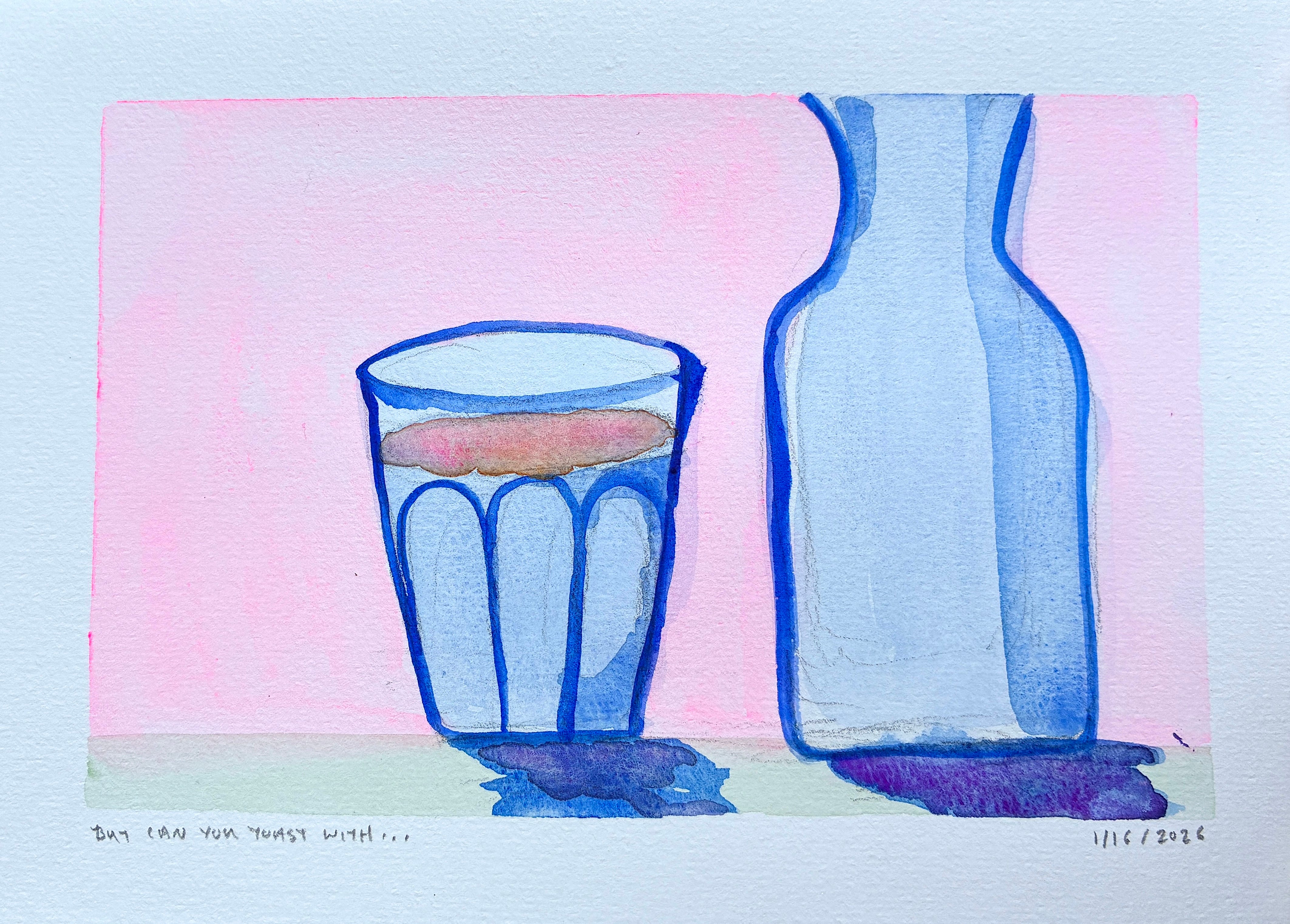
gathering around something to drink (water, tea, coffee)
talking about water: Did you get your well fixed? Your mother loved water. Do you drink bottled or filtered water? Water as medicine.
Can you toast with water? with tea?
Range Rovers, and other cars
“and… Bob’s your uncle!” well, Robert if you’re in Europe.
The Rolex: is it real? is it fake? How did our two characters, seemingly without jobs and money (Waits, Krieps) come into possession of these watches? hm…
The lingering awkwardness of leaving
Why be so over the top with these motifs…the skateboarders, the idiomatic sayings, the questions of what beverages you can toast with? Is Jarmusch suggesting that we all share more in common than we think or just pointing out the banalities of family conversations? Likely, both. But, the connective tissue between these three stories is the unknowable-ness of what makes up a life and the people we each are outside of, or in addition to, our roles as parent or child.
The film favors the perspective of the adult children, who are often left wondering ‘who were you before me and who are you now after me?’ We see Jeff and Em speculating about their father’s life, both as they drive to and then back from visiting him. Em wonders aloud, ‘That was strange. Was daddy always so weird?’ To Jeff’s reply, ’I guess usually more in a fun way when we were little…’1 There is only the ghost of once knowing, or what you thought was knowing, your parent.
Meanwhile, the parents remain mysterious throughout the film in all three stories. The viewer and the children, never get more than a passing peak into their lives.
In “Father,” we see Waits’ clean up the house with all neatly arranged and he’s changed into his dapper outfit—calling his date to meet him in town. He then drives to his date in a well taken care of car that is hidden under a sheet and parked out back of the house. The joke is on us, thinking he was so disheveled and hapless…
In “Mother,” we get the tail-end of Rampling on the phone with her therapist before her daughters arrive. The viewer, and her children, never get more than a glance at the cover of their mother’s books, and thusly, her life—only ever seeing what she wants them to from her precisely arranged tea table and manicured lawn. Even the flowers Tim brings, beautiful, but not right for the center of the table. A metaphor at how hard it was, is, to let her children in when she can just do it better.
In “Sister Brother,” we pour through photographs, documents, and ‘the stuff’ that remains after a life alongside the twins. But, even with a storage unit packed to the ceiling with their possessions, they remain a mystery.
The inability to truly know a parent is further exacerbated by the contrast between those who are conventional and those who aren’t. For example, surely, Waits’, who is unequivocally hip, didn’t anticipate having such square children? Are they loving? Yes. Are they understanding? Not exactly. The children are baffled by how their father can be so irreverent to a conventional life, making a living, or taking care of himself. How can they possibly be related?
In “Mother,” three strangers would have more to say to one another than la mere, Tim, and Lilith do at their annual tea. Their only commonality, besides being related, is their unintentional wearing of the same color, red.
The only character to comment on this dynamic is Skye asking, “Aren’t you glad we had such unconventional parents?” To which Billy replies, “Yea, I mean who wants to be a square and live a conventional life?”
But, Jarmusch isn’t pitting these two sensibilities of convention and unconventional or squareness and hipness against each other so much as he’s illustrating the absolute chance of family. Driver’s character, Jeff, muses that the saying is true, “It’s like they say, you can choose your friends and your lovers, but you can’t choose your family.”
While parent’s remain inscrutable, siblings can navigate the chasm… well if they’re twins who share 100% of their genetics. “Sister Brother” is the only relationship we see of two kin truly understanding one another. It’s what the film boils down to as the “twin factor.” But they too, struggle to understand who and why their parents were as they were. Skye questions many times why did their parents do what they did, like ‘why were they flying a plane in the mountains?’ To which Billy replies, ‘Does it matter? Who knows why they ever did anything.’
At it’s simplest, that’s what this film offers us—who knows why anyone ever does anything. And, well, isn’t the mystery the fun of it?
Not exact quotes. I don’t have access to the movie to rewatch and gather exact quotes 🙃
No posts
Comments
Nothing yet. Say the first thing.
Sign in to join the conversation.