
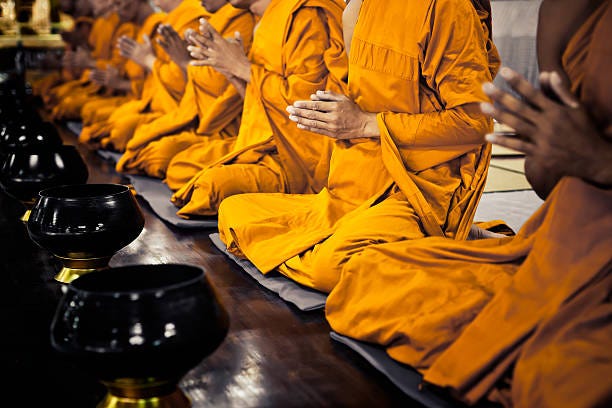
A common criticism of Buddhism goes something like this:
“There are too many rules.”
Too many precepts.
Too many restrictions.
Too many things you should not do.
Don’t lie.
Don’t steal.
Don’t kill.
Don’t engage in harmful speech.
Don’t indulge every desire.
And if you look deeper into the monastic tradition, the list becomes even longer.
Hundreds of training rules.
Detailed guidelines for daily life.
To many modern people, it can seem excessive.
Almost oppressive.
The immediate question arises:
Why would anyone willingly live under so many rules?
But what if this question misses the point entirely?
What if the Buddha was not trying to limit human freedom?
What if he was trying to develop it?
Because according to Buddhist psychology, the greatest threat to your freedom is not a government, a boss, a difficult relationship, or an unfair society.
It is the fact that most people are not actually in control of their own minds.
And that problem may be far more serious today than it was 2,500 years ago.
Never in human history have people enjoyed so much freedom.
You can choose what to watch.
What to buy.
What to eat.
Where to live.
Who to date.
What career to pursue.
What opinions to express.
The modern world constantly celebrates freedom of choice.
Yet something strange is happening.
People report increasing levels of anxiety.
Increasing levels of distraction.
Increasing levels of loneliness.
Increasing levels of emotional exhaustion.
How can a society with more freedom produce so many people who feel trapped?
The Buddha might ask a provocative question:
Are you free because you can do whatever you want?
Or are you only free when you are no longer compelled to obey every impulse that appears in your mind?
These are two very different things.
Imagine this.
Your phone vibrates.
You immediately reach for it.
A notification appears.
You open it.
Ten minutes later, you have forgotten what you were originally doing.
Someone criticizes you.
Instant anger appears.
You react.
Hours later, your mood is still controlled by that interaction.
You feel lonely.
You open social media.
You feel bored.
You seek stimulation.
You feel uncomfortable.
You look for distraction.
Most people call these choices.
The Buddha might call them conditioning.
Because if every impulse automatically becomes an action, are you truly choosing?
Or are you simply obeying?
This is where Buddhist training begins.
Not with morality.
Not with religion.
Not with obedience.
But with a simple question:
Can you experience an impulse without immediately becoming its servant?
Psychologists call it self-regulation.
Neuroscientists sometimes call it executive control.
The Buddha called it mindfulness and wisdom.
Different words.
Same phenomenon.
The ability to notice a thought without believing it.
To notice an emotion without becoming it.
To notice a desire without automatically following it.
This ability sounds simple.
But it may be one of the rarest skills in modern life.
Today entire industries compete for your attention.
Algorithms are designed to capture your impulses.
Advertising is built around stimulating desire.
Social media rewards emotional reactivity.
The result is a strange paradox:
People feel increasingly free while becoming increasingly controlled.
Not by dictators.
Not by kings.
But by their own unexamined habits.
This is where many people misunderstand Buddhist discipline.
The precepts were never primarily about creating “good people.”
They were designed to create awareness.
Take a simple example.
Suppose someone insults you.
Your immediate impulse is to retaliate.
Without training, the reaction happens automatically.
Insult leads to anger.
Anger leads to speech.
Speech creates consequences.
The cycle continues.
But imagine a gap appears.
Just a few seconds.
In that space you notice:
“There is anger.”
You do not suppress it.
You do not deny it.
You simply see it.
And because you see it, you are no longer completely controlled by it.
That tiny space is where freedom begins.
The Buddha understood that every precept was essentially training this gap.
Training awareness.
Training restraint.
Training the ability to pause before acting.
Modern neuroscience increasingly supports this insight.
Research suggests that mindfulness practices strengthen areas of the brain associated with emotional regulation, attention, and impulse control.
People who develop greater awareness often become less reactive.
Less impulsive.
More capable of responding thoughtfully rather than automatically.
In other words, they become more free.
This is the great irony.
Many people view discipline as the opposite of freedom.
Yet psychologists, athletes, musicians, and high performers often discover the opposite.
Discipline creates capacities that impulse never can.
The pianist gains freedom through practice.
The athlete gains freedom through training.
The meditator gains freedom through awareness.
The Buddha saw the same principle applied to the mind itself.
If this reflection gave you a new way of understanding Buddhist practice, consider buying me a coffee.
The Buddha once pointed toward a radical idea.
The greatest prison may not be outside you.
It may be inside you.
A person controlled by greed is not free.
A person controlled by anger is not free.
A person controlled by fear is not free.
A person controlled by endless craving is not free.
The tragedy is that many people never recognize these forces because they feel like “me.”
The impulse appears.
The action follows.
The pattern repeats.
Years pass.
Entire lives unfold this way.
And people call it freedom.
But the Buddha saw something else.
He saw that freedom is not the ability to satisfy every desire.
Freedom is the ability not to be enslaved by desire.
Many people imagine spiritual practice as adding something new.
More beliefs.
More rituals.
More knowledge.
The Buddha’s approach was different.
He was interested in removing what obscures clarity.
Removing compulsions.
Removing unconscious habits.
Removing unnecessary suffering.
The goal was not to create a perfectly obedient person.
The goal was to create a person capable of seeing clearly.
Because a mind that sees clearly is much harder to manipulate.
By advertisers.
By politicians.
By social pressure.
By fear.
By anger.
Even by its own thoughts.
Perhaps the most important question is not whether Buddhism has too many rules.
The more important question is:
How much of your life is actually being chosen?
How many of your reactions are automatic?
How many of your desires were planted by someone else?
How many of your worries repeat themselves every day?
How often do you act because you consciously decided to?
And how often do you act because an impulse appeared?
Most people spend their lives trying to control the world.
The Buddha suggested a more challenging project:
Learn to understand the mind that experiences the world.
The answer is not rigid self-control.
Nor is it blind indulgence.
The Buddha rejected both extremes.
The Middle Way is not about suppressing desire.
It is about understanding it.
Not about eliminating emotions.
But about not becoming enslaved by them.
Not about restricting life.
But about discovering a deeper kind of freedom within life.
A freedom that remains even when circumstances change.
When modern people look at Buddhist precepts, they often see restrictions.
The Buddha saw training.
When modern people see rules, he saw freedom.
Because the purpose of the path was never to create a smaller life.
It was to create a stronger mind.
A mind that can remain calm in chaos.
Clear in confusion.
Compassionate in conflict.
And free in a world constantly competing for its attention.
Perhaps the real question is not:
“Why did the Buddha create so many rules?”
Perhaps the better question is:
What did he see in human nature that made so much training necessary?
And perhaps the answer is uncomfortable:
He saw the same thing we can still observe today.
A mind that desperately wants freedom...
while constantly surrendering it to every passing impulse.
Before You Go
If this reflection gave you a new way of understanding Buddhist practice, consider buying me a coffee.
Every essay here is an attempt to bridge ancient wisdom and modern life—to explore the timeless insights that can help us navigate distraction, anxiety, relationships, and the search for meaning.
A coffee is a simple way to support this work and help more essays like this come into being.
If these reflections have helped you think more deeply, live more consciously, or understand yourself more clearly, your support means more than you know.
Subscribe for future essays on Buddhist wisdom, psychology, mindfulness, and the deeper patterns of human experience.
And if this article resonated with you, share it with someone who might appreciate it.
Sometimes a single insight can change the way we relate to our own mind.
No posts
Comments
Nothing yet. Say the first thing.
Sign in to join the conversation.