
The message arrived on an ordinary evening.
Just a few words.
Nothing dramatic.
Nothing that should have affected me so deeply.
But somehow, after reading it, I found myself sitting there quietly, remembering a person, a place, and a version of myself I thought I had already left behind.
It was strange.
Because I knew that chapter of my life was over.
I knew some things cannot return.
I knew time only moves forward.
And yet, a part of me was still holding on.
Maybe you know this feeling.
You see an old photo.
Hear a familiar song.
Pass by a place you haven’t visited in years.
And suddenly, something inside you moves.
Not because you want to go back.
But because some part of you never completely left.
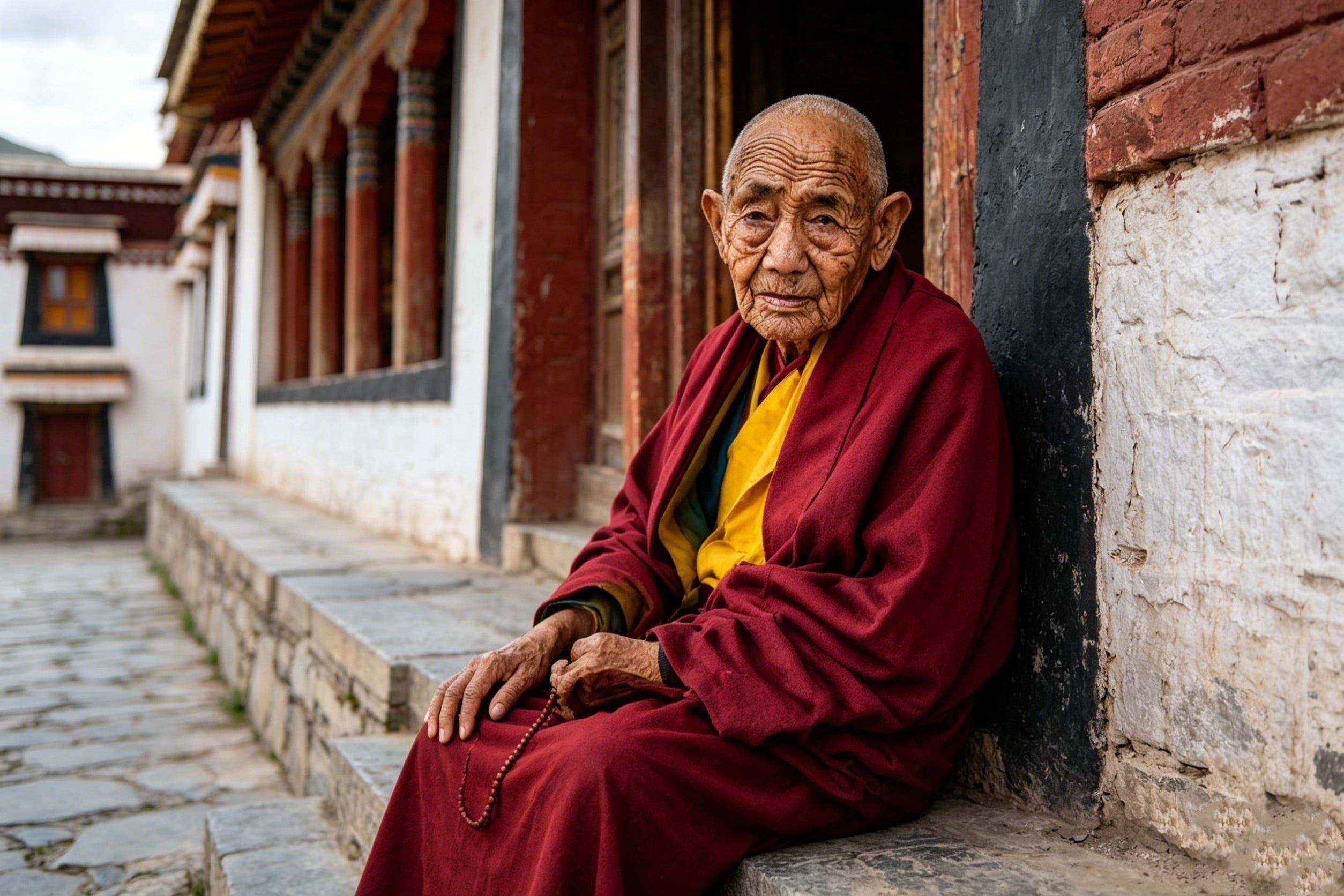
That was the question I brought to the 98-year-old monk who had spent 70 years in practice.
I sat with him in the quiet courtyard of the temple.
After a long silence, I asked:
“Why is it so difficult for people to let go of things that are already gone?”
He didn’t answer immediately.
He looked toward the trees outside the courtyard.
The leaves were moving gently in the wind.
Then he said:
“Because people are not only holding on to things.”
I waited.
He continued:
“They are holding on to who they were when they had those things.”
I didn’t expect that answer.
Because we usually think we are attached to:
A person.
A relationship.
A place.
A lost opportunity.
A past version of life.
But maybe there is something deeper underneath.
Maybe what we miss is not only what happened.
Maybe we miss the person we became during that time.
I asked him:
“What do you mean?”
He picked up a fallen leaf and held it in his hand.
“People say they miss someone,” he said.
“But sometimes they miss how they felt when they were with that person.”
“People say they miss the past.”
“But sometimes they miss the meaning they had during that period.”
That sentence stayed with me.
Because it explained something I had never really considered.
Why do we sometimes miss a relationship that was painful?
Why do we romanticize moments that were actually difficult?
Why do we want to return to places where we were not even truly happy?
Maybe because memory does not only preserve events.
It preserves identity.
Modern psychology has found that our memories are not perfect recordings of the past.
They are reconstructed by the mind.
Every time we remember something, we are also interpreting it.
We don’t simply remember what happened.
We remember what it meant to us.
And sometimes, we are not attached to the event.
We are attached to the meaning we created around it.
The monk said:
“The mind fears letting go because it believes something will disappear.”
I asked:
“But if something is already gone, what are we actually losing?”
He smiled.
Then he said:
“An image.”
“An image of how life should have been.”
“An image of who you should have become.”
“An image of what you thought would finally make you complete.”
That was difficult to hear.
Because sometimes we are not grieving reality.
We are grieving a possibility.
The life we imagined.
The conversation that never happened.
The apology we never received.
The future we thought was guaranteed.
And perhaps that is why some losses are so difficult.
Because we are not only saying goodbye to what happened.
We are saying goodbye to what we hoped would happen.
The Buddha taught:
“All conditioned things are impermanent.”
At first, this sounds like a sad teaching.
But it is not.
It is an invitation to stop asking changing things to remain unchanged.
The pain is not simply that people leave.
That situations change.
That seasons end.
The deeper pain comes from fighting the nature of life itself.
The monk said:
“A flower is beautiful because it does not stay forever.”
“If you try to make it permanent, you do not save the flower.”
“You only destroy your ability to appreciate it.”
I asked him:
“So does letting go mean we stop caring?”
He shook his head.
“No.”
“Letting go does not mean something meant nothing.”
“It means you stop asking the past to become the present again.”
That sentence felt different.
Because many people misunderstand letting go.
They think it means:
Forget.
Erase.
Move on quickly.
Pretend it never mattered.
But maybe true letting go is much gentler.
It is saying:
“This mattered.”
“This shaped me.”
“This was part of my journey.”
“But it does not have to continue in order for my life to continue.”
Before leaving, I asked him one final question:
“How do we know when we have truly let go?”
He thought for a moment.
Then said:
“When you can remember something without needing it to be different.”
I stayed quiet.
Because maybe that is the real test.
Not forgetting.
Not becoming indifferent.
Not pretending we never cared.
But being able to look back and say:
“It happened.”
“It mattered.”
“And now it can rest.”
The Middle Way is not about holding on forever.
And it is not about forcing yourself to forget.
It is learning how to honor what has passed without becoming trapped inside it.
Some things leave our lives.
Some people become memories.
Some versions of ourselves disappear.
That is not a failure.
That is the movement of life.
Perhaps peace does not come from keeping everything we love.
Perhaps peace comes from loving something deeply enough to allow it to change.
Thousands of people may read an article like this.
Many will nod in agreement.
Some will save it.
A few will share it.
But only a small number choose to support the work that made it possible.
If you are one of those readers who returns regularly, who finds value in these reflections, who believes thoughtful writing still matters in a world built for distraction, I would be deeply grateful for your support.
Buying a coffee isn’t just supporting one article. It’s helping create the next one.
It’s helping keep these conversations about psychology, Buddhist wisdom, suffering, healing, and awakening available to anyone searching for them.
If this publication has helped you think differently, live more consciously, or feel less alone, consider becoming part of the reason it continues.
Subscribe for future essays.
Share this reflection with someone who might need it.
And thank you for being here.
No posts
Comments
Nothing yet. Say the first thing.
Sign in to join the conversation.