
This story was first published in the now-defunct and much missed Tin House literary journal as “The Insincere House” in 2014. It has never had a life online, and so I decided to change that and the title. It is too long to publish in a single newsletter and luckily there is a natural break right in the middle. Part 2 appears next week.
Jack’s first thought as he opens the door to the house his family has rented for the week of the Fourth of July is that it is insincere.
He stands in the doorway to the kitchen, the door open, the knob still in his hand, and waits a moment before stepping inside, examining this feeling.
Most summerhouse rentals rented a fantasy—This was our house! We loved it! You will too! A guest book usually asked people to write in it, and after a week spent questioning the taste of the renters with his brothers—their books, furniture, their obedience to feng shui—it felt downright shitty to write, Thanks for a wonderful week! The Cho Family—but they still did.
Here, though, that first pretense is too thin. The landlords have never had any kind of happiness here, he can tell as he steps inside and closes the door. An image forms in his head of the owners, a couple standing on the marsh this used to be and saying, It’s beautiful, and embracing as they decided to build a house here just so people would pay money to rent it. Which is what he and his family are doing.
The house is long and thin, like a parade stand. From the kitchen, he can see into a dining room with French doors or something like them that open out to the lawn, and past that, a sunken living room, with picture windows like glass walls, strangely uncomfortable, no doubt, at the thought passerby might see inside these rooms, furnished apparently by amnesiac compulsives, people who at each point of sale forgot what they’d bought before, or even what they were doing, and just kept shopping. The kitchen’s nautical theme falters beside the dining room, where something aspires to French country in that way that always used to make him think he might hate France, in the years before he actually went there. In the living room, white wicker furniture crowds in near a beige leather modular sofa, a sad atoll of too-shiny skin, the decorating battle’s only scar. All of it is afloat on a sad kilim he finds suspicious the more he looks at it—the green more Newport Beach than Ankara.
A Turk might have made it, but if he did, he was probably, well, insincere.
In the place of any taste, the house was a series of gestures, each disorganizing the next, and none of it organized by a sense of a pleasure in the things themselves.
It is probably exactly like the owners’ lives. Anyone’s lives, for that matter.
The ritual of the summerhouse taken near his parents’ house in southern Maine began as a way to make room for the brothers if not at their parent’s home, then near it, now that there are spouses and children—his parents had recently moved to a smaller house, easier for them to care for during the 349 days of the year they are otherwise alone, and there simply isn’t room for everyone to visit them at once. After the first awkward year, he and his brothers told each other how much they liked the rental house, how it helped them let go of old patterns and welcome new ones, and they noticed they hadn’t begun fighting in the ways they always did, or at least, not until much later in the week. They told none of this to their parents, but decided to continue the ritual. And, away from the home where they’d grown up, the brothers did feel reborn each time they met up inside each new piece of real estate, as if with each new house, some old bitterness was left behind.
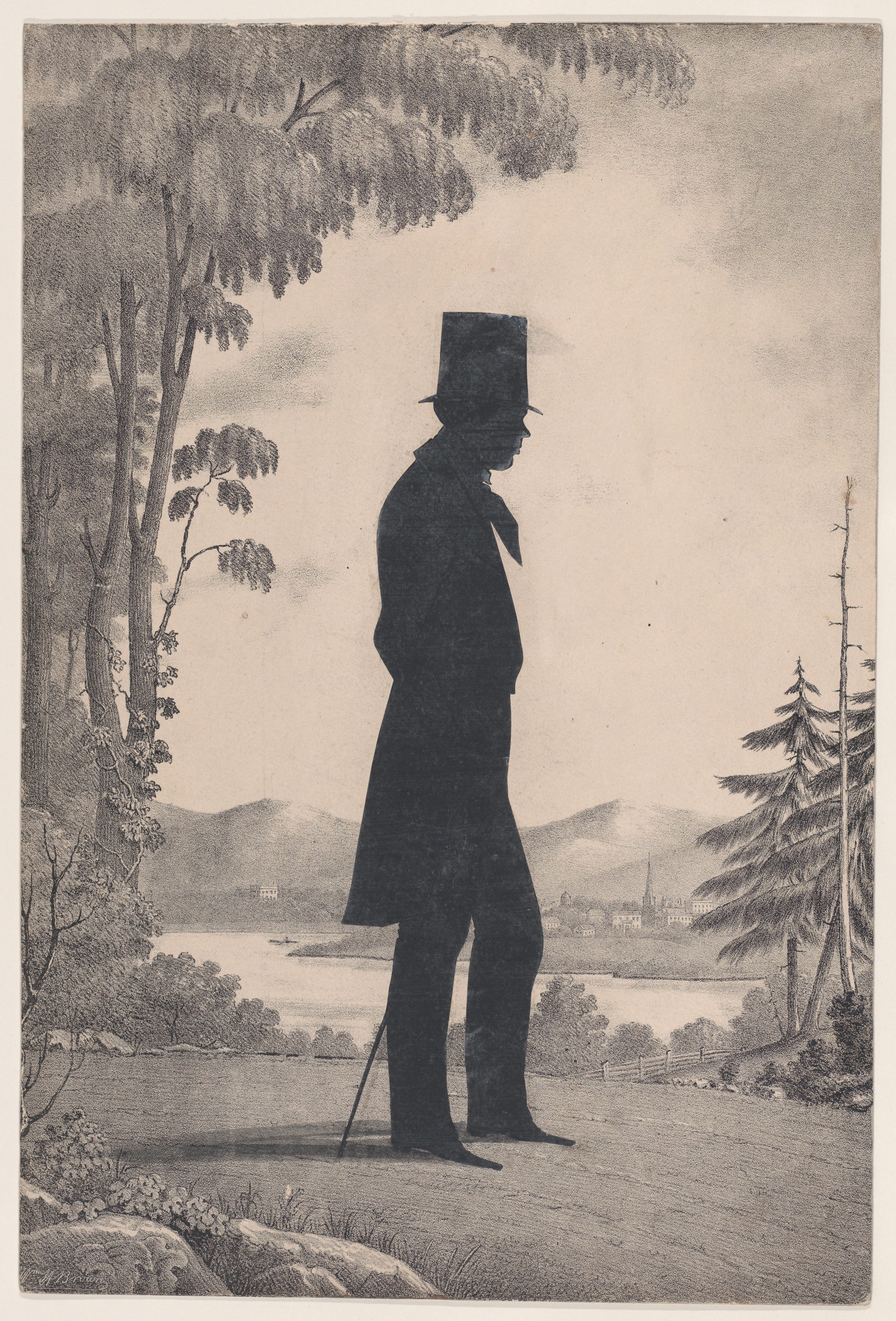
Silhouette of Edward Worth of Saco, Maine, by William Henry Brown, courtesy of the Metropolitan Museum of Art Open Access Collection.
Whatever the old patterns were, his new pattern, until now, has been that Jack usually arrives last to the next new summerhouse to find it full of his brothers and their spouses, his nieces and nephews already in their swimsuits, following his father to the beach to look for sand crabs. And his mother, patiently sitting at the kitchen table, eyeing him as he walks in alone, still no spouse, no children, as if he is tardy for their whole life together. He kisses her cheek, she allows it, smiles at him, and then stands up and asks him if he’s eaten. He never has, of course, as she has cooked immense amounts of food for the week, and expects her sons and their families to eat well. The time will come when she stops cooking for them but it hasn’t yet.
This year, Jack is the first to arrive. It feels sacrilegious, even thrilling, and so he marvels at himself, alone in the silent empty house.
How did we pick this place? he wonders. And yet he knows. He can’t really complain, not this time. Part of the family ritual now is a year-long quest for the next new rental, usually found after an intense search, with listings sent around between the brothers, and the parents going over to poke their way through the finalists, the qualities of each debated on exhausting e-mail chains until the right one is chosen. He almost never pays attention, not until the final result is produced, at which point he plugs the address into his phone and follows the blue trail on Google Maps to the newest location. He has only himself to blame.
He sets down his bag and scrolls through the nests of text messages, the group texts and side conversations unread until now, and pieces together that his younger brothers, Robert and Teddy, are close but still a few miles apart on I-95, stuck in traffic, still at least an hour away, driving up from Logan Airport. Teddy, the youngest, has already texted cellphone photos from the scotch and gin aisles of the New Hampshire liquor store, asking for help deciding—this liquor run is an important part of the ritual visit—and as Robert had joked Jack’s apparent inattention merits an Amber Alert, Jack taps out FIRST ONE HERE.
His glance at Teddy’s liquor photos reminds him that he would really like a drink, which brings him to his real favorite ritual in these rentals: finding the liquor the last renters left behind and making a cocktail out of it. Last year it was a Mexican brandy usually served at funerals and a vanilla-flavored vodka. The year before, Manischewitz and Gordon’s gin. He begins opening cabinets in the kitchen, to find olive-oil aerosols, a crusty container of Old Bay, Worcestershire sauce, a Morton Salt (vacation size), nonstick pans with rusty scars—why does no one know how to use a nonstick pan?—and then he finds, over the stove, a bottle of Malibu rum next to a bottle of Popov vodka, both of them hidden behind a massive container of store-bought croutons and several cans of Diet Coke.
It all looks so lonely back there for a moment, the bottles like kids playing hide-and-seek that no one bothered to find, that he reaches in and pulls the bottles out, quickly, blowing the dust off.
Someone’s vacation dark secret, he thinks as he fills a cup with ice and pours in equal parts of the vodka, coconut rum and Diet Coke. Now mine.
He winces as he tastes his creation, though he likes it more than he thought he would. There is no end to the ways his own taste will betray him, it seems, even though the drink tastes like the sort of body shot you take on a gay cruise. But then there is always what you think you should like and what you do like, the person you hope you are and the person you are.
The person he is allows himself one moment of redecoration. He plucks an enormous, misguided wreath, made of twigs and fake flowers, from where it hangs over the kitchen sink, blocking what would otherwise be the sunset view of the marsh. Someone hung it there as if it were covering a hole in the wall. He hides it in the nearest closet, and then turns his attention to the house. It is time to pick a room or, really, to find the one he must take, and so he sets off, looking for it.
He amuses himself with the idea of claiming the master bedroom for being here first and being the oldest—I am the master! he would shout as they entered—but he knows Teddy and Robert, with their spouses and two children a piece, determine between them who is taking the big room each year, and who gets the next biggest. Houses are remarkably undemocratic, this always the single real challenge for three brothers trying to rid themselves of their ancient rivalry—there is always a “master” bedroom, then large ones that are not as nice or commanding, and then smaller rooms, typically for children or, in his case, the single gay uncle.
Single Gay Uncle, he thinks, looking at the drink in his hand. That’s what I’ll call this.
Downstairs there is just one bedroom, good-sized but shady, and with not much of a view, a queen-size bed covered in a dark-emerald sateen. Upstairs he finds an entire second living room, full of more haphazard furniture, but this time with a chapel ceiling and skylights. The sofa up here is beige also, but canvas, with white piping. There are bedrooms with decks off to either side of the second living room. One he knows instantly is the master, for it is the largest and has a view. Jack goes across to the other side of the second floor, where he finds a room with two twin beds, a deck also. Roses cover everything, printed on everything—the lamps, the walls, the beds. Not exactly right for the gay divorced bachelor uncle, but not wrong, either. No matter how they are decorated, they are the same in every house somehow, these rooms he ends up in.
Hello, he says to the room, as he sets down his suitcase. I see it’s us again.
* * *
In the short history of the family’s summer gatherings, he has never brought a lover along. There is no loving spouse, no child. Last year there was Brian, but Brian didn’t come, and now he never will. Brian was the first real man in his life after his previous ex, Ted, and he turned out to be a compulsive liar with a taste for unprotected sex with men he found on the Internet. When Brian didn’t come along, in other words, he was wandering the bedrooms, bathrooms, and sex parties of any number of strangers and not, as he’d maintained, working on his dissertation. Jack never told his relatively liberal Korean family the real reason for the breakup—it was too humiliating, after all it took to come out to them. But also, he didn’t feel as if he’d broken up with Brian, not exactly. It felt instead as if he’d discovered the relationship he thought he was having was not the one he was having, as if he’d wandered into the wrong house and fallen asleep, and then left upon waking.
He sometimes misses the man he thought he’d been with, but each time remembers he doesn’t exist, and flinches and lets it go. The Brian he’d been with was a fiction, he reminds himself, carefully maintained by another Brian, a stranger, the one he’d met at the end of the relationship, and that man was the person he’d left. He didn’t know that man. He didn’t feel it as a loss of intimacy exactly, just the terrifying cold gap between what was real and what was not.
Like any Korean American male in the 1980s, he had been subjected to marriage pressure early, had sat through the terrifying marriage parties of Korean Massachusetts—there were more Koreans there than in Maine. The families would watch as their sons and daughters eyed each other as if at some all-Korean prom, conducted off season. Even if you did like someone from those parties it was a little embarrassing because you were supposed to, and yet there was no way around it, no way around any of it, except maybe this way he had found, coming out of the closet, which was like slipping out the back door of the marriage party and having a cigarette in the street, but for twenty-five years.
He had a friend in college who proposed to him once, the daughter of a Korean diplomat, a beautiful wild child named Suzy who couldn’t date a Korean man if she tried and was never really going to marry. “If you marry me,” she said, “we could cash in, get the money, the gifts, have separate lovers, divorce in a few years.” He took it seriously for exactly a minute, and abandoned the idea as soon as he tried to imagine introducing his mother and father to her. He was the eldest son, so it was a big deal if he chose a wife, he knew. Suzy looked like a model right out of Vogue Italia, complete with long gold-filtered cigarettes. She was the wife you chose only if you were gay. He imagined her drunkenly making out at their wedding with some friend of hers, or smoking while eating at the banquet, as she liked to do. His parents would each have heart attacks at the table. If either survived, there would be no forgiveness, ever.
In Jack’s mid-twenties, his paternal grandfather, perhaps sensing but not understanding the source of his reluctance to marry, offered him a wife, as if he were offering a new car. He very carefully did not react, and just as carefully did not react when his oldest uncle sat him down to encourage him to “do his duty to his family” and marry. “A wife is to be a lover in your youth, a mother in your adulthood, and a nurse in old age,” he said. “Why don’t you want one?”
When put in these terms, having a wife seemed immoral, like something no one should do.
When he came out to this same uncle at last, twenty years later, his uncle wept, held up pictures of Jack’s brothers’ sons and daughters and begged him to reconsider, asking him to have children no matter what. It shook him, and after he reassured his uncle that he could at least partner with a man, if not marry him, he left, went home, and told Brian about it, to which Brian had shrugged and smiled. And so the moment slid by, disguised for a while as a funny story about coming out late in life to an older relative who was just so prejudiced.
The story wears no disguise now. In his thirties, as his romantic mistakes piled up, his friends would ask him, apropos of nothing, he assumed, whether he wanted kids. What an odd conversation, he thought back then, as he wandered out into the streets of New York after their dinners together. Why were his friends suddenly acting like his uncle? But he wonders no longer. Jack knows he is at an age where if he were to have a child, he or she would graduate high school when Jack is sixty, graduating college when he is sixty-four. Forty-two is already a tough age to handle crying babies at night. He hasn’t yet found the man he’d do such a thing with, either, so all of this is academic, also more distant—fifty, sixty, sixty-two, sixty-three, sixty-six. Seventy. And now Brian is gone, and he is single again, and he has no family of his own, except the one coming at him through the traffic.
And there is still his uncle, so like him, really, also the oldest brother, each of them the bachelor patriarch of his generation. He sometimes thinks of his uncle as his future, alone in his old age in an enormous house in Seoul, divorced and childless, with only distant younger cousins sent in from the countryside to take care of him, children who don’t know or love him, and who sometimes steal from him. Only their blood is not a stranger. When he’d said, Don’t you want one? Jack now knows what he meant was You don’t want this. You think you can get by and you can’t.
His uncle is right, Jack suspects, though he keeps hoping to find him wrong. With each year, he has noticed something in the way his brothers move between the best and second-best bedrooms, as if they are some ever-expanding sine/cosine wave, and him the axis, the two of them moving further and further away from him into not just a new pattern, but a whole other life, without him.
* * *
When he returns from the car with the rest of his bags he passes through the upstairs living room again and spots another of these hideous dried wreaths, this one even larger, hanging next to the skylight like some awful giant spider. He comes to a stop underneath it. As he tries to figure out how to get the wreath down, short of hitting it with a Frisbee, the wreath begins to move, almost as if he has willed it, but it is only a breeze lifting it almost off the wall. A sign he has not shut the door downstairs.
The wind plays over the walls, like a ghost who once loved this house and is moving through, touching everything. The wind is sincere. Also the beauty of the marsh, the sun and the sea in the distance. Also the long stretch of sky, full of clouds making what look to be those so-called castles in the sky. As he stands there, watching the hideous wreath flap up and knock at the skylight, he wants to do just that, to rise as well, to lift into the air with the wreath, push open the skylight, and fly away from this sad house, so weirdly cheap and expensive at the same time.
When he was a small child he had the naïve belief that heaven meant you lived among those enormous clouds forever. You would fly along the air, full of light, feeling as if you were both in the world and of it--not always renting a piece of it, or buying it.
There is something he wants for himself still that is like this, a sense of belonging that he imagines regularly, one that has haunted him, perhaps possible only after death: an end to rent, to purchase, to employment, to the whole strange rigged machine of life. And while sometimes when this feeling comes, he wonders if this is a wish for the end of life—for death—death isn’t what he wants, either. This feeling he longs for as likely to elude him in the afterlife as it has eluded him here.
He’d stopped watching a television show that debuted that year about spirits made to work in the afterlife solving mysteries against their will, the wage-slave detectives of heaven. As the credits to the pilot rolled, he thought, Of course we’ll have jobs when we die.
Like, for example, having to live another life all over again.
More than a few people have described him as an old soul, but those who said it meant it as a compliment, a way to say that he is wise. It hasn’t been comforting, though, since the day a yoga teacher calmly told his entire yoga class what this means. He still remembers how it felt to lie there in the dark room, his eyes closed, and hear, “There is no social promotion in karma, it turns out. If someone is an old soul, in his past lives he died without learning what he should. He’s been sent back to be here until he does, the kid too old for the seventh grade of the universe, who can’t leave just yet.”
Poor Bitter Old Soul. Mean, mean, mean. Still held back from what’s next.
And yet what is there to do but take a breath and try one more time to belong?
Part 2 next week.
No posts
Comments
Nothing yet. Say the first thing.
Sign in to join the conversation.