
A long time ago, almost past remembering, and by this I mean the early 1980s, I was a student at Cape Elizabeth High School, a small public school in Southern Maine in the town of, yes, Cape Elizabeth. I have written about it in my first novel and my first essay collection. I could, it occurs to me, probably write about it more. I also wrote about it in a short story, “Mine,” for Everyday People, this anthology edited by Jennifer Baker. And I wrote about it for this newsletter in this post from last year about how to write about hometowns.
And so a few weeks ago I found myself in the entrance remembering the time I was surrounded there by the graduating senior class yearbook editors, all young white women, who told me their yearbook committee had just met for the last time and had voted for me and another student as editors. “We know you have no social life so we know you’ll get the work done,” one of them said, and laughed, not even really derisively, just in a sort of matter of fact way that was worse, and the others joined her. And while this made me want to turn them down, I knew the role would help with college applications, and accepted all the same.
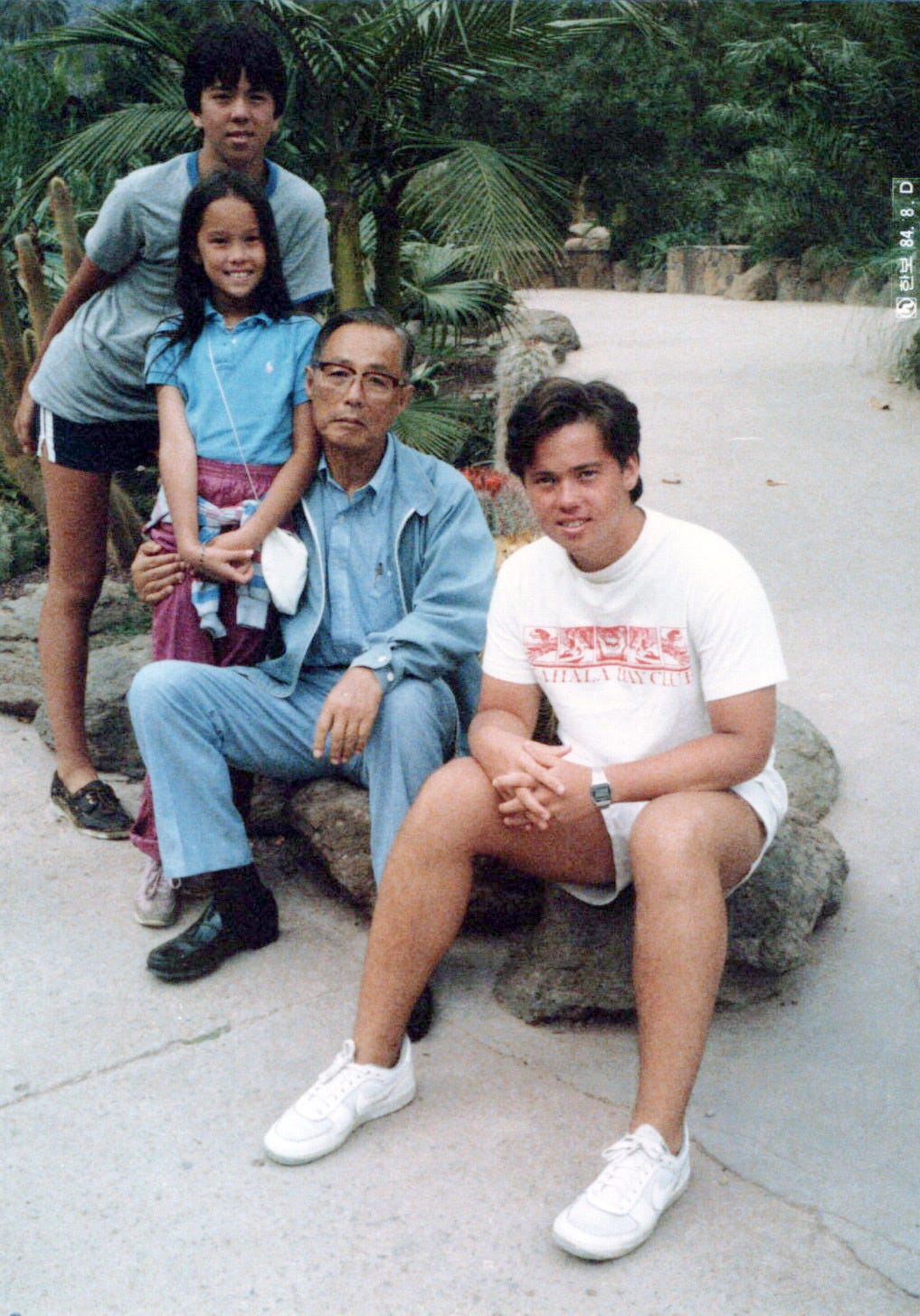
Me with my siblings and my grandfather in 1984, the summer between junior and senior year, months after being named an editor of my high school yearbook. My hair is impressive to me.
And I did get the work done, with my gracious and kind co-editor. And I am sure it helped me, in a way, to get into college. No, I won’t thank them. But this story was like much of my time at that high school.
When I left for Wesleyan in the fall of 1985, I was following a path I found thanks to a social studies teacher of mine who always used to say, to me and to my mom, “Don’t you worry. Someday you will be the toast of the embassy ball.” He never said which one. It didn’t really matter. This conjured a vague European capital in my mind, and when I did go to an embassy party finally, in Leipzig, I thought of him. It occurs to me I still haven’t told him. But the idea he had and that I had also was that I didn’t belong here, and would belong elsewhere. That is something my host, Mr. Phillips, assured me was now wrong.
So I stood again in the star-shaped intersection I remembered too well. The white dropped ceiling looked much the same as it did back then as did the lights and the grey and maroon floor tiles. The maroon lockers too. Maroon and white are the school colors, if I’m remembering correctly, and I still try to avoid wearing them. I wondered if I would know the place but I approached the san serif typeface above the entrance doors much as I always had and remembered that in Maine we have a saying, “Preservation through neglect.” Some things had been changed—new glass in the front offices and a guidance counselor office renamed and in a slightly different place—but I was welcomed by two young women assigned to bring me to their English class where their English teacher, Winthrop Phillips, waited with a box of doughnut holes from the Cookie Jar, a bakery I knew well from childhood for the Bismark doughnuts my mother loved. A moment’s embarassment came when I sat down and found the desk chairs were not, well, sized for a man like me. I fit, barely, so to speak, no longer the size of a student there. But I managed and we moved on to the questions.
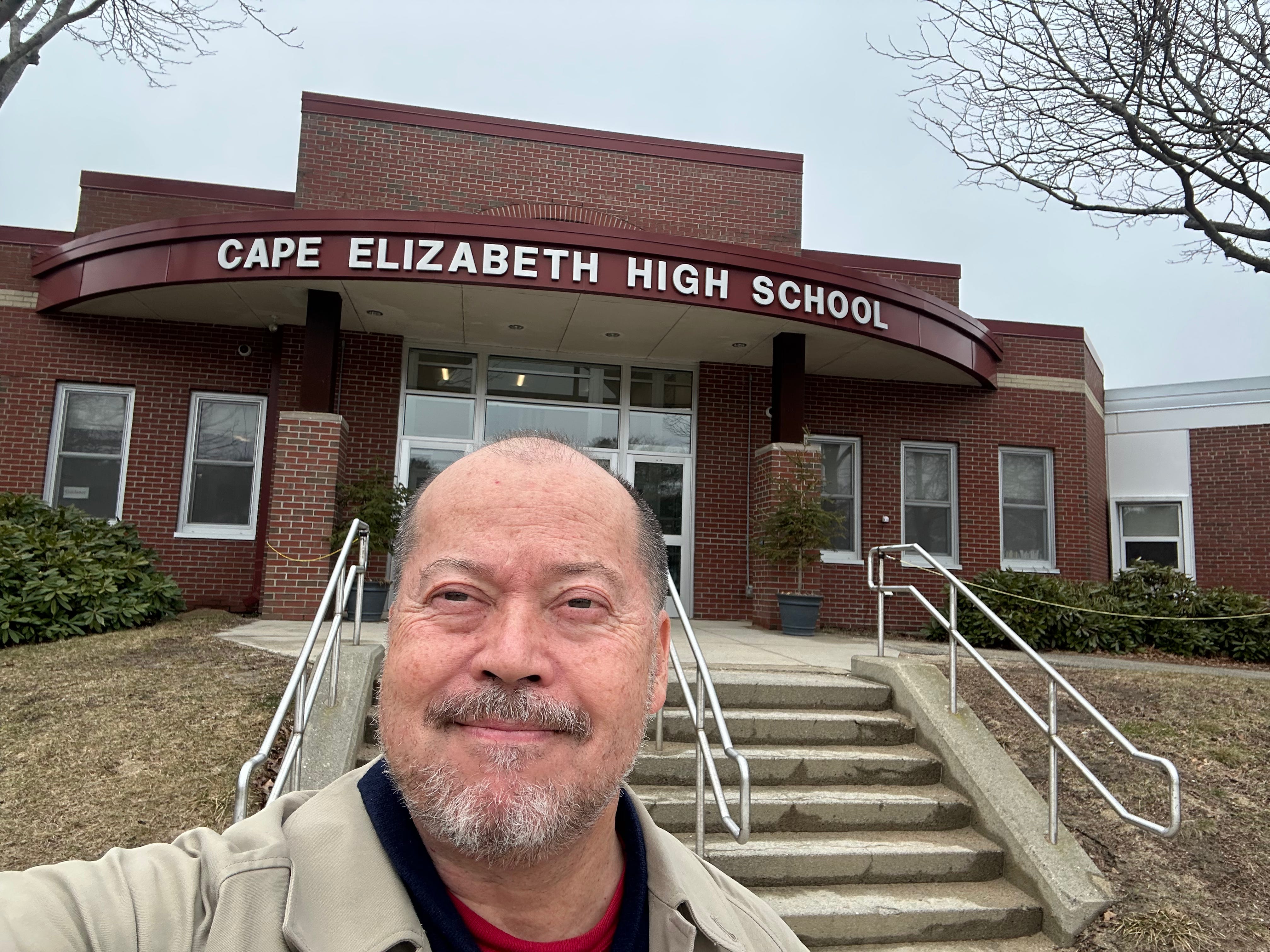
Me now with less hair.
Mr. Phillips had prepared me for this by telling me what they’d have read of my collection. He had also read everything I’d ever written that he could find. He told me his students were more liberal than the ones I went to school with and he was right. They had complex questions about my work and about being a writer and in general I enjoyed the time I spent with the class, before going to the school library, where I spoke with him about my work before an assembly of several classes, including a friend of my brother’s who I was very happy to see, who is now working there. “I said I’d never come back here and here I am,” she said.
And then I sat down in my high school’s library, a place I spent so much time in hiding from my classmates in books, and spoke with Win, as he asked me to call him, about my books. We covered a fair amount of ground. The students asked some questions also. And in what felt a little like a scene out of an indie movie, the writer visiting his old high school 41 years later was asked about despair.
For context for those of you reading this who don’t know me so well yet, I wrote about this in an essay that closes my first essay collection, “On Becoming An American Writer.” The essay is excerpted in part on The Paris Review website but if you haven’t read it, I would recommend you read the whole essay in the collection. Win asked, he said, because some of the students had the feeling that there was no hope for the world, because of the many harms to the environment, the current regime, the wars. And so I thought about it.
There were so many ways to answer. I had a whole education in despair by the time I got to high school, and for personal reasons researched an article for the school newspaper on teen suicide. I had a close friend who kept trying and failing to kill herself. I was trying to understand her and myself both. I don’t know where she is now, but we at least made it out of our high schools alive. But I have also had another whole education in this feeling in the last few years. I remembered feeling in October of 2016 that I had finally conquered my depression. In September of 2023, the fall I lived in London for work, I felt I was finally looking forward to life again after Trump. I won’t say the gods laughed at me but I have had to find help anywhere I could as I work to finish a novel, to teach, to show up for my husband, my mother, my friends. And myself. I suppose I could answer this question of how to face despair differently every day right now.
The answer that came to me there, in the library, surprised me a little. I spoke about how I live a life I was made to believe I could never have, and have lived that life for decades. Much of my life was spent being told that what I wanted was impossible or at the least that I shouldn’t do it. I was told I shouldn’t apply for the MFA with sexually explicit gay material, for example, which I did, and received fellowship offers from Iowa and U Mass Amherst. I was told I shouldn’t write a novel in the present tense, or publish a novel about sexual abuse as my debut, and I did both. The novel is still in print, and celebrates a 25th anniversary this year.
I told the audience that day about how sodomy was illegal in this country when I was in high school there and how as a student, I was haunted by the 1984 hate crime murder of Charlie Howard, a few towns away in Bangor. Howard was a gay man killed by three teenagers who targeted him for being gay. He was effeminate, outspoken, wore a purse and only in researching his murder for this post did I learn that his killing inspired a murder in Stephen King’s novel It. Or that Howard’s boyfriend was with him, and escaped, and then overheard Howard pleading for his life as they threw him over the bridge, telling his attackers he couldn’t swim. He is the reason we know this. I only knew from back then the news report that he’d begged for his life and the teens who killed him had not stopped what they were doing.
I think about Charlie Howard often.
I didn’t know what was possible for me back then, when I was 17, but I was trying to learn what was possible and how to change what I feared, to have more of the life I wanted. I was learning how to live. Most of my life in this country when I think about it has been spent trying to keep myself and those I love safe from violence because of who we are and who we love. Much has changed, but that remains at the core of what I am still doing. That I was even invited back and treated with this kind of respect tells me that for all the hate being summoned back right now, we still live in the changed world, the one that has marshaled so much venom. I won’t say everything is okay, but I won’t act as if we don’t have the numbers on our side. And one thing that makes me feel as if this world has changed are the solidarities I am seeing, new solidarities, on a massive scale, across the country but also right there in my home state of Maine.
Trump is a historically weak president, his administration is historically unpopular, and he and his regime will win only if we act as if this isn’t true. The sin of despair, the subject of the essay Mr. Phillips mentioned, was interesting to me to write about because of my understanding that it is founded in the idea that giving in to despair is to give up on God. And while I’m still no Catholic, God or not, I do know we can’t give up on ourselves.
If I could go back in time to the student I was then, I would say to him, I know this life feels full of murder and harm, but you will meet some of the best people in the world, people better than you can imagine right now. They will love you and you will love them, and together, you will teach each other to change the world together, and it will, unfortunately, still need more change, most likely for your whole life. And you can’t give up because giving up gives your enemies power and hope. But in doing this work you will meet pretty much everyone you will ever love. The loneliness you feel will part, especially when you start this work.
At the end of my talk at the high school, a number of the young men in the room came up to me to shake my hand and thank me for speaking to them. I wasn’t used to the handshakes. I think of this as one of those signs I am speaking of, of new solidarities. It didn’t seem like a prank, which I suspect I was sensitive to for the place I was in—they were sincere. One of the students who shook my hand and thanked me, he said, “I don’t know if I’ll be a writer but you made me want to try.” That he took that out of all of what I said, that perhaps was the most gratifying to me of all.
There’s an inspiring obituary for the AIDS activist Dr. Iris Long, whose work with ACT UP helped make the group one of the most effective advocates for people with HIV/AIDS. Her story of how she got involved is inspiring, if you need that today. Many people are alive today because of her. American healthcare research is better than it was because of her.
In the genre of people writing about where they were when they read a book, my old friend and colleague Peter Orner at The Believer wrote about reading Absalom, Absalom!.
The scholar and artist Frank Abe published his talk about the new American concentration camps being built, an urgent warning.
If you somehow haven’t yet read the news this week, I do find Today in Tabs to be a great way to catch up. Especially when it comes to news about AI. Some of those AI stories show we are in a new and dangerous era of deep fakes.
M. Gessen describes a new reason for hope in the fight against corporate support for war crimes.
Jasper Diamond Nathaniel interviewed Rob Malley, co-author of the book Tomorrow Is Yesterday: Life, Death and the Pursuit of Peace in Israel/Palestine, about thirty years of work as an American negotiator between Israel and Palestine, written with Hussein Agha, who advised the PLO.
I sat in a sunbeam earlier this week and read Catherine Lacey’s new short story in The New Yorker, “Rate Your Happiness.” Happiness rating was high.
No posts
Comments
Nothing yet. Say the first thing.
Sign in to join the conversation.