
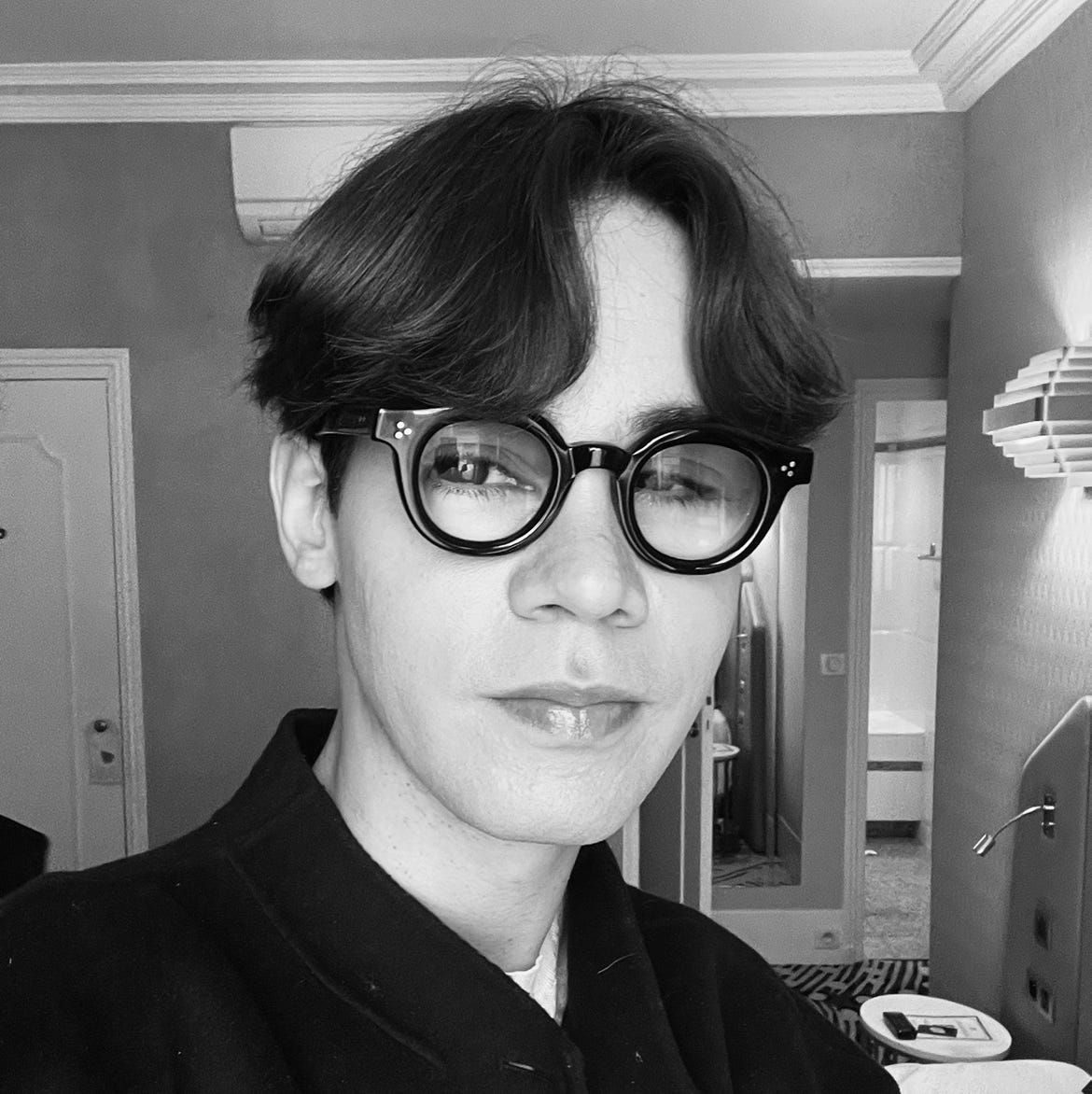
I grew up in Minas Gerais, Brazil, where the region’s rich cultural heritage, historic landscapes, and quiet beauty shaped my creative perspective from an early age. Later, moving to São Paulo exposed me to a vibrant world of fashion, art, and diversity, expanding my understanding of design and self-expression.
Today, living in Germany, I draw inspiration from the intersection of cultures and the constant dialogue between existing and living. My journey across these places influences both my work in fashion and my passion for writing. Through design and words, I explore themes of identity, movement, memory, and beauty, seeking to create meaningful connections between my Brazilian roots and the international experiences that continue to shape my vision.
I find a deep sense of peace in writing poems. For me, it’s a way to give shape to fleeting emotions. Each poem is a bridge between my inner world and a shared human experience.
What is your age, where in the world do you primarily live, where did you grow up?
I grew up in southeastern Brazil, more specifically in Minas Gerais. I lived there until I was 17, when I moved to Sao Paulo to pursue my dreams. Later on, I moved to Germany, where I still live now.
How do you define yourself on the LGBTQ+ spectrum?
I would say that identifying within the LGBTQ+ spectrum is a crucial foundation in who I am, but it doesn’t fully define me. Being part of this spectrum is a vital base in shaping my sense of self, and it also helped me realize, especially when I was younger, that there were others like me, and that there was nothing wrong with who I am.
When was your first intimate moment? Was it with someone you liked? Did you feel pressured into it?
Yes, my first intimate moment was when I had a crush on a boy at school. I started writing letters to him to express my feelings. It was an incredible moment, but I also felt some pressure—it was something different, yet it was very important in shaping who I am. It was the moment I realized that I truly liked boys.
How would you define love? Is it the thing you work at for a long period of time? Or is it the strong feeling you feel for someone right from the beginning for no reason?
Well, for me, I think the definition of love needs to be broken down first, because there is a kind of love that is sold to us in fairy tales, a love that is sold in movies, and many people end up comparing that kind of love—as if it were marketing—to absolute reality. That is not real.
So, for me, the first step is to break that cinematic idea of love and start from the premise that love can come in many forms. It can come as companionship; it can be a construction, a long cycle together. I believe that love is more of a building process of feelings and emotions over the years.
Does the relationship fill your deepest needs for closeness with a person? Or do you prefer not to share every part of yourself?
Well, I think that a relationship does not fulfill my deepest needs for closeness with another person. I feel that there are many parts inside me that I don’t even fully understand myself, so it would be almost impossible to expect that from a person or a partner.
For me, these deepest needs for closeness—this is something that a partner can never fully complement, because it is something between me and myself. And there is also a part of me that I don’t wish to fully explore. As the well-known German thinker Hannah Arendt once said, in a simple but very complex phrase: ‘Denken ist gefährlich’—thinking is dangerous. So, I prefer to keep that deepest part of myself with me, quietly, within myself.
When did you come out to family, friends and others for the first time?
This was something very interesting, because my father gave me a fashion magazine—since I’ve always been very interested in fashion—and I think it was at the time a magazine with an American model named Karlie Kloss. And he looked at me and said, ‘You don’t like women, do you?’ And I couldn’t answer him. I think that silence was clear to him—that, no, I didn’t like women, and I couldn’t answer him at that moment, but my silence was an answer.
So, for my father, it was something very interesting—there wasn’t a traditional coming out, per se, but rather a silent affirmation that served as a response. And for my mother, unfortunately, it was over the phone. And I think it was very clear that I didn’t like women.
I was always a bit more feminine; I always loved fashion, so it was something I lived a lot in my childhood, and many people didn’t question it, because it was a bit obvious. I didn’t need to say it—it was already there, out in the open. So, it was a natural process and a very peaceful process. It wasn’t painful, and it was really important, because my family and friends accepted me—it was a very calm acceptance, so to speak
Did you have any LGBTQ+ role models as a child or teenager? What do you remember about images of same-gender or queer relationships or messages you gleaned?
Unfortunately, I didn’t have any LGBTQ+ role models when I was a child or a teenager, and this is something I deeply feel needs to change in our society. It is not possible that in the 21st Century we are still questioning whether it is possible to be LGBTQ or gay or whatever. But we really need to introduce this in schools, introduce it everywhere, because all children should have a role model—and why not an LGBTQ+ role model? So, unfortunately, I didn’t had one.
What is your relationship with your biological family (if any)?
I was very lucky, and I need to acknowledge that, because this is not common. I know a lot of people have gone through difficulties, and my family served as a very deep and solid foundation in shaping who I am.
My family, from an early age, gave me a lot of freedom to express myself in the way I wanted, and I never faced much criticism. They never forbade me; my family never prevented me from being who I truly am. They always loved me a lot—my mother, my father—in their own way. And I am very fortunate to have grown up in my family, to have been accepted since I was a child. So, my relationship with my family is one of extreme trust, and we are very close.
What do you (did you) like about dating as a LGBTQ+ person? What do/did you dislike?
I think what I like about dating as an LGBTQ+ person is that we are very free to talk about sex, about all these nuances in sexuality, without fear, so I think we are very open, and we deal with sex in a more open way. But this also serves as something I dislike within it, because it exposes sexuality so much that it ends up becoming banal, something completely superficial.
Something else I always encountered, since I was very young living in São Paulo, was that it was a world—actually, I’m not sure if it is really the gay world—but I was inserted in this gay world where many people used a lot of drugs, and that was something I never really understood, and it’s something I have a bit of a fear of.
Has race, ethnicity or cultural differences been a factor in who you seek out?
I think that growing up in a poor family in the countryside of Brazil is something that still troubles me, even to this day. Because I didn’t have access to a university; I didn’t have access to many things that a middle-class family might have. So, for me, it was always very difficult; I always had to go against that, because in Brazil there is a kind of predestination.
If you are born into a poor family, I had to fight a lot, since my mid-teens, to accept—well, first to accept that I was born into a poor family—and to understand that this was just a phase, it was just a characteristic of my family or of the environment I was in. It didn’t mean I was destined to stay like that forever. So, for me, this held me back from achieving some things more quickly, but it also serves as an affirmation of where I come from.
Have you experienced heartbreak?
Yes, with my first boyfriend, I was very young at the time, completely insecure about myself, and it was something very painful, because I believe he was one of the men I loved the most in my life.
I remember even today—he was a guy a bit older than me at the time, and I was very young—and he used to tell me, “We’re not going to be together forever.” And I couldn’t accept that. I thought it was so strange for him to say that to me, because we were happy. Of course, we had our difficulties; especially now, looking back, it was mostly due to the fact that we had a big age difference. So, today, analyzing it, I realized it would never have worked, and that maybe he was realistic on that point, but it wasn’t easy to understand at the time—even because I couldn’t understand it then.
And I think that heartbreak was important for my feelings, to help me understand that maybe some people fall in love, but they won’t stay together forever—and that’s okay, because maybe love, in that moment, was a phase, and it can be a beautiful memory. I don’t know. So, that’s why I think heartbreak is something we need to experience in life, romantically.
Are there any things that standard heterosexual relationships have that you feel are out of reach or that you wish you had or could achieve?
I would say that for me, it’s the idealization of family, so to speak. Some heterosexual couples, or some heterosexual couples I have in mind, this… it’s this stability they have, with a family, with children, with work—everything. So, for me, this image of a perfect family, with kids, with procreation—all of that—it’s something I catch myself thinking about sometimes, whether it’s something I desire or wished I had experienced.
Have you had a difficult time navigating the “roles” you should play in a relationship?
I think the difficulty for me in understanding my role in a relationship is that it starts with understanding myself first. So, it’s something that, for me, comes from within—understanding who I am, and then being able to identify or embody what I am, what I want to be, and what I have the desire to be within the relationship. So, often, I place myself—well, it’s happened that I’ve been in relationships with older guys, and that can become a pre-determined role, or a role that’s kind of already there because I’m younger.
But over time, this question reshapes itself in my mind—whether it will always be like this, whether I’ll always be the younger one, always with an older person. But, for now, I think it’s about understanding how I am and how I function, and being able to express that in the relationship.
Any advice you’d give to someone younger than you who thinks it’s impossible to find love?
So, my advice would be this: Try to find love within yourself first. Spend time understanding how you work, what you accept or don’t accept, what you like or don’t like—because a lot of people, even before they talk about love, about the other person, they don’t understand themselves first.
And I think love is that: You understand yourself first, knowing how you love, how you care, how you deal with your passions, your hobbies. And then you understand how you function, and you can express that in relation to another person.
So, it helps you orient yourself. Thinking is a window that allows you to look out at everything around you and understand that there are nuances inside you that, even as you look out that window, you might not fully grasp—but you know they are there because you looked through the window. And you need to open that window first to be able to look outside.
So, my advice would be that: Think, spend time on how you function; think about your actions, first, before you think about finding love out there, beyond that window.
We all need more inspiration. Below, please recommend something that influenced or helped shape you significantly that you’d recommend to someone else.
Book: Réveries d’un promeneur solitaire is an essential work from; Jean-Jacques Rousseau, because it offers a profound introspection on solitude, self-discovery, and the complexity of human emotions. I recommend it to anyone seeking a deeper understanding of themselves
TV Show: Westworld
Movie: Persona by Ingmar Bergman
Song: “Wave” by João Gilberto
Comments
Nothing yet. Say the first thing.
Sign in to join the conversation.