
The reader may already know that modern cosmology tells us that the Universe began with a huge explosion, the famous ‘Big Bang’, about 13.7 billion years ago. According to this theory, in the past, all matter and energy were concentrated in a much smaller volume of space. Nowadays, we have strong evidence that the Universe is expanding; in fact, this expansion even seems to be subjected to an acceleration.
In the first phase of the Universe’s existence, matter and energy were subjected to such extreme pressures and temperatures that we can state with certainty that the laws of classical physics didn’t hold. To properly understand the physical conditions of the primordial Universe and the phenomenon that led to its origin, the laws of quantum physics are necessary for investigating the creation of energy and matter in the first place and nuclear physics to know how the first elements came into being. The former approach is that of quantum cosmology, while the latter developed into the theory of Big Bang nucleosynthesis (BBN).
Because the standard model (SM) of particle physics is a rock-solid theory which could not be superseded by a theory of quantum gravity (QG), likewise, while present quantum cosmology remains speculative, the foundations of modern cosmology are still rooted in very successful cosmological basics which were developed in the 1950s, on top of the discoveries of quantum physics and nuclear physics. Particularly successful in the microphysical domain became the theory of ‘Big Bang nucleosynthesis’, a well-established theoretical framework which describes the creation of the first light elements and which became the primordial bricks from which all the elements of the periodic table come. It received strong observational validation.
Nowadays, we know that most of the elements that built up the stuff of which we are made were not synthesized during the Big Bang phase. Rather, they were synthesized in the stellar interior through nuclear fusion processes. However, stars could come into existence only because of the elements created during the early phases of the Universe – first and foremost, hydrogen and helium and, to a much lesser degree, lithium and beryllium.
How do we know? Nuclear physics is a well established branch of science and its research is also facilitated by investigation with modern particle accelerators that can recreate, with few particles, the temperatures and pressures to which matter was subjected until about a few microseconds after the Big Bang. That’s another reason why particle accelerators are considered such important experimental tools. When particles are smashed against each other, they allow us to literally recreate ‘small bangs’. Moreover, a lot of evidence coming from astronomical observations made with powerful telescopes (on the surface as in space) has allowed us to collect a set of data which confirmed the theoretical predictions.
Immediately after the Big Bang, the Universe was still too hot to allow for the formation of not only atoms but also particles such as protons and neutrons. The Universe must have still been a ‘soup’ of even more fundamental constituents of matter – namely, a quark-gluon plasma. However, things changed quickly at those times: After about one microsecond, the Universe cooled down sufficiently to allow the quarks to bind together and form protons and neutrons (and other baryons – that is, particles made up of two or three quarks, which, however, decay quickly in protons or neutrons themselves). However, the temperature was still much too high to go beyond that; still no atoms could form. It took only another hundredths of a second of the Universe’s expansion to diminish the pressure and temperatures to about 10^9 K, which led to the formation of the first elements. At that point in time, the protons and neutrons (electrons, photons, and neutrinos as well, which we will not consider here) could form the first nuclei of the light elements through nuclear fusion reactions.
Fig. 1 provides a simple scheme of how the primordial elements were formed. This simplified Big Bang nucleosynthesis scheme can give you a glimpse at how the stuff that makes up stars was built from the bottom-up. For a more technical explanation see note1.
Right after the Big Bang, the universe was extremely hot and dense. During the first few minutes, particles were moving so fast that they constantly collided and sometimes stuck together. At first, there were mostly protons (hydrogen nuclei) and neutrons. These particles began combining through nuclear fusion, creating the first atomic nuclei.
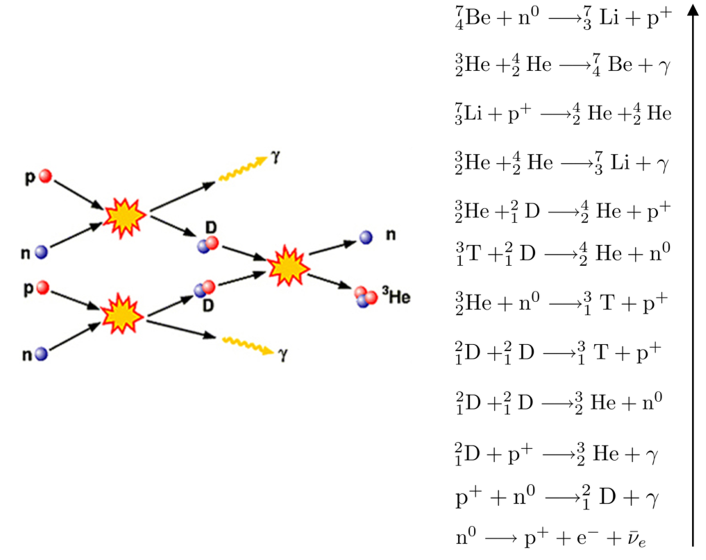
The process happened roughly like this:
Neutrons and protons combined
Some neutrons joined with protons to make deuterium, a heavier form of hydrogen.
Deuterium fused into helium
Deuterium nuclei collided with other protons or deuterium nuclei, producing helium nuclei and releasing energy as gamma rays.
Small amounts of heavier elements formed
Tiny quantities of helium-3, lithium, and unstable tritium and beryllium
were also produced.
However, the universe cooled very quickly. After only about three minutes, it was no longer hot enough for these nuclear reactions to continue.
The final result of this early “cosmic nuclear factory” was that about three quarters hydrogen (mostly protons), about one quarter helium, and only very small trace amounts of Deuterium, helium-3, lithium-7.
The heavier elements that make up planets, rocks, and living organisms (carbon, oxygen, iron, etc.) were not made in the Big Bang. They were created much later inside stars through stellar nuclear fusion and supernova explosions.
Thus, the first three minutes of the universe produced the simplest ingredients of the cosmos: mostly hydrogen and helium, with tiny amounts of lithium — the raw material from which stars later built all heavier elements.
This is what, in its essence, the Big Bang nucleosynthesis predicts. It is the result of a study first pioneered in 1948 by the Russian-American cosmologist George Gamow. He was also the first to predict the existence of a cosmic microwave background (CMB) with a blackbody spectrum. (His guess was 5 K temperature, against the observed 2.7 K.) However, Gamow did not realize that all the elements could be produced in the early Universe.

His co-workers, Ralph Alpher and Robert Herman, completed the theory by pointing out how there couldn’t be enough time to synthesize heavier elements. These could come only afterward by means of nuclear fusion reactions inside the stars. That’s why you might have heard scientists say that we are ‘stardust’. The elements heavier than lithium of which our bodies are made (especially carbon, oxygen, iron, and other building blocks essential for the emergence of life) were synthesized in a stellar furnace billions of years ago by a progenitor of our Sun and then were ejected into the solar system through a supernovae explosion.
The Big Bang nucleosynthesis is not just a theory. Nowadays, it is backed by solid observational evidence. In fact, it makes clear cut predictions which can be tested observationally—namely, that once the average density of matter in the universe is known, the model fixes a precise abundance of deuterium, helium, and lithium relative to hydrogen. The result can be summarized as what is known as the ‘Schramm’s plot’ of the primordial abundances (see Fig. 3—notice that the axes are drawn in logarithmic scale). We already knew of these relative abundances from astronomical observations coupled with spectroscopic analysis of the light coming from throughout the Universe, which indirectly furnished the universal density of matter and radiation. The matter density of the Universe, being defined as the ratio between the number of all baryons (essentially, protons plus neutrons) and the number of photons, could be measured directly. In fact, this is what the Wilkinson Microwave Anisotropy Probe (WMAP) satellite did by measuring the CMB. The CMB that we can observe in the sky today is the microwave radiation left from the Big Bang ‘echo’ corresponding to the ‘recombination epoch’, in which the electrons began to combine with the nuclei synthesized earlier and created the lighter chemical element atoms. This recombination epoch dates back to about 380,000 years after the Big Bang. The analysis of the CMB, such as the density of radiation, also furnishes the density of matter.
WMAP furnished a value of a ratio of about 5x10^-10 baryon to photon density (the vertical line in Fig. 3). Therefore, on average, there are two billion photons for every proton or neutron in the Universe. When one plugs this into the Big Bang nucleosynthesis theory (the curves in Fig. 3), the relative light element abundances are fixed. The dashed rectangles represent the observed abundances (obtained with optical and/or radio telescopes.)
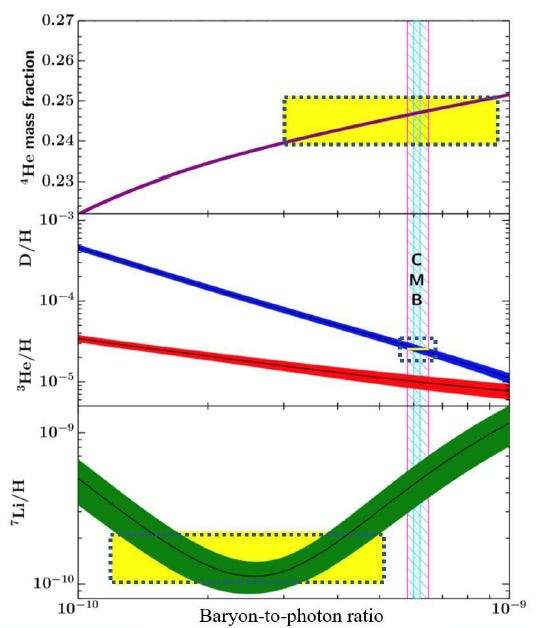
It turns out that under these conditions, the mass fraction of is roughly 24-25% that of hydrogen. Thus, shortly after the Big Bang, about ¾ of matter was hydrogen and ¼ helium. Only as little as of the D/H fraction (0.0015%) is left for deuterium, with one part over for (0.001%). Notice how the observed primordial abundances—the dashed rectangles–contain the predicted and observed data.
Unfortunately, this is not so for lithium-7. The observed Li/H relative abundance is about 1-2 x 10^-10, but what is predicted is 5 x 10^-10 — that is, lithium appears to be about three to four times less than predicted by the BBN model. This inconsistency is called the ‘cosmological lithium problem’. So far, different hypotheses have been developed to explain it. One possible explanation is that some yet-to-be-discovered nuclear mechanism, which goes beyond the presently known standard model of particle physics, was at work.
However it is, for all other elements produced shortly after the Big Bang, the theory conforms well to the measured data. This can’t be just a coincidence and is taken as a reassuring sign. This neat correspondence between observational data and theory (together with the neat match we could observe with the black body spectrum of the CMB) assures scientists that the basic mechanisms with which elements were synthesized during the first three minutes after the Big Bang theory are understood. Moreover, it is another nice example of the history of science in which particle physicists studying the microcosm collaborated successfully with astrophysicists investigating the macrocosm.
The history of the Universe could be graphically summed up as shown in Fig. 4.
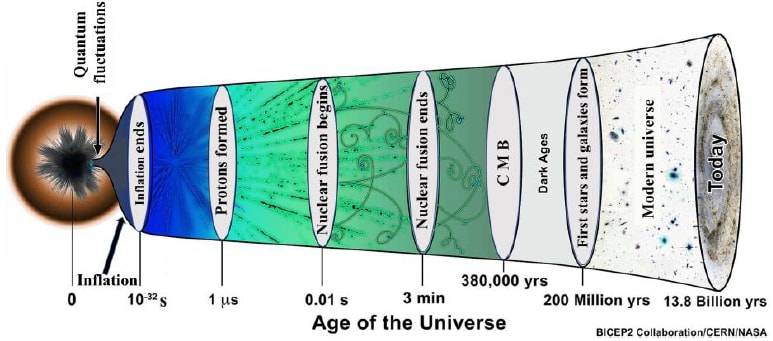
During the time between 380,000 years and 200 million years after the Big Bang, the Universe must have been a boring and dark place, as photons were all high-energy light particles invisible to the human eye. However, the temperature after recombination was still about 3000 K. Only at the end of these 200 million years did the Universe cool down sufficiently to form giant hydrogen clouds, which collapsed due to the gravitational pull forming galaxy clusters, galaxies, and stars and where, later on, planets could form.
The BBN model works remarkably well back in time to about one second after the Big Bang. Before that point, different physics becomes dominant, and we can only speculate about what happened. To describe this earliest phase of the Universe, we would need a theory of quantum gravity, which still doesn’t exist. In the next article, I will discuss what might have occurred even earlier—before the “era” described above—namely, the phase of cosmological inflation, which is thought to have taken place almost instantaneously after the Universe’s beginning.
If you find my work valuable, I would greatly appreciate your support. Explore more of my work and discover my books and courses.
You can also help me continue this journey by buying me one or more coffees.
And, you can…
Thank you for being part of this journey! 🙏
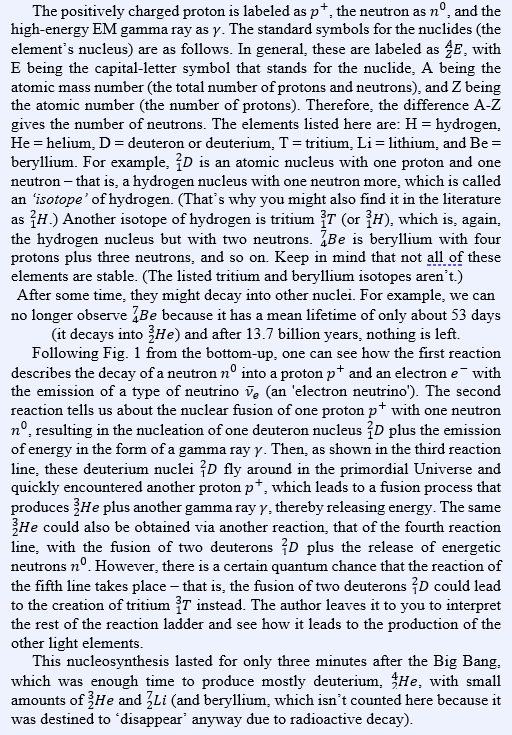
Unfortunately Substack does not offer inline Latex renderings. This is a severe limitation for anyone writing scientific articles! So, I just use the screenshot of it here.
.
No posts
Comments
Nothing yet. Say the first thing.
Sign in to join the conversation.