
Let us cut through it: This issue shows quantum’s bruising evolution from lab curiosity to something resembling commercial momentum, but the signal still lives in the research—and in the hard engineering. Northwestern University gave a sober demonstration of entanglement over 24 kilometers of live telecom fiber, running quantum and conventional internet side-by-side with over 94% fidelity. This undercuts hand-wringing about separate quantum networks—real-world coexistence is on the table. Meanwhile, University of Stuttgart’s team took a crucial, unsung step toward scaling Rydberg atom architectures, taming 2,000 laser beams in a compact system that could run into the thousand-qubit regime. Alaina Green, Norbert Linke, and collaborators showed that quantum machines’ own randomness—plus a chip’s native errors—can sometimes help neural net accuracy, flipping the usual “errors are fatal” script. PsiQuantum landed a $125 million Defense Advanced Research Projects Agency contract—its single biggest government win yet—to prove its photonics tech as part of DARPA’s Quantum Benchmarking Initiative. IBM doubled down on hardware diversity by acquiring HRL Laboratories, dragging spin qubits into its once-superconducting-only playbook, neatly folding HRL’s tooling into its New York chip operations. Not content with M&A, IBM also pledged up to $50 million in quantum access for the U.S. Department of Energy’s Genesis Mission, touting its Heron and Nighthawk systems for energy and security research. Pair that with Quantinuum and SoftBank’s joint white paper, which rather than blue-sky speculation, maps specific industrial use cases (think materials and fraud) to concrete hardware roadmaps and business models. Industry theater is alive but less fragile than before. SAXON Q, a Leipzig spinoff, unveiled diamond NV-center quantum machines that don’t need cryogenics, slotting straight into a server rack at 128 or 512 qubits—a technical and logistics play to make adoption less exotic. Infleqtion, not one to miss a headline, set sights on a 2027 deployment of its fault-tolerant neutral-atom system in Illinois, with a roadmap targeting 50–100 logical qubits and hybrid workflows via NVIDIA. Finally, Quantinuum stitched in Qedma’s quantum error mitigation software for enterprise workloads—a tactical move to get more mileage, and less noise, out of existing circuits. Bottom line: engineering is outpacing hype, but almost everything depends on whether these advances translate to real, reliable workloads—outside the press room and inside the datacenter. Let’s see who delivers.
Share for not Diamonds
Quantum Bits with Quantessa & Atomique
Latest strip published July 26, 2026 · by Yuval Boger
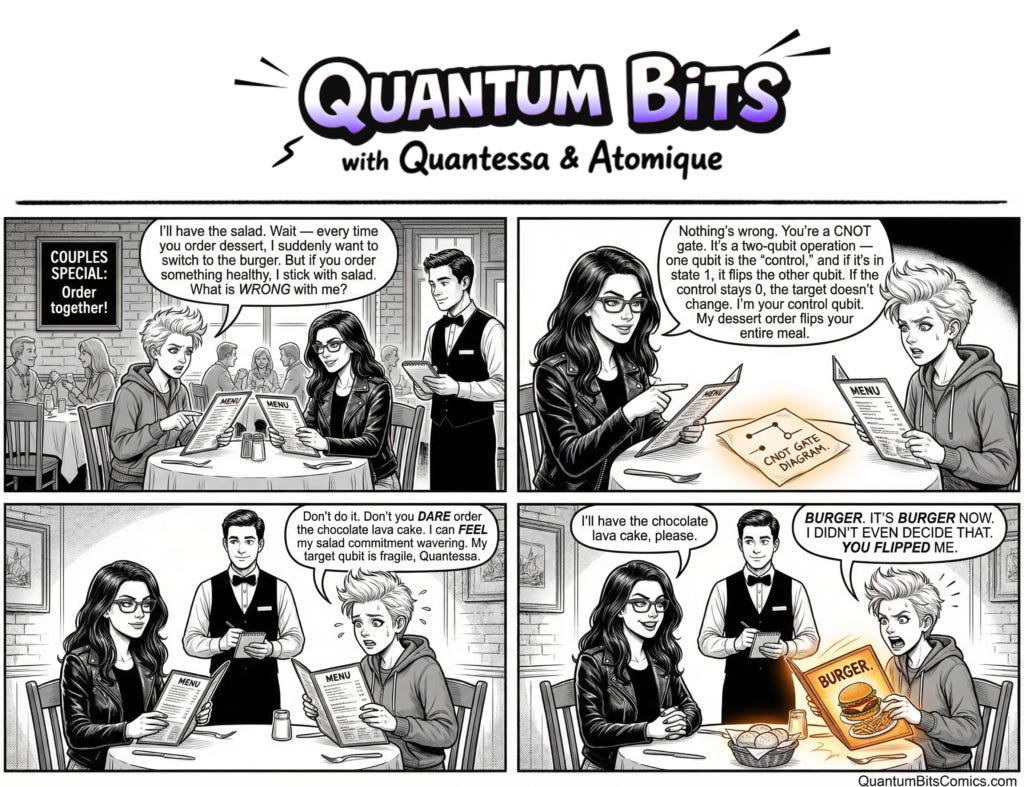
The CNOT (Controlled-NOT) gate is the standard two-qubit gate in quantum computing. It takes two qubits as input: a control qubit and a target qubit. If the control qubit is in state 1, the target qubit is flipped (0 becomes The post Controlled Not Gate first appeared on quantumbitscomics.com .
Read the full comic on Quantum Bits Comics
AI’s rapid growth is already straining global power grids — and the enterprise bottom line. It leans on error mitigation techniques, which are co-designed with the compiler and therefore tailored to IonQ’s hardware architecture, to mitigate operational noise and extract substantial utility out of existing quantum hardware. Exponential scaling paradox Since ETS is a key metric, the IonQ researchers compared and contrasted the energy needs of classical computing simulations and quantum runs on the Forte Enterprise processor.

Researchers at the Simons Foundation’s Center for Computational Quantum Physics, collaborating with Boston University, have solved a quantum simulation problem previously believed to require quantum hardware using only an ordinary laptop and advanced mathematical techniques.
Quantinuum and Softbank have jointly published a white paper, “Quantum Computing Frontiers,” which analyzes how advances in quantum hardware and algorithms could enable practical industrial applications in fields like quantum chemistry and graph analytics. The report maps these use cases against Quantinuum’s hardware roadmap, focusing on areas such as materials discovery and large-scale fraud detection that SoftBank is already researching with Quantinuum’s systems. The findings are intended to guide strategies for future quantum AI data center services and business models as the technology matures.
IBM has announced the acquisition of HRL Laboratories, a private quantum computing research lab previously owned by Boeing and General Motors, in a move that establishes a two-pronged approach to its quantum computing initiatives. Traditionally, IBM has focused on building quantum devices using superconducting circuits, but with the HRL deal, it will add electron spin-based qubits to its capabilities. HRL’s expertise will be integrated into IBM’s operations, including chip manufacturing at IBM’s facility in New York, to accelerate the development of spin-based quantum technologies.
Related coverage: IBM acquires HRL Laboratories to advance spin qubit and quantum computing technologies
Northwestern University researchers have achieved the first real-world distribution of entangled photons over a 24.4-kilometer fiber-optic cable running between Evanston and downtown Chicago while the cable simultaneously carried high-capacity internet traffic. By transmitting quantum signals alongside conventional data streams in the same fiber, they demonstrated that quantum entanglement could be preserved with over 94% fidelity, even amid heavy optical traffic. This advance shows that quantum networks could be built using existing telecommunications infrastructure, and the team now aims to enable quantum teleportation over similar commercial links.
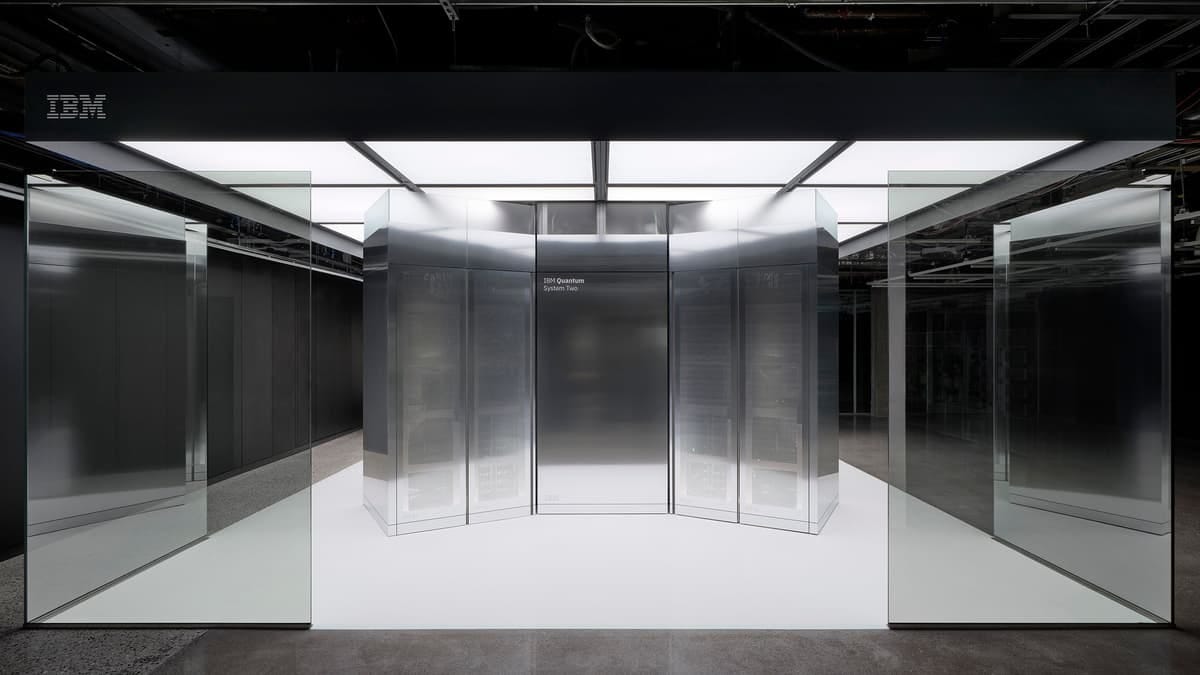
IBM has pledged to provide up to $50 million in quantum computing access to support the U.S. IBM’s contribution includes quantum system access powered by its 156-qubit Heron and 120-qubit Nighthawk processors, which will be made available to DOE national laboratories and collaborators over five years. The goal is to accelerate scientific breakthroughs in areas such as energy and national security through combined compute platforms and innovative research workflows.
Researchers at the 5th Physics Institute, University of Stuttgart, have reached a major milestone in their Rydberg atom-based quantum computer project by commissioning an advanced laser-optical system developed with the Fraunhofer Institute for Laser Technology. The technology integrates over 150 components into a compact footprint and uses 20 acousto-optic modulators to rearrange atom positions dynamically during computation. Following successful initial tests, the team aims to investigate fault-tolerant architectures with several hundred to a thousand qubits, advancing the prospects for scalable quantum computers based on neutral atoms in Germany.
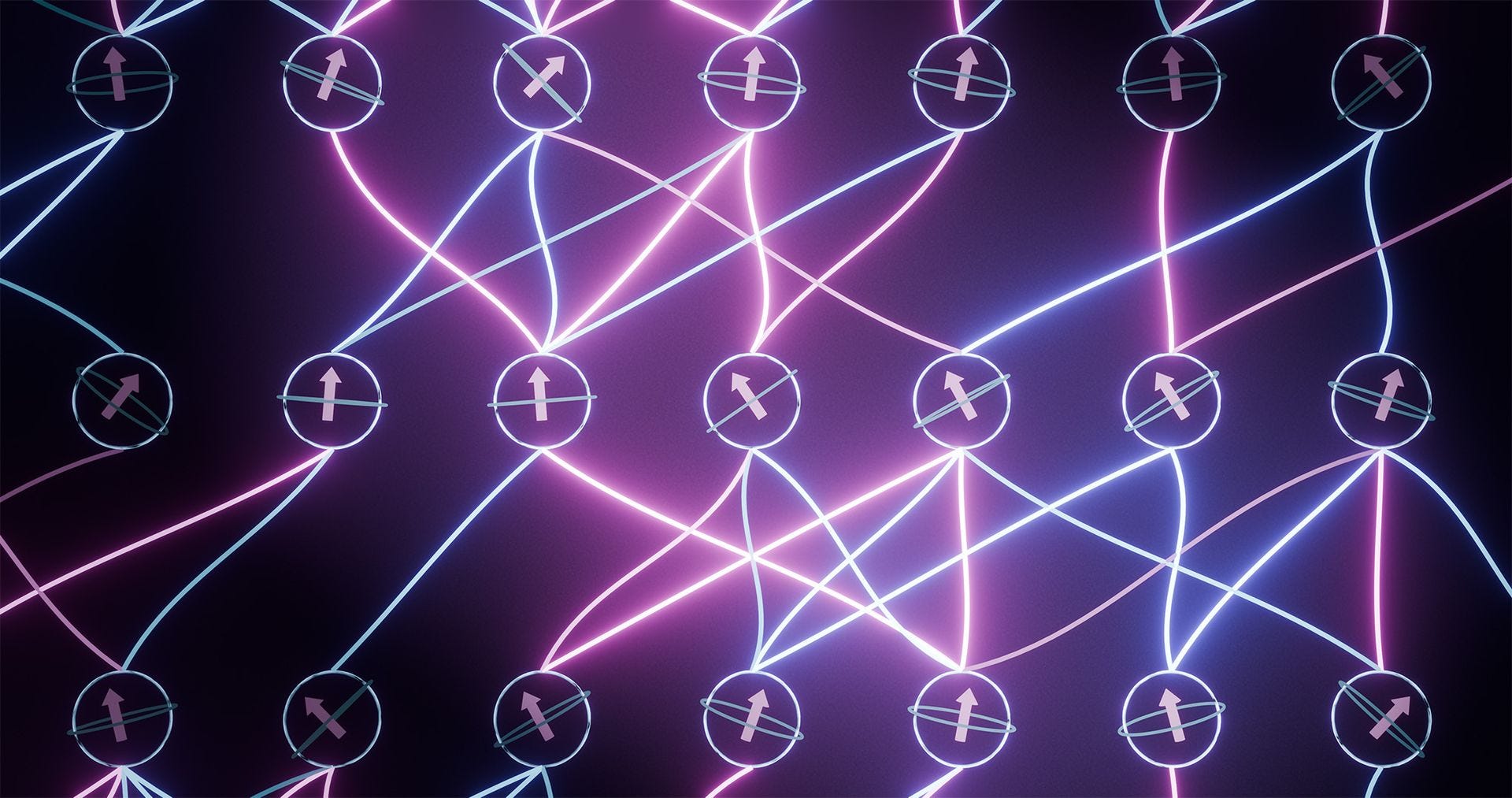
A team of researchers from the NSF Quantum Leap Challenge Institute for Robust Quantum Simulation, in collaboration with the Joint Quantum Institute and IBM, has demonstrated that quantum measurement-induced randomness, and even some hardware errors, can improve the performance of neural networks running on quantum computers. Results showed that introducing an optimal level of quantum randomness during inference led to higher accuracy in cases where classical or zero-randomness approaches failed.
PsiQuantum has secured a $125 million contract with the U.S. The agreement is part of DARPA’s Quantum Benchmarking Initiative, which seeks to assess the possibility of creating an industrially useful quantum computer by 2033, and will fund comprehensive testing of PsiQuantum’s photonics-based quantum hardware and software. Defense Advanced Research Projects Agency (DARPA), representing its largest government award so far.
The infrastructure will integrate at least three different quantum processing technologies and serve as a national center for the evaluation, integration, and adoption of quantum computing technologies. This is not merely an investment in technology, it is an investment in Israel’s future, its resilience, and its ability to lead the economy of the 21st century.” Dror Bin, CEO of the Israel Innovation Authority: “Quantum computing is expected to fundamentally transform the way industries address highly complex computational challenges. The national quantum computing infrastructure is a cornerstone in building an ecosystem that connects academia, industry, and government, accelerates breakthrough innovation, and reinforces Israel’s position as a global innovation powerhouse.

SAXON Q, a Leipzig University spinout, has commercially launched two room-temperature diamond quantum computers, the SXQ128 and SXQ512, that fit ordinary server racks and require no cryogenic cooling. These systems are claimed to be the first diamond-based NV-center quantum computers exceeding 10 qubits to reach the commercial market, with the SXQ128 offering 128 qubits and the SXQ512 scaling to 512. The company’s goal is to make quantum computing more accessible by removing the specialized infrastructure barrier, opening adoption to enterprise and research users who previously could not justify cryogenic systems. The real-world impact will depend on customer results, but this marks a significant step toward wider quantum hardware deployment.
Infleqtion announced plans to deploy a fault-tolerant neutral-atom quantum computer at the Illinois Quantum & Microelectronics Park, with installation targeted for 2027. The upcoming system, known as Sqale, aims to demonstrate over 50 logical qubits en route to a 100-logical-qubit milestone, and is architected for scaling beyond 1,000 physical qubits, backed by integration with NVIDIA NVQLink for hybrid quantum-classical workflows. Access to the platform will be provided via Infleqtion’s Superstaq software through the National Quantum Algorithm Center.
Qedma has integrated its Quantum Error Suppression and Error Mitigation (QESEM) software with Quantinuum’s quantum computing platform, aiming to boost circuit fidelity for research and enterprise users. This collaboration, developed through Quantinuum’s Startup Partner Program, allows clients to apply Qedma’s error suppression techniques directly to their quantum computations, supporting more complex workloads and higher accuracy than previously possible. The integration is intended to accelerate advanced research and widen the range of real-world quantum applications, with both companies highlighting their commitment to expanding software-hardware synergies for commercial and scientific advancement.
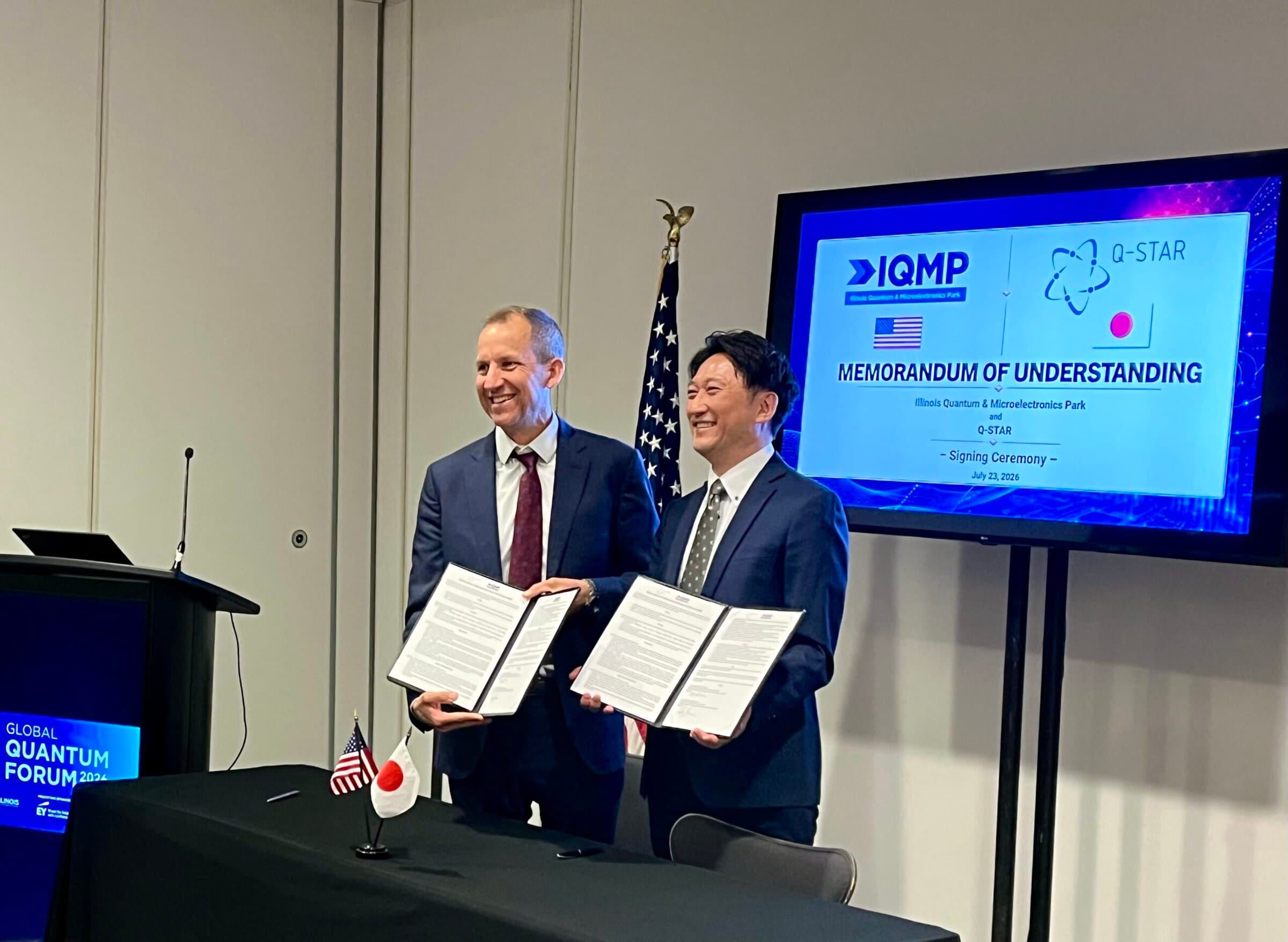
The Illinois Quantum and Microelectronics Park (IQMP) and Japan’s Quantum STrategic industry Alliance for Revolution (Q-STAR) have formalized a memorandum of understanding to deepen collaboration between the quantum technology sectors in Illinois and Japan. Signed at the Global Quantum Forum in Chicago by leadership from both organizations, the agreement focuses on fostering access to funding, networks, and investment for startups and small to medium enterprises in both regions. The partnership also aims to spur joint research, technology co-development, and supply chain growth by connecting companies, universities, and research institutions across Illinois and Japan.
The Trump administration has committed more than $5 billion to the Genesis Mission, a substantial national initiative aimed at advancing the use of artificial intelligence for scientific research. Led by the White House and launched in late 2025, the project involves over 15 federal agencies contributing resources ranging from research awards to specialized datasets and research facilities. The initiative is positioned to foster faster medical breakthroughs, improve infrastructure resilience, enhance national security, and strengthen America’s leadership in AI and science.
Related coverage: Argonne National Laboratory develops AI agent to automate and optimize quantum circuit design for nuclear physics · AI-Enabled Optimization of Quantum Circuit Design for Realistic Nuclear Problems | Argonne National Laboratory
Terra Quantum and Apex.AI have jointly succeeded in implementing NIST-approved post-quantum cryptography to secure communications between Apex.AI-based robotic systems and cloud control platforms.
The collection is organized into categories including programming frameworks like Qiskit and Cirq, simulators, compiler tools, error correction libraries, and educational tools, as well as algorithm and hardware platform repositories. Maintained collaboratively by researchers and developers from major quantum organizations, this resource is designed as a living directory that efficiently connects users with mature industry tools and emerging research projects.

IQM and Deutsche Bahn have jointly demonstrated a hybrid quantum-classical algorithm for optimizing railway scheduling using real operational data. Results showed the method yields feasible solutions with current hardware, with the quality of solutions improving as quantum processors handle larger subproblems—suggesting the approach will scale with advancing hardware.
Related coverage: IQM and Deutsche Bahn Demonstrate Quantum Algorithm for Railway Scheduling on Real Operational Data - HPCwire
No posts
Comments
Nothing yet. Say the first thing.
Sign in to join the conversation.