
Where Future Leaders Come to Learn.
Learn one powerful management idea every day and sharpen your business thinking.
A 5-minute learning loop: understand → observe → reflect.
Each issue breaks down one idea used in real business decisions.
Organizations often try to solve problems using:
established best practices
structured planning
linear analysis
detailed forecasting
Sometimes this works extremely well.
And sometimes, it makes the situation worse.
Why?
In leadership and complexity science, this is explained through:
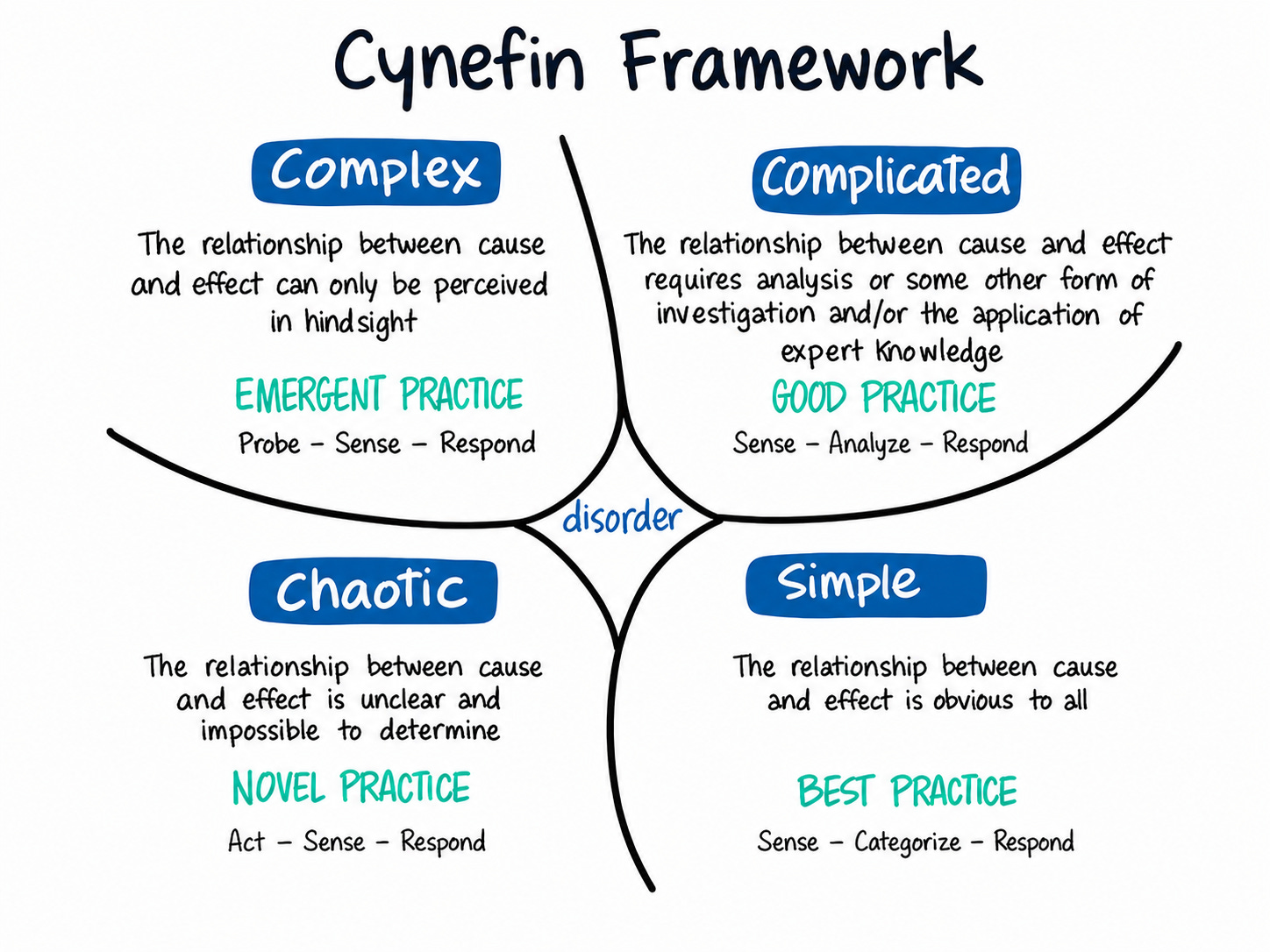
Cynefin Framework (Dave Snowden, 1999)
The Cynefin Framework argues that:
Different types of problems require fundamentally different approaches to decision-making.
The framework separates situations into distinct environments:
Obvious → clear cause-and-effect relationships
Complicated → expert analysis required
Complex → outcomes emerge unpredictably
Chaotic → immediate stabilization required
Which means:
The nature of the environment should determine the decision-making approach.
To evaluate a problem using the Cynefin Framework, ask:
1️. Is the relationship between cause and effect obvious?
(clear procedures vs uncertainty)
2️. Does solving the problem require expert diagnosis?
(technical expertise, specialized analysis)
3️. Are outcomes unpredictable even after analysis?
(emergent behavior, rapid change, interdependent systems)
4️. Is the situation unstable enough that immediate action matters more than analysis?
(crisis response, operational breakdown, reputational emergencies)
This shifts leadership thinking from:
“What is the best solution?”
to
“What kind of environment are we operating in?”
Let’s take Netflix during its transition from DVD rentals to streaming.
At the time, the streaming market was not an “obvious” or fully predictable environment.
Consumer behavior, infrastructure adoption, and competitive dynamics were still emerging.
1️. Was the cause-and-effect relationship obvious?
No.
It was unclear:
how quickly streaming adoption would grow
how customers would respond
whether internet infrastructure could support scale reliably
2️. Could the situation be solved purely through expert analysis?
Only partially.
Traditional forecasting models could not fully predict:
changing consumer behavior
platform dynamics
evolving content consumption habits
3. Were outcomes emergent and unpredictable?
Yes.
The market evolved through:
experimentation
user adoption patterns
technology improvements
competitive reactions
Netflix had to continuously learn and adapt in real time.
4. What decision-making approach became necessary?
Instead of relying only on long-term prediction, Netflix:
experimented aggressively
adapted iteratively
evolved the business model continuously
The environment was not merely “complicated.”
It was:
“Complex”.
And that required a fundamentally different leadership approach.
Strong leaders understand that:
not all problems behave similarly
not all environments are predictable
not all decisions can be optimized linearly
They adapt their thinking to:
The nature of the system itself.
No posts
Comments
Nothing yet. Say the first thing.
Sign in to join the conversation.