
In this session, we reviewed ‘Latent Lie-Poisson Neural Networks (LLPNNs): Discovering the motion of Lie-Poisson systems through observable data and latent dynamics’, a paper on learning physical dynamics when the variables we can observe are not necessarily the full dynamical state.
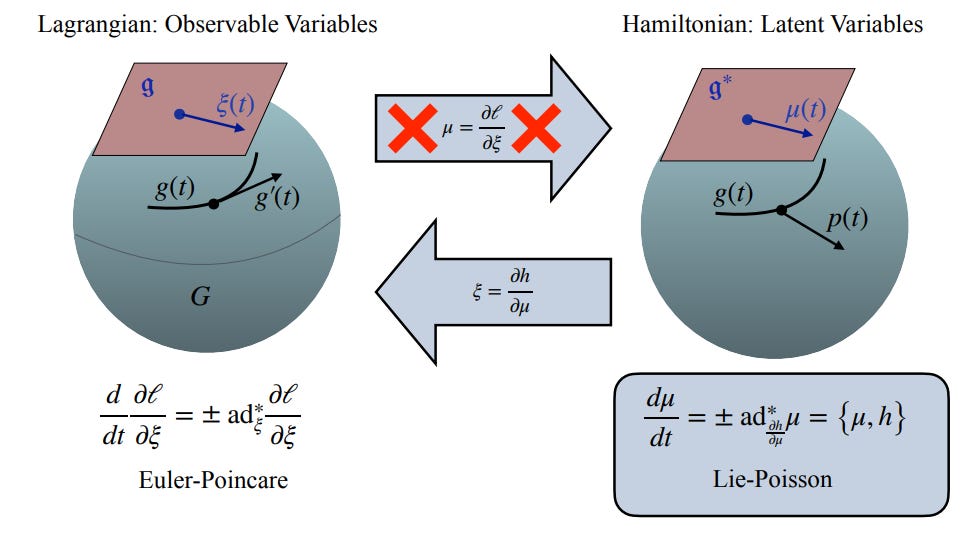
In many mechanical and control systems, quantities such as configuration and velocity may not be enough to determine future evolution. The paper reconstructs hidden momentum variables using known Lie-group symmetry and Noether’s theorem, then learns either a Hamiltonian or a pseudo-Lagrangian while preserving the Lie-Poisson structure.
We also discussed a possible connection with Yann LeCun’s JEPA (Joint Embedding Predictive Architecture) and world models. JEPA learns to predict in a latent representation space instead of reconstructing raw inputs such as pixels. In this paper, prediction also uses a latent state, but that state is much more tightly constrained by the known geometry and physics of the system.
Minor correction: This was a live session, so there are a few minor verbal slips. In particular, at one point the host says “pseudo-Hamiltonian” when he meant pseudo-Lagrangian. This does not affect the main discussion of the paper.
Mathematical foundations: To understand the paper in depth, it helps to have some background in Lie groups and Lie algebras, Hamiltonian and Lagrangian mechanics, Poisson and Lie–Poisson systems, symmetry reduction, Noether’s theorem and geometric integration. QF Academy offers foundational training to help you build the mathematical background needed to engage with papers of this nature:
Special shout out to our community member who joined us while on holiday in Baton Rouge, Louisiana. Thank you for tuning in and for asking some interesting questions! :)
Link to the paper: https://arxiv.org/abs/2607.28939
GitHub code: https://github.com/vputkaradze/LLPNNs
Wishing you a great new week ahead.
Quantum Formalism (QF) team
Comments
Nothing yet. Say the first thing.
Sign in to join the conversation.