Formal verification of quantum ancilla safety is now possible for circuits scaling to thousands of qubits, offering a complete workflow previously unavailable. This framework not only diagnoses faults but also guides repair, decomposing the verification of a register of *m* qubits into 2*m* independent checks. By decoupling verification from the underlying symbolic engine, a new avenue opens for…
Can a quantum computer cool its own components mid-calculation without losing information. This work demonstrates single-species cooling of a mixed qubit state, a technique previously requiring complex multi-species trapped ion systems or lacking a method to recool qubits. This advance unlocks non-destructive readout and paves the way for scalable, error-corrected computation.
A two-qubit controlled-Z gate now reaches 0. 9999 fidelity, exceeding the performance of previous methods. This level of precision is maintained even with fluctuations of up to ±2% in Rabi frequency and ±1% in detuning, a considerable improvement over existing approaches.
By 2030, existing digital encryption could be broken by emerging quantum computers, threatening secure communication worldwide. Addressing this, a new “Pathways Plus” programme is pioneering accessible quantum education, moving beyond traditional methods that struggled to visualise complex concepts. New tools, including quantum virtual labs and ZX calculus, aim to equip high-school and…
Any distributed quantum algorithm guaranteeing a perfect 3-coloring on a cycle of computers demands Ω(n) communication rounds. This establishes a definitive limit, demonstrating quantum computation offers no speed-up for this symmetry-breaking problem, unlike previous bounds reliant on physical causality. This work presents the first genuinely quantum lower bound, distinguishing quantum from…
Error correction between logical operations has moved from requiring a number of syndrome extractions proportional to system size, denoted as O(d), to effectively zero. This advance, enabled by transversal CNOT gates, promises faster quantum computations but introduces a substantial challenge for classical decoders. PACE, a new scheduling framework, directly addresses this bottleneck by…
A complex quantum calculation previously requiring thirteen controlled-NOT gates now operates with just twelve. This reduction, alongside the lowest measured circuit depth, represents a tangible step towards minimising error rates in quantum processors. The new circuit achieves this optimisation while adding only two additional single-qubit gates compared to existing methods.
LMU researchers are advancing perovskite solar cell technology, with support from german funding, to explore applications in quantum technology & beyond.
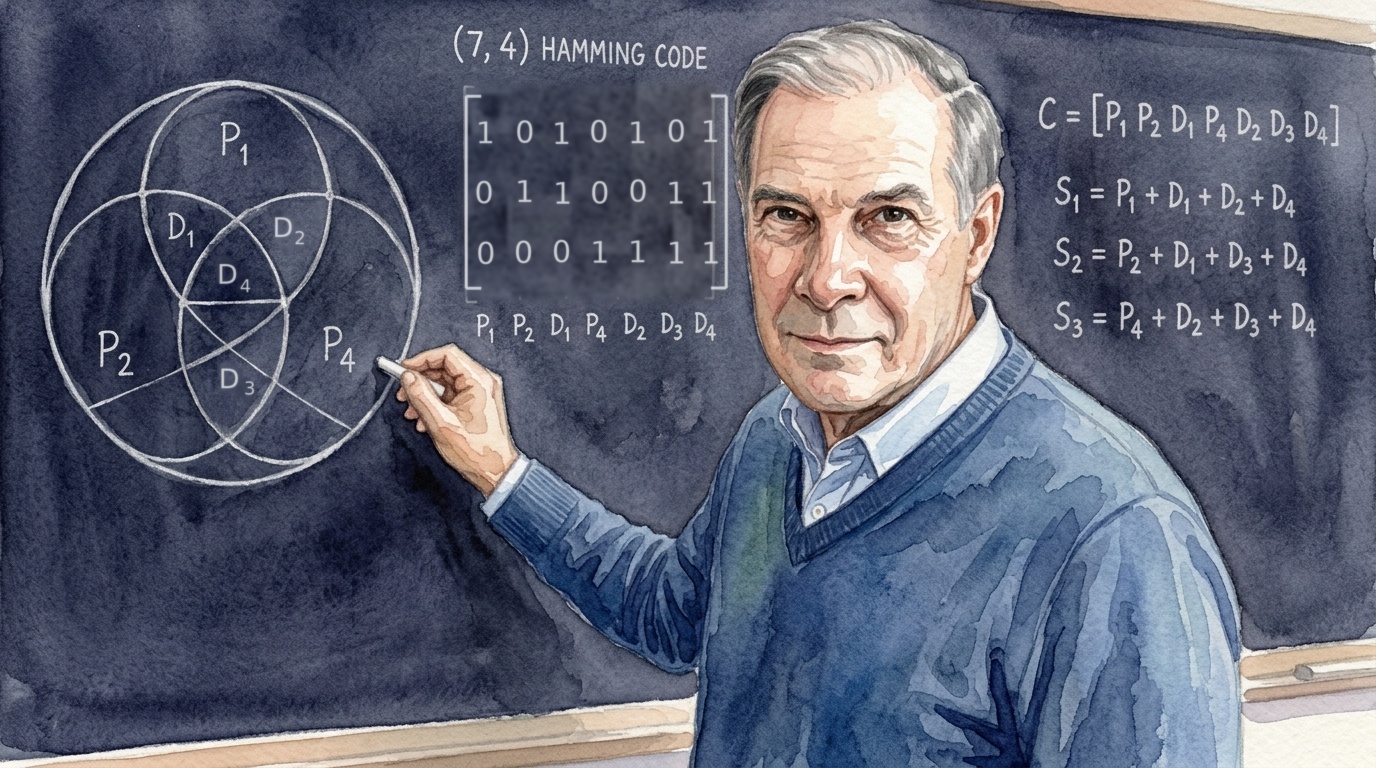
Richard Hamming built the first error-correcting code in 1950. The classical [7,4,3] Hamming code he wrote is a literal component of the quantum Steane code.
In this work, researchers address designing single-qubit quantum gates by means of a linearly-polarized field, showing any desired one-qubit gate can be generated by a modulated sinusoidal field with only the rotating-wave-approximation. Building high fidelity quantum gates is a fundamental task for quantum computing, as these logical gates are generated by electromagnetic control pulses.
University of Connecticut research details a perturbative theory predicting the height & timescale of prethermal plateaus, seen in quantum systems with long-range interactions.
A step-by-step walkthrough of lattice encryption using numbers small enough to check on paper. We build a key, encrypt a single bit, decrypt it, push the noise until the bit flips, and then break the scheme two different ways. Every value comes from code that was actually run.
Testing Lorentz invariance violation (LIV) is notoriously difficult, as its characteristic energy scale typically lies beyond current experimental reach. Applying this to the polymer-quantized scalar field theory, results show detector’s quantum coherence exhibits a pronounced dependence on rapidity and undergoes a sharp transition near a critical rapidity, a value within reach of existing…
This study explores Einstein crystals within Snyder and Snyder-de Sitter noncommutative backgrounds, revealing how noncommutativity alters internal energy and specific heat.
Lattice-based cryptography is the mathematics behind ML-KEM and ML-DSA, the post-quantum standards NIST published in 2024. This guide works up from what a lattice is, through the Shortest and Closest Vector Problems, Learning With Errors and its ring and module variants, to the protocols themselves and an honest account of why lattices are believed to resist quantum attack.
Welcome to this week’s quantum technology digest. The articles below cover advances across the quantum computing stack, from hardware development and error correction to algorithmic improvements and commercial growth. Several companies reported significant progress this week, indicating continued momentum in the field. This week’s updates demonstrate a clear focus on scaling and refinement.…
The Ethereum Foundation is redirecting its focus from the Poseidon hash function to established cryptographic methods, like SHA and BLAKE, to maintain post-quantum security and dependability. This shift signals a move toward enhanced protection against threats posed by quantum advancements, not just for Ethereum, but for the entire blockchain community.
Italy’s €2 billion Einstein Telescope project faces new scrutiny after an arson attack on August 1st targeted scientists in Lula, Sardinia, the proposed site.
Columbia University hosted its first Columbia Quantum Industry and Investor Workshop on August 10, bringing together industry and Columbia quantum faculty to explore emerging quantum research. The event showcased Columbia’s expertise and discussed use cases for quantum technologies, as combining research and innovation resources is needed to unlock the next generation of quantum applications.
Researchers halved the relaxation rate of a logical qubit, a key step toward fault-tolerant quantum computing, using a chain of superconducting qubits.
Quantum gate design is often represented as pulse optimization, although the physical object is the full controlled evolution generated by the pulse. Researchers at Shaanxi Normal University and Xi’an University of Posts and Telecommunications used physics-informed neural networks to represent single-qubit gate design at the evolution level, learning control fields, Bloch-state trajectories, and…
Researchers from Ghent & Vienna stabilized calculations of PEPS gradients, a key challenge in variational optimization, using implicit differentiation techniques.
This research demonstrates how Machine Learning enhances Quantum Sensing to track the phase of a three-level delta system, specifically analyzing the plaquette phase.
Trivalent qubit layouts—using degree three connectivity—can reduce two-qubit gates needed for lattice surgery, and thus the fluxonium cut, by an order of magnitude.
A new theoretical description of strong coupling relies on revealing three unknown parameters, and a proposed experimental protocol, using quantum dot devices, can measure them.
Finite entanglement scaling is a pillar of the tensor network ecosystem, and this paper resolves the open problem of determining perturbations induced by matrix product state approximations of critical systems. The authors demonstrate these perturbations can differ from those predicted by conformal field theory, developing a sparse linear solver to calculate derivatives of 2-dimensional tensor…
Columbia Quantum Initiative received 31 active research grants totaling over $66 million during the period of July 2025 to June 2026. The initiative includes 37 core faculty members and saw 39 PhD students graduate in 2024 and 2025, alongside 41 students enrolling in Columbia’s Quantum Science & Technology Master's Program.
Researchers used the periodic-orbit framework to study the integrable XYZ/XXZ spin-1/2 chain, tracking how these orbits relate to quantum many-body scars and Bethe ansatz solutions.
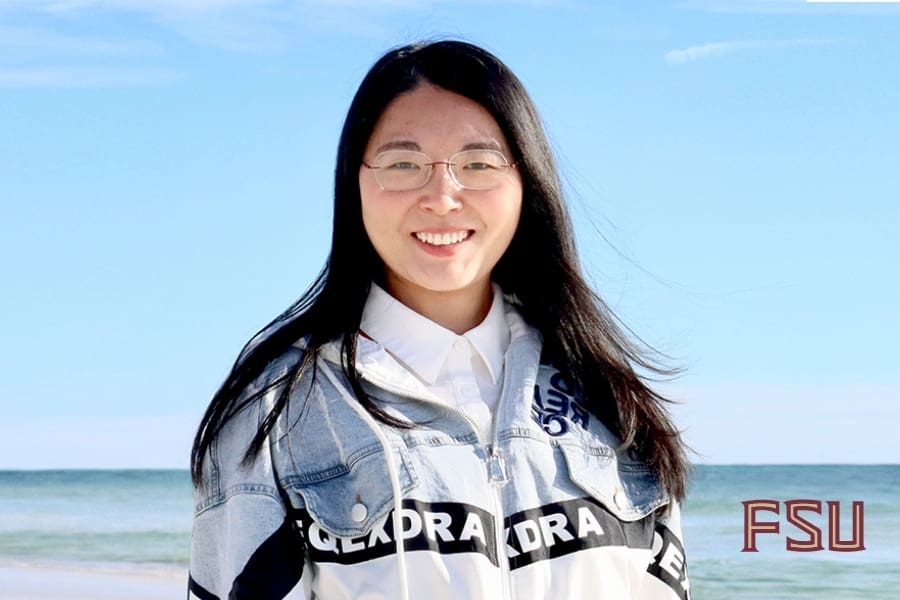
Assistant Professor Xiaonan Zhang, a Florida State University computer scientist, has received a 2026 NSF CAREER Award to advance collaborative AI systems, with five years of funding.
New Horizons in Quantum Gravity, April 11-16 2027 at Ecole de Physique des Houches, is a doctoral school dedicated to young researchers in classical and quantum gravity. The school, taking place near Mont Blanc, will cover advanced topics in general relativity and recent developments in quantum gravity, with lectures from Glenn BARNICH, Luca CIAMBELLI, and others.
Rodney Bartlett unveils “Theoretical Horizons,” merging quantum physics and philosophy to propose a future utopian earth. The book challenges the Big Bang and presents a universe built on digital interconnectedness, designed to guide humanity toward peace and eliminate suffering.
Antoine Brillant, a University of Chicago quantum PhD student, spent his summer at IBM’s Yorktown Heights team, applying his research to mitigate noise on quantum devices.
Innosphere, Montana Photonics and Quantum Alliance, & Headwaters Tech Hub will build a network to advance innovation, including facilities for quantum technologies.