
The Indian stock market is experiencing a seismic shift, largely powered by the surge of quantitative trading, commonly known as algorithmic trading. But how did this high-tech, data-driven approach take root in India? What impact has it had on market behavior, and what might the future hold? Let’s dive in.
At its core, quantitative trading is a strategy that relies on mathematical models and statistical analysis to identify opportunities and execute trades with laser precision. Unlike traditional trading, where experience and intuition play significant roles, quantitative trading uses algorithms that can scan vast amounts of data in milliseconds. These algorithms can execute hundreds, sometimes thousands, of trades per second, capturing fleeting market opportunities that human traders might miss.
In terms of strategy, quantitative trading covers a broad spectrum. Some algorithms use straightforward rules, while others incorporate advanced machine learning models. The goal is always the same: capitalize on small, rapid shifts in market data. This shift from human to algorithmic decision-making has been revolutionary for financial markets globally—and now, it's changing the landscape of Indian finance as well.
Quantitative trading officially stepped onto Indian soil on April 3, 2008, when SEBI (Securities and Exchange Board of India) permitted Direct Market Access (DMA) for institutional investors. DMA lets clients interact directly with the exchange's system, bypassing traditional broker intervention. This reduces errors and, crucially, speeds up order execution, giving DMA users an edge over the manual trading systems that previously dominated the market.
Following SEBI’s green light, major brokerage firms like Citi Group, Morgan Stanley, and Goldman Sachs began setting up their DMA software, syncing it with India’s National Stock Exchange (NSE) and Bombay Stock Exchange (BSE). These updates gave Foreign Institutional Investors (FIIs) access to India’s growing algo trading landscape, laying the groundwork for the large-scale, data-driven trading strategies that now define the market.
The DMA approval was only the start. As India’s exchanges expanded their technological capacity, quantitative trading gained momentum. In 2010, NSE introduced co-location services—allowing trading firms to place their servers close to exchange servers to reduce data transmission delays. This was a game-changer for high-frequency trading (HFT), where even microseconds can mean the difference between profit and loss.
Today, quantitative trading in India spans more than equities. Currency, commodities, and derivatives markets have also welcomed algo trading, driven by the combination of co-location services and protocols like Financial Information Exchange (FIX), which further boost transaction speed. By 2017, approximately 50% of NSE trades were conducted algorithmically, a staggering shift that underscores just how embedded quantitative trading has become in Indian finance.
Quantitative trading has brought both advantages and challenges to the Indian market. On the plus side, it has significantly enhanced liquidity, enabling the market to absorb large trades without causing drastic price fluctuations. This, in turn, helps stabilize prices and improves market efficiency. Additionally, because algorithms are driven by data rather than emotion, they tend to create a more rational and consistent trading environment.
However, there’s a downside to this speed and precision. When multiple algorithms react to the same news or signal, it can cause “flash crashes,” where prices drop and recover within seconds, potentially resulting in losses for individual traders. Moreover, the high-frequency nature of algo trading inherently benefits institutions with access to cutting-edge technology, potentially marginalizing smaller players who lack the resources for such sophisticated setups.
As India’s financial markets continue to embrace technology, the future of quantitative trading is both exciting and challenging. Here are three key trends to watch:
Quantitative trading is moving beyond traditional statistical models. With the advent of AI and machine learning, trading systems are becoming even more adaptive and intelligent, capable of analyzing complex patterns across massive datasets. As Indian exchanges grow more data-centric, we can expect an uptick in firms incorporating AI-driven models in their algorithms, making trades faster and more accurate than ever.
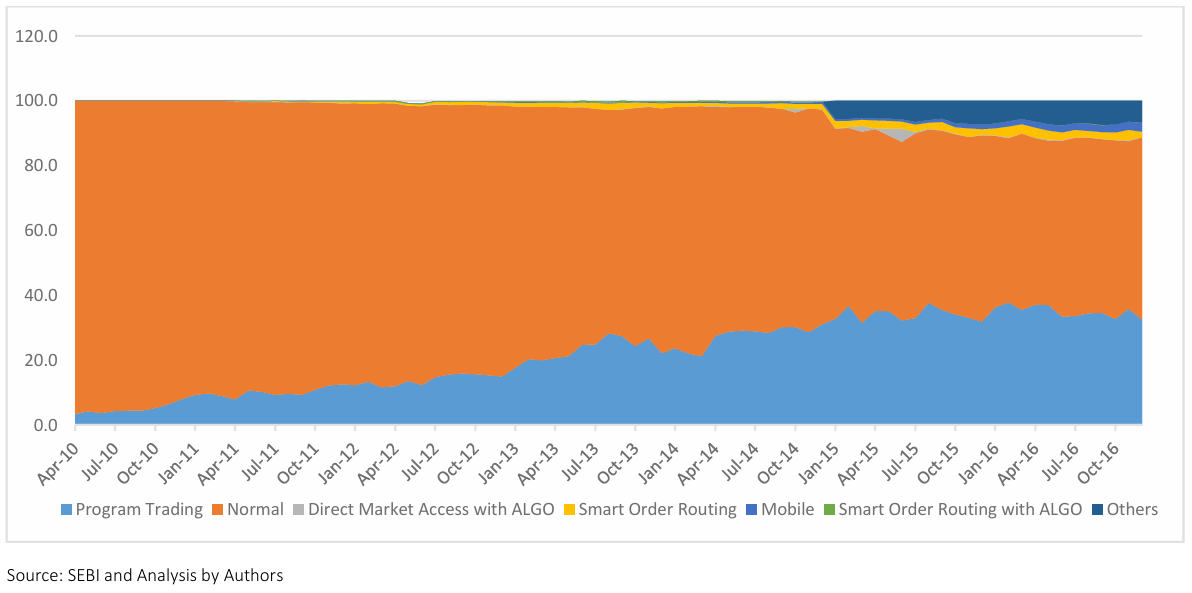
Algo trading was once the exclusive domain of institutional investors, but that’s changing. With SEBI’s proposed regulations aimed at enabling retail algo trading, individual traders may soon be able to execute algorithm-based trades. This could level the playing field, allowing individual investors to benefit from the speed and precision of algo trading previously reserved for larger firms.
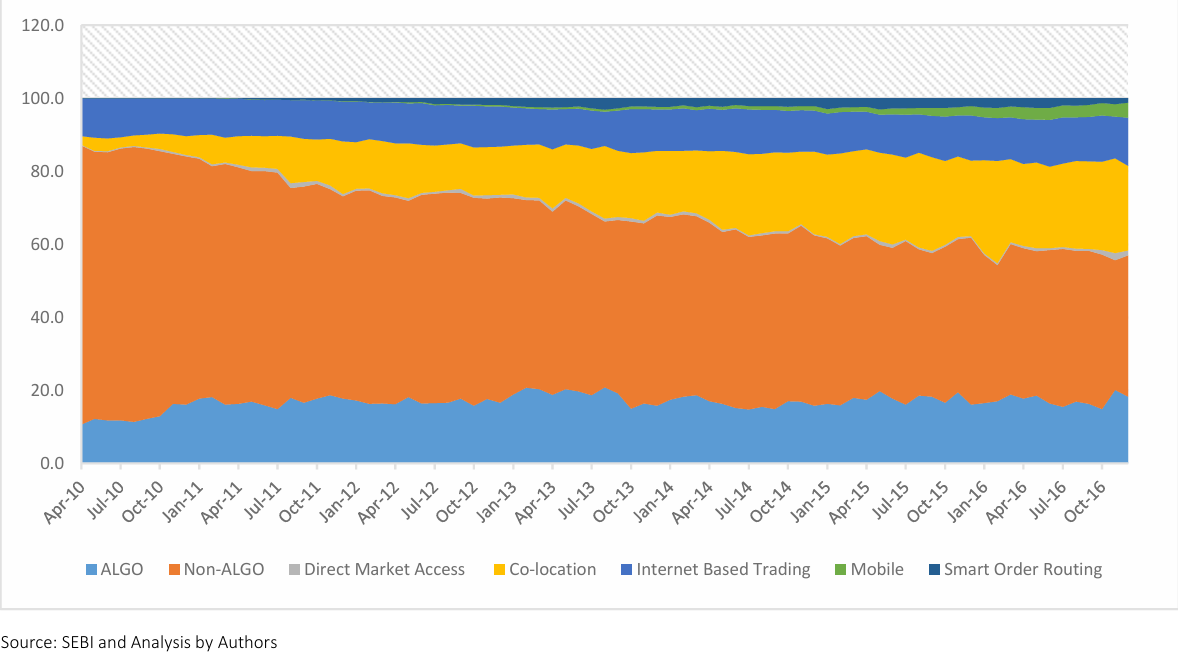
The rise of quantitative trading brings with it the need for stricter regulatory oversight to ensure stability and fairness in the market. SEBI has already introduced latency floors and other rules to mitigate risks associated with HFT, and as algo trading grows, we can expect additional safeguards. These measures are critical to ensuring that the advantages of quantitative trading do not come at the expense of market integrity.
The landscape of quantitative trading in India is dynamic, filled with opportunities for growth and challenges to overcome. Technological advancements are set to propel the industry forward, but access remains a concern for smaller firms and retail investors. SEBI's regulatory measures will play a key role in keeping the market balanced, helping to create an environment where all players can benefit from the efficiency and liquidity that algo trading brings.
As this new era unfolds, one thing is clear: quantitative trading is reshaping the Indian financial market in unprecedented ways. For both investors and institutions, it offers exciting possibilities, but only those prepared to navigate the complexity and challenges will thrive in the fast-evolving world of Indian algo trading.
This fascinating blend of technology and finance is far more than a trend; it’s a revolution. And in India, that revolution is just beginning.
Thank you for joining me on this journey into the world of quantitative finance with Quant India Pulse! Stay tuned for more deep dives, data-driven insights, and fresh perspectives on the latest trends and innovations shaping our markets. I’m excited to bring you more valuable content and look forward to exploring this dynamic field together. Until next time—stay curious, stay quantitative!
No posts
Comments
Nothing yet. Say the first thing.
Sign in to join the conversation.