
Luxury stocks are increasingly diverging in 2026. Richemont, Brunello Cucinelli and Ferrari continue to deliver strong growth, while LVMH, Kering and Burberry remain under greater pressure. Yet strong fundamentals don’t necessarily mean attractive investments: valuations remain demanding across many of the sector’s highest-quality names
My view: luxury remains a sector to approach selectively rather than overweight at current valuations
Back in late 2024, I mapped out the structural shifts transforming the luxury landscape. My thesis centered on a growing divide among market players: while ultra-luxury catering to high-net-worth individuals operates with near-immunity, aspirational and trend-heavy brands were heading into a period of prolonged friction.
Q2 26 earnings prove that this divide is expanding rapidly, with a few unexpected twists along the way. Today, we dive back into the sector, comparing Q2 results across listed giants and private titans to separate headline noise from long-term value creation.
For historical context, you can check out this article I published in early 2025 comparing the performance of major luxury stocks for FY24.
Richemont. Led by its flagship Jewelry Maisons (Cartier, Van Cleef & Arpels), Richemont reported +20% organic growth (+17% reported) for its fiscal Q1 2027 (calendar Q2 2026). The results highlight a sharp rebound in hard luxury jewelry and watches. They increased their net cash position, providing a strong strategic flexibility
Chanel (Private). According to financial media leaks, Chanel posted 16% H1 growth, spearheaded by a massive +25% surge in the US. Strong market reception to new Artistic Director Matthieu Blazy continued to insulate the private house from market softness
Brunello Cucinelli. A masterclass in Quiet Luxury. H1 2026 revenue reached 750M€, up +13.3% at CC (+9.5% reported), driven by a +19.3% retail channel surge. Management raised its FY revenue growth guidance to 10% – 11%
Ferrari. The company showcased pure pricing power with +8% revenue growth (+10% at CC) for Q2 2026. Higher-than-expected racing and lifestyle revenues, along with booming high-margin personalization demand, led management to raise full-year guidance.
Moncler. Generated +9% constant-currency growth (+5% reported) in H1 2026 to €1.29 billion. Stone Island led the group at +11%, supported by a +15% DTC channels boost. However, Q2 growth decelerated to +5% due to softer European tourist traffic, though operating margins (EBIT) expanded to 19.0% alongside €1.11 billion in net cash.
Prada Group. The company reported +5% organic revenue growth (+16% reported - Versace acquisition) in H1 2026. While the core Prada brand grew steadily at +5% organically, sister brand Miu Miu remains the real growth catalyst, continuing its explosive multi-quarter double-digit trajectory
Hermès. Delivered +6% organic revenue growth (+2% reported) in H1 2026 to 8.2B€, with Q2 accelerating to +7% led by strong US market demand. While Perfumes & Beauty slipped (-4%) and top-line growth lagged historical double-digit peaks, Hermès continues to outperform broader luxury
LVMH. Reported +2% organic revenue growth (+3% in Q2) in H1 2026, though foreign exchange headwinds pushed reported revenue down -3% to 38.6B€. While Watches & Jewelry stood out positively, the flagship Fashion & Leather Goods division (roughly half of group revenue) dipped -1% organically (-5% reported)
Kering. Showed early signs of operational stabilization with +1% organic revenue growth in H1 (-3% reported). While Jewelry surged +20% organically, flagship brand Gucci continues to contract (now representing a third of group revenue, down from 50% a few years ago)
Burberry. The company posted FY revenue of £2.42B (-2% reported, flat at constant currency). Comparable store sales turned positive (+2%), signaling a potential turnaround inflection point
While public conglomerates like LVMH and Kering contend with aspirational slowdowns, private titan Chanel is accelerating. Sourcing (+16% organic H1 growth, +25% in the US) demonstrates that the house remains uniquely insulated. The market’s enthusiastic reception of new Artistic Director Matthieu Blazy has ignited fresh brand heat, proving that when a tier-one mega-brand marries extreme price exclusivity with artistic relevance, it can defy a depressed macro backdrop. It also highlights a sharp risk: without constant desirability and creative heat, a luxury brand’s downfall can happen fast
Category exposure matters as much as brand name. Watches & High Jewelry significantly outperformed soft fashion and ready-to-wear across almost all groups. This explains Richemont’s standout performance (+20% organic growth), led by double-digit surges at Cartier and Van Cleef & Arpels. High-net-worth consumers are treating hard luxury pieces as lasting store-of-value assets rather than seasonal fashion statements
Outside of Richemont and Chanel, the real growth in H1 came from highly focused brands with uncompromising desirability:
Brunello Cucinelli continues to dominate “Quiet Luxury” (+13.3% constant currency), entirely untouched by aspirational fatigue
Ferrari stands in a category of its own (+10% CC growth). Despite minor noise around their upcoming EV transition, Ferrari’s unmatched pricing power, record personalization rates and raised full-year guidance prove that ultra-HNW demand remains inelastic
Houses that struggled in recent years (most notably Kering (Gucci) and Burberry) are still navigating long recovery paths. While there are early operational green shoots (+1% organic growth at Kering, +2% comps at Burberry), creative overhauls and brand repositioning require patient capital. In a tight consumer environment, turning around a massive luxury house is a long and difficult
The US is leading the market with surges at Chanel, Hermes or Richemont. High-net-worth spending in the Americas remains robust. This is the opposite for Asia (at least excluding Japan). The post-reopening luxury boom in China has settled into a slower, more selective growth paradigm
To bring this into focus, let’s benchmark 7 key players: LVMH, Kering, Hermès, Richemont, Ferrari, Moncler and Brunello Cucinelli. Instead of running a full Quality Stocks Investment Framework on each, I will keep it simple and compare some key metrics: revenue growth, margins and valuations.
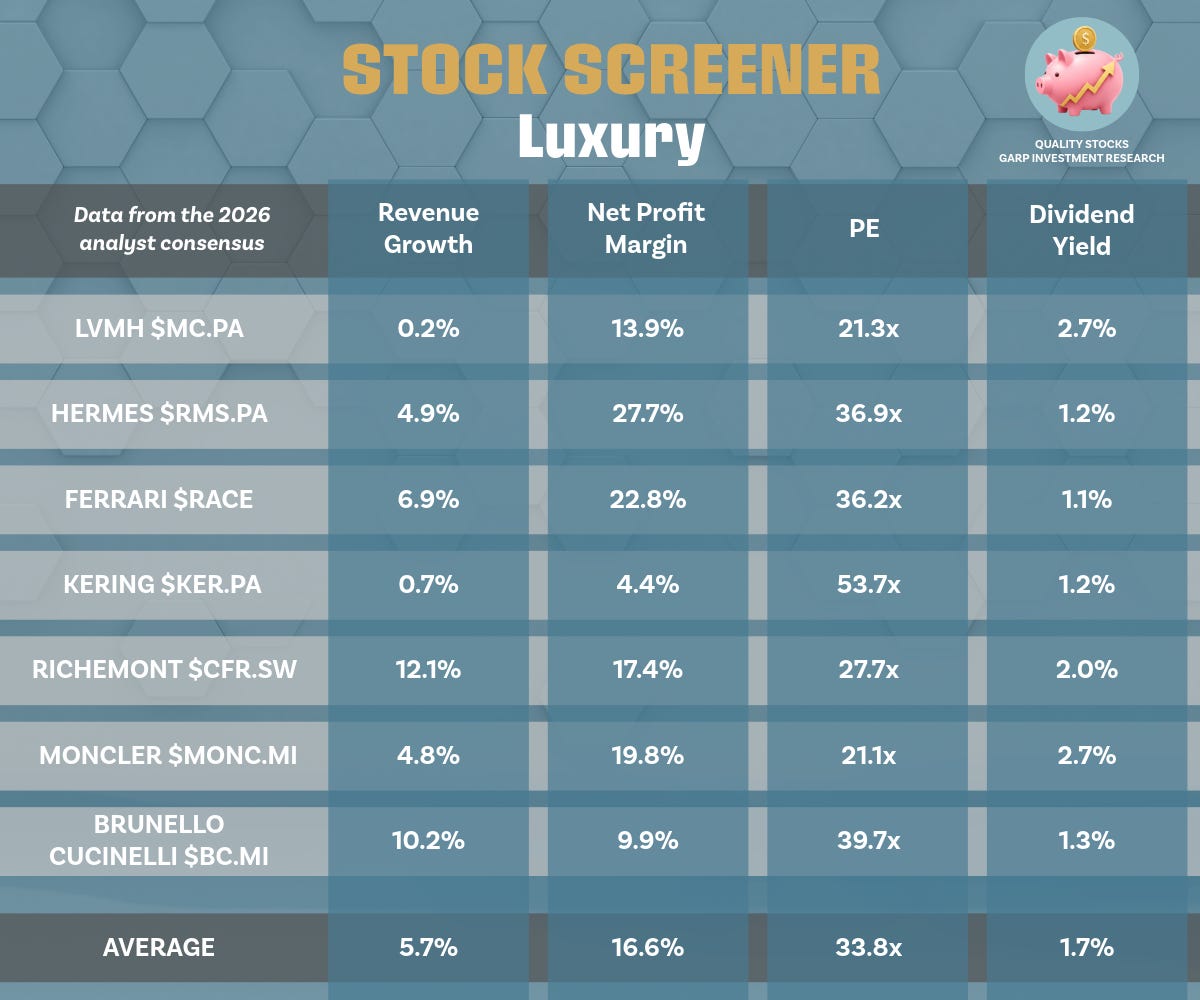
You don’t need to be a veteran GARP investor to see the issue here: sector-wide growth has slowed, but multiples across many names remain stubbornly high.
Ferrari, Hermes & Brunello Cucinelli. Decent growth, but trading above 35x PE, leaving virtually no margin of safety
Richemont. Excellent hard luxury momentum and clean balance sheet, but current pricing eats away at the risk/reward
Kering. A classic turnaround play. Note that PE is not useful given margin collapse. But the stock bounced back 80% from its lows, despite operational recovery not fully proven yet
LVMH & Moncler. Both show interesting technical setups for a rebound. But is the fundamental risk/reward attractive right now? Not quite. My target Buy Zone for Moncler sits at 45€ and LVMH at 440€. However, they look more like short-term trading plays than generational buying opportunities
💬 Where do you stand on luxury? Drop your view in the comments section!
Are there specific names on your watchlist, or are you sitting on the sidelines until valuations drop?
To wrap things up: the luxury market is still consolidating. Despite standout performances from Chanel, Ferrari, Richemont or Brunello Cucinelli, consumer fatigue and shifting behavior are weighing heavily on the broader industry.
Frankly, this sector is difficult to navigate at current levels. While a rising tide in the broader market might bounce these stocks higher, the underlying risk/reward does not offer a strong enough margin of safety. There might be short-term trading opportunities here, but I believe remaining cautious, rather than overweighting luxury in your portfolio, is the right move today.
LVMH results. H1 2026 earnings release - link
Hermes results. H1 2026 results - link
Richemont results. Q1 FY2027 trading update - link
Kering results. H1 2026 results - link
Moncler results. H1 2026 results - link
Brunello Cucinelli results. H1 2026 results - link
Ferrari results. Q2 2026 results - link
Chanel H1 revenue estimates. Reuters
Historical data and analyst consensus. MarketScreener
Investment assessment. Quality Stocks Investment Framework
Historical data and analyst consensus for my analyses are sourced via MarketScreener. It is my go-to platform for global stock data and analyst price targets. If you are looking to upgrade your research toolkit, click here (Full disclosure: this is an affiliate link, so you will be supporting this newsletter at no extra cost to you!)
No posts
Comments
Nothing yet. Say the first thing.
Sign in to join the conversation.