
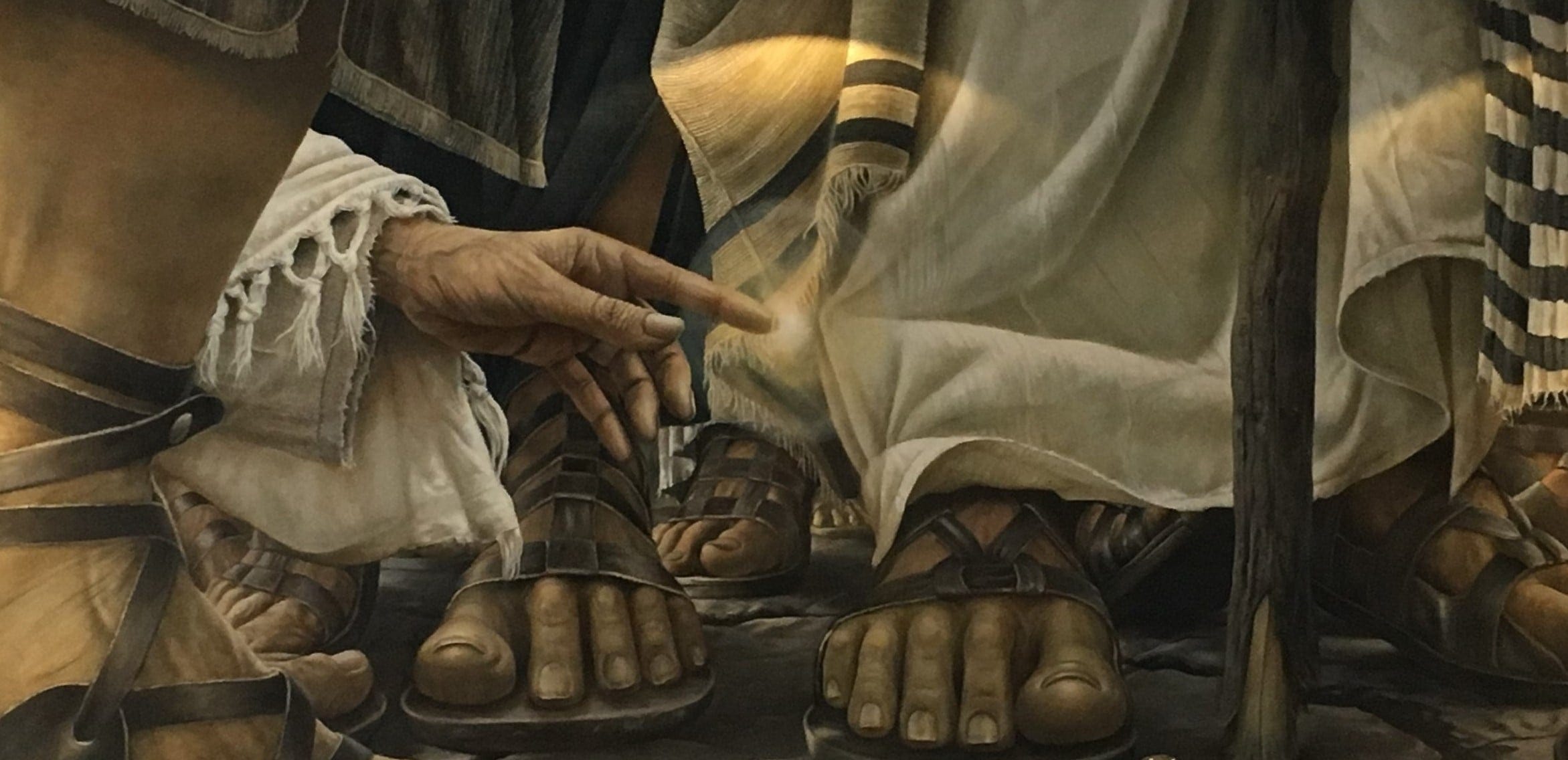
Jesus has somewhere important to be. A grieving father has begged him to come. A daughter has died.
And yet, in the middle of all that urgency, Jesus stops for someone everyone else might have missed.
In today’s Gospel, Jesus is on the way to a house filled with grief.
And while Jesus is on the way, another daughter reaches for him.
A woman who has been bleeding for twelve years.
Twelve years is a long time to suffer.
In her world, her bleeding was not only a physical burden; it also carried social consequences that pushed her to the margins of society.
So she comes from behind.
She does not stop the procession. She does not make a scene. She does not ask for everyone to look at her. She says to herself, “If I only touch his cloak, I will be made well.”
That is an extraordinary act of faith.
For twelve years she has suffered. For twelve years she has carried disappointment, isolation, and pain. Yet somehow she still believes that healing is possible. She still believes that Jesus can do what no one else has been able to do. She still hopes against hope.
And yet, as beautiful as her faith is, there is something heartbreaking about it too.
Because she believes there is healing in Jesus, but she is not sure there is room for her in the crowd.
She believes his mercy is real, but she reaches for it quietly.
She believes he can make her well, but she tries to be healed without being seen.
There are moments when asking for help feels riskier than carrying the burden alone, because we do not know whether our truth will be met with tenderness. It is possible to move through a crowded room carrying pain that no one else can see, surrounded by people and still feeling profoundly alone. And there are wounds we long to have healed, even as we hope no one notices they are there.
Shame teaches you how to shrink your joy. How to lower your voice. How to laugh off what actually hurt. How to calculate the room before you enter it. How to hide the part of yourself that most needs to be loved.
I know something about that.
Growing up, I was called names and some of them were cruel, meant to embarrass me and make me feel small.
And those words landed deeply because, during those same years, I was beginning to realize that what others were mocking was connected to a truth I was only starting to understand about myself: I was gay.
I was still trying to understand what it meant. I did not yet have the words for it, much less the confidence to embrace it. I only knew that something true and deeply personal was emerging within me, and that it seemed to be the very thing others around me mocked, feared, or rejected.
And for many years, shame had a louder voice in my life than the truth of who I was.
I never stopped loving Jesus. That was never the struggle. I loved Jesus deeply, and I longed to belong to God. But there were times when I questioned whether there was truly a place for me in the Church, a place for me in God’s story, a place for all of who I am within the mercy of God.
There are LGBTQ+ children of God who have been taught to live from behind the sight of the world. Taught to keep part of themselves hidden. Taught to confuse shame with holiness. Taught that God could love them only if they first became someone else.
But the Gospel speaks a better word.
Because when this woman reaches for Jesus, Jesus does not let her remain hidden.
He turns.
That simple action changes everything.
Jesus turns toward her.
He does not recoil from her touch. He does not shame her for reaching out. He does not scold her for interrupting his journey. And he does not allow her to slip back into the crowd healed in body but still unseen and alone.
She reached for healing in secret.
But Jesus turns toward her. He meets her gaze. And instead of letting her slip back into the crowd unnoticed, he speaks words that restore both her dignity and her place among God’s people: “Take heart, daughter; your faith has made you well.”
The name “daughter” is significant.
For twelve years she had been defined by her condition. People saw her through the lens of what was wrong, what was inconvenient, what set her apart.
But Jesus speaks a different word over her life.
He does not name her by her wound. He does not reduce her to her suffering.
He calls her daughter.
He gives her back her place in the community.
That is the mercy of Christ. Mercy does not only heal the wound. Mercy restores the person. Mercy does not only stop the bleeding. Mercy brings the one who has been pushed to the margins back into community. Mercy does not leave us hidden at the edges, wondering whether there is truly a place for us among God’s people.
God’s mercy turns toward us and says, “Take heart.”
Paul says in Romans that Abraham hoped against hope. He trusted that God’s promise was larger than what he could see, even when every circumstance seemed to point in the opposite direction. That kind of faith does not deny reality. It does not pretend the pain is insignificant.
Faith is trusting that what we can see is not all God can do.
This woman hopes against hope.
Her body says nothing is changing.
Her history says nothing is changing.
The community says there is no room for her.
But somewhere deep within her, there is still a holy refusal to believe that her pain gets the final word.
So she reaches.
And mercy turns toward her.
This is the pattern of Jesus’ ministry.
Just before this scene, Jesus calls Matthew, a tax collector, to follow him. Then he goes to Matthew’s house and sits down to eat with tax collectors and sinners. The religious leaders are scandalized. They see people who should be avoided. They see failures, outsiders, and those whose reputations make them unworthy of a place at the table.
But Jesus sees something different.
He sees beloved children of God. He sees people in need of mercy. He sees a table where healing, reconciliation, and new life can begin.
When they question him, Jesus says, “Those who are well have no need of a physician, but those who are sick.” Then he sends them back to the prophets: “Go and learn what this means, ‘I desire mercy, not sacrifice.’”
Faithfulness exists for mercy. The practices of our faith—our worship, our prayers, our traditions, our convictions—are not ends in themselves. They are meant to draw us closer to the heart of God, and the heart of God is mercy. When faithfulness loses sight of mercy, it becomes something Jesus repeatedly challenges throughout the Gospel. But when faithfulness serves mercy, it becomes a way of making room for healing, belonging, and new life.
God does not delight in religious performance that leaves wounded people standing outside the door. God does not measure holiness by how carefully we separate ourselves from those who struggle. God desires mercy—mercy that draws near, mercy that restores dignity, mercy that makes room at the table.
Jesus is not interested in a faith that keeps its distance from hurting people. Jesus is not interested in a church that knows how to name who is wrong but has forgotten how to sit with people who are aching to be seen.
The Gospel does not stop with what Jesus does for her. It also invites us to ask what kind of community we are becoming.
Because the question is not only what Jesus does when he notices the woman.
The question is what happened before that moment.
Why did she come from behind instead of approaching him openly?
Why did she feel she had to slip through the crowd rather than ask for help?
Why did she believe she could touch the edge of his garment but not stand before him face to face?
Why was there no one making room for her?
Why did she believe she could touch the edge of Jesus’ garment but not stand openly before him?
The question this story raises has never really gone away.
How many people are still reaching from the edges of our churches for the mercy they should have found among us?
How many people are still wondering whether there is room for the truth of their lives?
How many people are still carrying grief, addiction, shame, illness, sexuality, family pain, or old wounds quietly because they are not sure the Church will respond with mercy?
Dear friends, we cannot be a people who make others reach from the edges for the mercy they should have found among us.
We cannot be a people who guard the table while Jesus is pulling up chairs.
We cannot be a people who mistake exclusion for faithfulness or shame for righteousness.
If Jesus says, “I desire mercy,” then mercy must become the shape of our life together.
Because the mercy of Jesus comes close.
Close enough to sit at the table with sinners.
Close enough to be touched by a suffering woman.
Close enough to enter a house where death has already arrived.
Yes, Jesus keeps walking. He goes to the house of the leader whose daughter has died. The mourners are already there and the story appears finished.
But Jesus takes the girl by the hand, and she gets up.
The same mercy that says, “Take heart, daughter,” also takes death by the hand and gives life.
That is the God revealed to us in Christ Jesus.
A God who is not repelled by our humanity.
A God who notices the one trying to remain unseen, turns toward her with compassion, and speaks a word that restores her courage and dignity.
So take heart.
Let our tables get wider.
Let our eyes get kinder.
Let our hands get braver.
Let us turn toward the ones reaching from the edge of the crowd.
Let us make room before people have to crawl.
Let us speak holy truth over every beloved child of God.
You are not beyond mercy.
Take heart.
You are seen.
You are loved.
You belong.
And in Jesus Christ, your story is not over.
No posts
Comments
Nothing yet. Say the first thing.
Sign in to join the conversation.