
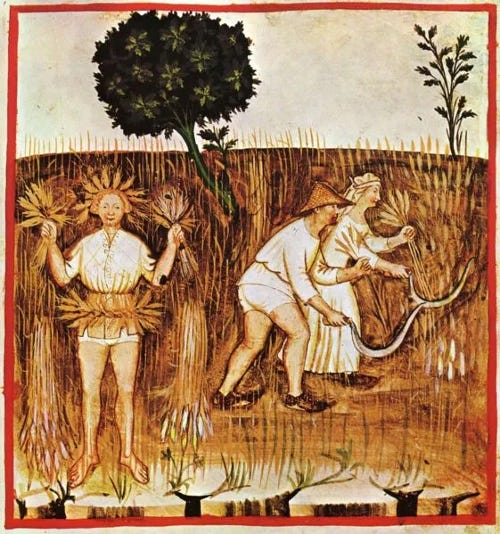
I have to confess that the servants in Jesus’ parable make perfect sense to me.
They look out over the field and discover weeds growing among the wheat. And almost immediately, there is that familiar temptation—to fix it, to clear it out, to deal with the problem before it spreads any further. When we think we understand what is happening, it is easy to assume we know what to do.
The servants are like: “Just say the word. Hand us the weed whacker. We can have this whole situation cleaned up before lunch.”
Some of us hear this story and know the urge to wish for a quicker, more decisive solution. I know I do. We understand the servants because we know what it is to look around at the world and want somebody to do something. We see cruelty flourishing. We see lies rewarded. We see vulnerable people harmed while those responsible seem to carry on untouched. We see division in our communities, conflict in our families, and sometimes painful failures within the Church itself.
There are moments when patience does not feel like a virtue but looks like negligence—or even indifference.
We want God to pull up what is wrong. And if God appears to be taking too long, we may be tempted to volunteer for the job.
But the master tells the servants, “No.”
The master tells them to wait because, in their eagerness to uproot the weeds, they may also uproot the wheat.
The weeds Jesus describes—often identified as darnel or tares—resemble wheat, especially during the early stages of growth. Their roots become entangled beneath the soil with the wheat, so the danger becomes that the servants will also destroy something good that is still growing.
Jesus is speaking to our deep desire to divide the field—to identify who belongs and who does not, who is righteous and who is wicked.
We do this in the world. We do it in politics. We do it in families. We decide that another person is beyond redemption, that nothing good can grow in them, that their worst moment tells us everything we need to know about who they are.
But Jesus reminds us that the field belongs to God.
That does not mean we abandon discernment. It does not mean that harmful behavior should be tolerated or that leaders should escape accountability. It does not require anyone to remain in an abusive or dangerous situation. Protecting the vulnerable is part of tending the field.
Yet there is a difference between accountability and condemnation.
Accountability seeks truth, protection, repentance, and repair. Condemnation declares that a human life has become nothing more than a weed and should simply be thrown away.
Jesus warns us against claiming knowledge and authority that belong to God alone.
And perhaps that is because God sees what we cannot yet see.
God sees the roots beneath the soil, the wounds and fears that have shaped us, the possibilities for repentance that have not yet emerged, and the grain that has not yet fully formed.
God sees the damage done by evil more clearly than we ever could. The Master does not confuse weeds with wheat because he knows that the harvest will come and with it, a reckoning, where that which destroys the life of the wheat will soon be tossed to the burn pile.
The final judgment belongs to the crucified and risen Christ, not to anxious servants standing at the edge of the field with their hands wrapped around a weed whacker.
That is a difficult reality to live in the hard, in-between time before the harvest, when the field remains unresolved and the outcome is not yet realized.
I love how in his letter to the Romans, Paul equates our lived experience with that of childbirth, groaning in labor pains.
Creation groans because the world is not yet what God intends it to be.
The earth groans beneath our misuse of it. Nations groan beneath the harsh realities of war. Communities groan from injustice. Families groan beneath grief. Bodies groan beneath the weight of time.
Paul was acutely aware of the reality of suffering. He had been beaten, imprisoned, rejected, threatened, and driven from one place to another.
Paul’s understanding is that underneath it all, the groans of creation is ever moving towards the freedom of God’s grace.
Something is being born within us that we cannot yet fully see: the redemption of our bodies, the liberation of creation, the glory of God revealed in all things.
“Hope that is seen is not hope,” he writes. We do not hope for what is already in our hands; hope lives in the space between what is and what is promised, reaching toward a fulfillment we have not yet seen.
Christian hope is not shallow optimism. Optimism looks at present circumstances and assumes things will improve on their own.
Hope, by contrast, refuses both denial and easy reassurance. It faces the tangled reality of the field—the wheat and the weeds, the damage and the promise—and still dares to trust that God is at work in ways we cannot yet see.
And while we wait, the Spirit keeps reminding us who we are.
We are not meant to live in a constant state of anxiety, as if everything depends on whether we get it right, nor to be driven by fear in an attempt to secure our place or prove our worth.
Instead, we are drawn into a relationship of belonging. We are not outsiders hoping to be let in; we are already part of the household, friends! The household of the living God who claims us as Their beloved children... with such intimate care that we would call God Abba.
That belonging reshapes how we wait. As the Spirit gently reminds us that we already belong to God, our urgency begins to loosen, and our grip on the whole field softens.
The spiritual life, then, is a continual returning to this Christian hope.
We return in prayer, bringing our fears and longings before God. We return in Scripture, listening again for a word that grounds our steps. We return when we confess what we’ve done or left undone, said or left unsaid... discovering once more, that God’s mercy does not run out.
And it’s here at this Table where-in we encounter Jesus in bread and wine.
There, we are reminded that we do not sustain hope on our own. At the end of Holy Communion, we pray that God has assured us in these holy mysteries that we are living members of Christ’s Body and heirs of God’s eternal kingdom.
The world remains unfinished. Creation is still groaning. Wheat and weeds still grow together. There is much that we cannot understand and much that we cannot repair by our own strength.
But the field is not abandoned.
The Son of Man has entered this field himself. Jesus has shared our suffering, borne the violence of human judgment, and passed through death into resurrection. At the cross, the world treated the Holy One as something to be uprooted and discarded. In the resurrection, God revealed that human judgment was not the final verdict.
So, perhaps for today, leave the weed whacker in the shed to tend what God has placed before us.
And wait, with the boldness of Christian hope, for the God who began this good work to bring the whole creation at last into the freedom of Christ.
Comments
Nothing yet. Say the first thing.
Sign in to join the conversation.