
There is a question that sits close to the center of almost every human heart: How do I get right with God?
How do I know that I am accepted? How can I be sure that I belong? What do I do with the parts of my life that I would rather keep hidden, the failures and wounds that still carry shame? Somewhere beneath those questions is the fear that God is far away and that the distance between us must somehow be crossed by us.
Some people try to cross it by working harder. We pray more, serve more, make new promises, and hope that a sufficiently improved version of ourselves will finally be pleasing to God. Others look at the distance, decide it is too great, and give up. God must be disappointed. Grace must be meant for somebody else.
In Romans Paul writes, “Do not say in your heart, ‘Who will ascend into heaven?’” Nor should we ask, “Who will descend into the abyss?” as though Christ had to be raised from the dead by our effort. Salvation is not a spiritual rescue mission in which we search the heights and depths for a distant God. God has already come near.
Paul is drawing here from Moses’ words in Deuteronomy. The command of God, Moses says, is not hidden in heaven or waiting for someone to cross the sea and retrieve it. “The word is very near you; it is in your mouth and in your heart.” Paul hears those words anew in the light of Jesus. The Christ who came down among us has entered the depths of death and has been raised by the Father. Nothing remains for us to retrieve. The word is near because Christ chooses to be near.
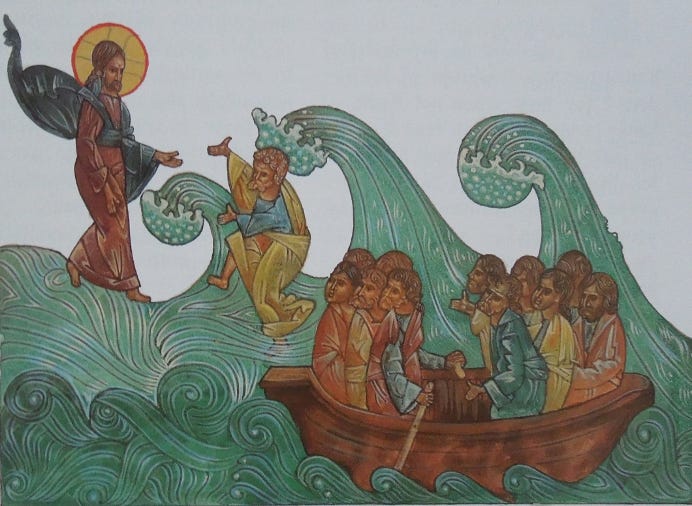
And if we want to see what Paul means, Matthew gives us Peter.
He is sinking under the tumultuous waves of the sea. Just a few moments earlier, he stepped out of the boat to walk towards Jesus. He trusted that voice enough to risk the sea, but when he felt the wind and saw the waves, fear overtook him. Whatever confidence carried him out of the boat disappears, and he begins to sink.
There, in the water, Peter becomes a living picture of Paul’s words. He cannot ascend to find Christ, and he cannot rescue himself from the depths. He has no argument to make and no good work to offer. All he has is the name upon his lips: “Lord, save me!”
Paul says, “Everyone who calls on the name of the Lord shall be saved.” Peter calls, and immediately Jesus reaches out his hand and catches him.
That word “immediately” carries the whole weight of grace. Jesus does not wait for Peter to master his fear or leave him in the water to ask whether he has learned enough from the experience. The hand comes first. Peter is caught before anything is explained.
Peter’s story brings back a memory of learning to ride my bike. My mom had been running alongside me as I pedaled down the sidewalk. As long as I knew she was there, I could keep moving. But then I looked over and realized that she was no longer right beside me. Fear took over and I stopped paying attention to the sidewalk in front of me, rode straight over a stick, and flipped over the bike into the grass.
And there she was. Almost as soon as I hit the ground, my mom was beside me. She had not been as far away as my fear had led me to believe. She never took her eyes off of me.
I hear something of that same tenderness in Matthew’s Gospel passage. Peter becomes frightened because the wind has convinced him that he is alone, but as soon as he begins to sink, Jesus is there… His hand reaches Peter before the water can claim him.
That is also why I cannot hear Jesus’ next words as a scolding. While Peter is held securely by the One who has caught him, Jesus asks, “You of little faith, why did you doubt?” I hear affection in that question, perhaps even the gentle amusement of someone who knows how quickly fear can make us forget that we are still being held. To me, Jesus is drawing Peter deeper into faith.
But “little faith” is not no faith. Peter had enough faith to leave the boat, enough to cry out when he could no longer save himself, and enough to take the hand extended toward him. Jesus has already said that faith the size of a mustard seed can move mountains. Last Sunday, one small lunch box became sustenance for a multitude. Matthew keeps showing us that Christ is not discouraged by what is small. A little bread, a little faith, and a little prayer. In his hands, even these become places where the kingdom is revealed.
Perhaps the question, then, is not how much faith Peter possesses. The deeper question is where his hope rests when his own strength gives way. He discovers in the water that faith is not the power to make himself unsinkable. Faith is trusting the One who reaches him in the depths.
That is very different from the way many of us have learned to live in this world. We imagine spiritual life as trying to get a signal from some faraway heaven. We adjust our position, try better prayers, make new resolutions, and wonder whether God is receiving any of it. Yet Paul says that the word is already near, on our lips and in our hearts. God has brought the Gospel close enough for frightened people to call upon him, close enough for doubters to trust him, close enough for those who are sinking to be saved.
The storms themselves are not imaginary. Peter is not foolish for noticing the wind. Faith does not require Palestinian families in Gaza to pretend that grief and displacement do not hurt. It does not ask people enduring war in Ukraine and Iran to call destruction peace. It does not ask us to minimize illness, addiction, loneliness, racism, the poverty or the sorrow that can make living feel impossible. The Gospel does not tell us that the water is shallow. It tells us that Christ comes across it and reaches into it.
This is why the confession “Jesus is Lord” matters. In Paul’s day, lordship was a claim about authority, allegiance, and the shape of our common life. To confess Jesus as Lord was to deny that Caesar held the final claim upon the world. It meant that empire, violence, fear, and death had all been placed beneath the crucified and risen Christ.
Peter’s cry is that confession stripped to its essentials. “Lord, save me.” The disciples make the confession together when Jesus brings Peter back into the boat. They worship him and say, “Truly you are the Son of God.” The story begins with a community crying out in fear and ends with that community worshiping. Between the two is Peter’s risk and the grace that would not let him go.
What happens to Peter changes what everyone in the boat can see. They learn something about Jesus because one of them stepped out, sank, and was saved. Peter does not bring them good news by displaying flawless faith. His wet clothes and trembling body preach a better sermon. They show the others that the one standing before them is Lord even of the deep, and that his response to a drowning disciple is mercy.
So “How are they to call on one in whom they have not believed?” Paul asks. “And how are they to believe in one of whom they have never heard?” The word that has come near to us is meant to be spoken. The Gospel creates witnesses, people whose lives say that Christ met them where they could not save themselves.
Some bear that witness from a pulpit, yes, but most will do it elsewhere, around a kitchen table, beside a hospital bed, in a classroom, at work, or in a conversation with someone who has nearly given up. The words matter, but so does the life carrying them. The Church proclaims Christ whenever it tells the truth about grace and whenever it reaches toward someone the world has left to sink. We do not save one another. We bear witness to the Savior whose hand has already saved us.
That is good news for those carrying guilt or shame. Christ does not wait for the polished version of us to appear. It is good news for Christians exhausted by sheer willpower, living as though grace opened the door but everything afterward depended upon them. The Jesus who saves also sustains. His nearness is not withdrawn when our prayers dry up, when our attention wanders, or when our faith feels very small.
Soon we will come to the altar and in confession of what we hold in our hearts: Jesus is Lord… We will open our hands to receive the life of Christ once again. Christ freely gives himself to all who could never climb high enough to reach him.
There will be times when the wind is against you and the waters are deeper than you’ve imagined. Yet even there, especially there, the word is near. The hand of Jesus is already extended into the depths, and the mercy of God will never let you go.
Comments
Nothing yet. Say the first thing.
Sign in to join the conversation.