
Defense is HARD. The rules slant the game for the offense. Yet, even still, lots of groups play a style of offense that simply cycles the offensive players “through the motions”, without explicitly having a tactical plan for the game, point, or possession and certainly no strategic plan which everyone knows and to which everyone is contributing.
I prefer an offensive “scheme” that relies on making defense EVEN HARDER, and we can make playing defense more painful and irritating by:
Adding cognitive load.
Using defensive concessions against the defense.
To that end, an offensive “scheme” can achieve these goals by being positionless, creating multiple “opposing” threats to force defense to make choices, and adjusting smartly to defensive choices—rather than on fixed movements. This isn’t original; I didn’t invent this idea. I’m just applying it to Ultimate.
How do we do this in Ultimate?
Well, Ultimate is qua definitione “positionless”. There can’t be people are only throwers, because then they would never be able to receive a pass which must precede a throw. Symmetrically, everyone who receives a pass becomes a thrower. Sure, some are better than others, but everyone has to know how. And, once you throw the disc, you’re now a receiver. Which means you have to know how to move like a receiver.
Now, this doesn’t mean that there isn’t ANY specialization in Ultimate. Of course it still makes sense to send the 6’7” player with the 32” vertical deep, and the short old bald guy with the great handles to be the designated dump. But, if the 6’7” player can’t throw, or the guy with handles can’t cut, then they’re both going to be turnover machines, and that’s not helpful to anyone. Plus, we have to get the deeps and handlers into positions where they do the most damage, and that takes some reasoning.
Smart offensive movements constantly force defenses into making a constant stream of choices. Making them aware of those choices—or, even better, forcing them to consciously decide—is what creates the cognitive load. Often players momentarily lose focus if they have to think too much, and if they don’t think enough, they’ll just be led by into bad positions.
We can do these things through the use of a “Motion Offense”.
“What is a ‘Motion Offense’?”, you ask? Well, we turn, surprisingly, to basketball, which can offer us a perfectly clear definition by way of dichotomy. In basketball, offenses are generally divided into two categories: “Continuity Offenses” and “Motion Offenses”.
That’s not what “Motion Offense” means. First we look at what’s NOT a “Motion Offense”.
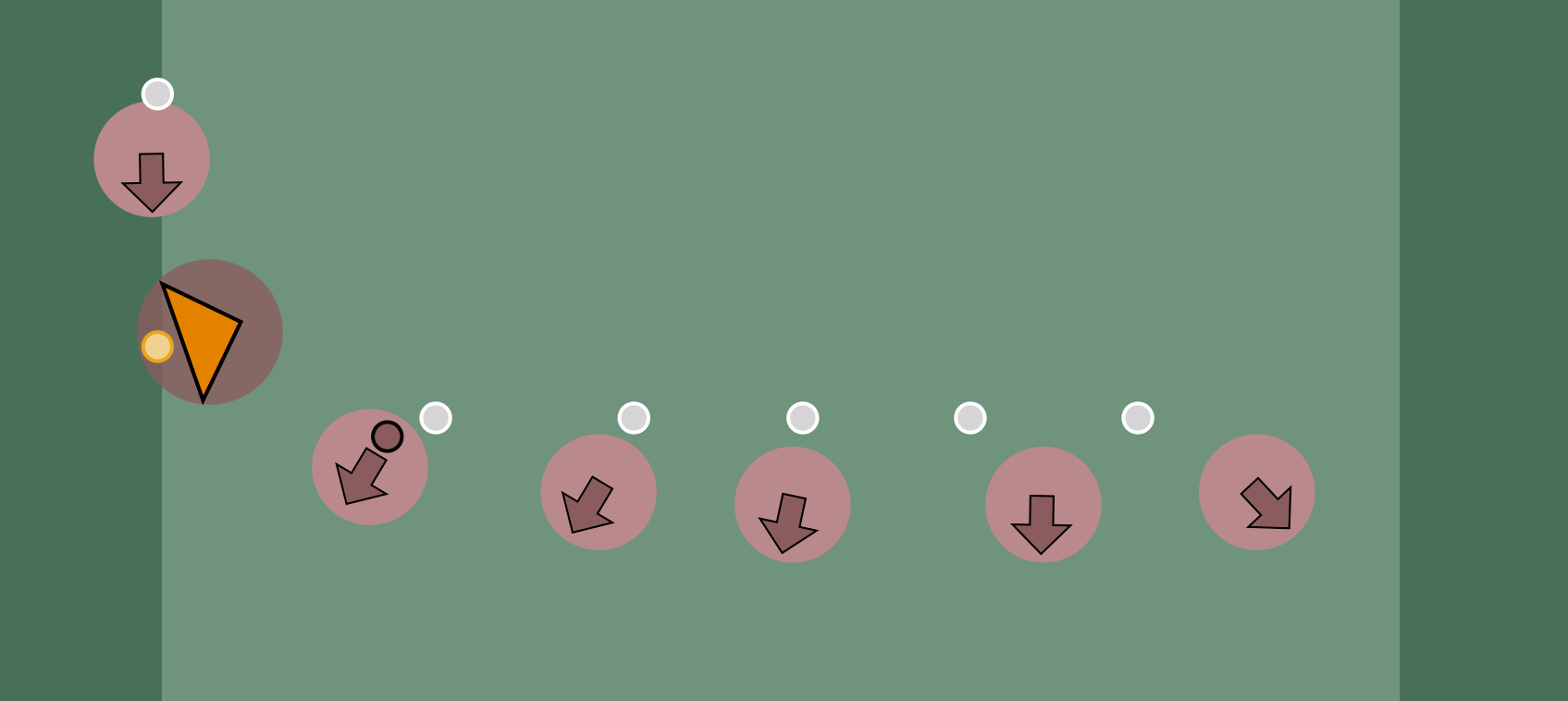
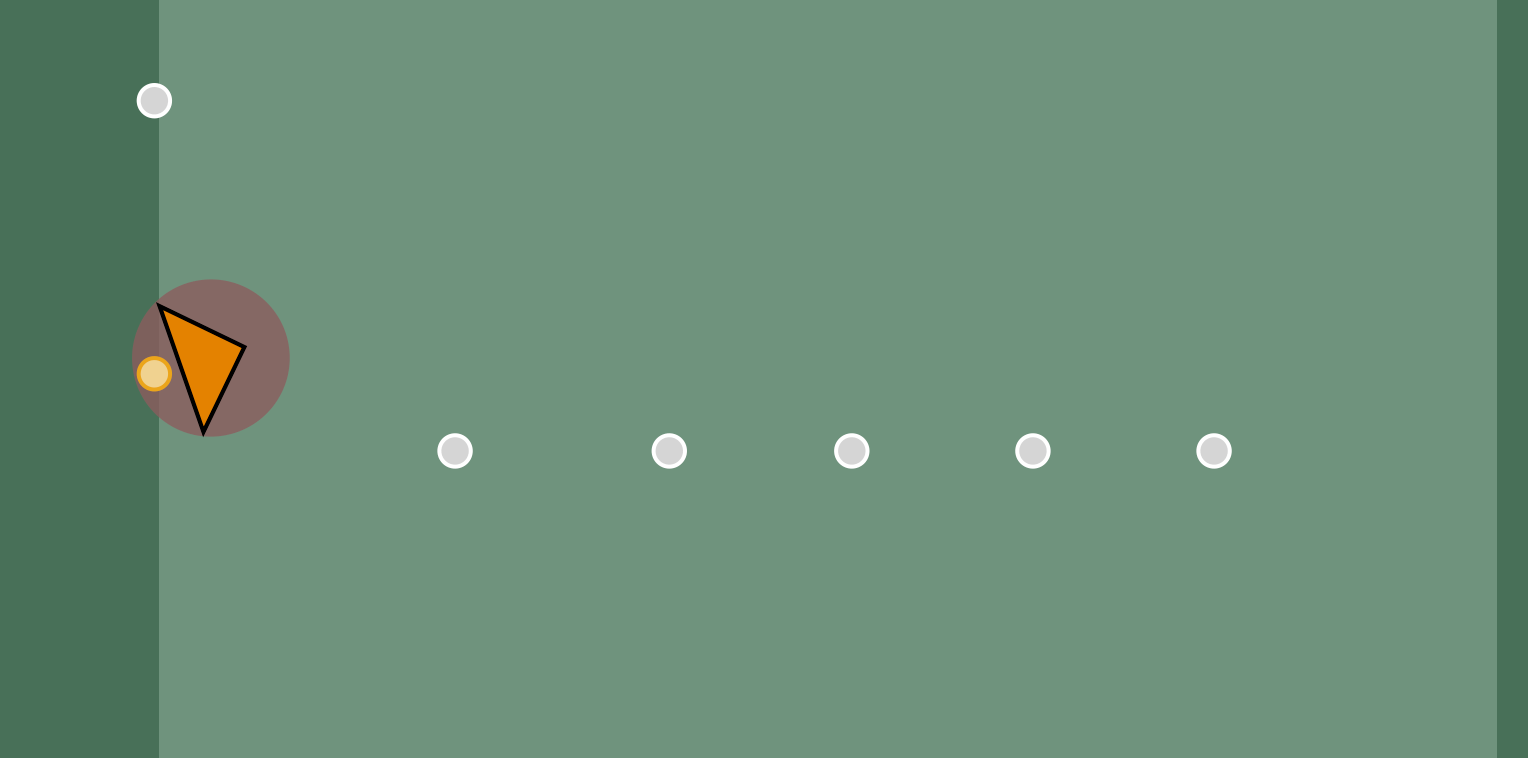
“Continuity Offenses” are a fixed set of movements, which eventually cycle back to the starting position. In Ultimate, we have lots of Continuity Offenses. You’ve heard of these. Things like Vertical Stack (“vert”), Horizontal Stack (“ho”), and Hexagon (“hex”), are all Continuity Offenses. The idea is to make movements to get open (“cut”), while preserving the overall “shape”. Every person who “leaves a space” leaves behind a “hole” or “vacuum”, which needs to be “filled in” by other people. In a Vertical Stack, which we depicted in Part 1 of this series, but didn’t give a name, the original idea (at least in 1993 when I first learned it) was: “Back of the stack cuts, and if you don’t get the disc, clear and cycle back into the stack.” And it looked a lot like this:
I’ll remove the defenders, leaving just the mark, so it’s even more obvious:
But Vertical Stack fell out of fashion…maybe about 20 years ago. Defenses realized:
“If we KNOW where they’re going to stand, we can shut this down.”
So, adaptations were formed:
“What if we cut from the FRONT of the stack?”
“What if we cut from the MIDDLE of the stack?”
“What if we cleared to a different place?”
“What if we shifted the stack to the break side?”
“What if we angle the stack?”
“What if we shifted the stack to the OPEN side?”
And defenses made their adjustments. Vert became “old tech”.
The new “meta” became the “Horizontal Stack”, which sought to undo all this.
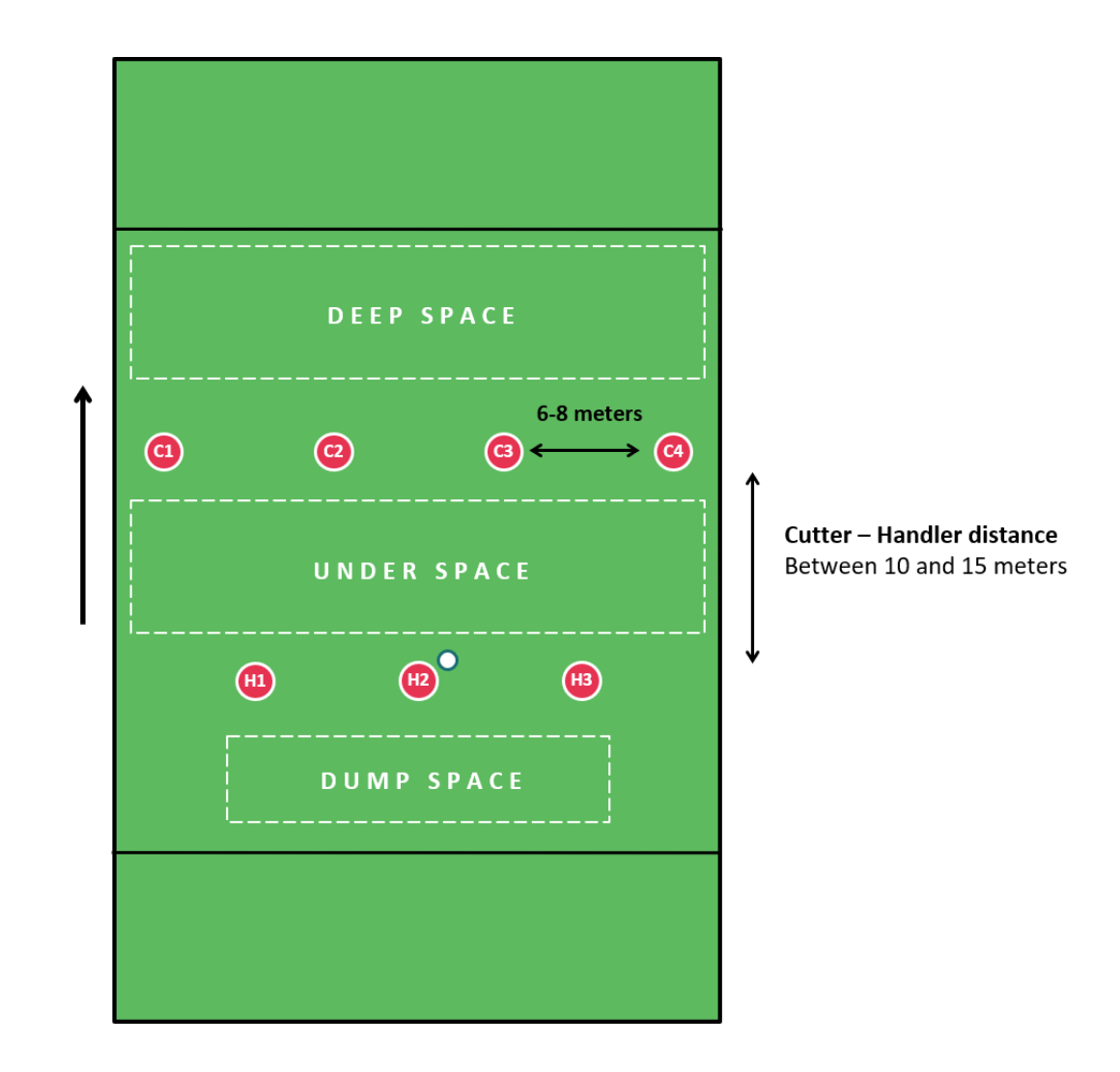
Diagrams were drawn, analyses made, games played. In the end, defenses realized:
“Wait. If we KNOW where they’re going to stand, we can shut this down.”
And then, 10 years ago, along came Hex.
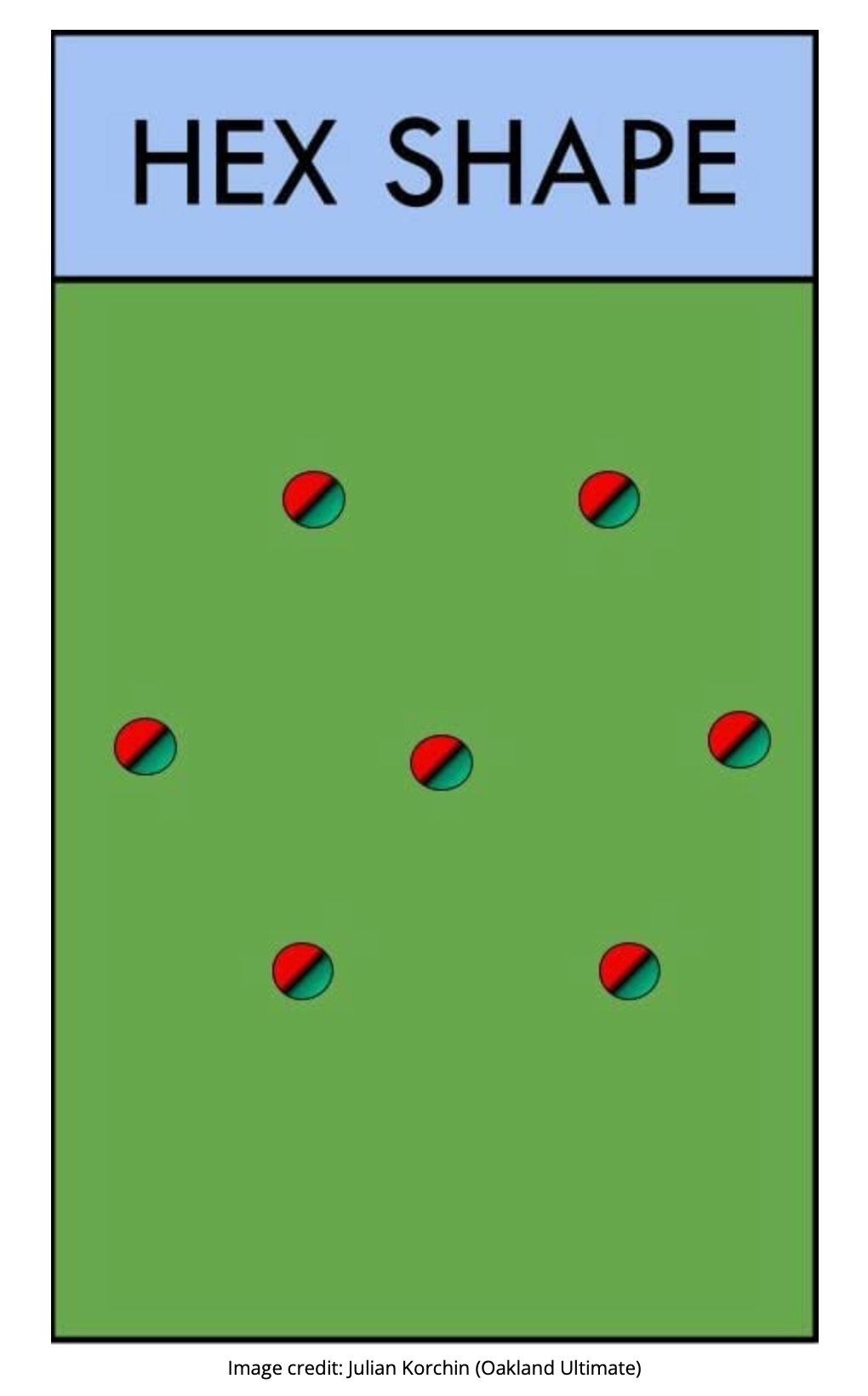
More diagrams, more analyses, more games. This time, with social media controversy, “beefs”, and “analysts” telling half-truths about teams that teams themselves had to refute. Interestingly, it’s not clear whether or not Hex was an “analyst”/spectator invention, or something intentionally created by a team on the field. But, it stuck, and the aftermath is that real teams do intentionally run this, sometimes to great effect.
The article from which I pulled this image is…fine…as far as casual Ultimate analysis goes. See it here, if you’d like to give it a look: Hexagon, the Bestagon. The title is amazing. My favorite passage from it, though, is this:
“Hex allows for an endless number of potential plays, making it a deadly and unpredictable offense.”
I’d love to catch up with this particular author, and wonder how this positioning is what allows the “endless number of plays” and unpredictability, and not: “Well, electromagnetism and the freedom to move wherever I like on the field is actually responsible for the infinite number of plays possible, and free will and creativity yield the unpredictability.”
But defenses remained calm, in the face of all the hype:
“Hold on a sec…If we KNOW where they’re going to stand, we can shut this down.”
The reality is, it doesn’t matter a great deal where you start when you start a point. The goal is to probe the defense, and probing the defense is part of the skill. Then, it’s down to how you’re analyzing the defense, the match-ups, and breaking it down.
Totally serious.
Getting better at sports, any sport—and certainly Ultimate—is a combination of working on physical skills and developing your “sport IQ”. Ultimate suffers from a lack of a cool acronym. Basketball has “BBIQ”, which sounds like “barbecue”, but Ultimate has “UIQ” (which is somewhat unpronounceable), or “DIQ” (“Disc IQ”, which is just somewhat unfortunate).
But, either way, developing your “field sense” or “field awareness” is what separates great players from good players, and good players from beginners.
The first step is to identify and assess your match-up. Are they slower? Faster? More agile? Better ups? Nailed to the ground? Can’t read? Taller? Slow to pivot? Quick hands? That tells you where and how you should play. If, by the end of the 3rd point, you haven’t worked out what your opposition can and can’t do, you’re not thinking about the right things.
Then, you have to COMPARE your match-up against the match-ups of your teammates. Talk to your teammates before the point. Take an early first half timeout to discuss, knowing that you can talk again at half. Or, if you’re a crafty veteran, you’ve either played against these people before, so know them already, or you’re watching them warm up to see who the weak throwers are, who the slow people are, and who has trouble catching the disc. It’s fine to warm up on the day of, obviously. But if you’re not watching your opponents warm up, you’re not getting the full value out of that time.
“Candy?” Yes. You know that expression “taking candy from a baby”? Well, defenses have to give you something. That something they give you is the “candy”. You just have to learn to take it. It’s easy. They’re giving it to you.
Are they giving you the deep cut? Go score.
Are they giving you the open side? Cut under.
Are they giving you the break side? Be the swing.
Are they face-guarding you? Read the thrower.
Are they back-guarding you? Signal your intent.
Are their hips facing the wrong way? Cut!
Did they stop paying attention to you? Quietly slip away.
Do they bite on every flick huck? Fake early, and break often.
Do they give you the flick huck? Learn to flick huck.
So, if you don’t have these things; IOW, if you can’t take the candy, well, those are the things you need to work on.
So, the two things you need to be able to assess for every defender is:
How do you compare in this match-up (vs the rest of your team)?
What is this defender giving you (vs the rest of your team)?
If you’re the weakest match-up; e.g., if you-versus-your-opponent is the least favorable speed match-up on the field compared with how the rest of your team matches-up against their defenders, one good thing you can do is to make space. It’s not glamorous, but it turns out not everyone is Messi or Ronaldo or Steph Curry or Bradley Wiggins. Wiggins needed an entire team, whose jobs it was to help Wiggins get the glory—but more importantly, for THE TEAM to win. And even Steph Curry makes space when it’s the right thing to do to help THE TEAM to win:
TL;DR - Dude was literally so good, that the other coach double-teamed him for the entire game. So, Curry stood in the corner, like in the thumbnail above, for the entire game to allow his team to play 4-on-3. He scored 0 points, but HIS TEAM would win the game in a blowout by 30 points. We are not Steph Curry, but we can still learn from this.
So, if you’re not faster, but your defender is giving you the under, cut in. If you’re not taller, but the defender isn’t paying attention to a break huck, go setup at the brick to go deep on a swing. If you’re not more agile, but your defender insists on face-guarding you, you can still handle; just let the thrower take them apart.
There is both TONS to say on this, but at the same time talking about it isn’t worth much. You just have to practice this. You need someone to say: “Hey, that’s what they gave you, but you didn’t take it.” You need film (videos of your playing sessions) to convince yourself: “Oh, I evaluated that wrong, and I didn’t take what was given.” You need to have people pause the game for you while you’re playing, and use that pause to interrogate your state of mind.
You have to identify the weaknesses in your opponent, and attack them. You can’t just run the same thing, point after point, game after game, year after year, and hope that at some point, it starts to work. That’s not a reasonable theory of change, business model, or growth plan.
The rules give the offense huge advantages. Rules like no-contact, no blocking, no-double-team. Offense is EXPECTED to score. So a good defense has to adapt. And yet, even good defenses don’t often CREATE turnovers; they simply experience them as a result of offensive mistakes, like doubled cuts (clog), no deep space (clog), too many dump handlers (clog), panicked dumps (throwaway), inaccurate hucks (throwaway), wild overhand throws (throwaway), swilly flicks (throwaway), or flubbed throws in the wind (throwaway). Our goal, at this time, is to simply use offensive principles that, when applied with a modicum of reliable throws, increases the cognitive load and creates mental anguish for the defense.
Like Smokey the Bear, only you can prevent throwaways.

But, clog can be mitigated, even prevented, by being smarter.
Against a moderately-well-played Motion Offense, a defense have to play WHOLE TEAM DEFENSE. Which, at a mid level, is harder for defenses. It can be hard for any defense. Even elite players can sometimes find it hard to look up, assess in real-time, and COMMUNICATE with the rest of the defensive players. That’s a lot to ask for. Most simply don’t do this.
So, at this level, this is the challenge we want to give the defense. Force them to:
Assess
Adapt
Communicate
It’s not something that’s easy to do on the spot. Against a “Continuity Offense”, a defense don’t need to do those things nearly as much. You run your defensive game plan, and leave it up to fate and the execution of fixed assignments.
Everything you learn playing a Motion Offense is something you can take with you on your Ultimate. Many things you learn playing a Continuity Offense will stop working when the next team you play for doesn’t run that particular offense, or when, on the next point, the defense plays Zone. That is to say, defense is already HARD. Playing a Motion Offense exacerbates those difficulties. And, learning to assess and adapt makes you a better player in every way.
No posts
Comments
Nothing yet. Say the first thing.
Sign in to join the conversation.