
The death of Kumanjayi Little Baby has a lot of people asking a lot of questions. Some of them are contradictory, most of them are difficult. It has caused soul-searching, reflection and while I have yet to hear any given group say, “we’ve been doing this wrong”, at least the questions are being asked.
One comment caught my eye, it was reported across multiple news services here and here. It was the CEO of the Secretariat of National Aboriginal and Islander Child Care (SNAICC), who made the following telling statement:
“In the Northern Territory, exposure to family violence is a mandatory child protection report. This does not necessarily mean a child is at risk and should be removed from family. Notifications do not mean substantiation.”
Think about those two sentiments.
An accusation of family violence does not necessarily mean the child is at risk.
Notification does not mean substantiation.
Regular readers will know exactly how this happened - the system is set up that way. Normally the child is ‘removed’ from contact with the father, but it can also affect mothers. I have heard nothing negative about Kumanjayi Little Baby’s mother, and the child was not removed from her care (the mother was the one who reported her missing): the point here is that the system is failing children either way.
Just last month I wrote about the changes to family law brought in by this very government. They increase the likelihood that a claim of family violence against any member of the family or any person caring for the child, can impact the child’s custodial arrangements irrespective of whether the risk is to the child or not.
And all this is built on a risk assessment matrix that prioritises protection for family members over the needs of the child: most importantly, whether the accusation is substantiated or not. Safety comes first - the child’s needs are secondary, if at all. And all this built into section 60CC of the Family Law act, which is purportedly about the “best interests of the child”.
We can thus respond to that CEO who asked why would a child be taken from family due to an unsubstantiated allegation of violence that isn’t aimed at the child? Because the system is deliberately designed that way.
Another article, in the SMH questioned this in passing, and this time they specifically identified the problem. While the framing is an horrific story of a child covered in the blood of their mother, murdered by her former partner, it ultimately addresses the issue in a gender-neutral way, asking a lot of tough questions about how to access support for children, and at the end spells out the problem clearly.
University of Melbourne Associate Professor of Social Work Kristin Diemer said supports have traditionally focused on a mother experiencing family and domestic violence.
“We feel that if we protect the mother, she will protect the child, which is asking an awful lot of a mother going through trauma to also support children going through trauma,” she said.
“We have a history of not creating appropriate services for children themselves, and we don’t have the service support easily accessible for young people and children.”
The children are NOT the priority - the mother is. Any benefit for the child in our system is designed to trickle-down through the mother.
How did we get here?
Through a generation, at least, of academia “informing” government that children need to be decentred from “child protection” and “child’s best interests”, and the focus must always stay on the woman. And this was done not by accident or oversight but in a deliberate campaign: that of removing - disappearing - children as victims of domestic violence, and re-defining them as witnesses of DV. Because the victim is the woman.
Always, only, the woman.
Nor is this a fringe issue - the major trajectories, in data collection, and research, and discourse around child abuse, are all focusing on this. Not looking at it alongside child protection from physical and sexual violence, neglect, and emotional abuse, but instead of.
The last ABS Personal Safety Survey positioned witnessing DV as the biggest problem facing children.
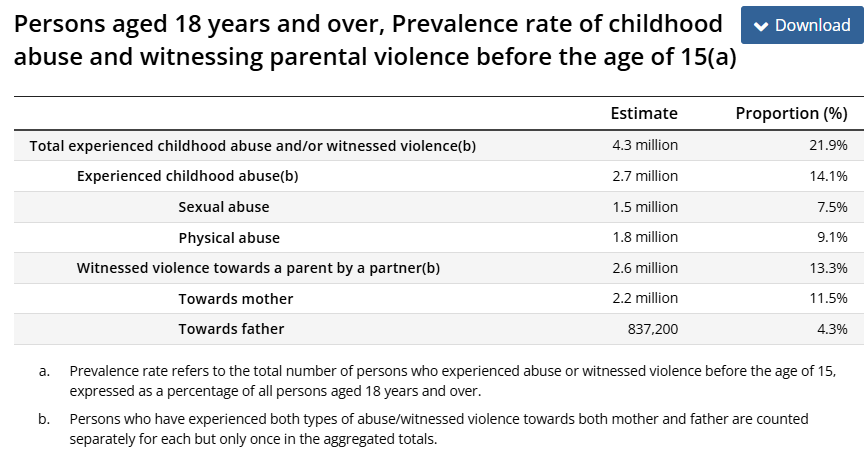
The personal safety survey, while our biggest source of data on both DV and other forms of violence, is collected and published under the auspices of the National Plan to End Violence against Women and Children 2022-32 and has to be understood accordingly.
And much like dealing with DV itself, the problem is not that we are addressing this issue. The trauma that exposure to DV causes a child is very real, and has long-lasting impacts that contribute significantly to the cyclical nature of violence.
The problem is when such things are weaponised to achieve ideological ends.
We see this in the sort of ‘domestic violence’ that is being considered. Is it the whole gamut of domestic violence, sibling abuse and parental abuse and everything else that can occur in a household? No, it is father-on-mother intimate partner violence (IPV), predominantly or, in many cases, exclusively.
This takes the whole field of child abuse research, child protection, and ending violence against kids, and subordinates it to ‘protecting women’. Exactly as that quote from the Herald said - we focus on mum, not on the kids.
Looking again at that table, we notice two things, one stated, one by omission:
That witnessing DV is basically as big a problem as the other forms of abuse (sexual and physical violence) put together
That emotional abuse and neglect are not shown
So, by focussing on witnessing DV, the discourse can be redirected - hijacked, if you will - by claiming this is the biggest problem affecting children. And those forms of abuse unquestionably committed more by mothers, emotional abuse and neglect, are quietly removed from the discourse. Nothing to see here.
This follows a well-established Australian pattern of covering up such data. Also see my previous looks into DV and child abuse here and here.
This has been going on for generations. As far back as 1979 a conference addressing family violence, conference papers published by the Australian Institute of Criminology here, addressed children’s exposure to family violence as “problematic” - yes, that word has been around since the 70s - and included the paper CHILD ABUSE: AN OVERVIEW OF RECENT DEVELOPMENTS (pg 27). The fields of both child abuse and DV research were in their infancy and had not yet been hijacked: this paper still distinguishes between the abuse the child experiences through exposure to family violence, and direct abuse of the child, both of which are important. It also gives us a quick historical look at models used for understanding child abuse, that persist today:
the criminal model, that focuses on the offender as a ‘deviant’
the ‘scientific approach’ that focused on identifying specific clinical manifestations of child abuse
the ‘situational morality model’, which considers, “the morality of compassion for the abused and the abuser, rather than an appeal to justice” (pg 28) and “signifies the first time that the needs of the child have been considered. It seeks to modify, even circumvent, formal legal codes in favour of rehabilitation”.
Of course, circumventing legal codes in favour of rehabilitation has also been a contributing factor to the levels of child abuse, especially in the Northern Territory, though it is not the whole story.
By the 1990s, research into the impact of domestic violence on children was a recognised field, for instance here. Again, this is, in itself, a good thing. But in 2011 the “Office for Women’s Policy” actively channeled that concern for children into a women-centred discourse. They funded a literature review for the past 20 years (going back to the 90s) titled The Impact of Domestic Violence on Children: A Literature Review. The key points this review supposedly revealed include:
Perpetrators often attack the mother-child relationship and use children in committing violence, such as threats to harm the children.
Children continue to be at risk from the effects of violence during and after parents’ separation.
Children experience significant risks in shared parenting arrangements when the arrangement involves substantial shared time with the violent parent.
The evidence shows that false allegations of domestic violence and child abuse are
rare. There is, however, evidence to suggest that perpetrators often deny or minimise their use of violence. All disclosures of violence should be taken seriously and investigated.
Children and mothers can cope with and recover from the effects of violence. Services and programs should build on their resiliency and coping strategies.
Specialised counselling and programs should be offered to children and mothers,
with a particular emphasis on rebuilding the mother-child relationship.
Note the last one - the mother-child relationship should be protected and encouraged, even though it is the father-child relationship that is far more likely to be damaged by separation and an encounter with family law.
There were 10 key points in all (pg 1) - we can see for these here that the focus is either the mother-child relationship, or the custody arrangements after the breakup: ie, the focus is mother-centred not child centred. “Children experience significant risks in shared parenting arrangements when the arrangement involves substantial shared time with the violent parent.” Well, of course we would be hesitant to allow the child near a demonstrably violent parent, but since male aggression tends to focus on other adults while female aggression tends to be aimed at the helpless and vulnerable, the numbers as they stand show the child is more likely to suffer abuse from the custodial mother than custodial father - something I have demonstrated previously. Ergo, the consideration should be who is going to be abusive or negligent to the child, not who has been aggressive in general. If this sounds outrageous, then I refer to my previous article on giving custody to fathers, where I point out that women are allowed to have smaller children with them in gaol, because we distinguish between woman as perpetrator and woman as mother. We should do the same thing for men, for the child’s sake - so that the children get access to their father, unless there is substantiated proof that the father’s aggression is a danger to the child.
Focusing on this literature review, it does not address DV in a gender-neutral way, nor examine the totality of DV. It defines ‘domestic violence’ as interchangeable with ‘intimate partner violence’ on page 2 - it is not, particularly when children are involved - and after the usual handwave to “mainly (but not only) by men” (still pg 2) we are told, “As domestic violence is most often perpetrated by men against their female partners (Australian Bureau of Statistics 2006; Mouzos & Makkai 2004), and women are more likely to experience more severe ongoing partner violence (Bagshaw et al. 2010; Bagshaw et al. 2011), this review examines domestic violence and the impact on children focussing on male violence perpetrated against mothers.”
The bottom line? Of all the domestic violence that can affect children, abuse from other men like uncles, problems with siblings and step-siblings, children traumatised not just by their own molestation but knowing what is happening to their siblings, older children (particularly girls) having to care for younger children in situations of neglect, or (particularly boys) placing themselves in harms way to defend the younger children in situations of violence because that’s what maternal violence looks like, targeting the younger children, and the one third of intimate partner violence where the man is the victim, only male-on-female IPV is considered.
To redefine domestic violence against children, something predominantly committed by women and particularly when the father is removed, as something the children witness as it is committed against the mother by the father, is willful blindness to the reality of the situation, and to the welfare of children.
And as I said, it is the trajectory of the entire field. When we move on to the next major publication by the AIFS, Domestic Violence as a Form of Child Abuse: Identification and Prevention (CFCA #36 from 2015), we are reminded that this is not just the opinion of a few researchers or even the entire Australian government: this reflects the position of the UN. On page 3 they define the ‘domestic and family violence’ the children are exposed to in the following way:
The Australian Government’s National Plan to Reduce Violence against Women and their Children (COAG, 2009a) adopts the UN (1993) definition, which states that violence against women is: any act of gender-based violence that results in, or is likely to result in, physical or psychological harm or suffering to women, including threats of such acts, coercion or arbitrary deprivation of liberty.
“Intimate partner violence” or “domestic violence” generally describe violence perpetrated by a current or previous partner, and is the most common form of violence against women (Phillips & Vandenbroek, 2014; WHO, 2010). “Domestic violence” and “family violence” are the terms commonly used to describe violence perpetrated against women in the home.
I don’t need to spell out what is wrong with these definitions, but I will state, again, that they are manifestly inadequate to describe the experiences of children.
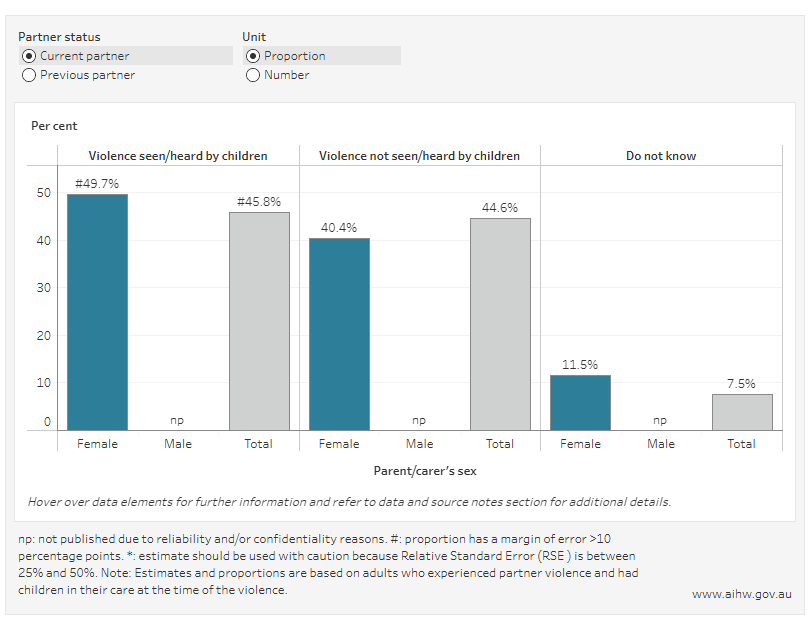
By defining ‘domestic and family violence’ as “something women experience at the hands of men’, they not only distort the experiences of the children themselves (as well as the experience of male victims and of the children who witness this), they create an inbuilt confirmation bias cycle. For instance, when the AIHW published Family, domestic and sexual violence data in Australia it became the standard dataset for subsequent research. But once we pass the summary, the research focuses on violence against women: community levels of intolerance of violence against women, understanding of non-physical forms of violence against women, and this reprehensible graph where the male experience is completely ignored and then included as though it doesn’t exist.
ANROWS is, unsurprisingly, worse - they ran the PATRICIA project from 2014-2017 to examine the ‘interface issues’ between DFV referrals and child protection services. Their recommendations looked exclusively at “fathers who use violence” and “the mother-child relationship” - attempting to co-opt the reality of child protection, which is frequently dealing with abuse and neglect by the custodial parent(s) and the people they bring into the child’s life, and replacing it with a woman-centred ideological focus.
Subsequent research then relies on this ‘data’ to propagate the women-centred approach to child abuse, such as this 2025 study which begins:
Domestic and family violence (DFV) refers to violence within a family or intimate partner relationship, that may be physical or non-physical in nature, and is a predominantly perpetrated by men, with women and children overwhelmingly the victims (AIHW, 2022)
And then there is the subtle shift from “women and children” to “women (and also children)”:
In addition to the serious physical and emotional harm to women, children are also adversely affected.
And finally, by the second paragraph, “women primary, children secondary”:
The DFV discourse has traditionally centred on women as the primary victim-survivors, with children’s victimisation as secondary and typically centred around the presence of physical violence (Katz, 2016).
But rather than directly addressing this, they then argue the coercive control narrative: ever-expanding the ways in which the woman can be seen as a victim and the child can be pushed further into the background.
And this is where we started - the recognition at the coal-face that this is not working: children need to have their own supports, to be prioritised and not regarded as some sort of secondary victim or ‘witness’.
But the research, the policies and the response are all deliberately going in the other direction. These few studies I looked at are but a handful of the many that have come out in the last few years, all with the same gynocentric methodology.
Children are not an addendum to their parents. They deserve protection in their own right. To characterise the safety of children as being dependent on the safety of their mothers denies them that protection.
Comments
Nothing yet. Say the first thing.
Sign in to join the conversation.