
Few events in history can shake the political status quo as thoroughly as revolutions. Bloody as they often are, messy and chaotic as they tend to be, revolutions can, in the span of just a few years, overthrow regimes that once appeared eternal.
And — much to the annoyance of those in power — revolutions frequently arrive with little warning. In January 1848, the great French historian Alexis de Tocqueville warned his fellow deputies in the French legislature that they were sitting atop an awakening volcano. Few took him seriously. One month later, Parisian crowds rose up and overthrew the monarchy in just three days.
Likewise, in the mid-1780s, French aristocrats laughed and applauded as The Marriage of Figaro was played to packed Parisian audiences. At the same time, the French elite willingly sabotaged a final attempt by the ancien régime to repair its finances without convening the Estates-General. Had they known what the future had in store for them, one might imagine France’s aristocratic elite acting quite differently during those crucial years. But they did not.
This raises an obvious question: could they have known? Were there visible signs that chaos was closing in?
These are the questions I will try to answer in this article by examining several recurring patterns found in societies on the brink of revolution:
the gradual decay of the state’s ability to perform its basic functions; -
elite factionalism which, on the one hand, blocks necessary reforms and, on the other, produces rival elites willing to lead an uprising against the existing order;
popular immiseration, which turns the masses against the ruling class and supplies the foot soldiers of revolution.
Successful revolutions are almost always preceded by some form of state breakdown: a gradual erosion of the state’s ability to fulfill its basic duties. A common cause of this dysfunction could be financial collapse.
Turning to our first example, Stuart England fell victim to financial collapse. Throughout the Middle Ages, English kings in peacetime were expected to live off revenues derived from the royal domain, customs duties, and ordinary taxation. In times of emergency — most often war — these revenues proved insufficient, and monarchs called upon Parliament to vote extraordinary taxes for the duration of the conflict. Kings could also turn to bankers for loans, though, as the Bardi and Medici families discovered, lending too much money to monarchs was an excellent way to change your status from banker to bankrupt.
The price revolution of the sixteenth century fundamentally altered this system. Even in peacetime, English monarchs now struggled to balance their finances. The declining ability of the state to fund itself reduced its capacity to conduct an effective foreign policy. Estimates vary, but the price revolution meant that the cost of putting a single soldier in the field rose by roughly a factor of five between 1530 and 1630. While crown revenues did increase over this century, they certainly did not rise fivefold. As a result, the later Tudor and early Stuart monarchs were forced to turn to Parliament even in peacetime and to seek loans on the international money market.
At the same time, the crown steadily sold off its landed assets. The royal domain shrank from more than 20 percent of England’s land to less than 5 percent by the 1630s, further undermining the monarchy’s ability to secure credit. Increasingly desperate, the crown resorted to ever more dubious methods of raising money. These culminated during the 1630s, when King Charles’s conflict with Parliament cut off parliamentary subsidies altogether.
During what became known as Charles’s Personal Rule, a decade when the proud and stubborn ruler refused to convoke Parliament, Charles attempted to finance the state through a series of deeply unpopular expedients. He levied ship money nationwide, extending a tax that had previously applied only to coastal areas. He declared royal charters invalid or expired, offering renewal only in exchange for payment. Offices and monopolies were sold, and long-dormant royal forest claims were revived. In 1634, the Crown even asserted that two-thirds of the county of Essex had once been royal forest, thereby casting doubt on existing land titles and demanding compensation amounting to 20 percent of the land’s current value.
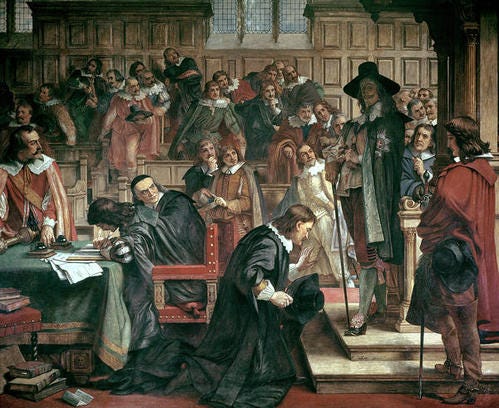
Through these methods — shady and needless to say highly unpopular — the crown managed to stay afloat during years of peace. War, however, exposed the system’s fragility. When the Scots rejected King Charles’s new Book of Common Prayer and rose in rebellion, the king was forced to raise and finance an army. The poor performance of the hastily assembled and ill-supplied royal forces in 1639 made it clear that Charles needed substantially increased funds if he wanted to crush the rebels. To obtain them, he had no choice but to recall Parliament.
The question, then, was whether the English elite would rally behind their monarch — or whether they would exploit his weakness to extract political concessions before agreeing to bankroll the crown? As Charles was to find out, Parliament was in no mood to help without a steep price, basically demanding the king dismantle the tools of his personal rule that the Parliamentary elite regarded as little more than royal tyranny.
The French monarchy faced a strikingly similar predicament in 1789. From the outside, the French state appeared strong, but beneath the splendor of Versailles and the prestige gained from victory in the American War of Independence lay a profoundly unbalanced budget slowly drifting toward bankruptcy.
By 1786, the crown’s deficit was estimated at 112 million livres, roughly 20 percent of annual expenditures. The Bourbon monarchy was no stranger to debt — Louis XIV, for instance, had accumulated obligations fifteen times his yearly income — but earlier regimes had relied on the return of peace and reduced military spending to stabilize finances. By the 1780s, this strategy no longer worked. Although France had been at peace for three years by 1786, the existing taxation system was incapable of restoring fiscal balance. Under Finance Minister Calonne, it became increasingly clear that major reforms were necessary if France was to remain a great power.
In theory, an absolute monarch could simply decree such reforms. In practice, Calonne’s ambitious, three-pronged plan required a more cautious approach. Its first pillar was a universal land tax payable by all landowners, directly challenging the remaining fiscal privileges of the elite. The second involved sweeping away archaic customs, including internal trade barriers between French provinces, the corvée, and the inefficient patchwork of indirect taxes. While these reforms promised substantial long-term revenue, they offered little immediate relief.
To bridge the gap, Calonne sought new loans. By the mid-1780s, however, confidence in the French crown among creditors was waning. Lacking a central bank comparable to England’s, France was forced to borrow at significantly higher interest rates. To reassure lenders, Calonne wanted to project an image of national unity by convening an Assembly of Notables, drawn from the highest ranks of the French elite, to endorse his reform program.
Thus, much like the Stuarts in 1640, the Bourbons found themselves at the mercy of their own elites. Their cooperation was essential to keep the state afloat. They found about as much support from the Notables and later the Parlements as the Stuarts did from their own elite a century and half earlier.
Financial collapse and elite intransigence sealed the fate of the English and French monarchies, effectively ending absolute monarchy — or, in England’s case, the attempt to establish it. Yet the ancien régime survived into the twentieth century in the other three great monarchies of Europe. All three would ultimately succumb under the pressure of total war during the final years of the First World War.
The Russian Empire was the first to collapse, so I’ll look at them in this article.
The central weakness of Russian autocracy was that it was not an efficient autocracy. Although the civil service was relatively large, it was ponderous and suffered from three fundamental flaws: chronic financial weakness, excessive reliance on the nobility, and — owing to its ad hoc development — a lack of clear institutional structure. Overlapping jurisdictions and competing chains of authority produced administrative chaos, making the implementation of coherent policies difficult.
This confusion is clearly visible in the reigns of the last three tsars. In the aftermath of Russia’s defeat in the Crimean War, Alexander II introduced reforms aimed at decentralizing the administrative apparatus of the state, most notably through the creation of provincial zemstvos and municipal organs. His successors, Alexander III and Nicholas II, reversed this course. They halted decentralization and strengthened the role of the central administration, curbing the authority of zemstvos and municipal bodies in favor of provincial governors. Yet this centralization came at the expense of the ministries themselves. In effect, the tsar set local governments, provincial governors, and the central ministries against one another, further fragmenting authority.
Compounding this confusion was the weakness of the tsarist administration due to its inadequate size relative to the population it governed due to the population boom of the 19th century.
As historian Orlando Figes has noted:
the power of the imperial government effectively stopped at the eighty-nine provincial capitals where the governors had their offices. Below that level, there was scarcely any state administration to speak of. Neither the uezd (district towns) nor the volost (rural townships) had permanent government officials. Prince Lvov, a leading figure in the zemstvo movement and head of the Tula zemstvo in the 1890s, put it bluntly: “ We knew as much about the Tula countryside as we knew about Central Africa.”
While at the turn of the century, Russia employed only four state officials per 1,000 inhabitants, the number was 7.3 in England and Wales, 12.6 in Germany, and 17.6 in France. The regular police force — excluding the political police — was extremely small by European standards. In this regard Romanov Russia was truly the continuation of the ancien regime, its repressive apparatus being more similar in size and capacity to that of the French ancien regime rather than Napoleonic France.
When serious disturbance broke out, often the Tsarist regime had little choice but to deploy the army, but reducing the armed forces was a risky move as professional soldiers regarded policing duties dishonorable and unworthy of military professionals, while the rank and file, mostly peasants, were forced to repress people of their own class.
Defeat against Japan in 1904–1905 already showed the limitations of the Russian army, but it was the First World War that brutally exposed the incompetence of the tsarist regime. On the northern front, Russian communications were intercepted by the Germans, contributing to catastrophic defeats at Tannenberg and the Masurian Lakes, costing Russia more than 200,000 in a matter of weeks. Outclassed in the war of movement, Russia was even less prepared for a war of attrition as the country’s industrial backwardness became decisive. The economy proved incapable of supplying the army with sufficient weapons and ammunition.
Despite its vast population, Russia also failed to mobilize effectively: while France mobilized 16 percent of its male population and Germany 12 percent, Russia managed only 5 percent. The myth of the unstoppable Russian steamroller proved to be just that, a myth.
One of the army’s greatest weaknesses was the absence of a clear command structure. Authority was divided between the War Ministry, the Supreme Headquarters (Stavka), and the front commands, each pursuing its own priorities. No coherent war plan emerged. As General Brusilov later complained, he had never been able to discover the overall strategy of the campaign. General Bezobrazov summarized the situation more succinctly: it was a system of “order, counter-order, and disorder.”
The unexpectedly high casualty rates overwhelmed Russia’s medical services for good measure also. After visiting a field hospital, Brusilov wrote to his wife that a facility built for 200 patients was treating over 3,000 wounded and sick soldiers. Doctors worked continuously, yet men lay unwashed and bleeding on straw-covered floors. Decorations and money could be distributed, but little else could be done beyond arranging evacuation to the rear.
As conditions deteriorated and losses mounted, morale and discipline collapsed by 1917. As the army expanded rapidly — nine million men were called up in the first year alone — and the professional Tsarist officer corps suffered crippling casualties, by 1917 the officers were struggling to maintain control.
For many soldiers, the years of defeat in the trenches was the decisive psychological moment of the revolution: the point at which loyalty to the monarchy finally began to evaporate. A government that had dragged them into an unwinnable war, failed to equip or supply them adequately, and appeared increasingly indifferent to their suffering no longer deserved their sacrifices. Already in 1915, during the Great Retreat, roughly one million soldiers surrendered to German and Austro-Hungarian forces, many preferring captivity to continued fighting. Tens of thousands more deserted to the rear, often turning to banditry.
As the war progressed, the army, once the main pillar of the regime, was rapidly becoming a revolutionary force. Thus, when the starving population of Petrograd rose up in 1917, the Tsarist regime was in for a rude shock. Rather than crush the uprising, the army joined it, and with the generals unwilling to risk a civil war while Russia was fighting a major war, the imperial regime found itself without any support and was toppled in less than a week.
Comments
Nothing yet. Say the first thing.
Sign in to join the conversation.