
Compared to the Napoleonic Wars, the French Revolutionary Wars are very much a poor relation. While I was researching this article, just out of curiosity I checked the volume of google searches of the two conflicts and the Napoleonic Wars emerged as the easy winner with over 22,000 searches/month. In comparison, the French Revolutionary Wars had less than 2,000.
Yet forgotten as these conflicts seemingly are, their role was still crucial. Without the success of French arms, the Revolution would have been crushed as early as 1792–93 and the course of European history could have been much different. The pivotal role the Revolutionary Wars played in setting the stage for the Napoleonic Wars cannot be overstated, yet in comparison with Austerlitz, Jena, Friedland, Borodino or Waterloo, the battles of Valmy, Fleurus, Rivoli or Hohenlinden are barely registered.
And not only are the Revolutionary Wars quite forgotten, but much of what’s known about the conflicts are shaped by the stereotypical antagonism pushed onto revolutionary France and the first Coalitions, painting the conflict thus as a fight between the new world vs the old, progress vs stagnation, freedom vs tyranny, either a revolutionary crusade or a counter revolutionary one.
In this article I will attempt to create a chronological narrative that will cover the Revolutionary Wars from start to finish and debunk some of the myths surrounding the conflicts. Rather than just focus on the conflict of France and the anti-French coalitions, however, I’ll try to cover them in their proper continent wide context.
In the popular image, the French revolutionary wars came about either thanks to the fanatical French revolutionaries, who were busy exporting their revolution at bayonet point, or due to the paranoid and conspiring old monarchies of Europe, who provoked a war only to have an excuse to crush the revolution in its cradle.
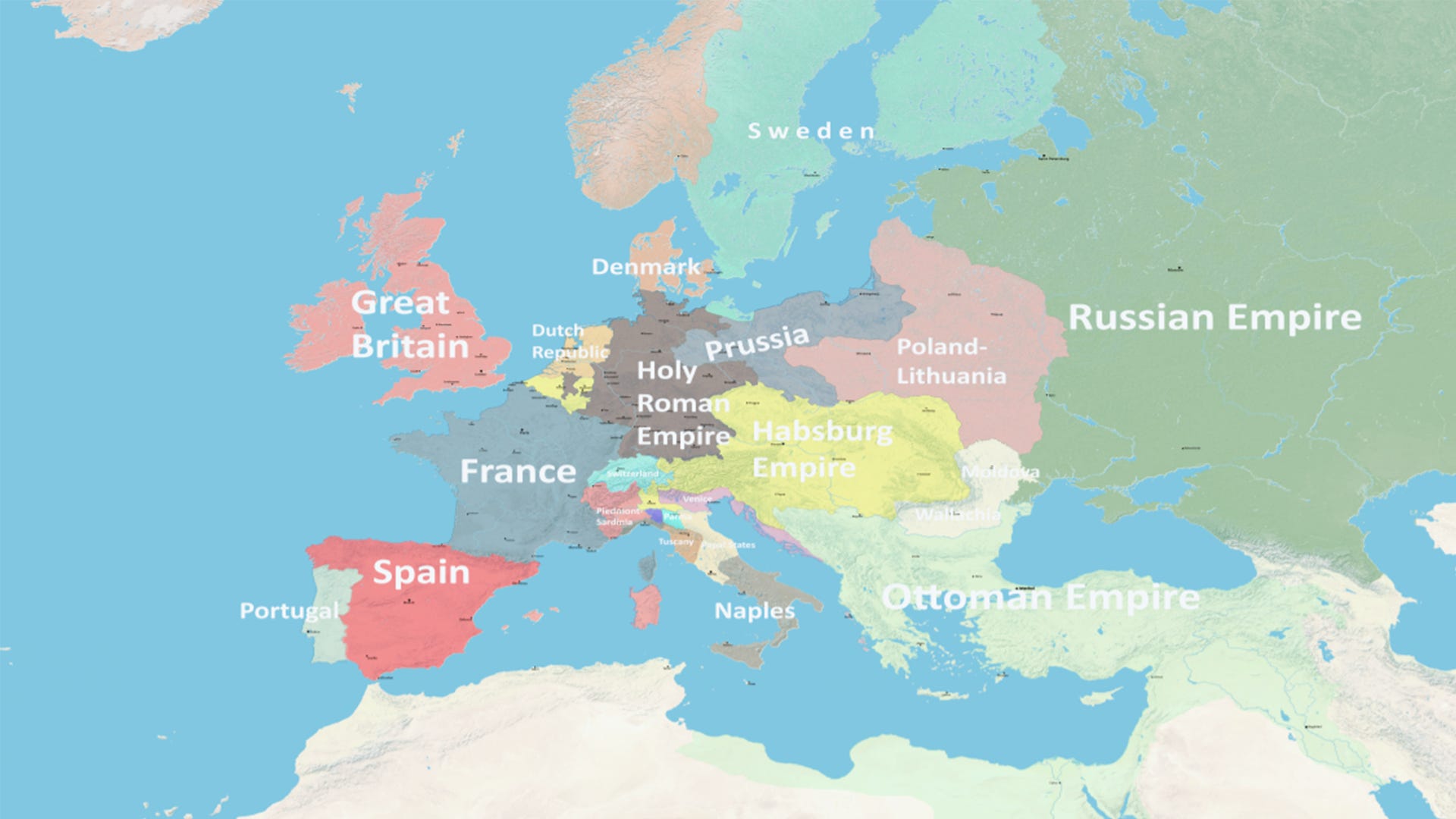
Neither image is entirely wrong, but in truth, both are much more wrong than right also. According to either interpretation, the revolutionary wars came like a lightning bolt to turn a peaceful Europe upside down, yet in reality, long before the citizens of Paris rose up and stormed the Bastille, from Scandinavia to the Balkans, Europe was already aflame.
Fighting began between the Ottoman Empire and Russia, the Ottomans declaring war in 1787, but what started as a regional conflict quickly expanded.
The Habsburgs had a defensive alliance with Russia, thus since the Ottomans were the aggressors, Vienna had no choice but to join Russia.
Sensing an opportunity, the Swedes attacked the Russians in the Baltic, but the Swedes were attacked by the Danes not much later.
With Russia tied down in a two front war, the Polish elite also saw a chance to reform their declining country, which in reality was little more than a Russian protectorate by this stage.
With the Habsburgs fighting on their southern front, the Prussians also saw an opportunity for expansion, and Berlin began to negotiate with the Sultan, offering to open up a northern front against the Habsburgs, while Berlin also began to assist disgruntled Polish and Hungarian elements within the Habsburg Empire.
Comparatively speaking, Western Europe was much more peaceful and the tranquility of the region was only threatened by the Prussian invasion of the United Provinces in 1787, and local unrest in the Austrian Netherlands.
This was but a quick recap of events, but as shown, pre-Revolutionary Europe was far from peaceful, and rather than the west, it was the eastern half of the continent that was worst hit by the turmoil.
Thanks to the conflict in the east, the French Revolution was allowed to exist more or less in isolation for a few years, and though the emigre princes were banging on the doors of Europe’s crowned heads, they found little sympathy, and even less support for an armed counter revolution.
The event that began to suck France into the great power politics of the continent was the King’s failed Flight from Paris. To understand why Louis XVI tried to flee in the first place, let’s do a quick recap of the French Revolution up to 1791.
By the mid 1780s, the finances of the French kingdom were in tatters. Though France emerged victorious from the American War of Independence, the price was steep. Unwilling to raise taxes, the French war effort was almost solely financed through loans, leaving the kingdom heavily indebted. By 1786, a year of peace, French coffers were 100 million livres in debt, and nearly half the state’s budget was earmarked for interest payment. Minister of Finance Calonne knew the situation was irredeemable as things stood, and the only way to restore the kingdom’s finances was through a sweeping reform.
Calonne proposed to introduce a new uniform land tax that would have cancelled much of the privileges enjoyed by the elite. Calonne also proposed an administrative reform, proposing to abolish the existing custom barriers among the provinces to facilitate the growth of trade. Calonne’s plan was ambitious, but as his reforms needed time to bear fruit, in the meanwhile he planned to bridge the gap through further loans. And that was the problem.
Lacking a central bank of its own, France was already taking loans on much higher interest rates than Britain or the Dutch, but by the mid 1780s, French credit was further eroded. Thus, rather than push through the reforms via royal decree that might stir opposition, Calonne wanted to reassure creditors by a show of national unity, and have his reform plan blessed by the Assembly of Notables, an organ composed by the cream of French society.
Calonne, however, overestimated his ability to convince the notables, who rejected to back the reforms, and he was sacked in the spring of 1787. He was succeeded by the Archbishop Brienne of Toulouse, but Brienne received no more support than Calonne and the Assembly of Notables was dismissed in May 1787. Brienne next tried to push through the reform package through the Parlements, but his efforts were resisted, forcing the crown to dismiss the stubborn Parlements and reorganize the legal system of the country by force. The reforms in turn unnerved the crown’s financiers, who refused to lend more money in the summer of 1788, leaving the crown as good as bankrupt.
Abandoned by its elite wholesale, the French crown was out of options, Brienne conceded defeat and resigned. He was succeeded by the popular Jacques Necker, who agreed to convoke the Estates-General for 1789, hoping the representatives of the people would prove more cooperative than the notables or the Parlements. It wasn’t to be.
Representatives from the Third Estate, proved uncooperative from the start, demanding the abolition of the estates to create a unified representative institution. When the king and the privileged orders resisted these demands, the deputies of the Third Estate renamed themselves the National Assembly and declared themselves as the source of law in the kingdom. A royal attempt to intimidate the third estate a few days later ended in failure and the king ordered the remaining clergy and noble deputies to join the National Assembly.
This, however, wasn’t the end of the story just yet. In late June the king sent orders to regiments on the frontier, recalling roughly 20,000 men to surround Paris and Versailles. The military build-up was not missed by anyone, and when Louis dismissed Necker, an uprising broke out in Paris. The revolutionaries seized the opportunity and ordered the creation of a National Guard in Paris, to protect the capital from the double danger of counter revolution from the court and the anarchy of the masses. By this time, the build-up around Paris was nearly ready, but as Louis’s commanders were unsure about the loyalty of the rank and file, the stand off ended in an anti climax and the king capitulated without a fight.
The absolute monarchy was well and truly dead after July, but the shape of the new order was still undecided.
Following the insurrection in Paris, a series of uprisings shook the countryside as well. The news of burning chateaus and butchered aristocrats scared the deputies of the Assembly, and in a grand gesture, they agreed to abolish the remnants of feudalism. Louis XVI was less than impressed and neither was he happy about the new role the assembly planned for him, thus in August and September, the king bided his time, and refused to ratify either the abolition of feudalism, the Declaration of the Rights of Man and of the Citizen and the new constitution that would have significantly curtailed his prerogatives.
As the king dragged his feet, Paris was boiling with tension and on October 5, a crowd led by Parisian women marched on Versailles. A few hours later the National Guard joined the marchers. October 5 ended in a tense stalemate, with the crowd refusing to go away, and the king asking for time to consider his options. The stalemate was broken the following day, when the mob invaded the palace and nearly lynched Marie Antoinette. Though the intervention of Lafayette and the more disciplined element of the National Guard averted a massacre, the King, his court and the Assembly were all forced to leave behind Versailles and relocate to Paris.
Though on paper Louis remained the head of state, in reality he felt little better than a hostage, and in June 1791, the king and his family fled Paris. The flight was intercepted at the town of Varennes and the royal family was dragged back to Paris, receiving a less than warm welcome. Upon his return, Louis XVI was even suspended from office. Calls were made even for the abolition of the monarchy, but a gathering on the Champs de Mars to gather signatures for a petition demanding the abolition of the monarchy was dispersed by force and a crackdown followed.
Up to this point Louis’s fellow monarchs showed little enthusiasm for the cause of the Bourbons, but the Varennes episode finally shook other monarchs to pay closer attention. King Gustav of Sweden was most belligerent, but Catherine the Great of Russia, Frederick William III of Prussia and Emperor Leopold II were looking anxiously on also.
Nonetheless, apart from the Swedes none was yet willing to go to war to save the Bourbons. Shrewd as ever, Emperor Leopold II hoped to use diplomacy to secure his goals, and joined by the Prussians, he issued the Declaration of Pillnitz, threatening to go to war with France if the royal family came to harm…provided that all the other powers of Europe joined him as well.
In reality, the Declaration of Pillnitz was a paper tiger. Leopold knew fully well that Britain had little interest in war. While Catherine the Great would have supported Prussia and Austria attacking France only to benefit herself. With both Prussia and Austria tied down in the west, Russia would have had a free hand to deal with the Polish reformers, a party Leopold hoped to protect in order to keep Poland alive as a buffer state against Russia.
Knowing the sorry state of the French finances and armed forces, Leopold hoped a show of force would be enough to intimidate the French and protect the family of his sister, but unfortunately, the Pillnitz Manifesto was to have the exact opposite effect. Rather than see the declaration as the worthless piece of paper it was, the French revolutionaries saw it as the confirmation of a grand conspiracy hatched to destroy the revolution. Initially, however, the reaction was hard to detect as following the Champs de Mars Massacre, the constitutional monarchists imprisoned or drove their opponents into exile. At long last, even Louis XVI seemed to have accepted the new reality and signed the constitution in exchange for his reinstatement. When the Constitution of 1791 came into effect, many hoped it will bring an end to the revolution..it wasn’t to be.
Weeks before the Constituent Assembly dispersed, in a gesture of selflessness, the deputies agreed to a self-negating law. According to which no deputy of the Constituent Assembly could sit in the next legislative. Nor become a member of the executive in the next five years.
Though at first it looked like a minor detail, it was to have major ramifications very quickly. The new assembly met in October 1791, and the Jacobins quickly gained the upper hand in the new legislative. Under the leadership of Brissot and his allies, they began to push their country towards war.
Eager to discredit the king, the Brisottins pushed through legislation that targeted the property of the emigres and non-juring priests, knowing full well Louis will veto these legislative projects. They also pushed through an ultimatum that demanded the Rhenish princes to expel the French emigres and their private armies from their lands, threatening war in case of a refusal. Much to the disappointment of the Jacobins, however, Louis supported the ultimatum and the princes meekly accepted to expel the emigres. But just when it looked as if France will be forced to solve her internal problems without an external conflict, the court of Vienna intervened again, once more with catastrophic consequences.
Misreading the French completely, the Habsburgs believed their threats from the summer of 1791 actually worked, and played a part in the reinstatement of Louis into office after his suspension.
Believing threats could do the job again, Emperor Leopold II issued an ultimatum, threatening war if French forces violated the borders of the Holy Roman Empire. Rather than being intimidated, the assembly was outraged, and amidst the fever for war, the king was forced to dismiss his cabinet and name Jacobins as their successors. The death of Emperor Leopold postponed the outbreak of the war by a few weeks, but on April 20, 1792, the National Assembly declared war on the Habsburgs.
During late 1791 and the early months of 1792, much of the French elite welcomed the coming of armed conflict. Brissot and his allies saw war as a chance to unify a divided nation, and confidently predicted that free people have nothing to fear from the armies of despots, who will be effortlessly brushed aside. In any case, the hawks were only expecting to fight a war against the Habsburgs, as rather mistakenly, they believed Prussia will remain neutral in the conflict.
The discredited Lafayette and some of his Feuillant allies also saw an opportunity in the war, hoping victory on the battlefield will allow them to re-enter the political scenery.
The most vocal critic of the war was Robespierre, reasoning that a war in France’s current state was too dangerous. Defeat could discredit the new regime entirely, and the victorious enemies could even occupy Paris and force a humiliating treaty upon France, while a prolonged war could militarize French society and pave the way for the rise of a military dictator.
Louis XVI backed the war also, though his rationale was the same as Robespierre’s, hoping defeat in war will rid the country of the revolution and the victorious allies will help him reestablish his old powers.
The early months of the war were to prove the king more right than the Jacobins. Though the army of the nord boldly advanced into the Austrian Netherlands, the French offensive quickly collapsed and the ill-disciplined soldiers even murdered one of their own generals during the panicky retreat. Luckily for the defeated French, the Austrians were in no position to exploit their victory, but as the news of defeat reached Paris, the capital became a pressure cooker of tension.
When the King sacked his cabinet and vetoed popular legislation, a crowd invaded the Tuileries and tried to intimidate Louis XVI, but the king remained as obstinate as ever. A few days later, Lafayette returned to the capital and addressed the Legislative, but found a cooler than expected welcome. The general planned to use a review of the National Guard to rally the guard to his side, stage a coup and rid the capital of the Jacobins, but his enemies tipped off the Legislative of Lafayette’s intentions and the review was called off. Amidst calls for his arrest for desertion, the frustrated Lafayette headed back to the frontiers, but the chaos in Paris was just beginning.
Calls for an uprising were made already in July, but what really made the Parisians to turn on the monarchy was a manifesto issued by general Brunswick, who threatened to unleash unforgettable vengeance on Paris if the royal family was harmed. If the duke believed he could intimidate the French capital, he was in for a very rude shock. As soon as the manifesto became public, the general feeling in Paris was one of outrage rather than fear and all but one of the Parisian sections demanded Louis’s removal from office.
In the words of Louis Philippe of Orleans, the future king of France:
“This manifesto of the Duke of Brunswick inspired more enthusiasm in France for the defense of the fatherland and national independence than all the patriotic appeals of the National Assembly and the revolutionary societies put together’.”
The Legislative resisted the sections. By this time, however, the control over hard power in the capital was under the control of the sections, as the National Guards were under their control, rather than the legislative. Thus, despite the uncooperative deputies, on August 10 the sections called out the guard and marched on the Tuileries, and in the bloody event that became known as the Insurrection of August 10, the royal palace was stormed and the king’s loyal Swiss Guard were butchered. Faced with the national guard, the remnants of the Legislative meekly agreed to suspend Louis from office a day later.
In the following weeks the capital was purged of constitutional monarchists and suspected enemies, filling the prisons. The new government impeached general Lafayette also. In a last gasp desperate attempt, the general tried to rally his army to a march on Paris, but found little support. Left with no choice, Lafayette fled to the enemy. Though he was deemed as one of the leading malcontents of the revolution, his life was spared, but he was to spend much of the decade behind bars.
While France was in turmoil, Brunswick finally crossed the border in late August and easily brushed aside what little resistance he met. By early September, the duke was less only 150 miles from Paris. The advance of the enemy served to radicalize the French capital even further. Tens of thousands volunteered to join the army to fight for the fatherland, but in the general paranoia that descended upon Paris, rumours began to swirl about a plot to free the prisoners following the departure of the volunteers. According to the whispers, once freed, the prisoners planned to fall upon the families of the volunteers and massacre them.
No such plot was ever proven to be more than a feverish imagination, but in the tense and paranoid atmosphere of 1792, it was enough to push radicals into the darkest episode of the revolution’s history. Between September 2 and 6, Parisian crowds broke into the prisons and formed tribunals, either convicting or acquitting the prisoners. Estimates vary, bur roughly half of the prisoners, mostly petty criminals, were found guilty and murdered on the spot.
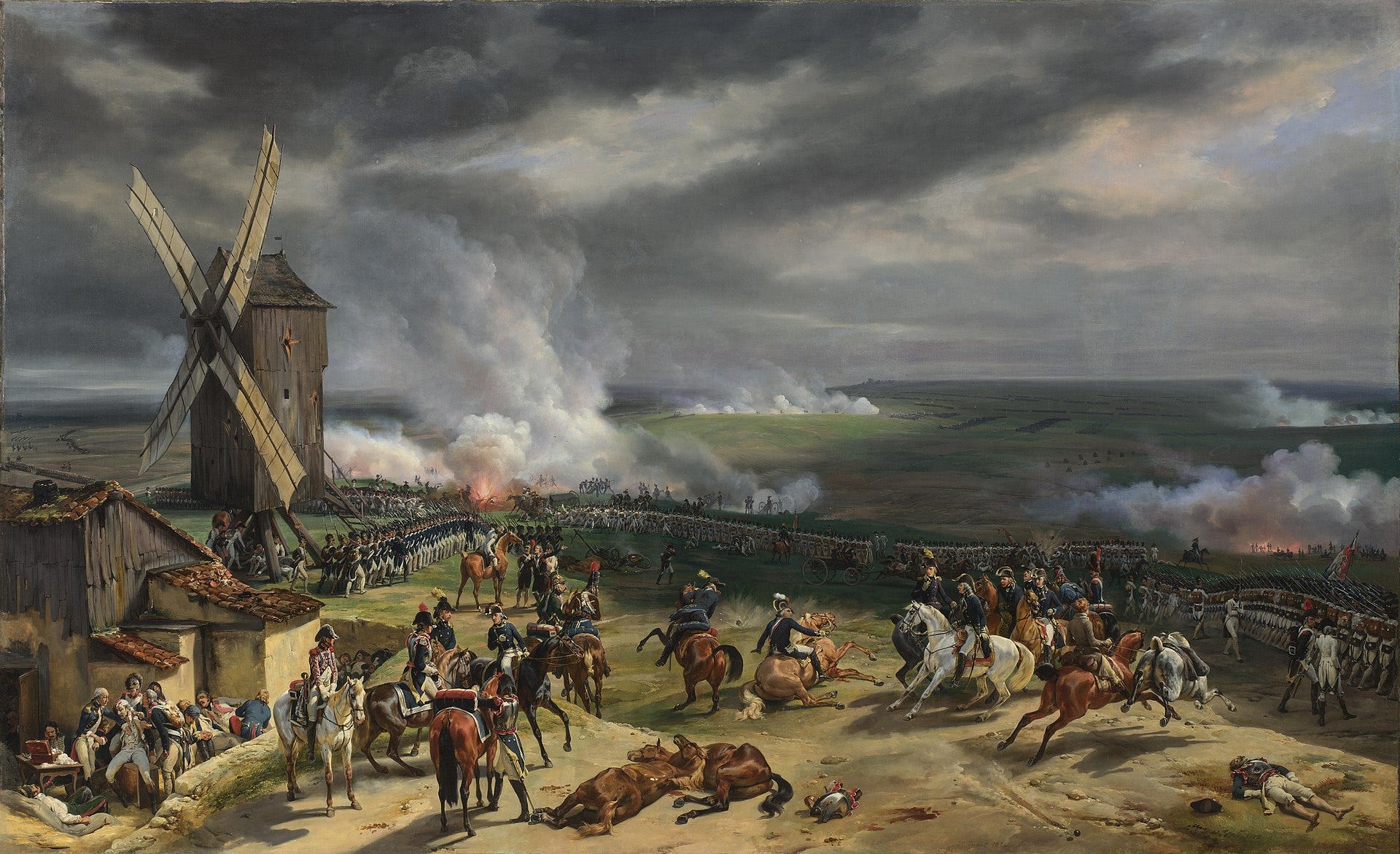
The Prussian advance in the meanwhile continued unopposed. Brunswick outmanoeuvred the French and succeeded to put his forces between Paris and the French armies, but in a bold move, general Dumouriez marched behind him to cut the Prussian lines of communications. Unwilling to march against Paris with his communications threatened, Brunswick turned about and faced Dumouriez at Valmy. In what can best be described as an anti-climatic artillery duel, the French stood their ground for the first time during the war and forced Brunswick to call off his march on Paris. With the Prussian army decimated by dysentery, the Prussians began to retreat and King Frederick William even opened talks for an armistice, but when news reached him that the new French legislative abolished the monarchy, the Prussians abruptly broke off negotiations.
With the Prussians heading to the eastern side of the Rhine, Dumouriez took to the offensive and invaded the Austrian Netherlands and defeated a heavily outnumbered Austrian force at the Battle of Jemappes. Buoyed by their upswing in fortune, French forces rapidly overran the Austrian Netherlands. French forces met little resistance on the left bank of the Rhine either, and rapidly occupied it, while in the south, the French overran Savoy.
The victories of the autumn of 1792 energized Paris, and the Girondins were feeling positively invincible by now. Beneath the cloak of success, however, the foundations of French victories were very fragile.
As one front line officer remarked in the winter of 1792/93:
My cavalry are not in a fit state to move: to repeat what I have already told you, their harness and saddles are in a dreadful condition; the soldiers have no breeches; and I doubt whether the horses are up to taking the field . . . on account of having spent the last month out in the snow with their backs covered in ice . . . The rest of the army set off to attack Triers bare-footed and bare-arsed alike, and it has come back in the same condition, while I receive nothing from the Minister except promises which do nothing to clothe them or put shoes on their feet. To order troops who are all but naked to take the field once again in so rigorous a season would be to run clean counter to humanity and justice alike . . .
Ill-equipped, ill-supplied and with many volunteers going home, by the spring of 1793, the armies of the republic were down to a mere 230,000 men.
While French forces were dwindling, the number of the republic’s enemies was growing by the day. French intransigence in opening up the Scheldt river to navigation unnerved both Britain and the Netherlands, with secret negotiations breaking down completely following the execution of Louis XVI. The republic promptly declared war on both Britain and the Netherlands in February. The demise of the Bourbon monarchy, in turn, frightened the Spanish Bourbons, whose supposed hostility towards the republic earned them a declaration of war in March 1793.
As the spring campaign of 1793 neared, France found herself virtually surrounded. With the armed forces in a sorry state, the Convention knew reinforcements were needed and a levy of 300,000 men was voted, the departments receiving quotas. Volunteers were preferred, but if there weren’t enough of those, the authorities were allowed to use compulsion to fill up their quotas. Conscription was never popular in France, or anywhere else for that matter, but in regions closer to the frontier were the population was more accustomed to military service and regular forces were present, the levy was accepted without resistance. The situation was to be much different in western France, where the call to the arms led to the outbreak of a civil war. Resistance was met in both Brittany and the Vendee, but thanks to the strength of the local garrisons, conflict was initially averted in Brittany, but in the lightly garrisoned Vendee, the masses rose up against the republic en masse.
Facing invasion and now civil war, rather than liberating the oppressed masses of Europe, as 1793 began to unfold, the revolution was struggling for its very survival.
After the republic declared war on Spain in March, the Spanish pushed into southern France and besieged Perpignan in May. Progress, however, was painfully slow and the conflict degenerated into a stalemate afterward. Both armies were in a sorry state.
In the previous decades the Spanish concentrated on their navy, while some French volunteer battalions were so ill supplied that they did not even had the right calibre of musket balls during the spring. French counter-attacks in September were repelled with heavy losses, but ill-supplied and under manned, the Spanish decided to lift the siege rather than wait for further attacks. Nonetheless, as the year 1793 ended, the Spanish went into winter quarters on French soil.
After the initial French advance into Savoy, French forces were withdrawn to deal with federalist revolts, allowing the Piedmontese to regain the duchy, but they refused to advance into France. Their timidity was punished in the autumn, as after the recapture of Lyon, general Kellerman evicted the Piedmontese from Savoy once more.
Spain, however, was to remain but a sideshow during the war, and the same was true of Italy until 1796, and during the first few years, the most important theatre of the war was to be the Low Countries and to a lesser degree the Rhineland.
Even with the depleted forces, Dumouriez remained optimist and as the spring campaign of 1793 began, he advanced north, invading the Netherlands. The other French field army was commanded by South American general Miranda, and was blockading Maastricht. Before the city could be subdued, however, Miranda was attacked and defeated, forcing Dumouriez to call off the invasion of the United Provinces. Despite Miranda’s setback, Dumouriez was still confident and attacked at Neerwinden, but was defeated. Not all was lost at this stage, as the French still had forces at their disposal, but Dumouriez suffered another defeat a few days later at Lubbeek. Demoralized, the French forces started to disintegrate and Dumouriez may have lost half his army in a week, either through combat or desertion. Left with few choices, the general opened negotiations with the allies, offering to evacuate the Austrian Netherlands.
By this stage, Dumouriez began to fear for his own life, and in a desperate gamble he attempted to rally his soldiers to march on Paris and reinstate the constitutional monarchy, but he found no more support than Lafayette did six months earlier and fled into exile.
By April, the Austrian Netherlands were lost, but the Austrians were in no state to advance against the heavily fortified French border on their own, thus the campaign got bogged down for a month until British reinforcements arrived. Once their numbers were up, the allies attacked and inflicted two defeats on the French at Raismes and Famars, but rather than press home their advantage, the differing objectives of the allies led to a split, with the British marching off to besiege Dunkirk, while the Austrians besieged the fort towns of Maubeuge and La Quesnoy.
The splitting off the allied forces gave back the initiative to the French, who launched counter attacks, and defeated the British at Hondschoote, forcing York to lift the siege of Dunkirk. A month later general Jourdan attacked the Austrians at Wattignies, forcing them to lift the siege of Maubeuge. On the north eastern front, 1793 ended in a stalemate. Though the allies succeeded to kick out the French from the Low Countries and capture some border fortresses, a march on Paris was way beyond their capabilities.
The situation was no different in the Rhineland either.
In the spring of 1793, a joint Austro-Prussian army crossed the Rhine and besieged Mainz in 1793. Though the allies had superior numbers and were better supplied, they refrained from trying to storm the city, and elected to reduce Mainz by blockade. Thus, the siege went on into July, ending with the surrender of the garrison on July 23. To quicken the fall of the city, the allies granted generous terms, allowing the garrison to depart with their arms, on condition they swore not to fight against the allies for 1 year.
Following the fall of Mainz the French were outnumbered 80,000 to 100,000, and the allied forces were both better supplied and trained, yet mutual suspicion poisoned the allied campaign, forcing the Austrian general Wurmser to attack on his own, capturing Wissembourg in October, but the allies got bogged down once more by besieging Bitsche and Landau. Yet as the French forces received a steady line of reinforcements through the autumn, they were able to counter attack, and though initially beaten in November at Kaiserslautern and Biesingen, in December, the armies of Hoche and Pichegru combined to inflict a heavy defeat on Wurmser at the second battle of Wissembourg.
As the year 1793 ended, both the Austrians and the Prussians retreated to the right bank of Rhine, taking up positions at Philippsburg and Oppenheim, leaving the left bank under French control.
1792 saw the revolution at its ugliest. Mob violence overthrew the monarchy, and the radicalization that spiraled out of control in 1792 was far from over just yet.
The defeats of the spring discredited the Girondins, whose rigid refusal to work with the sans culottes and centralize power in order to save the country sealed their fate, their leading deputies being arrested after the Insurrection of May 30-June 2.
With the Girondins out of the way, the Montagnards took over the government. The power of the government came to be centralized in the Committee of Public Safety. To placate the sans culottes, the Montagnards also agreed to implement price controls and organized the revolutionary armies, sans culotte militias, that were sent out into the countryside to pressure reluctant peasants to sell their harvest at fixed prices.
To crack down on real or imagined traitors, the draconian law of suspects was implemented in the autumn of 1793, and 177 people were sentenced to death by December 31, including Marie Antoinette and much of the Girondin leadership arrested in the spring.
With the call up of the spring being insufficient, a levee en masse was decreed in August, calling up all able bodied, unmarried or childless widower men aged between 16 and 25 to serve in the army. On paper, with the levee en masse France had now an army of 1,3 million. In reality the real number was around 700,000, but even this number was more than able to significantly shift the balance of power on the front once the conscripts began to arrive in force for the campaign of 1794. Ill-trained, ill-equipped, often undisciplined as the conscripts were, the French army of 1794 was the largest army Europe had ever seen up to that point, and from the point of view of the allies, it was a seemingly inexhaustible horde.
The February calls for conscripts drove the Vendee into revolt against the revolution and the uprising only expanded after the expulsion and arrest of the Brissotins created another faction into the civil war, the so called federalists, who took over such cities as Lyon, Caen, Bordeaux, Montpellier, Toulon and Marseille. Though from the point of view of Paris the two groups were traitors alike, in reality these two revolts were quite different, as the conflict of the Montagnards and the federalists was a civil war within the ranks of the revolutionaries.
At first, the federalists seemed a formidable enough enemy due to their control of key cities. Ultimately, however, the federalist proved to be the easier nut, as by the end of the year the uncoordinated federalist revolts collapsed entirely, Lyon and Toulon resisting for the longest and suffering draconian punishments after they were conquered.
The revolt in the Vendee was different. Less urban than the federalists, it was primarily a rural, a peasant uprising and that is what made it so dangerous. With the republican forces struggling to tell apart rebel from peasant, the rebels had the upper hand in early 1793, ambushing convoys, assassinating and intimidating officials, and even capturing towns. A lack of coordination and logistical support, however, was to plague the Vendéen rebels as much as the federalists, and as the military build-up of the republic accelerated in 1793, the tides began to turn and the rebels suffered a major check in the autumn, where the main rebel army was beaten at Cholet and driven north of the Loire. Hoping that the British could evacuate them, the rebels marched on the port of Granville, but their attempt to capture the port was beaten off by the well entrenched defenders. With supplies running low, the army dwindled rapidly afterward and by the time the republicans attacked them near Le Mans, what was in September an army of 40,000, was reduced to a mere 10,000.
Outmatched, the rebels lost half their force at Le Mans. The survivors marched west, towards the sea, but were set upon by an 18,000 republican force near the town of Savenay and anhilated. In the words of republican general Westermann:
‘There is no more Vendée. I have just buried it in the marshes and mud of Savenay . . . I have crushed children under the feet of horses, massacred women who . . . at least will engender no more brigands. I have no prisoners with which to reproach myself.’
With the main rebel army destroyed, the Vendee was now mostly defenseless against the republicans, whose revenge was savage.
General Kléber remembered the sacking of a town:
Hardly had the troops arrived than the town was being subjected to the most horrible sack . . . The most austere of men could not have suppressed a smile at the sight of the different costumes in which the soldiers decked themselves, the most popular items in their masquerades being soutanes, surplices and chasubles.
And that wasn’t the worst. To obliterate any semblance of resistance in the countryside, infernal columns were let loose, burning and pillaging the rural areas, planning to reduce it to such a state that the area will no longer be able to support a rebellion. Estimates vary about the total loss of life involved, higher estimates putting the figure to a quarter of a million, but the men who did were hardly ashamed of their actions.
Volunteer François-Xavier Joliclerc, as determined supporter of the republic as there was in France, passingly described the proceedings in a letter to his mother:
Fourteen columns are about to set out to ravage the departments of Deux-Sèvres and the Vendée. We are setting out . . . with muskets in one hand and torches in the other. Men and women, one and all will perish by the sword. Apart from the smallest children, it is necessary that each and every one of them should die. These departments must serve as an example to others that might have notions of rising in revolt.
Savage as the republican retribution was, it still failed to suppress the rebels. Though no more great rebel army was organized, rebel bands continued to operate, and through ambushes caused many more casualties to the republicans. Following the fall of the Jacobins in July, the Convention changed tactics and put general Hoche in charge, who turned to a policy of clemency, securing peace in February 1795, when the rebels signed the Treaty of La Jaunay.
Fighting in the Low Countries began in April, and the allies laid siege to the fort of Landrecies. The French launched counter attacks, but these were initially repulsed with heavy losses and the fort surrendered on April 30. The French went onto the offensive in May, and drove back the allies toward the Scheldt, inflicting a costly defeat at Tourcoing, capturing 60 allied guns. The defeat shocked the allied high command, and many advised Emperor Francis to evacuate Belgium altogether, but a more moderate approach was adopted, calling off offensives, but firm in its desire to hold onto the province through the defensive.
Initially, the allied defenses held strong, and five French attempts to cross the Sambre were repulsed. By May 30, at last the French succeeded to break through and besieged Charleroi, but the initial siege ended in failure when a relief force beat the French at Lambusart. General Jourdan, however, was undeterred, and pushed on by an impatiant Saint Just, he launched another offensive, forcing the worn down garrison to capitulate. The surrender of the town was not the end of the story just yet either, as a 60,000 allied army was on its way to relieve the town.
By the time they arrived it was too late for the garrison, but allied commander, Prince Saxe-Coburg, attacked the French at Fleurus. In what was one of the largest battles of the war, the French repelled the allies, who were forced to retreat, losing at least 5,000 men. Though allied losses were not crippling, the defeat at Fleurus ultimately sealed the fate of the allies. Rather than unite, the allies divided their forces once more, with York leading his men north, towards the Netherlands, with the French led by Pichegru ready to pursue them.
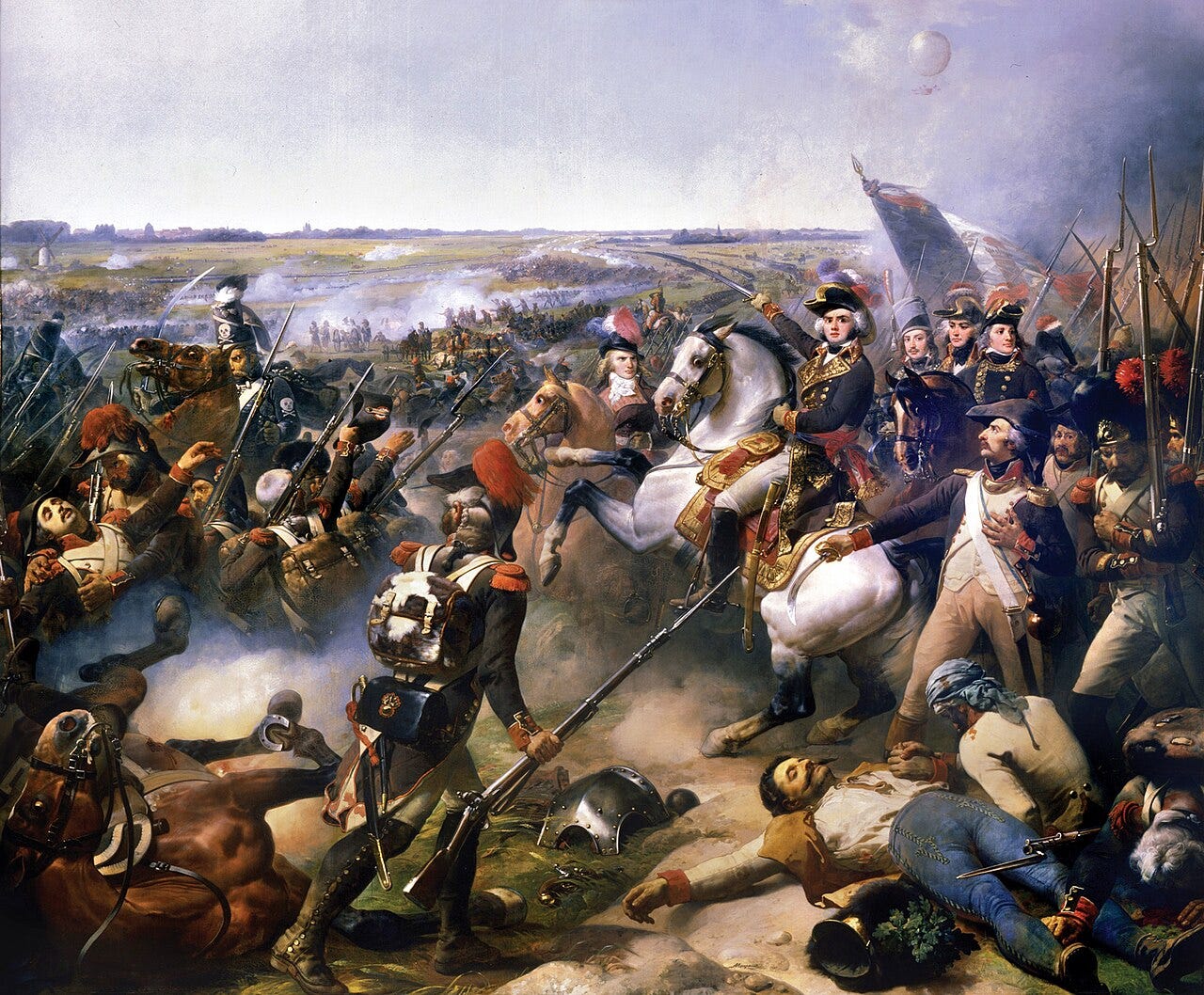
The Austrians initially tried to defend the line of Brussels, Mons and Namur, but by now Jourdan had well over 100,000 men under his command and rising still, and once he attacked, the French evicted the Austrians from Belgium by late September, confirming their conquest by their victory at the Battle of Sprimont.
With the Habsburg forces evicted from Belgium, Pichegru’s southern flank was secured and he invaded the Dutch Republic in September. The winter of 1794–95 was bitterly cold and the major rivers, including the Rhine, froze over. With the weather in assistance, Pichegru attacked relentlessly. Under the weight of French numbers Dutch resistance collapsed, and the country was overrun before the arrival of spring, knocking the Dutch Republic out of the conflict.
Following his victory at Fleurus, Jourdan took command over the forces in the Rhine and besieged the fortress towns of Mainz and Mannheim.
With another partition of Poland looming large on his eastern borders, King Frederick William II now was eager to make peace, and agreed to recognize French gains made west of the Rhine, thus the Prussian king succeeded to extract his armies which were now needed in Poland.
Compared to the successes of 1794, 1795 was to be a much leaner year for the republic on the Rhine frontier. Though with the departure of Prussia France faced fewer enemies, the offensives of 1795 ended in failure. One army under Jourdan attacked Mainz, while the southern army of Pichegru captured Mannheim in September, but determined Austrian counter attacks forced both armies to retreat and the year ended in a stalemate and with an armistice.
Just like in the previous years, Italy and Spain remained only sideshows. An offensive launched in Italy cleared the Austrians and Piedmontese from the Maritime Alps; the defenders finding refuge in the fortress of Cuneo.
Another offensive was launched in November, leading to a French victory at the Battle of Loano, inflicting 7,000 casualties on a combined Austro-Piedmontese army, but ultimately General Scherer was unable to break the strategic deadlock.
The French had more success in Spain, and in April 1794, general Dugommier defeated the Spaniards at Boulou. The victory allowed the French to clear Roussilon of the Spanish, but the fort of Bellegarde stopped the French invasion of Catalonia until September.
Across the Pyrenees, in July general Moncey also launched an offensive and captured San Sebastian.
In November, general Dugommier won the Battle of Figueras and captured the fortress of San Fernando, the roadblock that so far stopped an invasion of Catalonia.
With French forces now invading Spanish territory and the finances of the kingdom heavily strained, King Charles opened negotiations in the early months of 1795 and abandoned the alliance.
As in the previous years, the changes on the battlefield did not leave the capital unchanged either. After the chaotic 1793, the Committee of Public Safety was bent on centralizing power, and thus rival authorities got slowly but surely whittled down by the spring of 1794. “Overzealous“ deputies on mission were called back to the capital and the leeway accorded to the remaining deputies was curtailed, the Central Committee of the Sections and revolutionary armies were abolished, the Paris Commune purged, while the Jacobins eliminated both their more radical and more moderate wing, sending both the Hebertists and Dantonists to the guillotine on trumped up charges.
The pace of the terror, however, was not slowing down, only its nature changed, as so long the war was going on, Robespierre and his allies were adamant to maintain national unity, cost what that may. In June, a new law was introduced that basically abolished judicial process altogether and the rate of the death toll was reaching frightening proportions in Paris. Yet as French arms started to gain the upper hand on the field, many started to question the rationale of the terror, and in late July, the Convention turned on Robespierre and his allies, ordering their arrest and execution.
The instruments of the terrors were kept up even after Thermidor, least of all the Committee of Public Safety, but its powers were severely curtailed, as were that of the sections and the Jacobin clubs, while the Jacobin war economy of conscription, and controls on prices and wage was abandoned.
The Convention now got down to write a new Constitution that saw a steep reduction of the electorate, the new regime planning to make the property owners as its base. Before the new constitution could be adopted, however, the Thermidorean elite was challenged three times in 1795. In the spring, two sans culotte uprisings were narrowly seen off without the deployment of the army, but in October the royalist Parisian bourgeoisie rose in revolt also. This final uprising was the most dangerous of all, as to crush it, the Thermidoreans needed to unleash the army on the streets of Paris, becoming the first French government to do so since the spring of 1789.
As the year 1796 began, France’s strategic position was markedly better than what it was 12 months ago. Three of its adversaries, Spain, Prussia, and the Netherlands were knocked out of the war. And not only were all foreign invaders kicked out of French territory, by the conquest and annexation of the Rhineland and Belgium, the republic was actually significantly expanded.
Even so, the war was still not won just yet.
The main effort of 1796 was planned to be made on the Rhine, though the strategic situation was initially far from ideal. The Austrians and their allies outnumbered the French 175,000 to 143,000, and even the existing French troops were not in the best shape, especially lacking in cavalry. Coordination between the two armies was made difficult further by the Austrians holding a bridgehead west of the Rhine between Mainz and Kaiserslautern. Nonetheless, the situation wasn’t as hopeless as it seemed at first, as Napoleon’s successes in Italy forced the Austrians to divert 25,000 men, while the need to garrison towns such as Koblenz,
Mainz, Mannheim and Philippsburg diverted another 25,000 men, tilting the balance in favor of the French.
The generals were also hesitant to take onto the offensive as the armies were lacking supplies. In the words of general Soult:
Although our troops were excellent and in the best of spirits, they were short of many things in the way of matériel and transport . . . Our artillery, for example, had insufficient draught animals while our cavalry barely numbered half that of the enemy.
The offensive was at last launched in June, Moreau crossing the Rhine at Kehl, and Jourdan at Dusseldorf. Despite running into heavy resistance, Jourdan was able to capture Frankfurt, while Moreau also succeeded to consolidate his bridgehead. In response, Archduke Charles sought refuge south of the Danube. Rather than seek to unite their two forces and crush the wrongfooted Austrians, the Directory ordered the two generals to remain separated, Jourdan receiving orders to march towards Bohemia, while Moreau was to remain in the Danube valley. Strong Austrian garrisons in Mainz and Mannheim, however, forced Jourdan to leave more than 20,000 men behind to blockade the towns.
Thus, by the time Jourdan began his advance east, he was down to roughly 45,000 men. Still, the initial advance went well and he captured Wurzburg on July 22, and Forchheim on August 7. Ahead of Jourdan was retreating the Austrian army of general Wartensleben, who took up a defensive position at the town of Amberg. By mid August, Jourdan was less than 100 kilometers from Bohemia, but his aggressive drive eastward opened a gap between the French armies, as Moreau was advancing much more cautiously. Hoping to defeat his enemies one by one, Archduke Charles attacked Moreau at Neresheim. The battle ended inconclusively, but the bruising experience convinced Moreau to halt his march, which gave Archduke Charles the opportunity to turn against Jourdan.
Leaving behind a screening force to keep Moreau at bay, the Archduke turned north and attacked Jourdan’s advancing armies north of the Danube, mauling a division led by general Bernadotte at Neumarkt. With his lines of communications under threat, Jourdan began to retreat . While retreating, Jourdan was attacked at Amberg by the united forces of Archduke Charles and Wartensleben, suffering a bloody setback, taking five times the casualties of the Austrians. Beaten, his line of communication under threat and faced by a numerically superior enemy, Jourdan began to retreat, but was caught at Wurzburg and suffered another defeat against Archduke Charles. With his force utterly battered, Jourdan retreated towards Limburg, where he hoped to halt the Austrian advance. Though he received reinforcements, the French were once again beaten at the Battle of Limburg, and by October, Jourdan was back on the western side of the Rhine again.
Moreau fared no better in the south either. After the draw at Neresheim, Moreau remained passive for days, only to restart his offensive and advance cautiously eastward to capture Augsburg and Ingolstadt. Once he received news of Jourdan’s retreat, Moreau initially decided to hold on to his gains, but by September he changed his mind and decided to pull back to the Rhine, his forces being harassed all the way by Bavarian and Swabian peasants, suffering two minor defeats against Archduke Charles in October at Emmendingen and Schliengen.
Ultimately the war in Germany ended in a stalemate, but salvation for France came in Italy.
In 1796 the army of Italy received a new commander, 26 years old Napoleon Bonaparte who was to transform the war effort in Italy. Though initially outnumbered by the Austrians and Piedmontese (38,000 to 52,000), the young general took the initiative and concentrated his attack against the Piedmontese, defeating them at Dego and Mondovi, and advancing so rapidly towards their capital Turin that the Piedmontese lost heart and sued for peace.
Following the exit of Piedmont from the war, Napoleon turned on the Austrians and through a brilliant manoeuvre outflanked the Austrians defending the line of the river Po to make their position untenable, forcing general Beaulieu to abandon Milan to the French. The Austrians fell back behind the Mincio river to defend the great fortress of Mantua, but Napoleon broke through their defenses again and Beaulieu retreated again, this time to the Tyrol, but unlike Milan, Mantua was not abandoned without a fight, but was left behind with a garrison of 15,000, well supplied to resist a siege for months if needed.
While his forces were besieging Mantua, Napoleon marched south to overawe the neutral Italian states, the threat of French force being sufficient to force them to cough up significant sums of cash, artworks and the Papal States even allowing the French to garrison the forts of Bologna and Ferarra. The general arrived back north just in time to see off an Austrian relief attempt led by general Wurmser, who arrived with 25,000 reinforcements from Germany.
Another relief attack was defeated two months later at Bassano, though Wurmser’s attack at least forced Napoleon to abandon his invasion of the Tyrol to link up with Moreau. Two more attacks to relieve Mantua were launched by the Austrians in November and January, but Napoleon proved victorious again at Arcole and Rivoli, foiling both attempts. The French victory at Rivoli sealed the fate of Mantua. The garrison by now was out of food, and with more than half of the soldiers either dead or incapacitated, Wurmser was forced to surrender. With the threat to his rear now eliminated, Napoleon was finally ready to think of the offensive again, and invade Austria itself.
During the winter months Napoleon received substantial reinforcements and now heavily outnumbered the Austrians, who were struggling to replace the crippling losses suffered in the past twelve months. He was faced by Archduke Charles, but the archduke’s strategy was overruled from Vienna, and he was forced to scatter his forces thin, only to be brushed aside by the advancing French. Napoleon attacked in March and broke through Austrian defenses across the Piave river, while general Joubert invaded through the Tyrol.
With the Austrians on the ropes and his own supply lines stretched dangerously thin, Napoleon offered generous terms of peace to bring a speedy end to the campaign. With the French now less than 100 kilometers from their capital, the Austrians accepted.
Napoleon’s rapid advance in Italy did not give much time for the armies on the Rhine to contribute much to the campaign of 1797. Hoche won a victory at Neuwied and Moreau at Diersheim, but operations were brought to an end shortly afterward. An armistice was accepted on April 18 at Leoben, and a peace treaty was signed on October 17, at Campo Formio.
In the Treaty, the Austrians accepted the French annexation of Belgium, and the creation of the French puppet republics in northern Italy, while the final fate of the Rhineland was to be decided in a future Conference at Rastatt, where delegates of the French Republic and the Holy Roman Empire were to work out the ramifications of the French annexation of the left bank of the Rhine. In exchange for her losses, Austria received some more modest compensation in the form of the Republic of Venice, wiping off the map the Most Serene Republic, the city of the Lagoons losing its independence after 1100 years.
Reasons for the French victory were aplenty, but probably the following two were the most important.
Firstly, mass mobilization gave the French numerical advantage in the crucial years of 1793–95. As a general rule, during the first years of the conflict, whenever the allies were able to put into the field a force that was equal to the French, they won. After the mass mobilizations of 1793, for the better part of the next two years, the allied found themselves outnumbered and pressed hard. By the time the French numerical advantage began to wear off after the abandonment of conscription, years of campaigning had hardened the armies of the revolution into a fighting force that was more than an equal of the old regime armies.
Secondly, the outcome of the war was shaped by the haphazard nature of the coalition itself, and the divided attention of Austria and Prussia due to the crisis in Poland. Despite under utilizing their great resources, the allies repeatedly failed to coordinate even the forces they had at hand, which in any case proved inadequate to the task of defeating the French.
In 1792, rather than the initially planned 160,000, in the end the allied invasion force was a mere 80,000. In 1793, the Brits and the Austrians failed to coordinate, giving the opportunity for the French to defeat them in detail in northern France. The same story played out in the Rhineland, where after the capture of Mainz, the Prussians and Austrians struggled to coordinate their forces. While the British deployed the army of York to the Low Countries, this force was never large to begin with. As shown later by British commitment to the Caribbean, London had many more men, just not for the European theatre of the war.
Researching and writing these posts takes considerable time, so if you can, consider upgrading to a paid subscription for as little as 5 dollars/month or 50 dollars/year.
Follow Purple History on Medium and Instagram.
Dwyer, Philip (2009). Napoleon: The Path to Power.
Chandler, David (1973). The Campaigns of Napoleon. Scribner.
Esdaille, Charles ( 2018). The Wars of the French Revolution: 1792–1801. Routledge.
Schama, Simon (1990). Citizens: A Chronicle of the French Revolution. Vintage.
Andress, David (2006). The Terror: The Merciless War for Freedom in Revolutionary France.
No posts
Comments
Nothing yet. Say the first thing.
Sign in to join the conversation.