
The following is an extract from my current book-in-progress, Schubert dub. If you are new here: welcome! You may like to know that a list of previous instalments can be found here.
Of all the speculative historical cases of CF, perhaps the one we can be most sure of is that of a seven-month-old foetus, stillborn in Vienna in 1838. No one important, born of no one important, history remembers them only because of an autopsy carried out by one Carl von Rokitansky, who noted his findings for posterity.
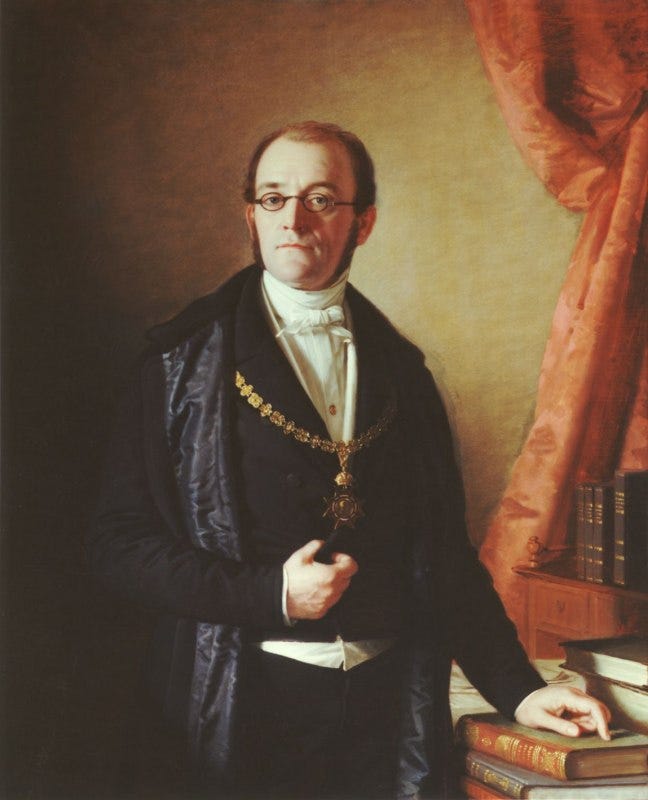
Rokitansky – round-faced, bespectacled, his cheeks framed by prominent mutton chops and joined by a thin moustache – was in fact one of the leading physicians of his age. Born in 1804 in the city of Hradec Králové in northern Bohemia, he went to Charles University in Prague, initially studying with the renowned liberal philosopher Bernardo Bolzano before focusing his attention on medicine. At the age of twenty, he moved to Vienna to continue his education at the University of Vienna, where in 1828 he obtained his doctorate. His thesis was on the smallpox vaccination, but his primary focus was already on pathology. He was the first to apply systematic, scientific procedures to the discipline, establishing the correlations between outward symptoms and internal organ disease, and thus making possible for the first time diagnoses and treatments based on the underlying condition rather than surface symptoms. Along the way, he developed a methodology and set of standards – published as the three-volume Handbuch der pathologischen Anatomie (1842–6) – that remains the foundation of modern practice. Over the course of his life, Rokitansky is believed to have performed almost 60,000 autopsies. Yet it was his very first that made his name and outshone them all.
On 27 March 1827, Rokitansky – still a doctoral student – hurried with his teacher, Dr Johann Wagner, to an apartment just outside the city gates, in the district of Alservorstadt. The day before, Vienna had been buffeted by a wintry storm, and the streets were presumably damp, chill and eerily calm. Ludwig van Beethoven, hitherto Vienna’s greatest living musician, had died at the height of the storm, at the age of fifty-six: if (sensationalist) legend is to be believed, shaking his fist at the thundering heavens. Rokitansky and Wagner were summoned to attend to his body.
It is unclear why an autopsy was ordered, although the scientific impulse to interrogate the body of one of the most famous and complex individuals in Europe will have been reason enough. A line in the so-called Heiligenstadt Testament – a letter written by Beethoven to his brothers in 1802 that detailed his despair at losing his hearing – has been suggested as a prompt. Lamenting the ill temper, stubbornness and misanthropy occasioned by his failing health, Beethoven urges Carl and Johann, ‘as soon as I am dead if Dr Schmid is still alive ask him in my name to describe my malady and attach this document to the history of my illness so that as far as possible at least the world may become reconciled with me after my death’. However, this document was only discovered after Wagner and Rokitansky had begun work, hidden as it was among other papers in a concealed cupboard drawer.
Reflecting their experimental practice, Wagner and Rokitansky concentrated on finding explanations for known clinical problems. Among the focus of their examinations were therefore Beethoven’s ears (where they noted shrivelled auditory nerves, if not sufficient evidence to establish conclusively the reason for the composer’s deafness), pancreas (evidence of chronic pancreatitis, no doubt the cause of his lifelong bowel problems) and liver (cirrhosis of which, likely due to excessive drinking, was the cause of his death). While their methods were not as complete or informed as those of today, their observations remain detailed enough to provide endless grounds for speculation by musicologists and historians of medicine alike.
A decade after working on Beethoven’s cadaver, Rokitansky was now an established pathologist at the Vienna General Hospital, one of the leading European figures in his field. Studying the stillborn foetus lying on his operating table that day, he discovered a perforation in the infant’s intestine that had led meconium (the baby’s first stool) to leak into the abdominal cavity. Today, we call this condition meconium ileus, and it happens when the meconium is thicker and stickier than usual, causing a blockage to the lower intestine and, in cases like Rokitansky’s, a potentially fatal rupturing of the bowel. Rokitansky appears to have been the first person to describe the phenomenon; today it is recognised as an almost certain indicator of CF. Nearly a century and a half later, my brother Matthew was born with the same condition. Thanks to a chain of knowledge that begins in Rokitansky’s laboratory, Matt’s life was saved by immediate and major abdominal surgery.
Comments
Nothing yet. Say the first thing.
Sign in to join the conversation.