
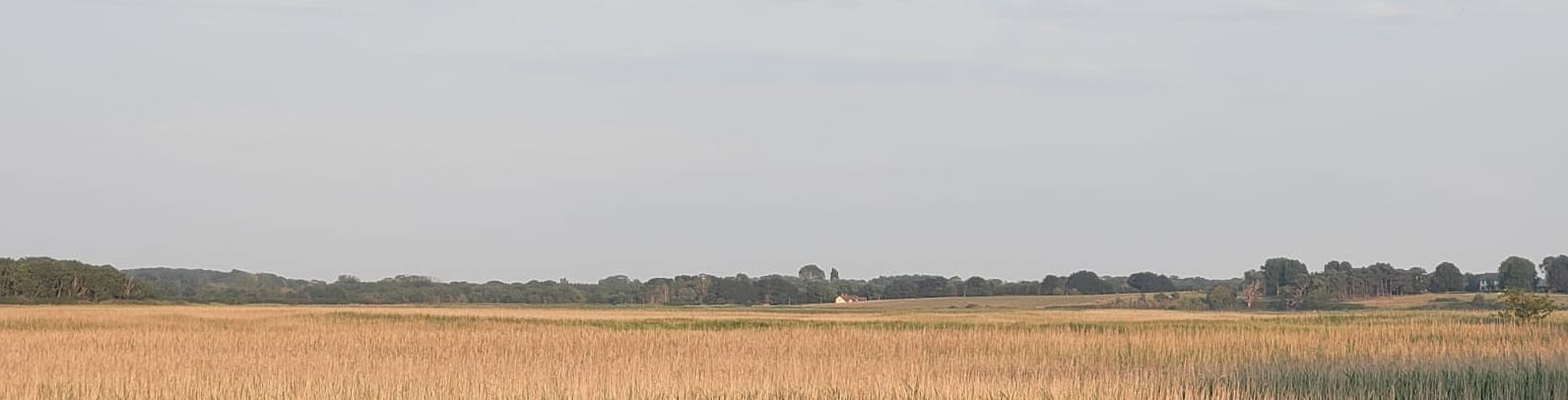
I’m writing the morning after returning home from two weekends on the Suffolk coast. I was partly there to write: to get into that unique space that a few days alone can bring, to see a whole project at once and to organise its parts. The project was Schubert Dub, and paying subscribers (why not become one!) will see some of the fruits of that work before long. But in addition to getting words on the board, the main outcome was clarity about several of the larger structural issues that I’ve been tangling with.
And I was partly there for the Aldeburgh Festival – at which I hosted two pre-concert talks this year, with mezzo Dame Sarah Connolly and conductor Ryan Bancroft on a baking hot Friday, and with composer/conductor Ryan Wigglesworth and violist Lawrence Power on a cooler Saturday before the premiere of Wigglesworth’s lyrical, chiming, beautifully constructed Viola Concerto. Two other concerts were the real highlights for me, though. On Thursday, I got to see the brilliant Sean Shibe on the Hepworth lawn, with the reedbeds behind him and hirundines overhead, play down the midsummer sun with music by Meredith Monk, Steve Reich, Julia Wolfe and others. Wolfe’s LAD has come across my radar a few times this year, but it wasn’t until hearing it live in Shibe’s arrangement for electric guitar and loopstation that I recognised it as the missing link between the bagpipes and Steve Hillage. Absolutely tremendous.
And the previous weekend, I was fortunate to see Pierre-Laurent Aimard’s afternoon recital of Schubert Ländler and Kurtág Játékok. On stage were three pianos (two grands, one upright) and one celesta. A small number of audience chairs arranged in a drift between them and across the stage. This was a concert with magic in every corner, beginning with the moment Aimard stood up from the first of the two grands – the one upstage left – and its strings continued to ring with the last notes of Kurtág he had just played. OK, I thought, he’s positioned himself so he can stand with his foot still on the pedal. But then, as he started to walk slowly to the other grand, downstage right, it started to play by itself: automated, of course, but the effect achieved seamlessly. It stopped as he sat at the second grand and began to play Schubert. And so on: for more than an hour, a dialogue and dance between instruments and composers. In their different ways, both the Schubert and Kurtág collections are versions of the same piece turned over and over. And Aimard leaned into this, making his moves through changes and similarities of texture, gesture or simply tone. The afternoon acquired the qualities of a dream: had we heard this before? Had we heard this?
And then he left the stage, silently, without applause, as the player piano continued once more on its way. A beautiful moment, but it was trumped by the coup-de-théâtre as Aimard reappeared, at a piano none of us had noticed behind our seats. A gasp at the prestige, a twist of the head and a little more Kurtág before we awoke.
For this issue, I’m delighted to give you an interview with the brilliant singer and composer Heloïse Werner. I spoke to Heloïse over Zoom from her home, and she was generous with her time and thoughts – and with a really close editorial read, for which I am very grateful!
For anyone who has been paying attention to new music in the UK over the last ten years, Werner needs little introduction. Born in France but resident here since winning a choral scholarship to Clare College, Cambridge in 2010, she went on to study at Trinity Laban Conservatoire of Music and Dance. In 2016, she appeared with the Multi-Story Orchestra in a performance of Steve Reich’s Music for Large Ensemble as part of the extended BBC Proms programme, and since then has made a career as a soloist, ensemble singer and composer. Her first group, the Hermes Experiment, was formed in 2013 with harpist Anne Denholm, clarinettist Oliver Pashley and bassist Marianne Schofield; in 2021, it won the Young Artist Award of the RPS. More recently, she has formed a trio, miré, with her husband, cellist Colin Alexander and pianist/organist Kit Downes. Their debut EP, Revelries, was released on Delphian at the start of the year.
As a composer, perhaps Werner’s breakout work was her one-woman opera, The Other Side of the Sea, developed in part during a week-long residency in 2018 at Snape Maltings, with her librettist Octavia Bright and cellist Zoë Martlew. Since then, she has written for the Manchester Collective, Royal Northern Sinfonia, Aurora Orchestra, CBSO and many others. This summer, she makes her Proms debut as a composer, with The Wood Pigeon, a BBC commission for Evelyn Glennie, the BBC Singers and the Fantasia Orchestra. That work can be heard on 11 August, and it gave me an excuse to talk to Heloïse about this and her multi-hyphenate career.
Tim Rutherford-Johnson: Could we start with your way into contemporary music? Were there gateway composers or gateway pieces that pulled you into it?
Heloïse Werner: When I was a teenager, I was a member of the French radio children’s choir, La Maîtrise de Radio France. I think I was about twelve when I joined. It was a special choir in which we had five hours of normal school every morning, and then every afternoon we’d have choir and also piano lessons, singing lessons, and we would do a lot of concerts.
So actually from a very young age, I was introduced without really realising it to lots of new music. Because as the children’s choir of French radio, we were often asked to premiere new works as part of quite big concerts. There was an array of mostly French living composers who we would perform and premiere. So I was straight into it without really realising. More recently, I’ve been thinking about how lucky I’ve been to have had this exposure to lots of different types of music quite early on. Some of it quite tricky to perform; we were really pushed in all directions.
TRJ: Can you remember any of that repertory?
HW: Yeah – Edith Canat de Chizey, Isabelle Aboulker, Thierry Machuel. There are loads. Also sometimes more jazz stuff, like a composer called Thierry Lalo, who wrote a children’s opera that we performed; a composer from Catalonia called Bernat Vivancos with very beautiful stuff.
TRJ: A real range then, not just the odd thing here or there.
HW: It was a lot. And regularly, I would say. Sometimes there were concerts where it was, I don’t know, five or six new commissions that we were premiering as part of a big new music festival. That was my introduction to contemporary music.
TRJ: When you came over to the UK to be a choral scholar, I imagine you were probably not doing as much new music then?
HW: I was in the choir of Clare College, Cambridge and we did a mixture. We did do some contemporary music and new pieces. I also studied composition as part of my degree; I took that as one of my main modules when I could choose it in my second and third years. My teacher was Giles Swayne, and he was at the time also composer in residence at the college. So we would also sing quite a lot of his music, which was great.
And because I was studying composition, part of that was that you’d get your student friends to record your pieces for your portfolios, or to organise new music concerts. So I was involved in it at the university level, let’s say.
TRJ: And you were already composing at that point as well, then?
HW: Actually, I started composing when I was in La Maîtrise. They had the opportunity to enter a little composition competition. I entered it twice and I won both times; the prize was that the choir would perform the piece in a concert. So that was my first proper experience. The first time, I think I was about fourteen. And when I was growing up, I also liked to write songs. I would sing and play at the piano. So I’d always written stuff.
And then when I went to university I was singing and also still playing the cello quite a lot and doing other things, but composition was also part of the portfolio.
TRJ: I’m interested in this idea of being a singer-composer. Obviously, historically, there are a lot of pianist-composers, and there’s a clear way in which sitting down at the piano, working out harmonies or whatever, feeds very easily into composing. But as a singer, do you sing into your compositions, as it were? Or are you writing on paper and then some bits you might sing? How do the two things connect for you when you’re writing?
HW: I definitely use my voice a lot. I would say I come up with a lot of the material singing it, I’ll record it into my phone and then transcribe it and orchestrate it. Even when it’s not a vocal piece necessarily, like an orchestra piece or a quartet piece, I’ll often get ideas for melodic lines or motifs with my voice and then transcribe it, arrange it and orchestrate it so that it fits whatever instruments I’m using.
Obviously when I am writing for voice, whether it’s for my voice or another singer’s, then I also sing everything I write. But then also, my first instrument was the cello. I started the cello when I was very young. And when I was a teenager, as well as being in the choir, I did a lot of cello – which I still did a bit at university and then now I don’t really. But during my upbringing, the cello was definitely a big part of my identity.
So I love writing for strings, and I understand string writing quite well because I am a cellist as well.
TRJ: If you’re composing, as it were, from the voice, do you feel that gives you access to certain compositional approaches or materials? If you’re writing at the piano, for example, you can understand how you’re going to be led by a certain harmonic or contrapuntal way of thinking. But if you’re starting from the voice, does that give you certain affordances that you might not get from somewhere else?
HW: I think with the voice stuff, I use it more for melodic lines and motifs and earworms. But I also spend quite a while at the piano working out the harmony and the chords. I don’t do that all on paper. I don’t have that ability. Once I’ve got the harmonic structure and the chords, the melodic lines and also the concept of the piece, then I’ll sit down and try to put everything together.
But with the voice, I think there’s something quite nice … I’ll often have an idea and sing it into my phone, and generally that ends up in the piece. I quite like the immediacy of it – that I can just sing something that feels good to me, singing it, I might tweak it a little bit, but often the first idea ends up in the final piece.
And when it is a piece that involves voice or voices, and especially when it involves my voice, I can experiment with certain sounds and techniques, and more unusual sounds and effects. I definitely workshop a lot, just on my own. And then try to notate things in a formal notation that I’ve worked out by performing or practising. Some kind of cool sound that I can do, and then I try to explain that on a score.
TRJ: A lot of your music has voices in it somewhere, whether it’s as a soloist or chorus. When you’re writing for voice, do you feel like you’re composing for your own voice or are you trying to be a bit more neutral – particularly in a piece that’s not necessarily going to be sung by you?
HW: I would say it depends if I know that the piece is going to be sung by me at least the first time, or if it’s a commission for another singer. There are two kinds of cases. Sometimes the singer might ask me to write them a song cycle, or a choir will ask me to write a piece. I would approach that differently to a piece that I’m writing for myself or myself plus other people, when I know I’ll be in the room and I’ll be able to demonstrate certain things.
But obviously, even if it’s a piece like that when I’m going to be the person recording it or premiering, I am trying to notate it as specifically as possible so that another singer could perform it. When it’s a piece that I’m premiering, I’m very much writing for my voice. But when it’s for other singers, then I have the other singer’s voice in mind.
And when it’s for choir, I would say, I guess it’s sort of a middle ground. Because even if I’m writing for another singer I’ll still have my style and I’ll still probably put some of my tricks in it. But I might not go as far … I might try to write something that would also suit the performer’s performing style or voice. For instance, I’ve written a song cycle for the wonderful Helen Charlston, who’s a beautiful mezzo-soprano, and the pianist Sholto Kynoch [Knight’s Dream, 2023]. The brief was quite open, but they wanted a companion piece to Dichterliebe. So that’s quite a big task, but I could do what I wanted within that.
So I wrote a cycle in five movements, setting the prologue from Heine’s poems, which Schumann didn’t set, as a sort of prologue to Dichterliebe. That’s just been released actually, so it’s available to listen.
https://open.qobuz.com/track/397207889
And if you listen it, there’s definitely my style in it. There’s a fast movement that’s got more of the virtuoso, acrobatic vocal things, and the outer movements are more folky and pure. I tried to do something that I’m very satisfied with, but that suits Helen’s voice as well and her beautiful, lush timbre and very rich mezzo voice. So it’s a mixture.
And when I write for choir, equally, depending on which choir it is that’s commissioning me and how experienced they are, how much rehearsal time they’ll have or how comfortable they are with experimental sounds, then I’ll adapt. And of course, depending on the text I’m setting and the concept of the piece.
So there’s quite a wide range, I would say. From quite nice and folky to some quite out there, and everything in between.
TRJ: Who would you say are your compositional inspirations?
HW: Well Giles Swayne is really the first one. He was a wonderful teacher in that he didn’t tell you what to do, but he really encouraged you to pull things apart – to go into the material and into the sound. He was definitely an inspiration. Also, his music was an inspiration for me at the time and still is.
And then Errollyn Wallen has been quite a big mentor for me. She’s just been very kind in my career, supporting me and putting me forward for things. And again, never telling me what to do, but just supporting me in my choices and my compositional voice.
Obviously, Meredith Monk comes to mind as a big figure of a composer-performer who uses their voice ...
TRJ: … someone who really is in that space.
HW: … in an exciting way. I’m also very inspired by all my colleagues. I love going to see new things – people like Oliver Leith or Josephine Stevenson, who are friends of mine but who also have quite distinctive musical voices. Or someone like Lara Agar, or Soosan Lolavar; just great people who have interesting things to say in music.
Purposeful Listening 14
·
May 6
I first encountered the British-Iranian composer Soosan Lolavar in 2020. Quite early in the pandemic, Riot secured funding to commission and record solo pieces by six composers, which we would then release as streaming videos. They were made in collaboration with the online gallery Zeitgeist, and initially it was a way to make work and to keep things ti…
I think I’m always inspired by hearing the music of today and people creating new things. But I love early music as well, and I grew up with lots of early music. Lots of Bach. Also lots of French singer-songwriters from a previous era. People who, again, were so multi-talented at writing lyrics, beautiful singing, accompanying themselves on the piano, and just able to be very direct with their music.
I wouldn’t say I’m trying to be anyone or to copy anything, but obviously everything that I hear informs what I do in some ways.
TRJ: I wondered about someone Georges Aperghis, that jumping between registers of voice and so on …
HW: Definitely, definitely a big inspiration. Actually, he’s someone that I discovered quite young as well. I was still at the Maîtrise. It was towards the end of my time there and one of the teachers, who’s a a great singer, did a recital of various unaccompanied vocal things, including quite a lot of his Récitations, and I remember being really blown away by it. I’d never heard anything like it.
And then I started performing them and they definitely inspired me. Hugely, I would say. Also just to realise that this is something you can do. Also the visual element of the scores, and the theatrical element of his music is something that I’ve been really attracted to, how to bring theatre into music in a very intertwined way.
TRJ: I really felt that from close-ups. Where obviously the style owes something to Aperghis, with that chopping and changing kind of thing, but also you’re doing a lot – actually, you and your partner – you’re doing a lot of acting as well as singing. That’s a very Aperghis thing to build in as well.
In that piece, how much of the visual expression is written in? Or is it you putting that in as the performer?
HW: The idea with this piece is essentially exploring different characters. There are four characters. And it is trying to explore those characters just through sounds without words. So there’s a character who’s super overly keen and excited, the sort of person who talks too much and always wants to help. The second character is the sort of person that you’d meet in a very admin job who is constantly unable to help or will be like, ‘No, you have to come back tomorrow’, or ‘No, we cannot help you’.
And then there’s a character who’s really posh and so posh that they can’t really talk at all. And the final character is someone super chilled – a bit like Ollie Leith [laughs]. Just a very, very chilled out character.
The idea is that we meet the different characters and we switch from character one to character three, back to character one, and the violin is also part of the character. They add to the character musically, but also with the actions they have to do.
So yes, there are specific actions written in the score. When, for instance, for the chilled character, the violinist has to sit down on a high stool, and it says where exactly they sit down and so on. And I’ve got hand-held percussions for different characters, and that’s all kind of in the score, timed rhythmically, it’s all fixed.
And then, I guess, in terms of my facial expressions, it just goes with the characters, so I know I’m trying to be that kind of character. I’ve tried to kind of do that musically, but then I’m also imagining being that character, so I guess it affects the theatricality of it in my face.
TRJ: There’s enough in the score already that that’s going to come out more or less naturally.
HW: Yeah.
TRJ: I wanted to go back to one of your first major pieces, which is The Other Side of the Sea. Within that piece, I think there’s a lot of stuff about your experience of becoming bilingual, of coming to England, learning English and then working out who you are within that duality from a linguistic point of view. What was it in particular about that experience that made you want to not only write about it, but also write about it on such a big scale?
HW: I think I’ve always loved acting and theatre. But something that I feel frustrated with living in the UK is that as someone who is a native French speaker and having learnt English – not from birth but much later – I find it very difficult to act in English because speaking in English is already a sort of performance. Accessing real emotions, reading a text in English – I feel very comfortable reading a script in French, but doing it in English I find very difficult. So deciding to write a solo opera about it explores that tension. I guess music has a way of bridging that tension. Because it’s kind of a performance within a performance. But it’s not just speaking, it’s obviously with sound and music added, and that allows me to get to the real emotions.
TRJ: It’s interesting what you say about the difficulty you have in acting in English. Have you been here long enough now that you sing in English?
HW: Yeah. I can definitely sing in English, and actually, I find it much easier to sing a song in English than just to say those words straight without the music, if that makes sense. Because adding the music adds a level of performance, so, I don’t know, it makes it more performative …
TRJ: The performer part of your brain engages and takes over?
HW: Yeah, exactly. There’s a performative state that’s heightened. But what I did with The Other Side of the Sea is essentially … throughout the piece the idea, roughly anyway, is that I try to teach the audience a language that’s made of kind of abstract sounds. It’s kind of trying to create a universal language that people will understand that is not with words, but actually with sounds and music.
I did a condensed version of the opera called Confessional, which gradually replaces words with sounds and then creates a new sort of lexicon of sounds. And then the audience can sort of understand what I’m saying, because they can connect a sound with the meaning.
And so what happens – as well as other things – in The Other Side of the Sea is that this happens gradually, and at the end I perform the whole thing with just sounds. And actually, when I do perform that piece, I feel very comfortable and very myself because it feels very kind of raw and direct. I can really just do the actions and perform the task. There’s nothing that gets in the way.
TRJ: I really love Confessional because it does, as you say, do something that’s quite easy to follow in terms of the linguistic substitution of actions for words. But then it’s also doing something quite specifically sonic and musical in the way that those words are fitted into a timbral and rhythmic space.
It reminded me of an essay I wrote for Marie Schreer last year. She had an album that was related to her experience of being a German musician in the UK and again, not really knowing where she was from, as it were. And told me about how her violin became kind of an extension of her voice and her language – it was a space that was always her, but it didn’t need to be attached to a place, as it were. I’m not saying your experience is necessarily the same as Marie’s, but her instrument is a violin, so it’s external, whereas yours is a voice, so it’s very internal and very much more closely attached to language. I wondered how you thought of that relationship of voice, text and everything?
HW: Definitely. Actually, in close-ups, those characters without words are made up of quite raw sounds or effects, quite guttural things that I can do with my voice that are really connected to my body and feel very anchored to the emotion I’m trying to convey or the character I’m trying to convey. And in some of my other pieces, I just love playing around with my voice, with sounds not attached to words. And that feels very connected to what I’m trying to do. Yeah, it’s a very physical sensation, as well as being a mental one.
TRJ: It kind of sidesteps the language question and just becomes a more direct kind of doing?
HW: Exactly, yeah. And then, of course, I also love using words. I’m not a writer myself, so I collaborate with other writers who write the words and I love setting words and playing with words in different ways. For instance, I wrote this piece for Lawrence Power and me, a duo piece called Mixed Phrases, and I used a poem by Arthur Rimbaud. The structure is that there are two worlds within the poem, there’s the world of earth and then there’s a world in the sky that is more ethereal. And so the world that’s on earth is a familiar place, and so that’s where Lawrence plays his viola. It’s his first instrument and also it’s the Rimbaud poem in its normal form in French, so the language I know.
And then the other world is the more unknown ethereal world, so for that Lawrence switches to violin, which is almost his second language and the text there, what I did was I cut all the text up. Mixed it all together and created made-up words. So it’s kind of nonsensical. I also based the music, or at least the effect of the voice, on my little half-sister who was about three at the time, and she was learning to speak and making all kinds of wonderful sounds. So some of the intonation of this made-up language is based on her learning a new language. That piece plays with a kind of text, but also a deconstructed and reconstructed text, and also the intonation of a young child learning to speak.
TRJ: We started this by talking about a piece that’s now eight years old. Is this engagement with language – and particularly with two languages at once – still a big theme in your work?
HW: I think probably less than it used to be at the beginning. I think this is what was on my mind eight years ago, more than it is now, because now I feel a lot more familiar. But I still have the same problem with reading text in English or reading a script. I still find that really hard.
But yeah, I don’t think I only write about that now. I guess generally, I’m always interested in language, and in words and text and sounds and how they interact and that. And characters and how, like with close-ups, you can create characters or a story or emotions with sounds, not with words or with reconstructed words. I guess that’s still part of what I’m interested in, but now not just based on my own experience, more generally.
TRJ: That seems like a good place to turn to The Wood Pigeon, then. Again this piece has a chorus in it, so there’s a vocal element, but you’ve also got Evelyn Glennie. What is the basic summary of the piece?
HW: I guess there are a few things. One thing is to say is that I was really keen to write something funny. I wanted to write a comedy piece. Because I love comedy and it’s something I’m thinking about quite a lot – humour and music and comedy and music.
So that’s one thing. And then it’s not very long, it’s like five minutes. So the question is how to do something that has an impact in such a short amount of time – but also for quite a lot of forces because it’s got orchestra, choir and solo percussion. So the concept, roughly, is that it is like a rehearsal for the concert. I’m pre-recording a tape part as the composer. Commenting on it in hopefully quite a funny way and with quite a lot of in jokes about the new music world and everything that goes with it; but also not having enough time to rehearse stuff, and the general things that people do in rehearsals or how orchestral musicians or singers behave – without being rude and offensive! [laughs] And also with my inner voice of the composer in the room slightly freaking out and just trying to give good instructions to everyone in front of you, but with not that much time.
There’s a tape part, which I’m actually doing at the moment, that would be triggered by one of the percussionists at very specific times. And it’s basically me – there are maybe eight times where the tape part is triggered, so it’s not constantly – when I say, okay, let’s go from letter A or I suggest, can we hear this? And then it goes wrong on purpose ... And by the end of the piece, when we get to the end, I ask if we can now run it and they say, no, we’ve run out of time and then I say, okay, cool, see you at the gig. And that’s how the piece ends.
But the actual music is totally composed within that. It’s a setting of a poem by a friend of mine, Ali Lewis, called ‘The Wood Pigeon’. It’s a very cute, short poem, and basically, I’ve set it so that we do hear the whole poem. I’ve divided the poems into three sections, three short movements almost. And so we do get to hear the whole poem set to music in a very specific way, but it’s all within this sort of theatrical thing of it being a rehearsal. The two outer parts are completely set and orchestrated in a very specific way. The first part is quite playful and the last part starts with just a choir, singing this kind of counterpoint, like a chorale, and then everyone jumps in and it finishes.
And the middle bit is like a game. It sets the two middle lines of the poem about the pigeon fluffing his wings and stuff. And the idea is something I love to do. I’ve done it on a smaller scale, the idea where there’s one person who leads what happens. So one person will have a set of musical material, like box 1, box 2, box 3. Everyone else will have the corresponding material for box 1, for box 2, for box 3. And you have to catch them. So if Evelyn is on box one, everyone needs to play box one, musical material. And if Evelyn then jumps to box 3, everyone has to jump as quickly as possible to the musical material of box 3.
So for box 1 is like she’s on vibraphone. The second one, she’s on the rototoms, and the 3rd one on the tam-tam. So she’s switching between them and she’s got very specific things to do, and everyone has to follow her as quickly as possible. It’s hopefully quite fun!
And by the end, it gets really, really hard and then hopefully it just falls apart and then the tape part says, okay, well, that’ll be all right on the night sort of thing and then we move on. The whole piece should be quite fun, light, hopefully funny, quite surprising.
We’ll see how it goes. With the tape part, I’m finding it hard to know what will people laugh at and what they won’t, because I need to imagine leaving a long enough gap after I’ve said something for potentially people laughing or not, and then how long to leave between my sentences so the laughter doesn’t cover what I’m saying. But maybe no one’s going to laugh, in which case you don’t want to leave long pauses, so ...
TRJ: Very hard to do if it’s all recorded.
HW: I was semi-wondering whether I wanted to do it live, but actually I think it’s more cool if it’s pre-recorded and kind of planned. It’s part of the piece that it’s like a performance within the rehearsal, within the performance; it’s kind of weird. And I like the idea of a tape part, I’ve never really done that before.
TRJ: The way you were describing it also feels, with those interjections of ‘Let’s go back to section A’ or whatever, that you’re doing something with the linearity of the poem. You could just do it straight and it would have its own musical arc. But this format is a way to chop up the timeline similarly to how the characters in close-ups cut across each other.
HW: Yes. The first two minutes are the first two verses of the poem, but the text is quite broken down. The first line is ‘Breaking cover’, but you hear brr–k–co-ver, the text appears gradually. And the middle bit is ‘Its flutter of greys and browns’, and again I’m dissecting the text, you don’t hear just the words.
And then at the very end, I’ve done it so that this kind of you hear the final lines of the poem and then you hear basically the whole poem again, but with a kind of hocketing thing where one voice will do a syllable and then the next voice will do the next syllable. So you hear the whole poem but no one’s saying any whole word. And so at the end, you do have the whole poem in one go, but not just one voice saying the poem, it’s across the choir, with added bells and kind of other soundscapes.
I really like the poem. It’s really sweet and quite cute, and at the end the final line is ‘Like the piano keys, you only see when they’re played’, and so the poem also worked with the whole idea of it being a rehearsal and being inside a rehearsal, a performance within a performance, and hidden things.
TRJ: Have you done a lot of work yet with Evelyn Glennie herself?
HW: I had a workshop with her, back in March I think, I went to her studio. I basically had the structure in my head and I’d written roughly her part. I’ve never really written for percussion before. A lot of it is on vibraphone, and then for the middle section there’s the tam-tam and the rototoms. So working out how quickly she can go from one to the other for the game section and also experimenting with different sticks and clever ways to switch, to use the same stick from one to the other. But yeah, she was super nice and really warm and very up for anything, really.
TRJ: Presumably a lot of the comedy element is going to rely on her timing?
HW: That’s something I wanted to be careful about because I didn’t want the comedy element to just rely on the audio tape part because Evelyn won’t be able to hear that. So I wanted to give her a leading role in the middle section. She’s very performative and her task is to make it as hard as possible for the orchestra.
I mean, the middle part is literally only two minutes in total. So each game is fifteen seconds maximum. She needs to surprise people every time, to make it as performative and fun as possible and I think she’ll be great at that.
I wanted to give her that role so that she’s in charge of the comedy in that section. And then the outer sections, she’s on vibraphone and she has like a solo part, but it’s more, I don’t know, like accompanying the choir. And in the last section, she’s playing these bell-like things on the vibraphone, this tune that’s still a solo part, but less virtuosic.
And also in the first part, in the ‘breaking cover’ section, it’s kind of playful and quite virtuosic for the singers, and it’s quite fun, light orchestration. And then I say, Okay, great. Could we now hear it again? Could we hear the version that I sent through last night? And I’ve written an alternate version that’s really, really bad, in which Evelyn has this really annoying virtuoso part, repeated semiquavers that keep going up in semi-tones, and which is really, really irritating. I can’t really explain it. The orchestra and the singers play what they were doing before, but Evelyn does this other part, and it sounds totally different and hilarious and really bad.
And then I say, stop, stop, okay? Bin that, that was terrible!
So she has her moments in the limelight and also carrying the comedy.
TRJ: Is it all basically written now?
HW: The only thing that I’m finalising is the tape part, and just getting my husband [cellist Colin Alexander] to help me a bit. We’ve got a little recording setup at home so I can record it all upstairs. Just getting the tone right and tweaking the wording as well. And then the final text because I’m putting the text in the full score.
I’ve sort of written a draft of the text, but until I record it I’m not quite sure of the exact wording until I’ve tried it out.
TRJ: The last thing I wanted to ask you about was goes back to being a singer. I realised that you will be the third soprano that I’ve interviewed here.
I spoke to Stephanie Lamprea last year and then Juliet Fraser earlier this year, and now you. And Stephanie and Juliet have written and thought a lot about the position of the singer within contemporary music, in particular. And I was curious as to whether you had thoughts on this. Because a lot of new music is ensemble-based, but a singer, even if they’re in the ensemble, looks like a soloist and behaves (at least musically) like a soloist. But new music is not necessarily a kind of diva-ish sort of space. It tends to be a much flatter hierarchy. So I was just curious as to how you think about that and how you negotiate that world.
HW: Maybe because some singers – more on the operatic stage or in that kind of world – there’s this thing where they’ve always wanted to be a singer growing up. And for me, that wasn’t really ever a thing. I loved singing and obviously I was in this amazing choir. But … I wanted to be a musician. I think that I knew. Even though I also liked other things, I decided that I needed to be a musician.
But then within that … obviously singing I did more and more, then my voice developed, you know, at university and everything, and then I ended up singing a lot. But in my head, it was always being a musician more than just being a singer. And obviously the composition stuff was also part of that. And when I used to play the cello as well, it was all part of the same type of work in a way.
And obviously I’m not really into the diva vibe! [laughs]
But I suppose the reason why singing was attractive to me as well was the theatrical aspect and the fact that I love going to the theatre, I love acting. So singing was naturally something that crosses some of these skills or interests.
But what’s quite nice … I have been in a few new operas, and obviously when I did my solo show – but that was a bit different because, while it is an opera in a way, it was just me on stage, so it’s different – I have enjoyed being in opera, in bigger productions, but what I found is that the creativity was often rather limited. I think that depends on the production and the director, but I didn’t have particularly amazing experiences. The few experiences I’ve had in new operas where I was just a puppet and being used for just a tiny bit of my skills were quite frustrating.
What I’ve really enjoyed as a singer is that I’m really lucky in the sense that I do a lot of chamber music. So with the Hermes Experiment, even though I am the singer in that group, and of course, I will often carry the story or will have the words, it does feel like in that group, we are four equal voices, which is why I love it so much. I don’t think anyone who sees Hermes will see it as voice-plus-instruments. It’s very equal. That feels really, really good, that environment.
I also love performing more improvised stuff. We’ve been playing together for a while, but we recently properly formed as a trio, with Colin and Kit Downes as miré. We perform like our own staff and it’s semi-improvised, but we each bring a tune and then we compose it together in a semi-improvised way. And that also feels super-exciting because again, when I’m performing on stage with them, I never feel like I’m on the forefront at all, it very much feels like three equal voices. And also in that setting, I’m often using my voice quite instrumentally. Sometimes we do arrangements of folk songs or set pieces, but often it’s more sonic. Wordless things or just creating a soundscape –exciting sounds together that I never feel like I’m the singer. I just feel like we are all equal voices in it. That’s why I love, I love, performing with them.
Obviously, I have also done stuff with like orchestra where I’m the soloist, and obviously that’s more like I’m at the front and I’m the soloist, but even then when I’ve done that often it’s been for my pieces that I’ve written and the way I’ve written them is that there’s a lot of interaction with the orchestra, and again, I don’t always use my voice purely as a kind of storyteller, but it can also be more instrumental, with lots of interactions with lots of different instruments in the orchestra. That feels more like soloistic, but I still don’t feel like a singer, I’m more like a musician.
TRJ: I suppose if you’re the singer of your own things, you get a bit more of a pass.
HW: And I think that’s why I’ve never been attracted to – well, maybe because it’s incredibly competitive and there are so many people who do it so much better than me – but singing more standard repertoire with orchestra or oratorios or classical things. I never had that desire. And also it wasn’t something I was particularly good at, or interested in working on and perfecting. There are plenty of people who do that amazingly. So in a way, I am definitely a singer, and I consider myself a singer and a composer, but I guess because of the writing as well, it’s quite linked with being a creator rather than just a singer.
TRJ: When I spoke to Stephanie, because she’d been trained in opera, she’d been trained with a bel canto voice. And then encountered the Aperghis Récitaitons, and then went, ‘Oh, I have to completely rethink what I can and should be doing with my voice’. But it sounds like you never really had that, maybe because you’d come through a choral tradition.
HW: I did still train classically; I did a master’s in singing. But I never felt totally comfortable in just doing that. And actually, I still do perform quite a lot of early stuff. I’ve got this Wigmore Hall concert coming up on 17 July that I’ve curated with four other singers [Ema Nikolovska, Adèle Charvet, Karim Sulayman and James Newby] and three cellists [Alexander, Peteris Sokolovskis and Stephanie Tress]. And the programme I’ve created is mixed, with very old music: madrigals and songs of Monteverdi, Josquin, Ockeghem and Dunstaple – that kind of repertoire, which I really enjoy singing – as well as new things, including a new piece I’ve written for everybody.
But I think probably, if you’d told me ten years ago that I’d be at Wigmore singing that repertoire, I would have been like, there’s no way, I would have felt so out of place doing that. But now I feel totally comfortable singing that sort of repertoire. I’ve found a way to feel very comfortable, vocally, and without trying to be this or that, just finding my voice. And technically feel confident that I can do that repertoire, and I can sing with the singers I’ve invited – they are really amazing singers who do a lot of opera, but are also really interesting and do not only opera but also other things and have amazing, flexible voices. I think it’ll be really exciting.
But yeah, I think I would not have imagined that I would be doing this kind of work with these kinds of top international singers. But actually doing a programme that has a mixture of old things and very new things and finding a way to tie it together in a kind of coherent way … the programme is very thought through. This whole package is not just about singing, it’s about presenting a whole concert that will make an experience for the audience.
So yeah, I think about all these things when I perform – not just turning up and singing. I think that helps me feel confident about presenting something if I’ve really thought it through. And I think it’s going to work.
TRJ: It sounds brilliant. You’re one of lots of musicians who work in contemporary music but also do some early music as well. And then there’s a two-hundred-year gap of repertory that you don’t touch. And as someone who does that, why do you find that you’re comfortable in an early music environment, whereas you wouldn’t be singing, I don’t know, Schubert, Schumann, things in the middle?
HW: I’m not sure. Obviously, not all the romantic repertoire is big, but some of it is bigger and I don’t have a big voice. There are certain things that I can’t sing. But I think with the early stuff as well, I mean, some of it is quite bonkers harmonically and stuff, you feel like you’re seeing contemporary music anyway!
You know, the harmony in Machaut and Dunstable is quite wild, actually. What I think I like about that kind of music, though, the really early stuff, is that you’re just serving the music. There’s no ego behind it or trying to prove how beautiful you sing or how great it is. There’s a certain focus that I really like: just perform this beautiful madrigal and just really enjoy the harmony and the kind of crazy shifts. And also the fact that with this type of repertoire as well, because a lot of it is so old and maybe some of it is not really well known or done a lot, you can arrange it and you can do cool things with it.
So with this concert that I’m doing in July, the whole concert is for five voices and three cellos. So we’ve arranged some of the madrigals to add three cellos, so that some of the Monteverdi madrigals will be with five voices plus three cellos, some of them shadowing some of the vocal parts and hopefully doing cool things with it.
So I think with that repertoire, it’s obviously well out of copyright, but it’s also so unusual in places and harmonically so rich, there are ways to bring it to life in a new light that I really enjoy doing. On my album close-ups, there’s a beautiful arrangement by Marianne Schofield, who’s Hermes’ bass. She’s a brilliant arranger, and she arranged this song by the Baroque composer Julie Pinel, who’s very, very unknown. I just discovered her tunes by chance – really amazing, amazing melodies and basslines. And Marianne just created out of the bassline a whole arrangement, really kind of a composition, really reimagining this music. And I love what she did with it. With that repertoire, it feels like there’s also scope for that, which to me is really exciting.
https://open.qobuz.com/track/261234444
TRJ: There’s not quite such a rigid performance practice. So in the same way with new music, you can just come at it – Let’s just read the score and play it.
HW: And perhaps also the sort of style of singing. I think when I was at music college, I was – or at least I thought I was – encouraged a bit to … not that my teacher would encourage me, but the general vibe is to try to sound very lush with lots of round sound and big sound and vibrato and all this stuff, trying to sound like a proper singer. But actually I found that doesn’t work for me, but instead finding the core of your sound and then expanding from that very pure kind of natural sound that you can make.
And with this kind of repertoire, it’s really fun to go to the really pure and simple, just produce a really nice sound. So in the Wigmore programme there’s a really nice Dunstaple three-part song, it’s just really sweet and uplifting and really fun. It’s just a little song, but obviously we’re singing it with amazing singers. Yeah, I’m really excited for that.
No posts
Comments
Nothing yet. Say the first thing.
Sign in to join the conversation.