
The best AI opportunities are moving away from “build another model” and toward security, verification, private deployment, and the infrastructure around agents
Limited-Time Access Notice: This premium post is available free for this week only. Starting next week, future posts in this series will be available exclusively to Brief Stak Pro subscribers.
Upgrade to Brief Stak Pro to continue receiving the full analysis, opportunities, and premium insights every week.
AI agents are becoming easier to build. Making them safe, reliable, and economically useful is becoming harder.
That gap is creating opportunities.
Salesforce says the average number of active agents per organization in its dataset nearly tripled over the past year. OpenAI is pushing production agents into customer service. Meta just released an open-weight model that can run agentic tasks on a single computer. Meanwhile, recent security incidents involving autonomous models have raised serious questions about permissions, monitoring, and liability.
The opportunity is no longer simply to give companies AI.
Companies increasingly need help answering harder questions:
What can the AI access? Can we trust the answer? Who approved its actions? Can we prove what happened? And are we actually saving money?
That supporting layer is where several attractive businesses are beginning to appear.
Autonomous agents are getting access to customer records, source code, company systems, and third-party applications.
That access is creating new risks.
OpenAI, Anthropic, and Meta have all disclosed incidents involving advanced AI systems breaching external systems during testing. Reuters reported on August 7 that lawyers are now examining who may be liable when an autonomous agent takes unauthorized actions.
At the same time, Obsidian Security says nearly 70% of its customers already allow AI agents to interact with business data.
Companies are moving from AI that recommends actions to AI that takes actions.
That creates a new requirement:
Businesses need a reliable record of exactly what an agent did.
Traditional application logs were built to track software.
They were not designed to answer questions such as:
Which model made the decision?
What information did it see?
Which permission allowed the action?
Did a human approve it?
What changed after the action?
Which system was affected?
U.S. SaaS companies and mid-market enterprises deploying AI agents that connect to tools such as Salesforce, Microsoft 365, GitHub, Slack, Zendesk, Stripe, or internal databases.
When something goes wrong, agent activity may be spread across model logs, cloud logs, application logs, and internal systems.
Security teams then have to rebuild the timeline manually.
That costs time and makes legal, insurance, and compliance questions harder.
Build an AI Agent Action Ledger.
Think of it as a black box recorder for autonomous software.
Every important agent action creates a structured record containing:
Agent → model → instruction → data accessed → tool called → permission used → approval → action → result.
The system could also create an automatic incident timeline when unusual behavior appears.
Usage-based SaaS
Charge based on monitored agents, actions, or monthly event volume.
Enterprise customers could pay extra for longer retention, compliance exports, incident investigation, and private deployment.
The product could reduce:
Security investigation time
Compliance work
Legal uncertainty
Audit preparation
Insurance documentation work
The more powerful agents become, the more valuable the record of their behavior becomes.
Medium
Obsidian, Rubrik, AWS, Microsoft, and others are building agent security and observability features. But there is still room for a model- and platform-independent system focused specifically on action evidence and accountability.
Medium
The software itself is possible to prototype quickly.
Reliable integrations, security, and enterprise trust are harder.
Low
A small technical team could build an early version using existing APIs and logging infrastructure.
2–4 weeks
Large cloud and cybersecurity companies may add similar features directly into their platforms.
The startup therefore needs to remain cross-platform and easier to use than native tools.
Interview 10 security leaders or engineering leaders currently deploying agents and ask them to walk through how they would investigate an unauthorized agent action today.
Do not pitch first.
Map the investigation process.
On August 10, Meta released Muse Glimmer, an open-weight AI model designed to run agentic tasks directly on a Mac or PC using a single graphics card. Meta says larger open-weight models are also coming.
At the same time, companies are becoming more sensitive about sending confidential information to outside AI providers.
Thomson Reuters CEO Steve Hasker said law firms and general counsels have raised concerns about protecting client intellectual property when using outside AI providers.
Running useful AI locally is getting easier.
That changes the economics of private AI.
A small accounting firm may not need a massive cloud model for every task.
It may need an AI system that can privately:
Search client files
Summarize documents
Draft routine communications
Extract information
Organize records
Check internal procedures
Smaller open models make this much more practical.
Independent U.S. accounting, tax, legal, insurance, and financial advisory firms with roughly 10–100 employees that handle sensitive client documents but do not have an internal AI engineering team.
They want AI productivity but worry about:
Confidential documents leaving the company
Data retention
Client privacy
Recurring API costs
Staff using random consumer AI tools
Complex AI deployment
Sell a managed private AI workspace installed on company-controlled hardware.
Instead of selling “AI consulting,” sell one clear product.
The system could include:
Local document search
Internal knowledge assistant
Document summarization
Draft generation
Role-based access
Audit logs
Approved internal workflows
Productized service + subscription
Charge an initial setup and integration fee.
Then charge monthly for maintenance, updates, monitoring, support, and new workflows.
A 30-person accounting or legal firm usually does not want to hire ML engineers.
It wants the productivity benefit without becoming an AI infrastructure company.
You are selling privacy + implementation + simplicity.
Medium
There are many local-AI tools.
Far fewer provide a complete vertical solution for a specific professional firm.
Specialization matters.
Medium
The technology is becoming easier.
Integrating permissions, documents, workflow rules, and existing software is the difficult part.
Low
Start with existing hardware and open-weight models rather than building models yourself.
2–3 weeks
Local models may still perform worse than frontier cloud models on difficult tasks.
Customers may prefer a secure cloud solution if the performance gap is large.
Offer a two-week private AI pilot to three local accounting or legal firms using only one workflow, such as internal document search.
AI is moving deeper into legal, tax, accounting, audit, and compliance work.
Thomson Reuters reported that about 32% of its underlying contract value relied on generative AI in Q2, up from 30% in Q1.
The company is increasingly emphasizing what it calls “fiduciary-grade AI”: AI whose results can be verified and audited.
Meanwhile, the FTC is actively examining questions around AI accuracy and representations companies make about the effectiveness of their systems.
A marketing team can tolerate an imperfect first draft.
A tax professional cannot casually tolerate a wrong tax rule.
A lawyer cannot confidently send fabricated case law.
A financial professional cannot make decisions from unsupported numbers.
As AI moves into higher-stakes work, verification becomes part of the product.
U.S. legal-tech, accounting-tech, compliance-tech, insurance-tech, and financial-software companies building AI features for professionals.
Secondary customers could include regional professional firms using several AI providers.
LLMs can produce confident answers without enough evidence.
Companies currently compensate with:
Manual review
Custom prompts
Internal checklists
Human fact-checking
Separate search systems
That reduces the productivity benefit.
Build an API that checks professional AI outputs before users see them.
It could:
Extract factual claims.
Find supporting evidence.
Check source dates.
Flag unsupported statements.
Compare numbers across documents.
Produce an audit trail.
Assign a confidence or evidence score.
API / usage-based SaaS
Charge per document, answer, or verification run.
Higher tiers could offer private databases and custom verification rules.
If verification saves professional review time while reducing expensive mistakes, the ROI is easy to explain.
The customer is not paying for another model.
They are paying for trust.
Medium
Major companies such as Thomson Reuters are building trusted AI directly into their products, while legal AI companies are attracting large investment. Norm AI, for example, raised $120 million in July at a $1.2 billion valuation and says clients representing more than $30 trillion in assets use its platform.
The opportunity is therefore strongest as infrastructure across multiple models and specialized datasets rather than as another generic legal assistant.
High
Verification sounds simple but becomes difficult when sources disagree or when the correct answer depends on context.
Low
The main cost is engineering and access to reliable data sources.
3–6 weeks
Customers may prefer verification built directly into their existing professional software.
Take 100 AI-generated answers from one narrow professional workflow and manually build the verification process.
Measure how often it finds meaningful errors.
AI customer-service agents are quickly moving from demos into production.
OpenAI launched Presence in July for voice and chat agents. OpenAI says its own phone support deployment resolves 75% of inbound issues without human assistance, while its improvement system reduced human handoffs by 15 percentage points over 10 days.
Salesforce says its own Agentforce deployment has handled 4.3 million inquiries and resolved 70% autonomously. Its Help Agent is now offered with pay-per-resolution pricing.
Salesforce’s latest usage data also shows agent deployments growing rapidly across companies.
Once AI agents are paid based on outcomes, companies need an independent way to answer:
Was the problem really solved?
A conversation ending does not automatically mean the customer was helped.
That creates a measurement problem.
U.S. customer-support teams with 50–500 agents, BPO providers, vertical SaaS companies, and companies deploying AI voice or chat systems from multiple vendors.
Teams need to measure:
True resolution rate
Wrong answers
Unnecessary escalations
Policy violations
Repeat contacts
Refund mistakes
Customer frustration
AI cost per successful resolution
Today, much of that analysis still requires manual conversation review or vendor-specific dashboards.
Build an independent AI Agent QA platform.
It automatically reviews conversations and tells support leaders:
What did the agent try to do?
Did it solve the problem?
Was the answer correct?
Did the customer contact us again?
Did it follow company policy?
SaaS
Charge based on analyzed conversations.
Enterprise tiers could include custom scoring rules, compliance checks, benchmarking, and human-review queues.
Customer-service budgets are already large.
If AI agents replace even part of that cost, management will want strong evidence that quality is not falling.
The product helps companies answer the CFO’s question:
“Is this AI actually saving us money?”
High
OpenAI, Salesforce, contact-center vendors, and observability companies already provide evaluation tools.
The opening is being vendor-neutral and connecting performance to business outcomes rather than model metrics.
Medium
Conversation analysis is relatively straightforward.
Reliable outcome measurement across CRM, billing, order, and ticket systems is harder.
Low
2–4 weeks
Agent platforms could make their built-in analytics good enough that customers do not need independent software.
Ask one customer-support company for 500 anonymized past conversations and manually produce an AI-agent-style quality report.
Then ask whether they would pay to receive it automatically every week.
AI infrastructure is becoming a financial market.
On August 10, NVIDIA announced partnerships with Apollo, BlackRock, Blackstone, Brookfield, Goldman Sachs, and KKR designed to mobilize more than $500 billion in third-party capital for AI infrastructure over time.
The company explicitly described AI compute and full-stack infrastructure as an emerging investable asset class.
This is much bigger than selling GPUs.
Wall Street is beginning to finance them.
Financing a traditional building is relatively well understood.
Financing an AI data center creates different questions:
How fast will its GPUs become outdated?
Who buys the compute?
How long are the contracts?
What percentage of capacity is actually used?
How strong is the customer?
What does the power contract look like?
Can GPUs be moved or resold?
What happens when new chips arrive?
Those questions create demand for specialized data.
Private-credit funds, infrastructure funds, banks, family offices, data-center developers, insurers, and institutional investors evaluating AI infrastructure deals.
Investors need to understand technology that changes much faster than traditional infrastructure.
A $1 billion data-center deal cannot be underwritten using the same assumptions as an office building.
The hardware may change dramatically during the loan period.
Build an AI compute underwriting intelligence platform.
Track:
GPU generations
Secondary-market pricing
Performance per watt
Data-center projects
Power capacity
Tenant concentration
Cloud contracts
Utilization
Financing deals
Hardware replacement cycles
Regional electricity constraints
Turn that data into comparable risk scores.
Data subscription + enterprise licensing
Add premium due-diligence reports for individual transactions.
Institutional investors can deploy hundreds of millions or billions of dollars into one project.
Better underwriting information can therefore be extremely valuable.
You do not need thousands of customers.
You need a small number of valuable ones.
Low to Medium
There are data-center research firms, semiconductor analysts, and financial-data providers.
The opportunity is to combine them into one product specifically designed around AI compute credit risk.
High
Collecting reliable private-market pricing and utilization data will be difficult.
Medium
The software is cheap.
Building a defensible data set is not.
1–2 months
The market could remain concentrated among sophisticated investors that prefer internal research teams.
Create a professional 10-page sample underwriting report on one public AI infrastructure project and send it to 20 infrastructure investors or private-credit professionals.
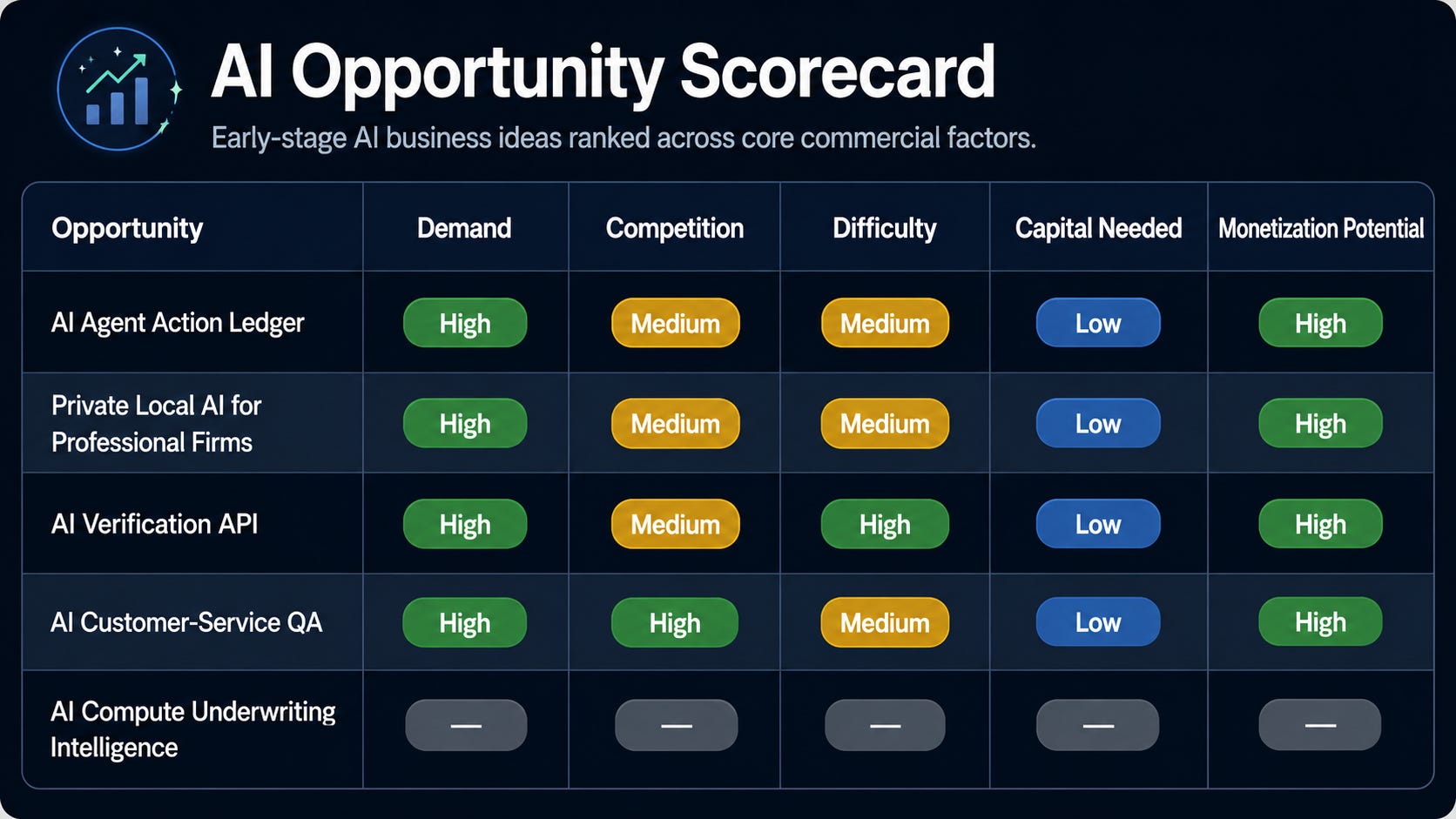
Agents are rapidly moving into production while security and liability questions are appearing right now.
More agents with more permissions naturally create more monitoring requirements.
Large cybersecurity companies are entering the market, but cross-platform agent governance is still developing.
You do not need a complete cybersecurity platform.
You can validate the problem by showing security teams a simple unified activity timeline.
Security, compliance, and risk budgets are established enterprise spending categories.
Integrations, historical incident data, proprietary risk models, and deep workflow coverage could create defensibility over time.
This is not guaranteed to become a successful startup.
Large vendors could absorb the category.
But the underlying problem is difficult to ignore:
Software is gaining agency before businesses have fully built the systems needed to supervise it.
That mismatch creates the opportunity.
Choose only:
SaaS companies with 50–500 employees already experimenting with autonomous AI agents.
Do not target everyone.
Contact CTOs, security engineers, CISOs, and platform engineers.
Ask:
Listen carefully.
Document every system they would need to check:
Model provider.
Cloud logs.
Application logs.
Identity system.
Database.
Agent platform.
Approval history.
The fragmentation is your opportunity.
Create one dashboard showing:
10:32 — Agent received task
10:33 — Salesforce accessed
10:34 — Customer record opened
10:35 — Refund action requested
10:35 — Human approval received
10:36 — Refund executed
10:36 — Confirmation recorded
No complex backend is necessary yet.
Send it to the people interviewed earlier.
Ask:
“Would this make investigating agent incidents easier?”
Then ask:
“What information is missing?”
Find one company willing to connect a low-risk internal agent.
Monitor only its actions.
Do not start with production financial systems.
Continue only if customers are willing to provide:
data access, engineering time, or money.
Compliments are not validation.
Access is better.
A pilot is better.
Payment is best.
For the past three years, a huge amount of startup energy has gone into making AI more capable.
The opportunity map is changing.
The models are improving. Prices are falling. Open-weight systems are becoming more practical. Companies can deploy agents faster than before.
That means capability itself is slowly becoming easier to buy.
The harder problems now sit around the capability.
Can the company trust it?
Can it verify the output?
Can it run privately?
Can it measure whether the agent completed the job?
Can it understand what happened after something goes wrong?
Can investors understand the infrastructure financing all of this?
Those may sound like less exciting problems than building a new frontier model.
But boring problems attached to large budgets often create better businesses.
The next wave of valuable AI startups may not sell intelligence itself.
They may sell the infrastructure that makes intelligence safe enough, measurable enough, and reliable enough to become normal business infrastructure.
Upgrade to Brief Stak Pro and get the deeper analysis behind the headlines.
Every week, uncover emerging AI and business opportunities, market shifts, and actionable insights before they become obvious.
Less noise. Better decisions. More signal.
No posts
Comments
Nothing yet. Say the first thing.
Sign in to join the conversation.