
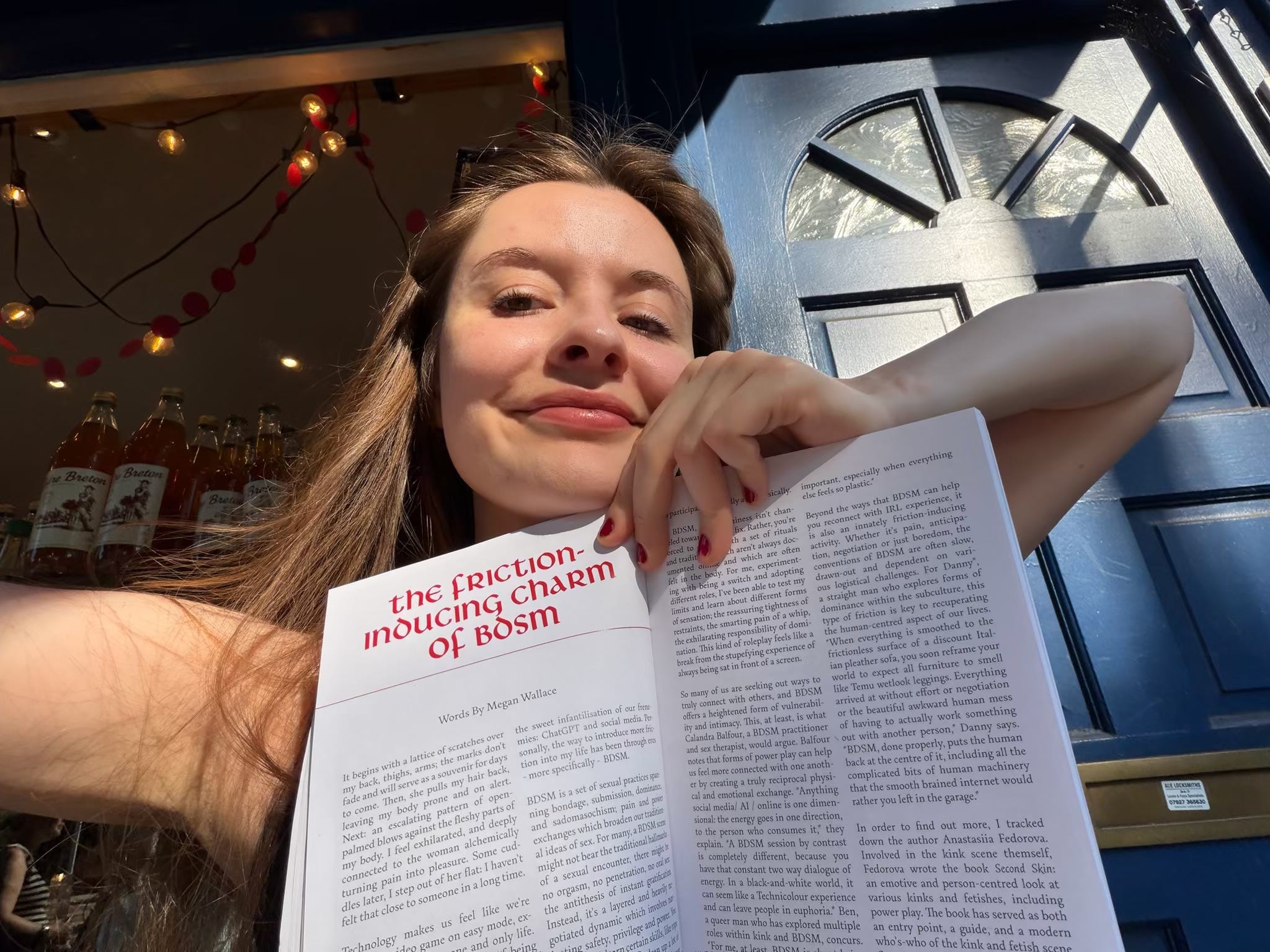
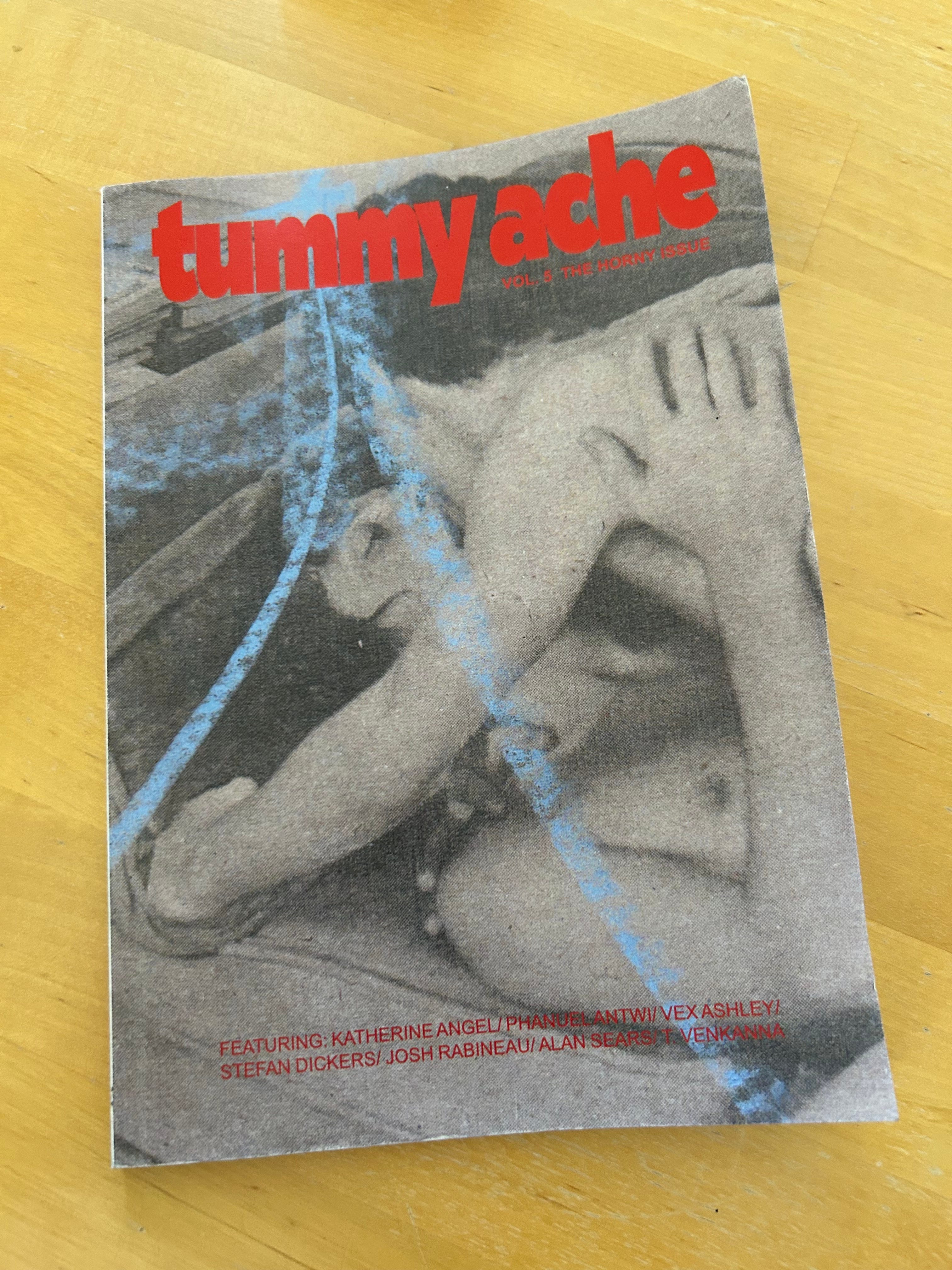
This article was originally published in the ‘Horny Issue’ of Tummy Ache. The issue features some incredible work and you can buy it here.
Technology makes us feel like we’re playing a video game on easy mode, except it’s real life: our one and only life. It seems like the very essence of being human (challenge, struggle, experience) is slipping through our fingers. In response, there is a movement towards friction-maxxing: embracing difficulty and inconvenience in the everyday, as a way of building character and resisting the sweet infantilisation of our frenemies: ChatGPT and social media. Personally, the way to introduce more friction into my life has been through eros - more specifically - BDSM.
BDSM is a set of sexual practices spanning bondage, submission, dominance, and sadomasochism; pain and power exchanges which broaden our traditional ideas of sex. For many, a BDSM scene might not bear the traditional hallmarks of a sexual encounter, there might be no orgasm, no penetration, no oral sex: the antithesis of instant gratification. Instead, it’s a layered and heavily negotiated dynamic which involves navigating safety, privilege and power. You may have to learn certain skills, like rope play; you may have to clean up a lot of mess; and you’ll certainly have to engage in pre-care, to set boundaries and discuss consent, and after-care, to check in on participants mentally and physically.
In BDSM, your horniness isn’t channeled towards a quick fix. Rather, you’re forced to engage with a set of rituals and traditions which aren’t always documented online and which are often felt in the body. For me, experimenting with being a switch and adopting different roles, I’ve been able to test my limits and learn about different forms of sensation; the reassuring tightness of restraints, the smarting pain of a whip, the exhilarating responsibility of domination. This kind of roleplay feels like a break from the stupefying experience of always being sat in front of a screen.
So many of us are seeking out ways to truly connect with others, and BDSM offers a heightened form of vulnerability and intimacy. This, at least, is what Calandra Balfour, a BDSM practitioner and sex therapist, would argue. Balfour notes that forms of power play can help us feel more connected with one another by creating a truly reciprocal physical and emotional exchange. “Anything social media/ AI / online is one dimensional: the energy goes in one direction, to the person who consumes it,” they explain. “A BDSM session by contrast is completely different, because you have that constant two way dialogue of energy. In a black-and-white world, it can seem like a Technocolour experience and can leave people in euphoria.” Ben, a queer man who has explored multiple roles within kink and BDSM, concurs. “For me, at least, BDSM is about being fully present. In these times, I feel like having some kind of real connection is important, especially when everything else feels so plastic.”
Beyond the ways that BDSM can help you reconnect with IRL experience, it is also an innately friction-inducing activity. Whether it’s pain, anticipation, negotiation or just boredom, the conventions of BDSM are often slow, drawn-out and dependent on various logistical challenges. For Danny*, a straight man who explores forms of dominance within the subculture, this type of friction is key to recuperating the human-centred aspect of our lives. “When everything is smoothed to the frictionless surface of a discount Italian pleather sofa, you soon reframe your world to expect all furniture to smell like Temu wetlook leggings. Everything arrived at without effort or negotiation or the beautiful awkward human mess of having to actually work something out with another person,” Danny says. “BDSM, done properly, puts the human back at the centre of it, including all the complicated bits of human machinery that the smooth brained internet would rather you left in the garage.”
In order to find out more, I spoke to the author Anastasiia Fedorova. Involved in the kink scene themself, Fedorova wrote the book Second Skin (now on paper back): an emotive and person-centred look at various kinks and fetishes, including power play. The book has served as both an entry point, a guide, and a modern who’s-who of the kink and fetish scene. So, what does the author of one of the most definitive kink books to date think about the relationship between BDSM and friction-maxxing? “BDSM is a safe container to push your boundaries and better understand what you’re comfortable with or not,” for the writer, it’s about greater understanding of who you are and what you want as a human.
“In BDSM, you can challenge yourself by sitting with discomfort or asking yourself why you have a problem sitting with discomfort. It forces you to ask the basic human questions of what am I comfortable with? What am I not comfortable with? What’s the difference between the two?,” Fedorova explains. “BDSM can be a very visceral, personal way to work out these questions. I don’t think there are many places in life where you can work through this on both a physical and psychological level.
Fedorova adds that BDSM is unique in that it allows us to recuperate ideas of personal growth and challenge away from capitalistic, results-orientated environments, instead exploring this within truly personal and intimate spaces. “It’s a fundamental fact that we do need a certain amount of challenge, friction, or discomfort to grow and develop as humans. When everything is getting automated to serve our needs, we really lose that feeling of challenge, especially in spaces where we can be more vulnerable. I’m not talking about work or more achievement-focussed settings but about our more intimate, personal areas, spaces which aren’t about achieving something but are about understanding who you are.”
In our culture, sex is often still framed as self-indulgent, inconsequential and selfish. Double that for queer sex, kinky sex, or any sex which sits outside of the ‘norm’. However, it’s one of the few ways we can still feel truly embodied and connected to others beyond a simply transactional, surface-level. There’s a deep amount of care involved, as well as a desire to meet yourself and others with curiosity and a desire for growth and exploration without expectation or, shudder, soulless optimisation.
Call it far-fetched, but BDSM helps us connect with the ghost in the shell.

FYI: I publish a free Substack essay, feature or interview every week, generally Monday 8am UK time.
I’m Megan (they/them): a Scottish writer specialising in the erotic. You’re reading my Substack, PULP, but my writing can also be found in British GQ, CNN, British Vogue, The Guardian, etc.
If you like my work, you can tip a one-off payment of £4 here.
Meet Overflow: The Berlin Collective Giving Ravers A Soft Landing for Happy Tuesdays
PornHub’s New Sapphic Venture Is Even Worse Than Pinkwashing for Autostraddle
Hotwifing: A New(ish) Term For A Dynamic As Old As Time for Feeld
No posts
Comments
Nothing yet. Say the first thing.
Sign in to join the conversation.