
Insights on current policy issues in India
—RSJ
A good way of earning public distrust on a policy is to change something that they use every day and telling them they have no other choice. That is where the E20 protests in India started. Most motorists did not wake up one morning determined to debate ethanol blending. They discovered, often after reading reports or conversations with mechanics, that the petrol available at their neighbourhood pump was no longer the petrol they had been buying for years. The government’s response initially has largely been to reassure them that there is nothing to worry about. That may well prove to be true. But reassurance is a poor substitute for choice.
As the protests gathered steam, the government resorted to its favourite trick. This is what the Petroleum and Natural Gas Minister said this week: “Yet, as India accelerated its journey towards greater energy self-reliance, opposition to ethanol blending suddenly intensified. It is worth asking: who benefits if India remains dependent on imported crude oil or batteries.”
Yes, the best way to get people to adopt a policy is to force it upon them and if they protest the lack of choice, label them as part of some sinister lobby that’s working overtime to pull India down. There’s no greater proof needed that this a badly designed policy than this anti-national ploy employed now to counter the dissent.
Yet, it is worth beginning by acknowledging something that many critics of E20 gloss over. India has a genuine strategic problem to solve. Nearly 90 per cent of crude oil that the country consumes comes from overseas, and this means every disruption in West Asia, or a spike in oil prices, or a sudden depreciation of the rupee eventually finds its way into inflation, government finances and household budgets. Reducing this dependence is a sensible policy. Ethanol blending, electric vehicles, compressed biogas, hydrogen and improvements in fuel efficiency are all different ways of addressing the same strategic challenge. The objective is therefore not in question. The question is whether this particular transition has been designed in a way that carries people along rather than expecting them to simply adapt.
Governments have three ways of changing behaviour. They can persuade. They can change incentives. Or they can eliminate an option through bans or diktats. Good policy generally works best in that order because people rarely object to change itself; they object to being denied agency in the process. India could have arrived at exactly the same destination through a different route. Conventional petrol could have remained available during a transition period, priced a little higher to reflect the strategic cost of continued dependence on imported crude. E20 could have been the cheaper alternative. Owners of older vehicles, people who drive long distances and value fuel economy, or simply those who were unconvinced could have paid the premium for conventional petrol. Everyone else would gradually have shifted to E20 because the economics favoured it. As more E20-compatible vehicles entered the fleet, conventional petrol would have become a smaller part of the market before disappearing altogether. That transition would probably have taken a little longer. It would almost certainly have generated far less resentment.
Instead, consumers discovered that in most parts of the country there was effectively no decision left to make. That may well have been administratively convenient. Maintaining parallel supply chains costs money. Petrol pumps need additional storage and distribution becomes more complicated. These are legitimate operational considerations. But they are not reasons to eliminate choice altogether. In any case, the way the ethanol input costs and supply chain works, the E20 blend at this moment costs more than normal petrol. And this isn’t changing any time soon. Governments should use markets to reveal what consumers value. It is bad economics when they choose not to find out.
Much of the public discussion has since become mired in an argument over mileage, engine wear and laboratory testing. Manufacturers point to extensive validation though I have my suspicions on how quickly they have toed the government line. Government ministers cite studies showing that compatible vehicles perform normally. Consumers point to their own experience at the fuel pump and service stations. The evidence will become clearer over time because millions of vehicles operating in real-world conditions provide a better test than any laboratory ever can. But even this misses the central issue. Suppose the government is entirely correct and E20 causes no measurable damage to vehicles. A motorist may still prefer conventional petrol because it delivers better mileage, because he owns an older vehicle, or simply because he is willing to pay more for what he believes is a better product.
There is another part of this story that deserves much greater attention because it illustrates how complicated incentive structures emerge once governments intervene at multiple points in the same market. Much of India’s ethanol continues to come from sugarcane, one of the country’s most water-intensive crops. Surplus rice has also become a source of ethanol. The government procures rice at support prices, stores it at considerable cost and eventually sells excess stocks at a discount to ethanol producers. Taken together, the taxpayers are financing the procurement, storage and discounted disposal before the final product reaches the fuel tank. That should invite the same scrutiny as any other public expenditure. What’s the real cost of this transition, and who is benefiting disproportionately, are legitimate public interest questions. If maize or other feedstocks eventually prove cheaper and more environmentally efficient, policy should move in that direction rather than becoming tied to existing production structures simply because those investments have already been made or there are entrenched political interests.
The government’s response to criticism has also followed a familiar pattern. Questions over implementation have increasingly been answered by defending the objective itself. Nobody seriously disputes that India should reduce its dependence on imported oil. Yet those expressing concerns over the manner in which E20 has been rolled out often find themselves answering a different accusation altogether. Do they want the country to remain dependent on imported crude? That is an unhelpful way to conduct policy debates because it treats disagreement over means as disagreement over ends. Public policy improves when implementation is questioned. It weakens when criticism is dismissed before it is examined.
Transitions of this kind also benefit from a degree of humility. India’s vehicle fleet is remarkably diverse. Newer models are being designed for higher ethanol blends or so we are being told. Older vehicles were built under different assumptions (possibly at best up to E10 petrol). Manufacturers may be confident that compatibility issues have been addressed, but confidence is not a substitute for experience accumulated over years of use across different climates, maintenance practices and driving conditions. A transition period would have allowed consumers, manufacturers and policymakers to learn together. Now that there is only one type of fuel available, every unexpected outcome becomes a policy problem. This issue will continue to simmer as problems of this transition emerge over time.
The E20 controversy will eventually fade as India will continue increasing ethanol blending, and over time the vehicle fleet will adjust accordingly. But the manner in which this transition has unfolded offers a useful lesson about policymaking. Governments often spend enormous amounts of time deciding where they want society to go and surprisingly little time thinking about how people would prefer to get there. The approach to policy implementation determines whether citizens feel they are participants in a national transition or simply expected to accommodate one. The lesson from E20 is that a sensible policy becomes better when its implementation relies more on incentives and less on compulsion. The people don’t need directions from a paternalistic state. They need the state to trust their judgment as they ultimately have to live with the policy.
—Pranay Kotasthane
Sensing the growing public frustration, the government released a 9-point FAQ on the Ethanol Blending Programme on 10th July. True to its form, the press release picked out some straw man arguments and demolished them without addressing the kinds of concerns RSJ raises in his article.
Take, for example, its defence of not offering consumers a choice. Here’s the response:
India runs over one lakh retail outlets through a vast network of refineries, terminals and pipelines. Stocking three separate base fuels nationwide would multiply costs and complicate quality control at every single outlet.
Premium petrol is not a fair comparison. It is a small, additive enhanced product sold at a premium in limited quantities, not a separate nationwide base fuel.
There is also the question of what already exists. Public sector banks have financed close to Rs 1 lakh crore a year in ethanol plants, storage and logistics. Reverting to E10 now would strand this investment and hurt the farmers and entrepreneurs who built it in good faith.
Such a lame excuse, this. Retail outlets already distribute at least two types of fuels—diesel and two variants of petrol. Offering retailers the option to stock a low-ethanol variant is not as difficult a task as this FAQ makes it out to be. Instead, not only has the government introduced a single standard on its oil marketing companies, but it has also imposed it on all private players.
One way to understand the nature of this intervention is to locate it on this framework of “Eight Things All Governments Do” that we use at Takshashila in our public policy courses.
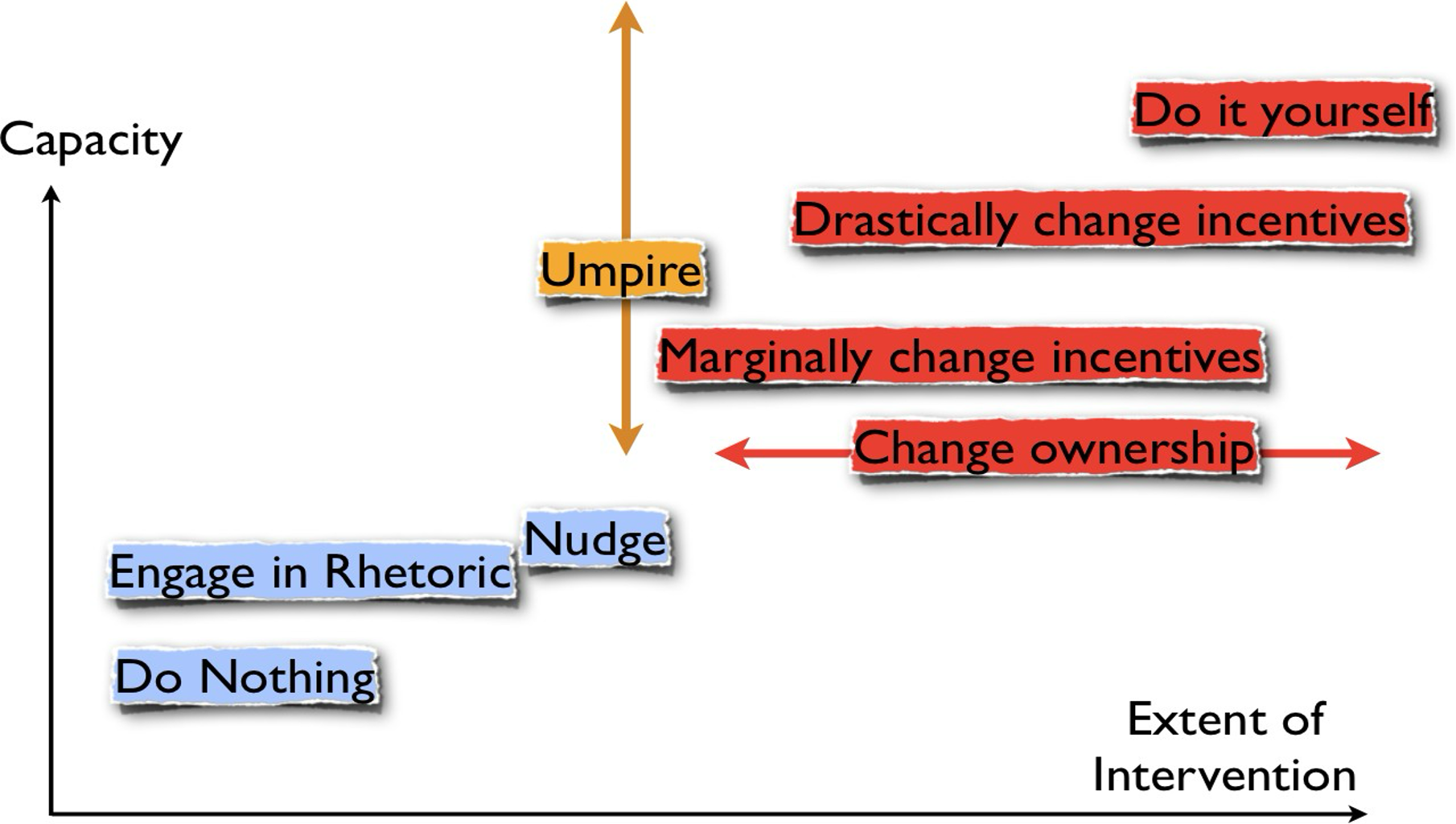
This E20 imposition without transition is a mix of “drastically changing incentives”, “change ownership”, and “do it yourself” without any notice.
Next, the defence that reverting to E10 or lower would hurt the investments already made is an amateurish defence that falls prey to the sunk cost fallacy. I mean, what about the investments that automakers and auto buyers have to make to shift to this new fuel? Don’t they deserve the same courtesy that the government seems to be offering to the farmers and ethanol makers?
Actually, the government did the politics right, even if I disagree with its policy. It correctly sensed that petrol is largely consumed by an unorganised interest group. Learning from the non-response to high taxes on petrol, the government knows that the opposition to anything related to petrol is diffuse and electorally manageable. Thus, it concluded that giving this segment of consumers short shrift is not as combustible as blending diesel with isobutanol or ethanol. The latter might see farmers blocking highways with their tractors, while the former only generates some mildly harsh commentary on social media or on newsletters like this one.
Another disingenuous response was to the question relating to the price of the blended fuel not being any cheaper than petrol:
The Government ensures that farmers receive a fair price for the ethanol supplied under the programme. For example, maize based ethanol is procured at around Rs 71.86 per litre, even before GST, transport, and storage costs are added.
When global crude oil prices are around USD 70 per barrel, producing E20 can cost as much as, or even more than, pure petrol. Ethanol becomes the cheaper option only when crude prices rise sharply, typically to USD 120 to 130 per barrel or higher.
Now, some of you might remember that we had discussed India’s byzantine sugar policy in edition #241:
To balance the interests of cane farmers and sugar mill owners, who are both politically powerful interest groups, the government does another complex juggling act. A union government committee announces a Fair and Remunerative Price (FRP) every season to take the price volatility out of the equation. The FRP is what sugar mills are supposed to pay to the farmers per unit of cane procured. Thus, an increase in FRP hurts their profit margins. Hence, the government also fixes a minimum selling price (MSP) for sale by sugar mills.
But the plot thickens further. Some state governments don’t like the FRP. They announce their State Advised Price (SAP), which is pegged far higher than the FRP. These are states where sugar is widely practised, and hence, its farmers are an even more important political interest group. SAPs are often announced ahead of elections.
So what the government is telling us is that it intends to make no changes to this spectacularly wasteful pricing scheme because it can just afford to pass all costs on to retail consumers instead. How convenient!
And remember, we have not even discussed the second-order implications of incentivising sugar cultivation in a groundwater-stressed country, something we discussed in detail in edition #313.
The government’s tone-deafness on this policy deserves much more criticism, but, more importantly, highlights how easily it can shift the entire burden of energy security onto an unorganised, diffuse, and docile citizenry.
For more, do check out the latest Puliyabaazi, where we discussed some other facets of this issue.
Insights on current policy issues in India
—Pranay Kotasthane
Mumbai had its wettest start to July in decades. Over a single week, several parts of the city recorded 200–300 mm of rain in 24 hours, at least 13 people died in the city and its surroundings, and a landslide blocked the newly upgraded Mumbai-Pune Expressway for a few hours. The city received almost all its typical July rainfall within a week.
The criticism that follows such weeks is now a ritual. And within that ritual, one line of attack has become popular that “See, the situation in Mumbai shows that India is building vanity infrastructure like coastal roads, bullet trains, glossy tunnels, but is failing at the basics.” The implication is that we are building too much of the wrong, showy stuff and should redirect our ambitions downward.
This criticism, however satisfying, teaches us exactly the wrong lesson. Worse, it lets governments off the hook by misdiagnosing the failure. Let me explain.
Nothing India is currently building qualifies as “more than needed.” Our per capita infrastructure stock—roads, ports, flyovers, bridges, urban transit, sewerage—remains far below not just rich-country levels but below where China was at a comparable income level. The backlog is so large that almost every project we inaugurate today should have been completed a decade ago. The Mumbai Metro, endlessly derided during construction, now moves lakhs of commuters daily. Similarly, the Atal Setu, the coastal road, and the expressways are all required and should have been built years ago.
Infrastructure has a peculiar property: it is best built ahead of demand, because it is exponentially difficult to change anything in an urban setup. By this standard, India’s problem has never been premature building. It has been perpetual lateness, where building after congestion imposes years of deadweight losses on citizens.
There is also something corrosive buried inside the “stop building fancy things” demand, a soft poverty of low expectations. It asks citizens of a poor country to internalise scarcity as virtue and to believe that a coastal road or a high-speed rail line is somehow above our station. When we frame infrastructure as an indulgence rather than an entitlement, we lower the bar for what the Indian state owes its citizens. Governments are only too happy to oblige—cancelling an ambitious project is far easier than delivering it and the basics. The demand should never be “build less of the good stuff.” At our stage of development, it should be “why are you not building far more, of everything, everywhere?”
The more effective line of questioning is to ask what percentage of government spending goes into providing private or unproductive goods. Across all our governments, the past few years have seen an explosion of untargeted revenue expenditure—cash transfer schemes launched in election years, power subsidies, loan waivers—that is crowding out capital expenditure. Several states now spend more servicing populist commitments than building anything. Maharashtra itself has strained its finances with large welfare-scheme commitments even as its cities’ infrastructure deficits compound. Every rupee locked into a recurring, politically irreversible subsidy is a rupee unavailable for the drains, transmission lines, and transit systems whose absence we then mourn every July.
This is where the citizens’ criticism should be aimed. Not “why is the government building a coastal road”, but “why is the government spending on unproductive transfers while the invisible infrastructure that keeps citizens alive goes unbuilt and unmaintained?” The first criticism gives governments an easy out, while the second demands the hard thing of restructuring expenditure.
Share Anticipating the Unintended
Reading and listening recommendations on public policy matters
[Post] How an Oil Refinery Works by Brian Potter is a must-read. Made me wonder, how were Reliance and India able to build the world's largest *and* most complex oil refinery? Why didn't this achievement spill over into other areas of manufacturing?
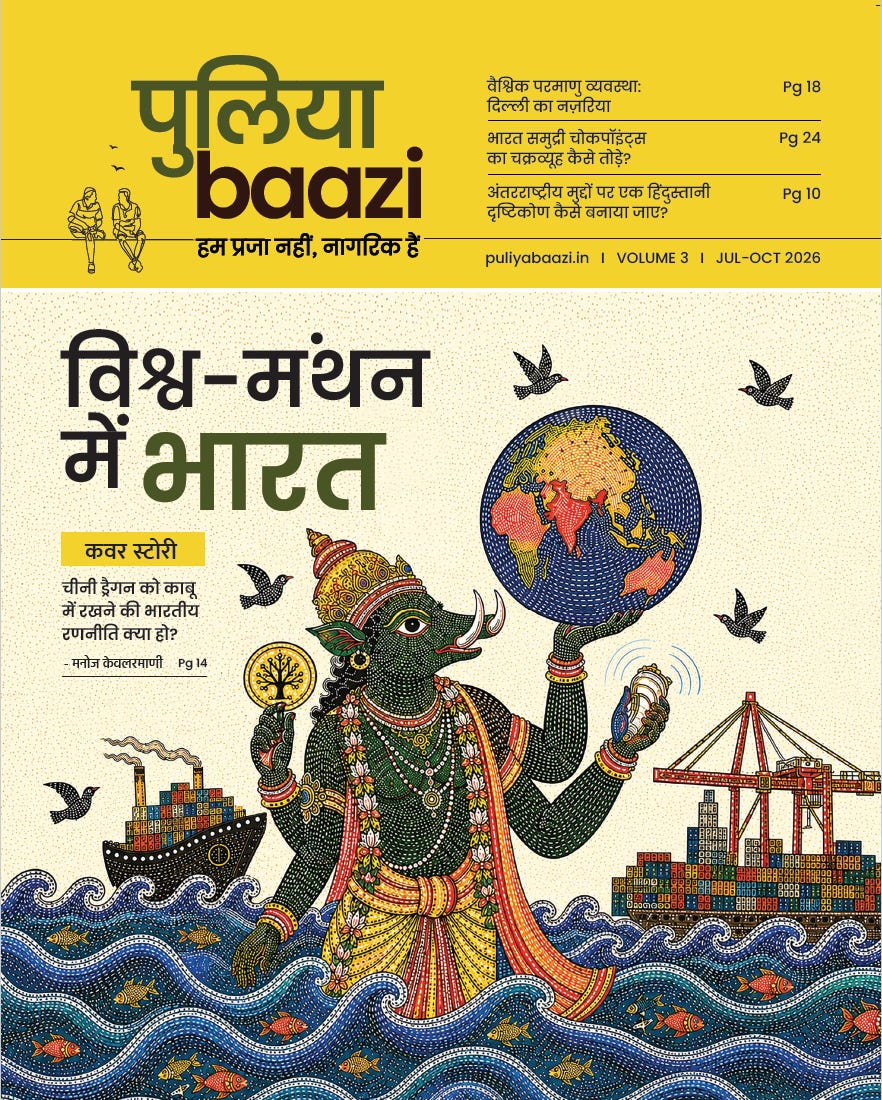
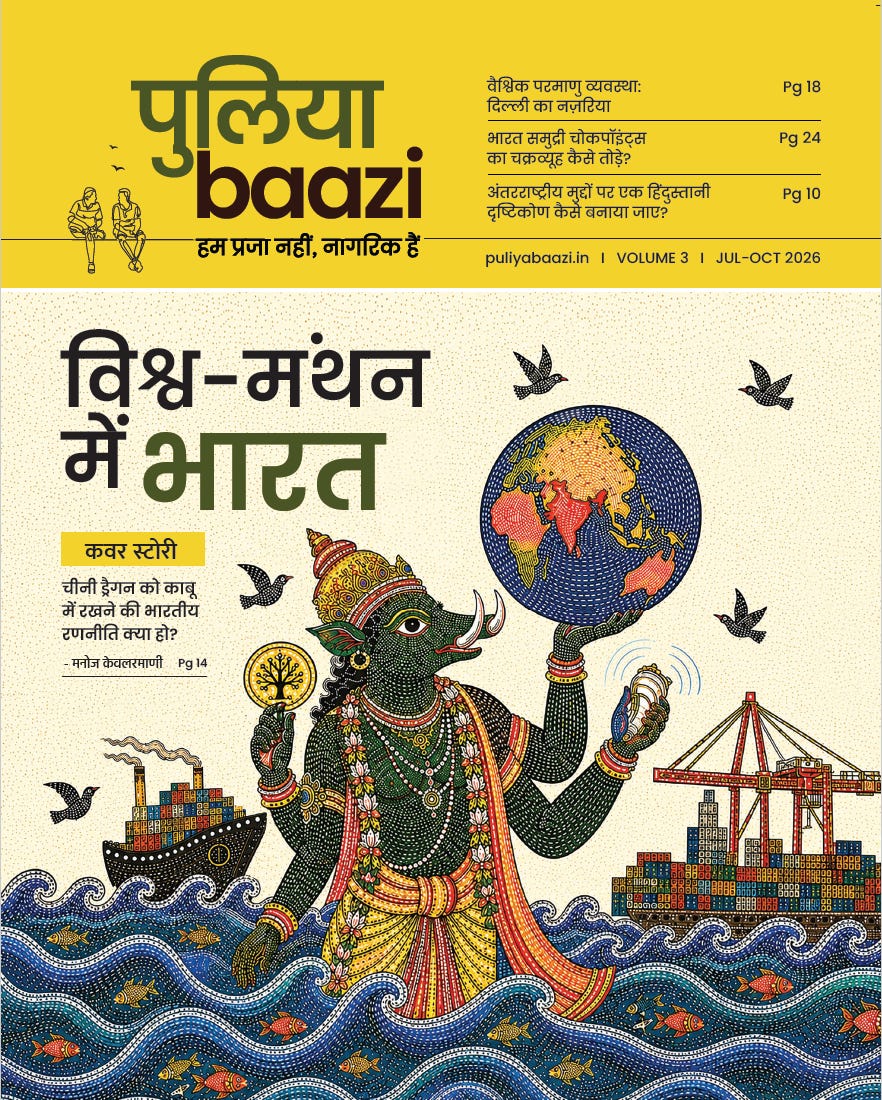
[Magazine] Puliyabaazi Issue #3 is on geopolitics and Indian foreign policy. Check it out.
Comments
Nothing yet. Say the first thing.
Sign in to join the conversation.