

“Calvin Coolidge’s ‘Hebraic Mortar’” by contributing editor Devorah Goldman was one of our most popular essays in 2025. Here is an excerpt:
Coolidge did not plead for special favors on behalf of Jews, but for a return to the biblical precepts he believed would bless the nation. This plea doubled as a warning: in a troubled anniversary year, when the nation was fatigued by war and wary of the future, it might succumb to ancient hatreds and jealousies inherent to the human heart and fall into disarray. Or it could make sense of things another way, remembering the diverse elements present at the founding, including the Jews who sacrificed their lives or fortunes to the revolutionary effort. One hundred years on, Coolidge’s message captures some of the best of American conservatism: a frank and grateful appraisal of the past combined with a religious spirit that embraces religious toleration.
Read Devorah’s full essay here!
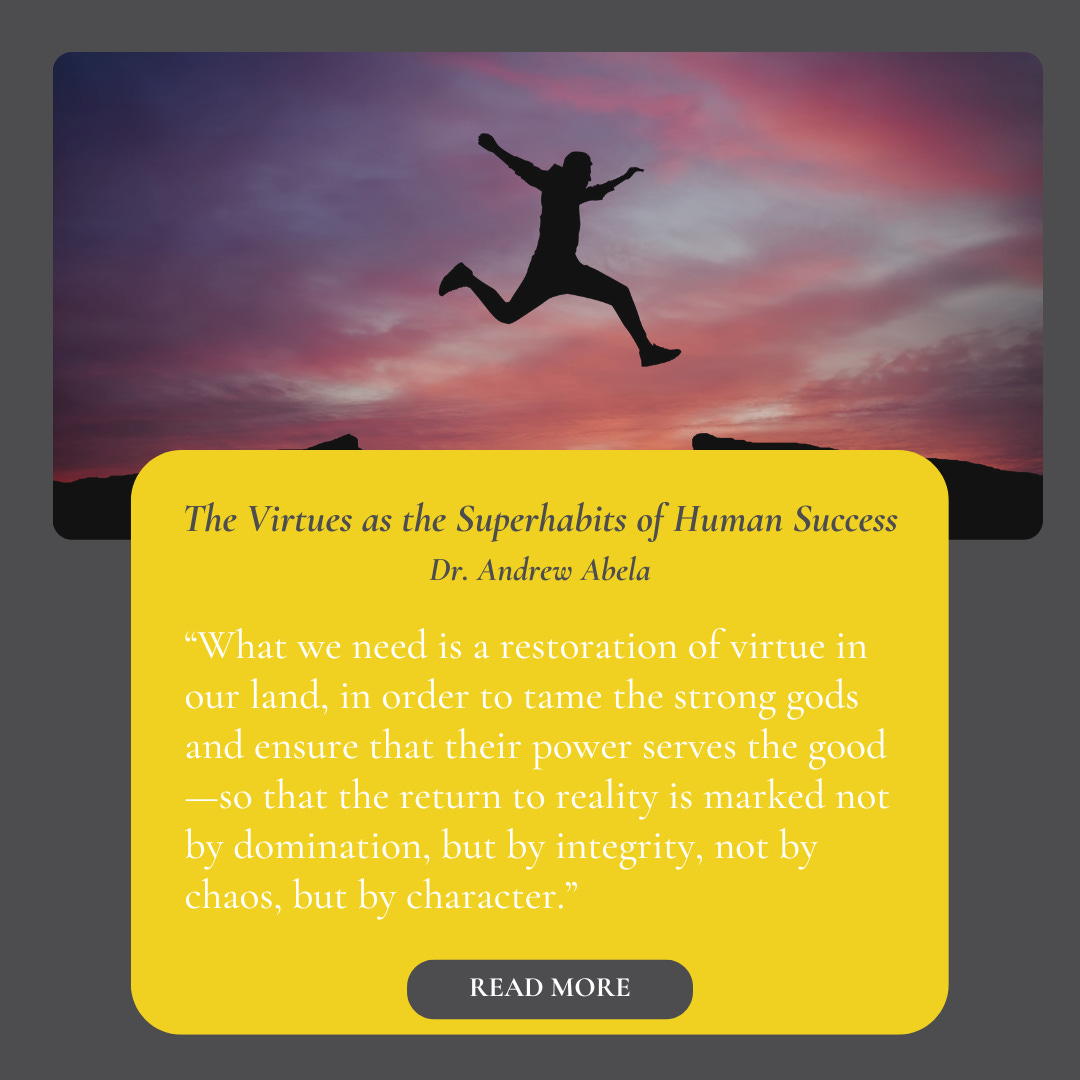
In “The Virtues as the Superhabits of Human Success,” Catholic University’s Dr. Andrew Abela writes:
[T]he original meaning of the word virtue is a good habit, particularly a habit of excellence. The reason this is significant is, if we understand that virtues are habits that anyone can acquire through practice, then virtue is no longer this abstract ideal that we’re aspiring to, but something we can all do and become. If you want to grow in restraint, for example, each day, practice some small effort of restraint and steadily you will build the virtue of restraint, like you would build a muscle. The virtues are like psychological or spiritual muscles, which all of us already have, but which have to be exercised to be strengthened.
Ancient civilizations knew this. The ancient Greeks and Romans would habituate themselves to virtues like courage and wisdom; they would practice them and honor them. The virtues became a sort of human operating system, underlying every personal and social achievement. This was true for almost every major civilization through the millennia, until a couple of hundred years ago, when we started to abandon the pursuit of virtue.
Alasdair MacIntyre tells this story in After Virtue. At the risk of vastly oversimplifying the book, his argument is that virtue had become associated with religion and was rejected during the Enlightenment, along with many other things religious. MacIntyre explains that people in the past shared a clear idea of what the virtues were and why they mattered. Virtues were habits that helped people live good lives, guided by traditions and communities. Over time, however, the Enlightenment tried to rebuild a sense of morality using reason alone, and that project failed utterly. MacIntyre argues it failed because reason alone could not give people strong, agreed-upon rules for how to live. The result was a moral world where people often talk about values, rights, and maybe even virtues, but these words lack any real foundation.
You can read the rest of Dr. Abela’s piece here.
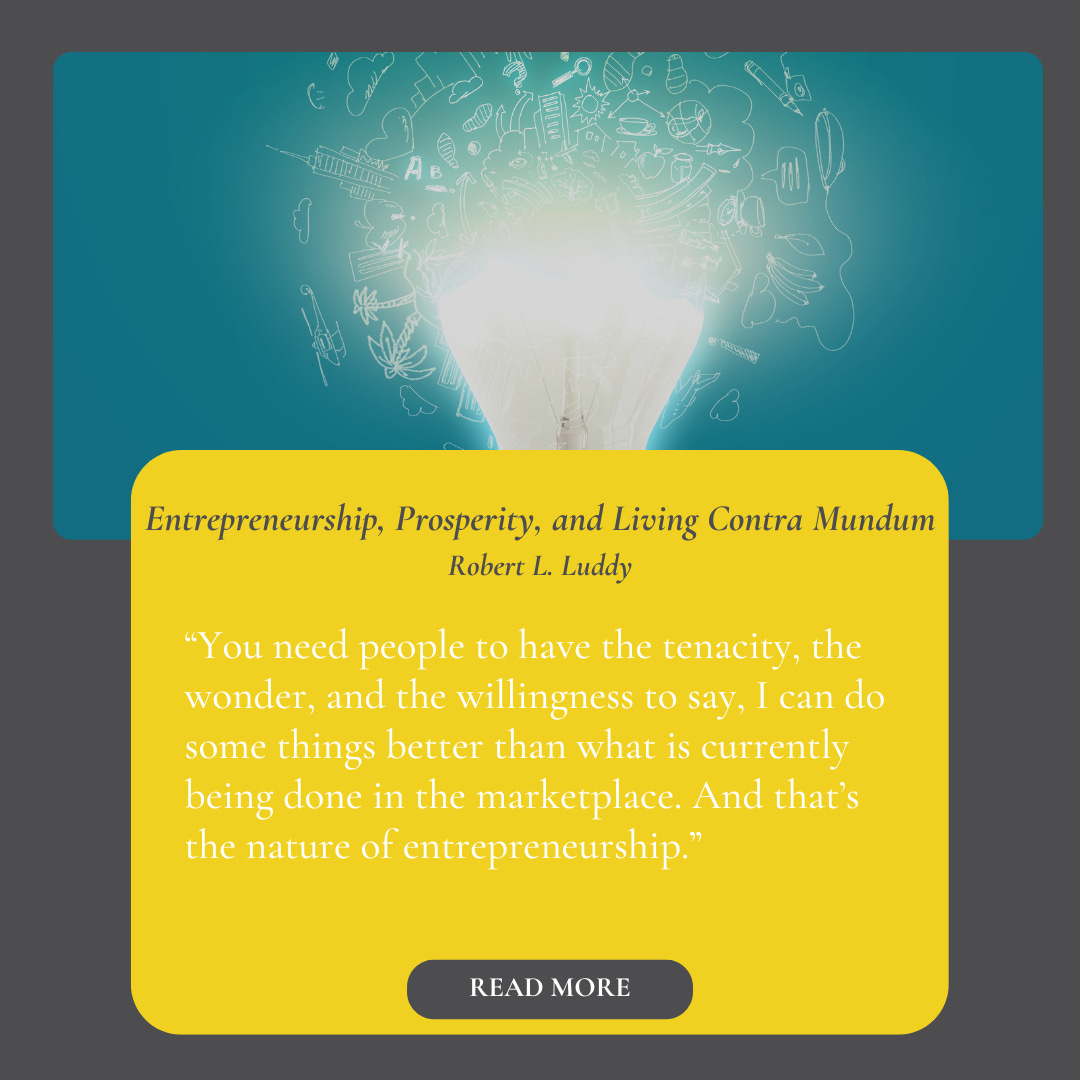
Managing Editor Alexandra Davis interviewed entrepreneur Robert L. Luddy in “Entrepreneurship, Prosperity, and Living Contra Mundum”:
“Against the world.” That’s the nature of an entrepreneur. They’re looking at the world entirely differently. And in most cases, entrepreneurs are providing a superior outcome at a lower cost. There are times that it’s a higher cost, but even if it’s a higher cost, it’s a superior outcome. So yes, entrepreneurs, people who are willing to make a contribution, who are willing to take risks, are the whole basis of an economy. And if you don’t have those entrepreneurs, you have a socialistic economy.
A way out is for young people to figure out how they can make a contribution at whatever level, within companies, within organizations, within churches. And, as you stated, it needs to come from the ground up; it’s not going to come out of the federal government. It needs to come from the individual. And, as you probably know, in modern-day colleges, they talk about collaboration, as if people sitting around at a table would figure anything out. And there was a comment by Edwin Land, the inventor of the Polaroid camera. He said that if you put five intelligent people around a table, you’re going to get the lowest common denominator; you’re going to get bad ideas. But one of those people at the table might say, “Here’s the best idea, here’s how it needs to be done.” That’s what entrepreneurship is. It’s not a blending of things down to where everybody feels good. It’s about unique ideas.
You can read the full interview here.
Elizabeth Kulze, “The Motherhood Advantage,” Fairer Disputations: and a response essay by Alexandra Davis entitled, “The Surprising Benefits of Working Motherhood”
Siobhan Heekin-Canedy, “Conservatives Must Not Abandon Human Rights to the Left,” Providence Magazine
Charles Murray, “How I Changed My Mind on Assisted Suicide,” Compact
Many thanks to a new PD reader for his feedback. We are so glad to have you!
Don’t forget about our daily and weekly emails, which ensure that you will never miss a new essay. Get our newest pieces delivered straight to your inbox.
We can all cut back on doomscrolling, so why not get your favorite content hand-delivered … every morning?
Give us a try!
Subscribe to our weekly essay roundup.
Thank you for reading Public Discourse, the Witherspoon Institute’s online journal of religion, education, and culture. We are a reader-supported publication. If you enjoy our work, please consider becoming a donor, subscribe to receive our (free) daily and weekly essay drops, or better yet, share this newsletter with a friend.
No posts
Comments
Nothing yet. Say the first thing.
Sign in to join the conversation.