
Tell me, O muse, of that ingenious hero, who turned one of the oldest stories in Western civilization into a multimillion-dollar box office success — but don’t spoil the ending because my tickets aren’t until Monday. If it’s Friday, it’s Family Matters:
The Family-Friendly Skies (Congress’ Version): Making airplane travel more parent- and kid-friendly
Dipping into the SIPP: New data on diverging American childhoods
By Your Leave: Boozman and Gillibrand team up
It’s Me, Hi: Reason
Parting Shots
Family Matters has previously cheered the roll-out of “Families on the Fly,” a TSA initiative to pilot family-friendly security screenings at a small batch of airports that tend to serve a large number of flyers with kids. The initial reviews have been positive: by giving families traveling with kids 12 and under their own designated lane, families get more help with folding up the stroller and dealing with the recalcitrant three-year-old who doesn’t want to walk through the magnetometer (what, just mine?) while other less-encumbered travelers can look forward to a more streamlined security experience. Assuming there is infrastructure and staff present to ensure both standard and family lanes are processed efficiently, it’s a pro-family win-win. Under Secretary Sean Duffy’s leadership, the Department of Transportation has stepped up as well, launching a $1 billion campaign last year to expand amenities like airport play areas and nursing rooms for moms.

Now, Congress is getting into the act. This week, the House of Representatives passed the “Improving Travel for American Families Act,” co-sponsored by Reps. Ryan Mackenzie (R-Pa.) and Valerie Foushee (D-N.C.). The bill would require the TSA to build on its Families on the Fly initiative for two years, prioritizing airports with high volumes of family travel and looking at ways to improve the passenger experience while maintaining security standards. The bill passed by a resounding 398-12 majority, with ten Republicans and two Democrats voting against it.
I’ll be blunt: This is a very nice bill and the Senate should pass it as soon as possible, and President Trump should sign it shortly thereafter!
“As the father of two young children, I know firsthand that the existing TSA screening process creates an added layer of stress for families already navigating the challenges of travel,” Rep. Mackenzie said in a press release. “Parents must wrestle with strollers, bags, and young children while trying to move through security lines that were not designed with families in mind.”
That kind of intentionality is too often missing in Washington. Of course, not every family flies, and not every trip to the airport is a hassle. But this is the kind of practical, common-sense approach to giving parents a little forbearance in our public spaces that we need more of. (We should also tip our cap to Secretary Duffy’s efforts to make travel great again, which have included some family-centric messaging, such as encouraging travelers to help pregnant women put their bag in the overhead bin.) But it’s nice to see Congress taking some action as well, rather than relying on executive branch agencies to take up and formalize these initiatives on their own. After all, that is the way our constitutional order is supposed to work.
As the Families on the Fly initiative grows, we might imagine a dedicated partnership with the DOT’s campaign to expand amenities for families. More airport play areas and nursing rooms for moms, yes, but we could think bigger; free strollers to help families get from security to the gate; foldable cots at customer service areas to help toddlers get naps in during flight delays; a family-friendly lounge or two; or other, better ideas (feel free to submit your own!) Not every pro-family policy needs to be centrally planned; but if you’re operating a large (or small!) bureaucracy like the TSA, and you’re not thinking about what you can do to make the lives of the parents and kids you interact with better on a day-to-day basis, you’re missing a big opportunity to make America more family-friendly. Kudos to Representatives Mackenzie and Foushee.
Family Matters readers come to this newsletter expecting the best in all that has been written and researched in family policy. This week, we’re taking advantage of that trust to give you something a little bit more provisional — a first cut at data from the 2025 Survey of Income and Program Participation (SIPP), a longitudinal survey that tracks family dynamics in a unique way. The SIPP’s primary purpose is for evaluating participation in and eligibility for government programs, and also asks some pretty detailed questions about financial well-being and assets. It also has a reputation for being a bit of a handful to work with, so I will ask the readers’ forbearance if this initial look at the most recent SIPP data didn’t get the replicate weights quite right.
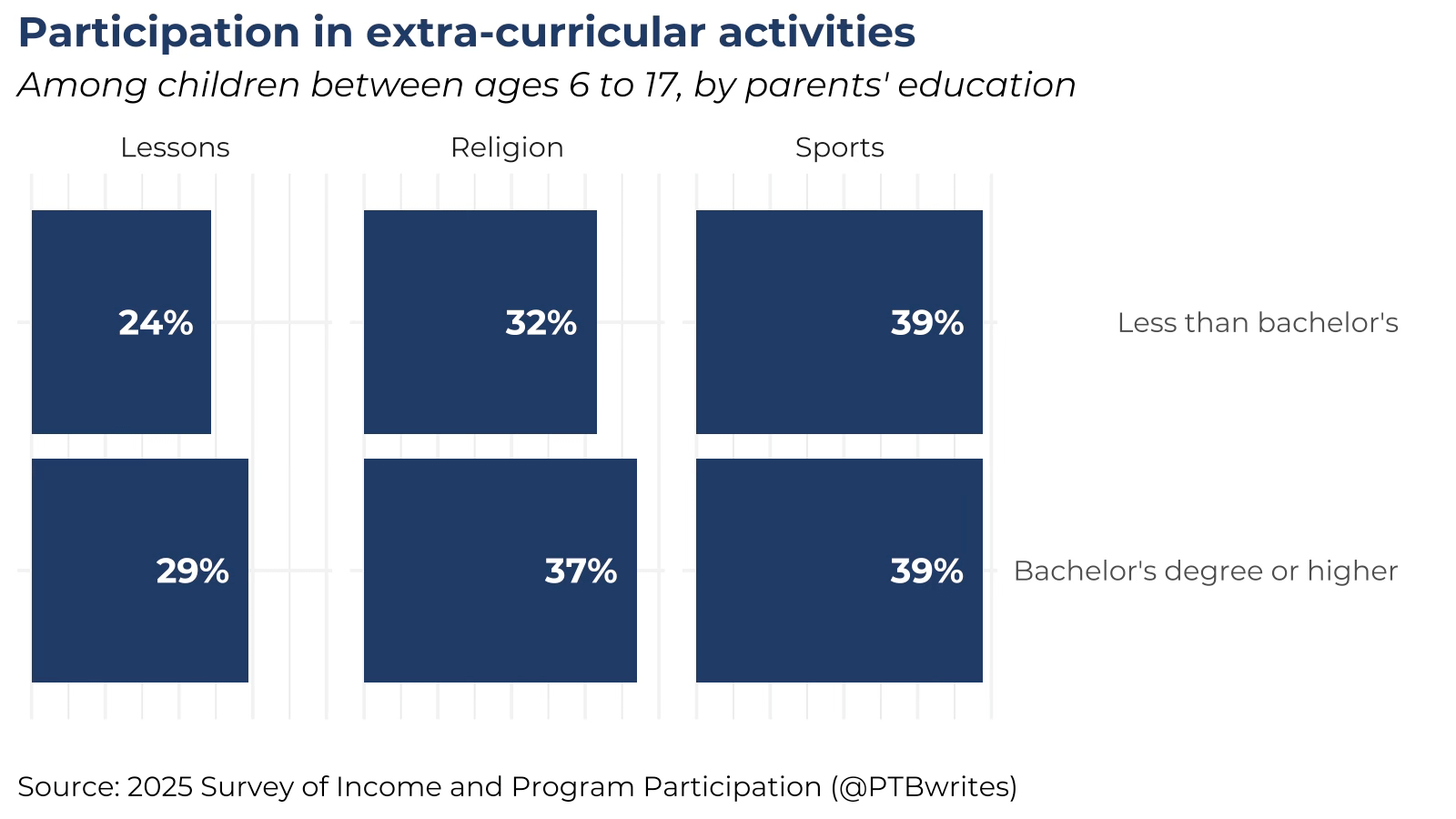
In addition to participation in government programs, the SIPP also asks parents about their child’s participation in various activities, including after-school lessons (like music, dance, or language), religious services or social events, or a sports team (in or out of school.) It’s perhaps not especially surprising that children raised by college-educated parents are more likely to participate in academic extracurriculars, but note that sports participation is even across the two groups. For this breakdown, we are looking at religious participation in one event or service a week or more. One other thing I’d point out: Kids being raised by parents without a college degree are 21 percent (7 percentage points) less likely to participate in a religious activity than participate in a sport.
We can also see some class differences in other aspects of family life as well — college-educated parents are 31 percent (18 percentage points) more likely to report having dinner with their children every night in a typical week than those without a four-year college degree:
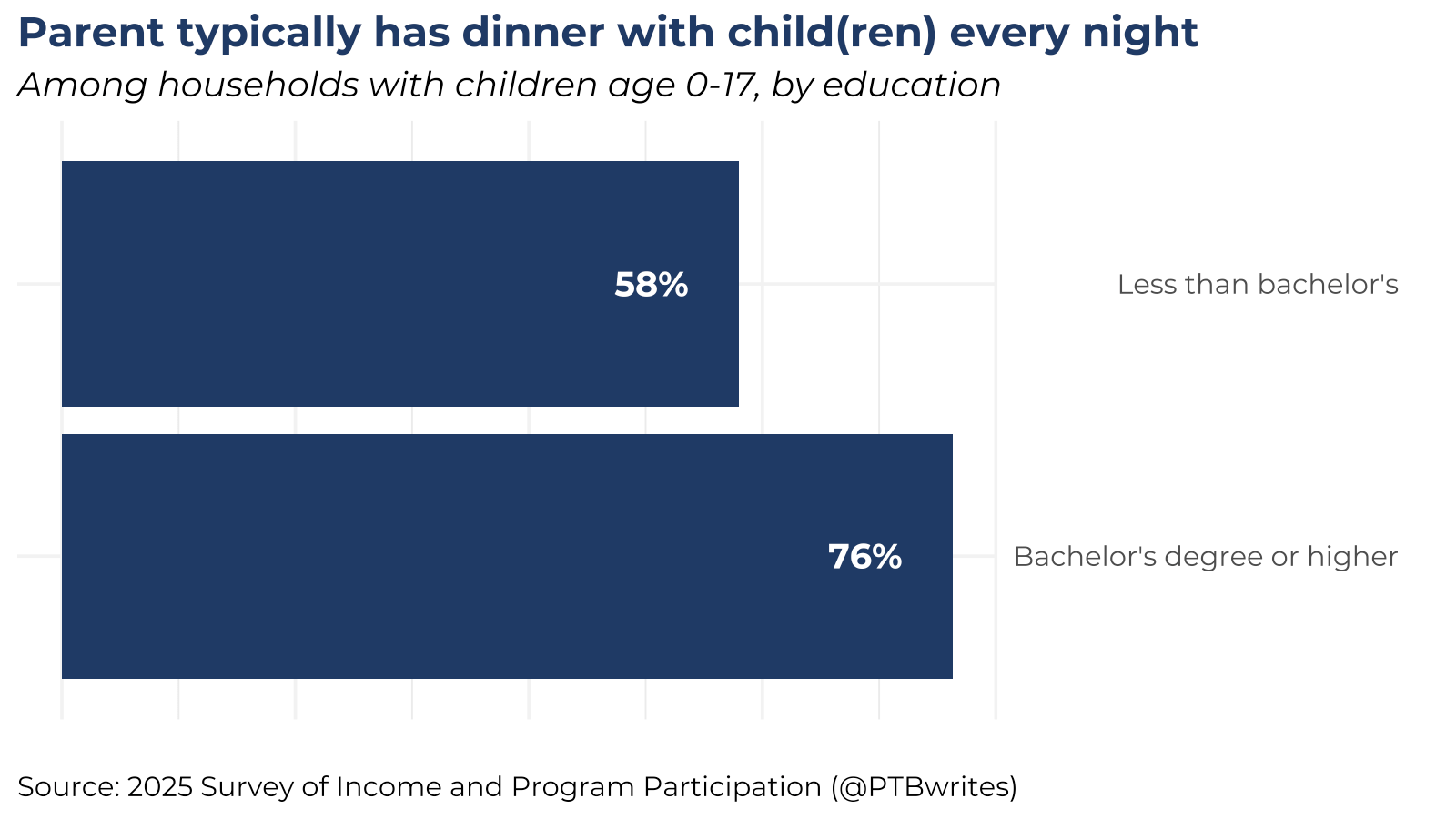
Some of that is unquestionably driven by the higher prevalence of single parents among households without a college degree; they might be pulling a double-shift or working a service-sector job without much control over their hours. But it could also reflect different attitudes to technology or other distractions as well — I wonder if it’s another warning that, as University of Chicago pediatric surgeon Dana Suskind warns in her new book, Human Raised: Nurturing Connection, Curiosity & Lifelong Learning in the Age of AI, human attention itself could be on track to becoming a kind of privilege.
One of the points I return to again and again in interviews and talks is the mathematical reality that parents bear certain costs that non-parents don’t — both in terms of diapers, carseats, and bigger cars, as well as in forgone opportunities to earn income or increase earnings. This is a major reason why I support expanding the Child Tax Credit, upfront assistance for new parents, and other ways of shouldering the financial burden of raising the next generation.
One simple illustration of this imbalance is simply looking at household balance sheets across the life cycle. What the graph below is showing us is the total value of household assets held at a financial institution (think savings and money market accounts, not illiquid sources of wealth.) Married couples without kids (DINKs) see a very healthy financial picture, particularly into old age — which makes sense, given they have two potential earners and no dependents. Married couples with kids start off with very low financial assets in their 20s and 30s (there is some selection here — families with a stay-at-home parent, who might be more likely to marry young, will have fewer earners and higher expenses) but by their 40s and 50s their financial picture starts to look pretty rosy.1 And, unsurprisingly, unmarried adults tend to see lower balances in their bank accounts, though single parents catch up to their childless peers as their kids leave the house.
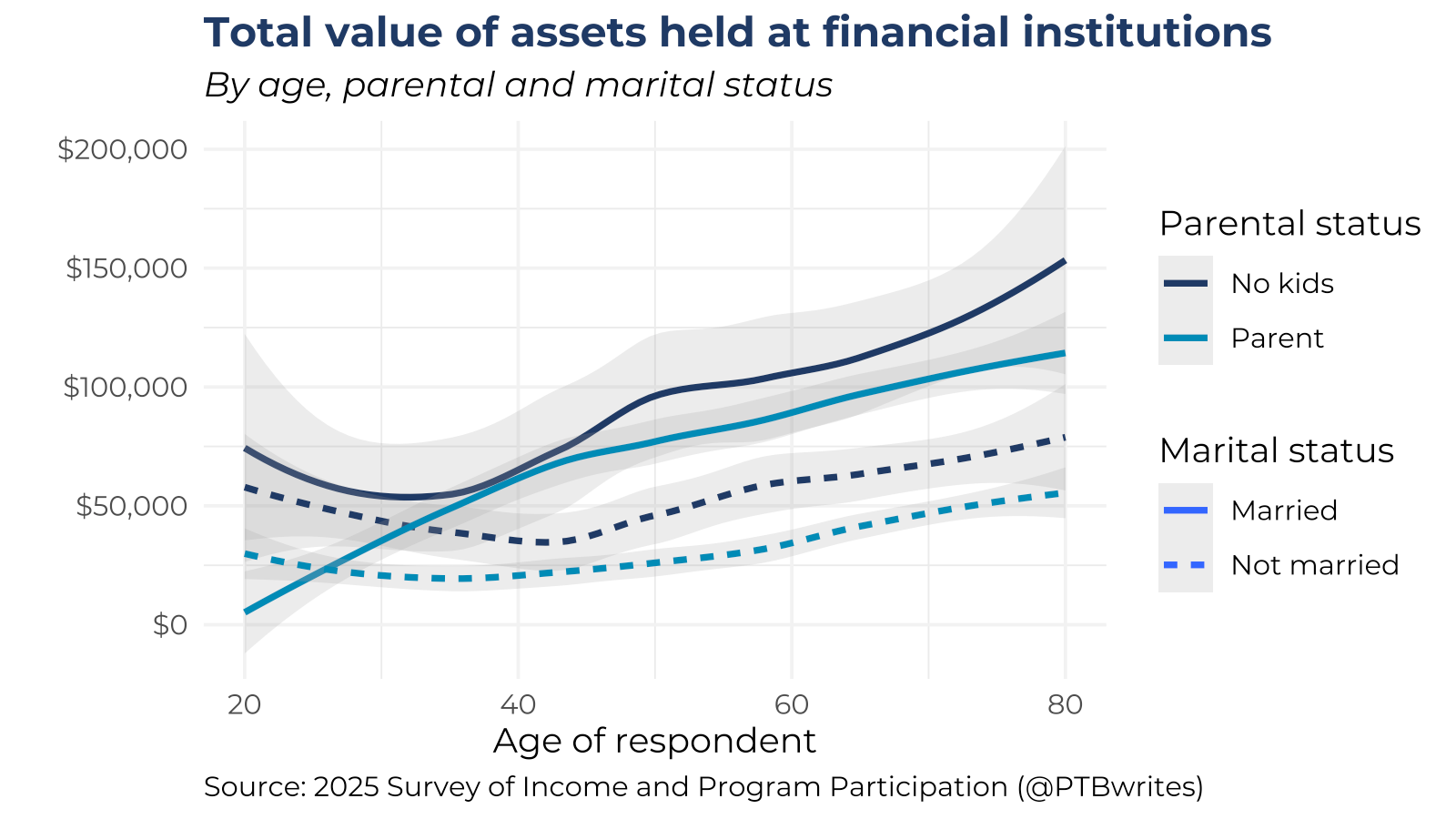
Remember, this is what we might consider liquid assets, so it’s not the full financial story, but if we think of it as a proxy for “what’s readily available in case of emergency” it tells a certain story. One takeaway, for example, might be a greater interest in helping families time-shift more of their resources — recall then-Senator Marco Rubio’s proposal to allow parents to borrow from their expected Social Security benefits tomorrow to pay for paid leave today. Two other thoughts it might leave you with: a future with fewer marriages is one that will lead to greater financial precarity, and a culture that expects couples to delay having kids until they are financially “stable” and independent will lead to lower fertility rates overall.
As a reminder — only paid subscribers are able to comment on Family Matters posts. Subscribe today to give yourself not just the phenomenal cosmic power of being able to comment, but the warm glow of supporting high-quality family policy writing.
Lastly, a new bipartisan paid leave bill has been introduced, featuring a Republican Senator who hasn’t previously taken a leading role on the topic: Sen. John Boozman (R-Ark.,) a former optometrist and the senior senator from the Natural State, has partnered with long-time paid leave stalwart Sen. Kirsten Gillibrand (D-N.Y.) on a bill they are calling the “More Paid Leave for More Americans Act” (section-by-section here).
Structurally, it builds off the bipartisan IPLAN (Interstate Paid Leave Action Network) act introduced last year in the House, which would create a kind of interstate consortium oriented towards harmonizing paid leave laws across state lines, reducing administrative burdens for employers, and improving technical assistance for employees, employers, and insurers. The Boozman-Gillibrand bill supplements that approach with a three-year pilot program that would give states grants of up to $7 million to stand up a public-private partnership paid leave program.
The pilot program is a nice idea, though the parameters on it are probably too restrictive to get many states to buy in who don’t already offer some kind of paid leave already (in other words, it feels more likely this ends up subsidizing blue states’ paid leave offerings than inducing red ones to launch a new effort.) To get the funds, states would have to set up a partnership to provide a minimum of six weeks of paid leave (once a year) for new parents, family care, and personal leave, at a benefit of 50-67 percent of weekly earnings; that gets pricey (for reference, Minnesota’s comprehensive paid leave program has already paid out $600 million in its first year of operations.) Interestingly, the summary of the bill provided by the sponsors says it would allow DOL to give preference to states that provide paid leave benefits for the arrival of a new child, but that seems to conflict with the bill text’s comprehensive vision of leave and a national floor. If the bill does end up offering some flexibility for states to offer a more narrowly-defined benefit, it could provide an interesting opportunity for reddish-purple states.
Either way, it’s heartening to see new voices and perspectives bringing ideas to the table, and one could conceivably imagine a kind of interstate partnership and technical assistance paid leave package getting included in what is likely to be a divided Congress next year.
My most recent Family Matters update, on Finland’s intergenerational baby bond proposal, was included in Liz Wolfe’s roundup at Reason magazine.
The number of abortion-related ballot amendments this November now stands at four: voters in Idaho, Virginia and Nevada will be considering moves to liberalize abortion law, while Missouri voters will be asked whether to bring back a version of state’s abortion ban (Associated Press)
Georgia: A new law aimed at protecting kids - requiring child care programs to get approval from two state agencies before beginning background checks on new hires - is slowing the hiring process down and making it harder for providers to fill open positions (WMAZ)
New Jersey: A temporary boost in the state’s Child Tax Credit will bring the value per-child up to $1,250 through next tax year — it still has a pretty less than optimal design, however (N.J. Spotlight)…Gov. Mikie Sherrill also announced a free website designed to help lower-income New Jersey families quickly apply for the state’s Child Tax Credit in 15 minutes or less (New Jersey Monitor)
California: San Francisco Board of Supervisors member Danny Sauter wants to make public transit more reliable and safe for families (San Francisco Examiner)
Kentucky: Lawmakers passed a pilot program authorizing child care “micro-centers” earlier this year, but Gov. Andy Beshear, unhappy with being turned down for a statewide universal program, signed an executive order mandating a pre-K for all pilot program in two counties at a cost over nearly $1.3 million (Lexington Herald Leader)
Elliot Haspel highlights the gap between some child care plans and parental preferences, and suggests people take a look at the proposals offered by the Bainum Family Foundation, which suggests “reimagining childcare policy to support two pathways for families: high-quality licensed [early childhood education], and “trusted caregivers” which include parents and [family, friends, and neighbors] caregivers.” (The 74 Million)
The country of Turkey (Türkiye, if you watched any of the World Cup) has fined more than 100 OBGYNs for excessive C-sections, saying the nation needs to work harder to bring down its rate of C-section births, the highest in the OECD (SCMP)
The regional government in Madrid, Spain, has introduced a law that would allow families to claim certain benefits linked to family size after the 14th week of pregnancy, causing reproductive rights groups to charge it is “an attempt to control women’s bodies” (Politico EU)
After a two-year legislative battle, the parliament in France has voted to legalize physician-assisted suicide. Un vrai dommage. (New York Times)
U.S. Senators Bill Cassidy, M.D. (R-La.) and Tommy Tuberville (R-Ala.) introduced the Strengthening Transparency and Oversight to Prevent (STOP) Child Care Fraud Act, which would eliminate parental self-attestation of income, citizenship status, and other characteristics, and statutorily require attendance-, not enrollment-, based payments. States with high rates of improper payments will be at risk of having their block grant funds withheld.
Is there a big city mimayor in America having more fun than Zohran Mamdani? His latest proposal is squarely aimed at parents, offering 500 families free babysitting for an inaugural “Parents’ Night Out.” (ABC 7)
Fitch ratings finds that the 21st Century ROAD to Housing Act will not affect the credit quality of U.S. single-family rental (SFR) securitizations, suggesting that the new legislation’s greater regulatory clarity “partially offsets” the constraints on open-market acquisitions.
Senators Tommy Tuberville (R-Ala.), Jim Banks (R-Ind.), and James Lankford (R-Okla.) have introduced a bill that would prohibit the use of federal funds for depicting or describing sexually explicit content, gender dysphoria, and transgenderism. Bill text.
My EPPC colleague Mike Fragoso has some interesting thoughts on the current dust-up between pro-lifers and acting Attorney General Todd Blanche during his confirmation hearings (National Review)
Fascinating, if not fully persuasive, case from Kelsey Piper for The Argument on why age-gating the Internet will ultimately be a higher price for kids’ safety online than she’d be willing to pay. This idea behind this paragraph, however, deserves much more attention:
“YouTube is happy to help me restrict my kids’ viewing to YouTube Kids, which is full of algorithm-promoted hypnotic slop, but offers absolutely nothing to let me enable a bunch of content marked for adults (like documentaries, historians’ channels, or math videos) that I think are good. There are tons of tools to spy on my kids so I know whether they’ve been served gruesome videos of murders but none to just avoid gruesome videos of murders.”
Madeleine Kearns writes for The Free Press on the restorative reproductive medicine approaches that helped her become a mom — twice (mazel tov!):
Comments and criticism both welcome, albeit not quite equally; send me a postcard, drop me a line, and then sign up for more content and analysis from EPPC scholars.
I am speaking poetically here, to be clear; this is a one-year look at all ages, not following the same couples over time.
Comments
Nothing yet. Say the first thing.
Sign in to join the conversation.