
Waka waka, eh, eh, tsamina mina zangalewa — this time for the Americas. If it’s Friday, it’s Family Matters:
Beautiful Game, Where Are You: New report stresses parents’ hemterogeneous preferences
TV Off: Weighing in on whether the ratings system adequately supports parents
Take the “A” Train: Sec. Sean Duffy introduces a new dashboard on family-friendly transit
It’s Me, Hi: Daily Wire
These United States
Parting Shots
For the first time since 1994, the FIFA World Cup is back on American soil, with plenty of rapacious greed, abject corruption, and political cynicism attendant. Despite the predictable pre-event grumblings from sports columnists, I’m sure it will be a ratings success, even if it doesn’t impact the cultural landscape the way the prior U.S.-hosted edition did (my predictions: the Americans valiantly get bounced in the Round of 16 and Kylian Mbappe and the French team take home the trophy in East Rutherford on July 19.) If nothing else, we are getting some absolutely spectacular home jerseys for the U.S. side out of it.1
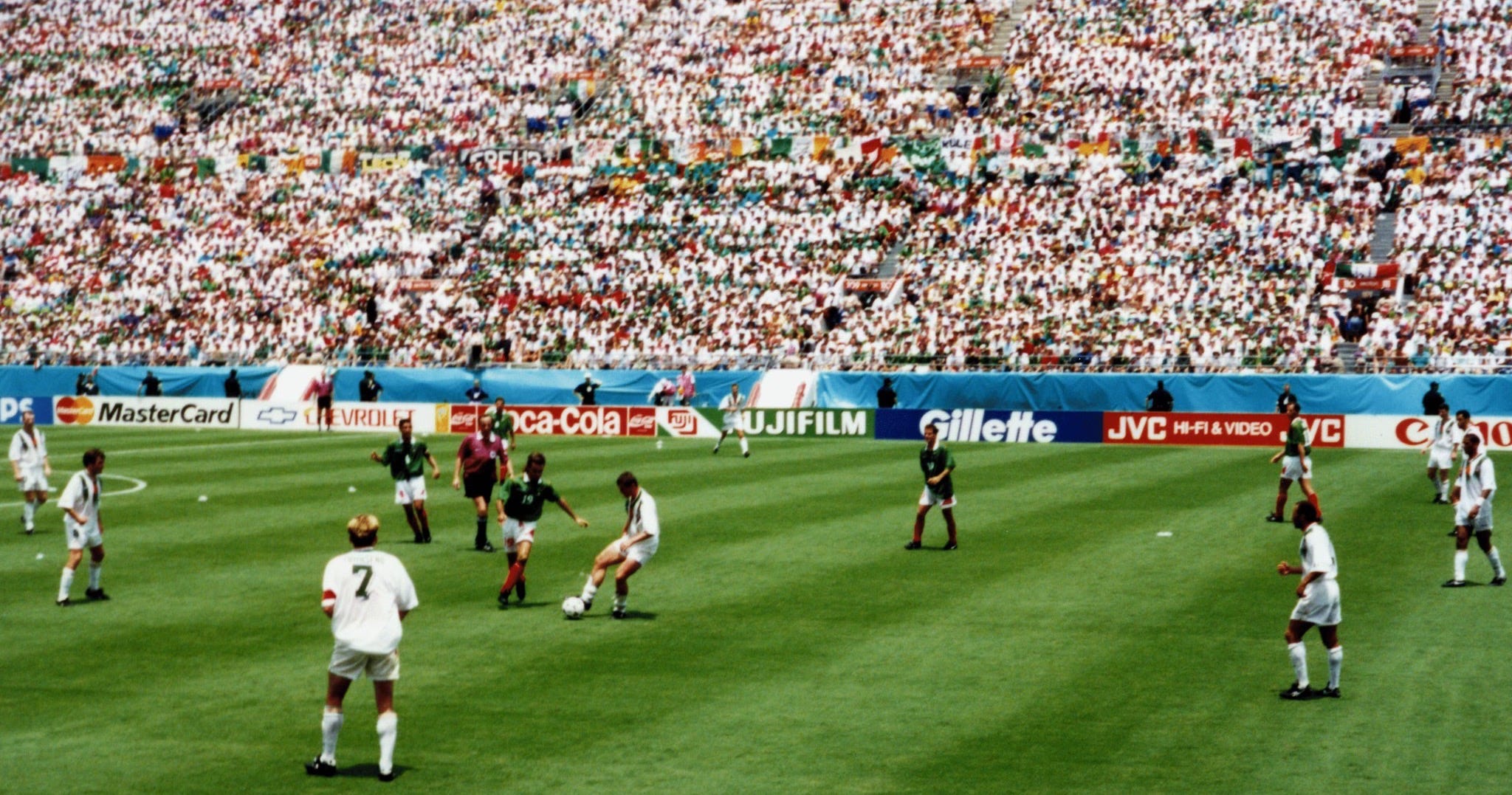
There’s little to be said in defense of Gianni Infantino’s ruthless pursuit of revenuemaxxing the largest-yet edition of the World Cup in the richest market in the world. Perhaps FIFA deserves a grudging respect for seeking to capture as much of the producer surplus as possible, rather than allowing scalpers to get their hands on some of consumers’ willingness to pay (even as this has led to rushed, last-minute ticket giveaways to local residents). But as I wrote last summer, there was nothing forcing FIFA to price tickets as high as the market could bear, rather than delivering a product that was more affordable for middle-class families:
“Aside from the token 22 young people that routinely flank the two teams’ starters as they walk onto the pitch, the games themselves will be for adults, not youth. The demand to attend a World Cup match will always exceed supply – yet a stadium full of corporate executives is not the atmosphere that inspires dreams and builds lifelong fans.”
It’s not just the ticket prices; the whole tournament is about TV revenue and corporate dollars, even breaking up each game’s halves with a “hydration break” that serves as another ad slot. Two of the U.S. Men’s National Team’s group stage matches kick off at 9 p.m. and 10 p.m. EDT — the perfect way to ensure kids on the East Coast aren’t able to make the memories to fuel the next generation of would-be Landon Donovans. The 1994 World Cup was intentional about cultivating the next generation of fans; this edition feels more like soccer is eating its seed corn.
But this weekend also features a different kind of corruption of the commons for private gain — the installation of a fighting ring on the South Lawn of the White House, and the hosting of a mixed martial arts contest by the President of the United States, on his birthday, as a kind of tribute to our nation’s 250th anniversary. Bud Light and Polymarket ads are prominently displayed on the octagon. At best, the spectacle promises to be tawdry; at worst, degrading.

Andrew Leyden@PenguinSix
Scenes from the UFC Arena on the South Lawn of the White House.
12:14 PM · Jun 11, 2026 · 91.9K Views
65 Replies · 118 Reposts · 1.16K Likes
This is where I out myself (again) as reflexively opposed to the “Barstool Conservative” brand of right-wing politics. The Ultimate Fighting Championship has unmistakably grown in popularity, racking up about as many viewers as your typical Big 12 mid-season football game, and recently signing a $7.7 billion, 7-year deal with CBS/Paramount. UFC impresario Dana White spoke at the 2016, 2020, and 2024 Republican National Conventions, and has been a big supporter of the President Donald Trump’s, so it’s not surprising that he would have offered to cover the expenses of a star-spangled event just off the National Mall.
But the White House should have said no to the offer — not just because of the dubious grounds of commercializing the South Lawn (the UFC expects to make millions back through advertising and VIP hospitality packages), and not just because it is part and parcel of the second Trump administration’s act-first, ask-forgiveness-later (or -never) approach to public lands.2 But let’s be honest — there is no honor in politics; the partisan outrage about the commercialization of public institutions would surely be flipped if a President from the other party were host a sponsored WNBA shootaround.
But primarily, they should have declined to host the event because American culture is not enhanced by promoting or endorsing bloody pugilism. There is violence, or the potential for it, in a lot of professional sports, but moving it from incidental to the action to the action itself turns us into worse versions of ourselves. We become habituated to, rather than horrified by, blood and barely-checked aggression on the mat.
Religious conservatives have had concerns over violence as entertainment ever since St. Augustine helped dissuade his friend Alypius from attending the violent “circuses” in the fourth century. When the UFC was first getting started, the Washington Post’s George Will quoted the late Senator John McCain’s concerns about the sport: “He also worries about the ‘glorification of cruelty,’ which raises the problem of virtue: What do we want government to do in the name of that?… ‘[E]xtreme fighting’ forces a commercial society to decide when the morals of the marketplace are insufficient. Do we really ban cockfighting only because the birds cannot consent?” Or ask Matt Morin, a former mixed martial artist turned divinity school grad, who wrote some years back for The Other Journal:
“If you go to any live event, you will know why: the fans are there for blood. Well, more accurately, they are there to get drunk, whistle at ring-card girls, and bullshit about why they would fight if some circumstance outside of their control were different. But mainly, they are there to see blood…By their cries, many fans make it clear that they are there for one reason: to see someone get hurt.”
To be certain, UFC has become more upscale from its origins as sheer gladiatorial spectacle, and there are doubtless habits of perseverance, discipline, and courage that can be exemplified in the octagon. Boxing, too, was once a form of organized violence that thrilled the American imagination. But those virtues can be found elsewhere, too, without the risk of disfigurement, concussion, or even death that commercialized human-on-human violence condones. Turning MMA into a pay-per-view profit center suggests a cheapening of our national culture. Putting it at the symbolic heart of our civic semiquincentennial celebrations feels ever crasser.
In too many cases, sports feel like they are reflecting a commercialized degradation of our culture, rather than a communal escape towards something more diverting. Is there a single college football fan happy with how the defanging of the NCAA, the advent of the transfer portal and conference realignment, and the destruction of decades of tradition in the name of ever-higher TV revenue has changed their sport?3
The latest example comes from Texas, where a judge ruled for Texas Tech QB Brendan Sorsby, allowing him to play and collect millions of dollars in NIL money this season despite having admitted to having bet on his own team at least 40 times. That was once the cardinal sin in sports — just ask Pete Rose or Shoeless Joe Jackson. Now, the world of uninhibited sports betting demands we take Sorsby’s claims of a chemical addiction to gambling at face value and welcome him back to the starting lineup. His lawyers, displaying the chutzpah of the child who kills his own parents and pleads for the court’s mercy as an orphan, argued that it would be harmful for Sorsby’s mental health and recovery from his gambling addiction if he were to be punished for having bet on his own games. It’s a mockery of actual mental health treatment and of the integrity of the game.
Some of fans’ frustrations there are no policy solutions for. As happy as I am for my New York Knicks-supporting friends, there was no world in which tickets for the NBA Finals wouldn’t cost thousands of dollars, given the team’s (a) large fan base in (b) the wealthiest city in the US (c) facing a decades-long title drought and (d) a capacity of only 20,000 seats inside Madison Square Garden. Tickets to the World Cup and the Olympics were always going to be expensive because America is a wealthy country. Some constraints you can’t supply-side your way out of.
But that doesn’t mean every sporting event should be an exercise in ruthless profit extraction either. The growing, $40 billion business of youth sports is gauging parents, exploiting dreams of college scholarships, and turning 10-year-old soccer teams into nation-trotting powerhouses, community ties and family dinner nights be damned. Senator Chris Murphy’s (D-Conn.) bill, recently discussed in Family Matters, would take that head-on. We can take policy steps to prioritize local leagues and kids having recreational fun, or we can let investors seeking big returns turn youth sports into another profit-maximizing venture. I see very little benefit for American culture in the latter.
Sports, or “sport,” if you’re feeling continental, is one of the few communal experiences that we can tap into — live sports, for example, is pretty much the only thing keeping the monoculture together (even if the fragmentation of the media landscape makes some of these “big events” feel a little less monolithic than they once did.) But without guardrails — moral ones, yes, and appropriate legal ones as well — it will consume itself. Rampant profiteering, the embrace of unchecked sports betting, rising interest in combat sports, the subordination of regionalism and tradition to the almighty dollar — policy alone will not put the genie back in the bottle and make sports fun again, but better ideas can at least take steps to prevent it from getting worse.
The current TV ratings system was created when the top-rated series were ER, Friends, and Touched by an Angel. Technology has changed, but TV-Y, TV-Y7, TV-PG, and the rest have not. If you pay attention to the small letters in the black box at the outset of your program, you might see some content descriptors, like crude language (L), violence (V), or sexual situations (S). Those are assigned by an industry-appointed Monitoring Board whose job it is to self-police TV programming.
Last month, the Federal Communications Commission issued a public notice as to whether the decades-old Monitoring Board system is responsive to the world of streaming and video-on-demand. In particular, some parents have found themselves surprised at age-inappropriate content around gender identity and sexual orientation. In its notice, the FCC notes that “family-oriented perspectives [ ] are not well represented in the media industry,” and asks whether “descriptions of the content provide a sufficient basis for parents to make informed decisions concerning viewing decisions for their family, including when gender identity themes are discussed or displayed?”
These are good questions, answered in a new, well-researched brief by my EPPC colleagues Eric Kniffin, Rachel Morrison, Mary Hasson, Theresa Farnan, Maddy Pelletier, and Chloe Lawrence.
In particular, they point out that many of the institutional voices on the advisory board have taken public positions that are out-of-step with many parents around gender ideology, and point out that “placing faith-based groups, including faith leaders and religious media, on the Monitoring Board would also help protect ‘the rights of parents to direct the religious upbringing of their children.’” They also call for more than the current system of periodic “spot checks” for a more comprehensive approach, and argue that the extensive jurisprudence around children’s exposure to LGBTQ issues in the classroom should “apply equally to parents’ concerns over children’s TV programming.”
In a post-Obergefell world, a pluralistic approach to these questions may require messier compromises than some social conservatives would prefer. But taking seriously parents’ responsibility to raise their children well, and the state’s obligation to support their ability to do so, should lead to more robust conversations around what the role of government and industry is in informing parents about their entertainment options — at least, until the rise of YouTube and other online content makes conversation about the “entertainment industry” as traditionally understood rather moot, for better and for worse.
Secretary of Transportation Sean Duffy continues his surprising reign as highest above-replacement-value Cabinet official continues. This week, he announced a new Federal Transit Administration dashboard that will measure “key family friendly metrics on transit systems across America.”
In a press release, Duffy says that “American families deserve transit systems that actually work for them. That means a safe, clean, and reliable experience every time…By focusing on these family friendly features, transit systems will be putting the needs of American families first. It will also help states learn from one another on what efforts are already helping communities elsewhere.”
Safety is an important part of this dashboard; so, too, should be reliability, family-friendly pricing, and stroller accessibility. If you have ideas, submit them to FTA by August 3. A welcome endeavor!
At the Daily Wire, I offer some quick thoughts in response to the viral new NBER working paper from Middlebury College’s Caitlin Myers and Ezekiel Hooper on the rollout of mobile broadband and fertility rates:
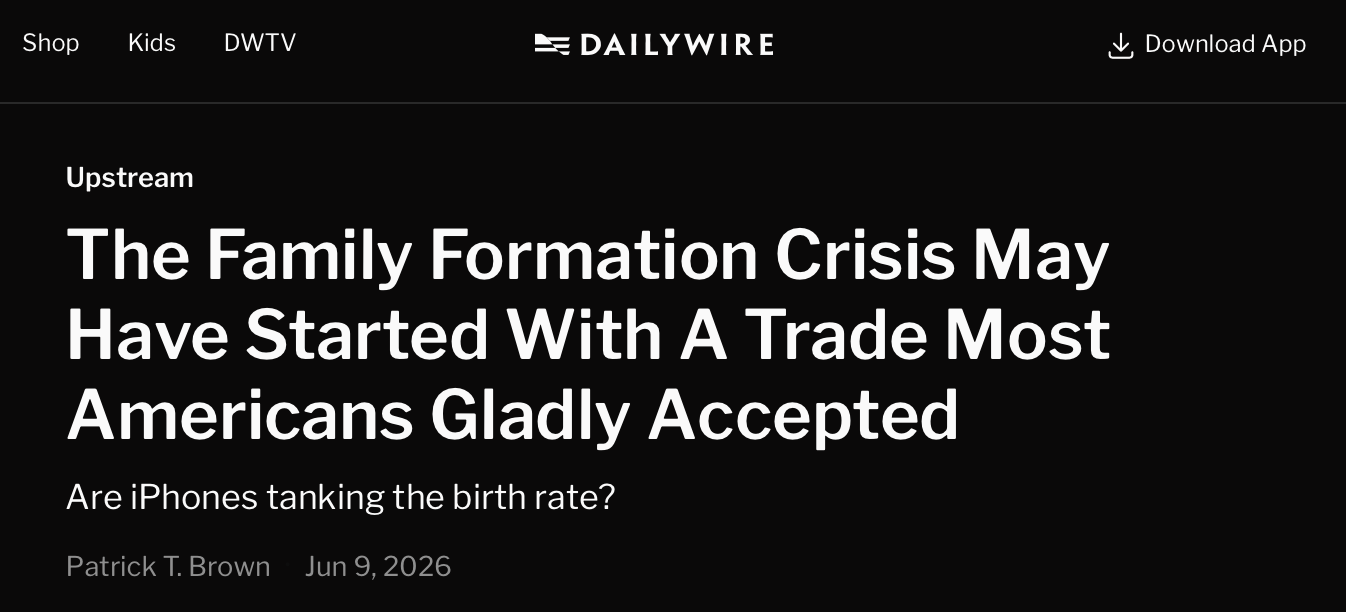
The paper gives “us more evidence (as if more was needed) that the digital revolution is upending the way we interact as humans…[even if the] iPhone had flopped, the introduction of social media, short-form video, and always-on communication, information, pornography, and entertainment on whatever device would have still had an impact on our dating and mating culture.”
As a reminder — only paid subscribers are able to comment on Family Matters posts. Subscribe today to give yourself not just the phenomenal cosmic power of being able to comment, but the warm glow of supporting high-quality family policy writing.
Going to try something different this week — breaking out our local and state updates worth noting and then slightly meatier one-line responses to the pieces and commentary that caught my eye:
Ohio: A bill would direct the state director of health to create a list of high-risk drugs that cause severe adverse effects in more than 5% of the drug’s users, which could include the abortion-inducing pill mifepristone (WOUB)
South Carolina: After the success of “Operation Ganjapreneur,” which resulted in the seizure of more than 30,000 pounds of illegal THC products, the state legislature is debating new limits on how THC products can be sold in the state (Randy Pate for S.C. Daily Gazette)
Indiana: 19.8% fewer children in the state are enrolled in Medicaid/CHIP than in January 2025, part of the more than two million fewer children who are enrolled compared to January 2025, per the Georgetown Center for Children and Families
New Jersey: A bill aimed at expanding the Garden State’s protection of abortion rights would allow people to be charged with “interference with reproductive health care services,” including causing “mental anguish or emotional harm.” This dubiously-constitutional provisions concern the New Jersey Press Association, among others, who point out it could criminalize reporting out any negative stories about abortion providers. (POLITICO)
Two contrasting but complementary pieces on child care prevalence and demand: Tim Carney writes about the “obsession” Democrats have for daycare subsidies for the Washington Examiner. Stephanie H. Murray covers the New America survey discussed in Family Matters at her Substack, Family Stuff, pointing out that “Among young kids broadly, American reliance on formal childcare is quite low.”
A quick follow-up to last week’s item on Medicaid work requirements: CU-Boulder’s Chloe East and Harvard’s Adrianna McIntyre have weighed in with a closer look at the dubious math included in HHS’s rosy picture of the labor market response. Worth digging into at the Can We Still Govern? Substack:
Emi Nietfeld covers the transition to parenthood for dads — apparently some more involved fathers are showing signs of post-partum depression. It’s an interesting discovery, one I’m not fully sold on — there’s a lot going on in the days and weeks after baby is born that could be causing symptoms even if the chemical/neurological pathways may be different than what moms experience. (The Cut)
Zaid Jilani writes about how the newfound Democratic enthusiasm for moderation has not extended to positions on abortion that more closely map on to the preferences of the median voter (something short of full “reproductive freedom,” that treats a fetus at six and twenty weeks of development differently, and that has broad health exemptions.) Well-intentioned advice that I think runs into the implacable belief from many Democratic voters that full “reproductive autonomy” is a matter of principle, not political expedience (New York Times)
“The rising tide has lifted all boats notably, even if unequally. It has not left everyday Americans stranded on the economic shore.” If you see AEI’s Scott Winship on an op-ed you know it will be puncturing declinist economic narratives, and on this one he teams with Stephen Rose for an op-ed about how — despite rumors to the contrary — the middle-class is shrinking not because Americans are moving down, but because they’re moving up. (New York Times)
Eric Levitz reviews the latest on fertility, technology, and family, and warns that the future of AI-powered relationships with chatbots could offer a good-enough substitute for human companionship that the future could look grim indeed. Another piece that illuminates, rather than obscures, the realities of our demographic crunch. (Vox)
“The sheer logistical and financial madness of raising children in America is now officially a matter of political concern,” writes Jia Lynn Yang for the New York Times Magazine, though I must confess I see it less as a break and more of a continuing trend of greater interest in family policy issues (in other words, NYT readers have read this kind of piece before.) She quotes my EPPC colleague Erika Bachiochi, among other legal scholars.
An absolutely fascinating on-the-ground piece from Elaine Godfrey, reporting on Turning Point USA’s annual Women’s Leadership Summit: “With Erika [Kirk], a former New York City entrepreneur, now serving as CEO, it’s difficult to avoid the ambitious career-woman associations. Perhaps, consciously or not, the organization is making room for them.” (The Atlantic)
A new report from researchers at the Institute for Family Studies and students at Wheaton College find a gap in expectations and standards around parenting: “18% of liberals are unsure whether they would be a good parent, compared to only 9% of conservatives. Similarly, whereas 36% of liberals view parenting as “very complicated, difficult, and stressful,” only 24% of conservatives do.” The cage of high-intensity parenting is, in many cases, locked from the inside!
Benjamin Ryan looks at a new study that shows that 1 in 100 Oregon youth ages 8 to 17 were diagnosed with gender dysphoria, and about 1 in 250 natal girls were taking testosterone (Hazard Ratio: Benjamin Ryan):
Welcome, Joe Waters, to Substack! His new newsletter, Per Capita by Joe Waters, promises to explore what “a true, authentic moral reformation for this moment” could look like. Available here:
Welcome, Emma Waters, to Substack! Her new newsletter, Rethinking Fertility, is about “navigating reproductive technology, and what it means to be human in an age of limitless medical possibility. Available here:
Editor’s note: Joe Waters and Emma Waters are not, so far as I know, related — except in both being interested in questions of what it means to be fully human in an increasingly technocratic age.
Comments and criticism both welcome, albeit not quite equally; send me a postcard, drop me a line, and then sign up for more content and analysis from EPPC scholars.
True state capacity-heads, however, should be rooting for Switzerland, whose red home jerseys for the World Cup were “inspired by the nation’s futuristic passports”!
In fairness, I think the East Wing ballroom was a good idea, and the original design and scale would have been the right approach if executed well.
Comments
Nothing yet. Say the first thing.
Sign in to join the conversation.