
My 2024 trip to Barcelona turned out to be one of the most interesting of my life.
My trips usually follow a long-familiar script: stay in an Airbnb or a hotel, walk around the city, taste the local cuisine. To be thorough, I check both the tourist attractions and the bumfuck end of the town — to understand the city in both of its incarnations. None of this is bad, but repeated for the umpteenth time, this template gets old. You never run into any dog-headed people, and people everywhere satisfy their basic needs in roughly the same ways.
Before Barcelona, I had radically deviated from this template only twice. The first time, in the winter of 2019/2020, I spent two weeks over the New Year’s sailing on the Canary island in a lovely Russian-speaking company. The second time was two years later, when I spent three months learning Serbo-Croatian and then traveled through the four Balkan countries where the language is spoken — Croatia, Bosnia, Montenegro, Serbian. Knowing even a bit of language helped me immerse myself in the local culture and get into stories I wouldn’t get speaking English.
And now, in 2024 — Barcelona. I came there to stay in a group house of neurotech enthusiasts who originally started living together to facilitate productive collaboration. The living together part didn’t go quite smoothly and the group house pretty much disbanded. But the two people who’d invited me were still living there.
In Barcelona I stumbled upon an expat English-language comedy club — The Comedy Clubhouse. I ended up performing my stand up there practically every day. I’d taken up stand up that year of 2024, six months before my trip. But in all those months, I’d actually performed it on stage only ten times. In three weeks in Barcelona I doubled that amount, performing ten times more. This leveled up my comedy skills — but the most important thing turned out standup changing the way a city felt.
***
This post is a translation of my older 2024 post from my Russian blog. I wrote the introduction above two months before publishing the original version. The logic of the narrative suggested that what should come next was something about my standup.
But for those two whole months I’d hit a creative block every time I tried to figure out what exactly I should write about standup — and how to explain why this trip turned out so unusual. For two months I kept putting the post off: writing travel notes around a city for yet another time is something I’ve learned to do — there are a couple dozen of these on my Russian blog. But writing about standup? Not so much.
Carl Jung wrote about Animas and Animuses. The Anima is the feminine part of a man’s psyche, the Animus is the masculine part of a woman’s psyche. These are internal generalised gender archetypes people navigate by in their lives — consciously or unconsciously. A woman preening in front of a mirror is often orienting toward her Animus; a man trying to make an impression, toward his Anima. You could say the Anima and Animus are one’s inner woman and inner man.
I think writers have something like this too — a generalised archetype of a person they write for, an inner reader.
My inner reader kept gnawing at me from inside: “Sasha, why on earth are you going to write about standup? What’s the point of making one art form about another art form? Ask yourself — isn’t this just intellectual masturbation you’re about to engage in? Especially considering that your standup is itself a refined remix of observations about the culture around you. Film critics at least write about other people’s films — you’re trying to write about your own standup. And anyway, you record videos of your sets, so just post the videos — let your readers be viewers for a minute, for fuck’s sake!”
And of course I’m going to put a video to this post. Here it is! (As a heads up, the subtitles in the second part are kind of messed up)
As for having a good answer to why write about standup — I don’t seem to have one. “We choose to go to the moon not because it is easy but because it is hard,” and all that.
Going on stage and trying to be a little funnier than you were last time takes considerable tensing of one’s personality muscles. Laughter is one of those human reactions that’s hard to fake, just like hashes in a blockchain.
You walk out on stage, the spotlights blind you, you can barely make out the audience’s faces, and you’re left one-on-one with your demons jokes. Often, though not always, you manage to set off a cascade of biochemical reactions in the bodies of highly evolved primates — a cascade that ends with them cackling loudly, baring their teeth. And for some reason this brings you satisfaction. Every performance is a little quest, a miniature hero’s journey: descending into hell going up on the stage and coming back changed.
Writing these two paragraphs likewise required straining my personality muscles for — depending on how you count — an hour, or two months. But in the end it, too, for some reason brought satisfaction.
***
Still, the main thing isn’t the standup itself. It’s that the city stops being just the cold stone and glass of its buildings and in addition becomes a web of intricately tangled human relationships. You do your five minutes at an open mic — and immediately afterward you’re part of a community of interesting people all engaged in the same pursuit. You’re no longer a passive observer but an active participant, if only in passing.
You learn people’s stories, their aspirations, their successes and failures, and sometimes you even get to watch their comedy evolve. Here’s Aiden from Ireland — a muscular, bearded sweetheart — performing for the first time, then a second, a third, a fourth. Here’s Pedro, a Portuguese guy who did stand up back in Portugal for a few months, quit, and then started up again in Barcelona. Here’s Mila — she loves the Moomins and has been running Russian-language open mics for two years; in those two years she has grown a Russian-speaking community of comics from scratch, teaching her own standup courses. Here’s Mary, who moved to Spain from the US for a master’s in history; she kept coming to the club and at some point started performing herself. And here’s the bartender girl — I forgot her name — she stepped away from her duties for just five minutes to perform for the third time in her life.
Speaking of bartenders: by day three or four, the club’s bartenders knew me by sight — which was pretty cool.
***
I could tell you all sorts of things about Barcelona: how my wallet was nearly stolen on the streets; the street art at every turn; the strange floor numbering (where their first floor is the third one above ground); the city’s laid-back ease; the guy I ran into dressed as Jack Sparrow; the excavated ruins of the medieval city right in the city center.
But human attention is a lens that separates the essential from the incidental. And on this trip my attention seized not on the usual urban curiosities, but on a small comedy club and the people in it.
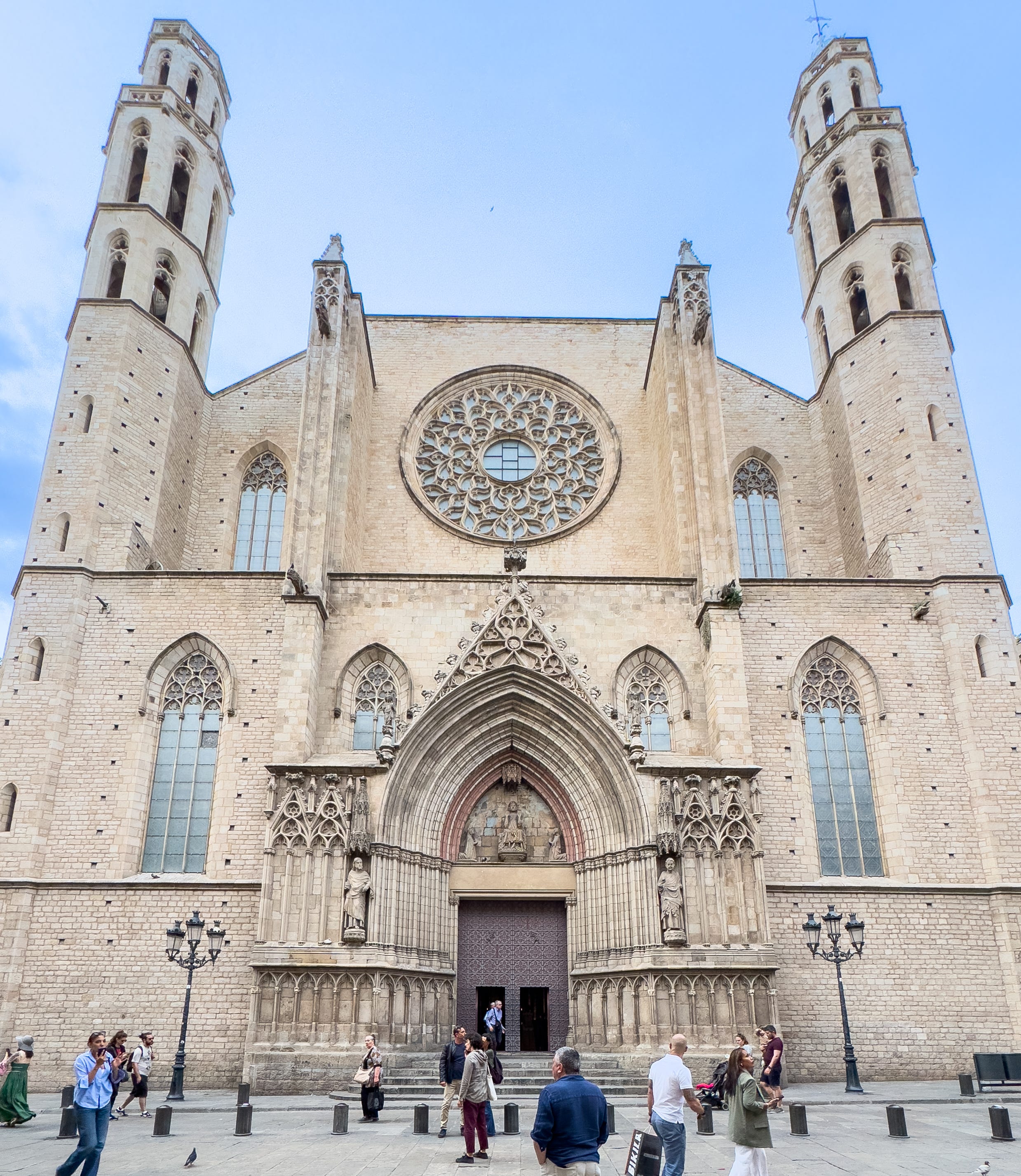
The club sits fifty meters from the Gothic church of Santa Maria del Mar, which took 55 years to build back in the fourteenth century. It’s hard for me to imagine what it’s like to build something for 55 years — you start laying the stones knowing you may never see the final result. In the modern world there aren’t many projects planned half a century ahead. My standup jokes, meanwhile, I’d often finish writing half an hour before going on stage — and many got thrown out immediately after.
But my standup and that church have things in common, too. For instance, English-speaking tourists came to see them both.
The church’s architects sought simplifications and symmetries, turning them into elegant forms and sturdy structures. The medieval architect’s work was to seek objective harmony — harmony that feels right not because someone invented it, but because it rests on fundamental laws of conscious perception. And the additional constraints of the physical world — from the pull of gravity to the weather — left architects not much room for self-expression.
Standup, of course, has more room for self-expression than Gothic architecture. But at the heart of standup as an art form lies the same impersonal search for simplifications and symmetries. Symmetry means an object’s invariance under transformations: e.g. a mirror reflection, a rotation around a point, a shift along a vector — though in the general case the transformations can be more complex than that. In standup, the basic setup+punchline formula of a joke itself is a symmetry. The setup has to create the expectation, yet keep “working” under the transition to the punchline. There are many variations on this general construction, so beauty of this fundamentally mathematical kind is everywhere in standup.
Some art forms are more similar to each other than others. One parameter you can group them by is the resistance of the medium. For instance, paper resists less than stone — leaving a brushstroke on canvas is easier than chiseling away the excess rock in a sculpture. Good standup must, above all, be funny — and this seemingly simple constraint creates serious resistance of the medium. In practice it means, for example, that not every interesting thought can be expressed there — I have no idea how to fold the thoughts of this very paragraph into a comedy bit on stage for example. And the free rearranging of words that comes so easily in essays risks breaking the construction of a joke. In its high resistance of medium, too, standup resembles architecture.
Architects turn ordinary materials — stone, glass, wood — into elegant forms. Standup comedians transmute ordinary life observations into crystals of meaning. The successful finds in both artforms, reflected in people’s subjective experience — passersby, visitors, audiences — weave themselves into the spacetime fabric perception, even if the timescales differ a millionfold.
***
They say that to be happy, you should have no expectations of life. Of Barcelona I had none — I didn’t fly there to do standup. Tuesday, the last set of the trip, the bar at the comedy club, leaving the day after tomorrow — did this city make me happy? Probably not, unless you allow the comparative degree — happier. And at that particular moment what I mostly felt was exhaustion settling over me.
Every joke is a wager in a communicative game. Winning these feel like an intoxicating sweetness of a mini-triumph, losing feels like a prickly sting of defeat. Tugging at the hem of Fortune’s dress is fun and thrilling, but draining all the same. Over one short set, these small victories and defeats braid themselves into a complex emotional experience with dozens of distinct shades — dozens of notes, like a good perfume or a good wine.
I was finishing my fourth beer in a group of four — comics and audience members. Midnight. The club was closing.
We left the club and headed to an Irish pub that was still open, walking past that very church. Who were the church’s architects? A hard question — we do know their names, but almost no other information about them themselves has survived the centuries. Who am I? A harder question still. A simple Siberian guy. A tool in the hands of God.
We got to the pub, took the only free table, and continued our conversation. Then a group of five more people came up to the four of us — they’d been sitting at the table before us — and staked their claim: we were here first, they said, we stepped out for a smoke and left our glasses covered, and you brazenly took our table. Our group did not love the idea of giving up the table.
Drunk people, a territorial dispute — the conflict was starting to flare. Who should get the table? The decisive move on our side came from Aiden — the muscular, bearded Irish sweetheart I mentioned above: “We don’t mind you staying and hanging out with us. It’s you who are trying to kick us out”. In chess, moves like this are called forks — we win either way: either they admit they’re the unfriendly ones, or we keep sitting at the table. A simple move, but it worked — they did agree to drink with us.
In a conflict, strength is often doing the standup thing: subverting your enemy's expectations the right way, at the right time — and turning the enemy into a friend.
No posts
Comments
Nothing yet. Say the first thing.
Sign in to join the conversation.