
Before we begin, if you appreciate independent writing about mental health, politics, war, trauma, and moral accountability, please subscribe to PsychiatRick. I know that your time is precious, and I appreciate that you chose to spend some of it with me. New articles are always free. Paid subscriptions help keep this work independent. Now, let’s get into it.
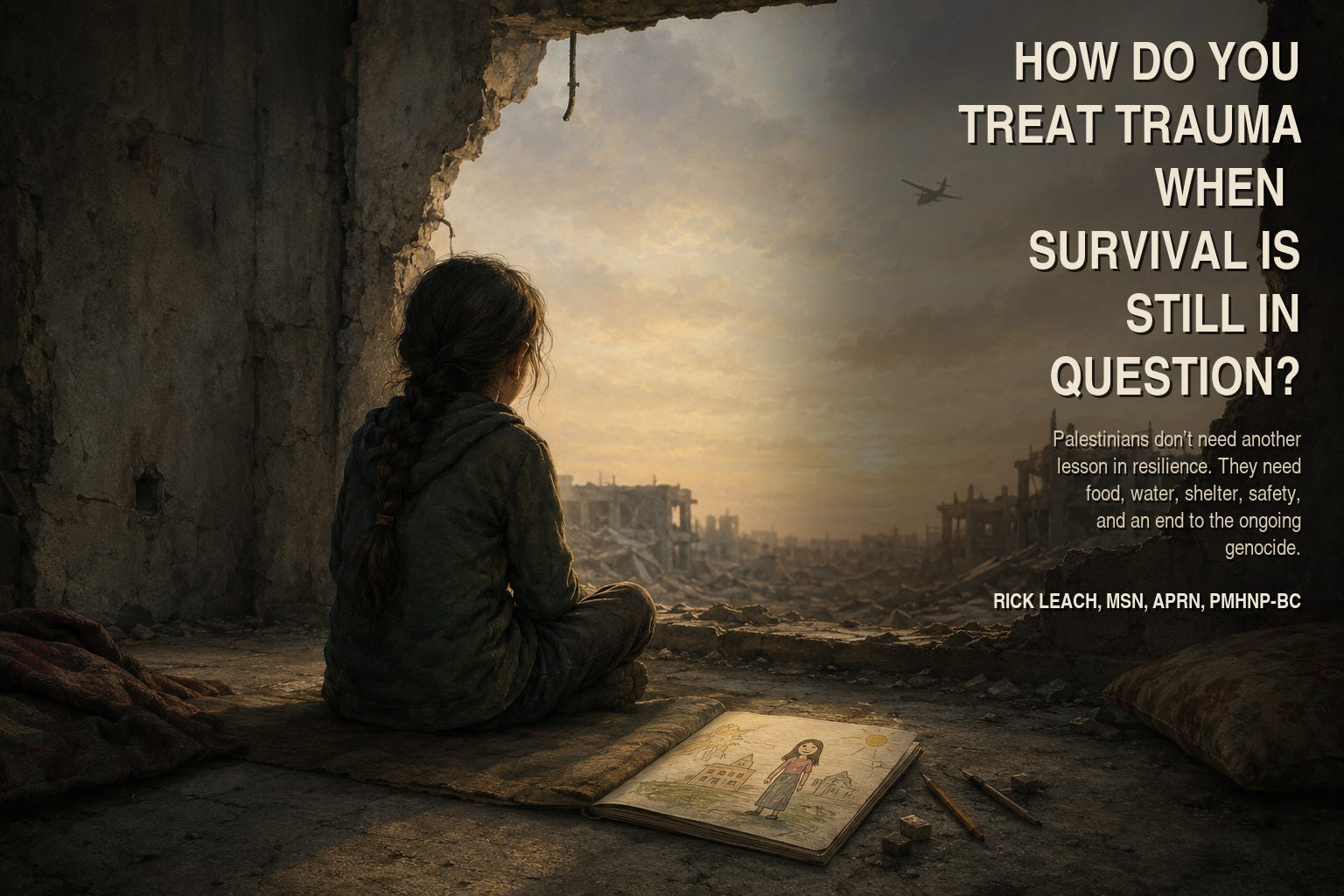
Mena is 11 years old.
When bombs strike near her in Gaza, she closes her eyes and imagines who she wants to become later in life. She learned the exercise through a UNICEF mental-health program (UNICEF, 2025).
The exercise gives her mind somewhere to go when she cannot physically get away.
The aircraft remain above her.
I was 20 in Iraq when an IED, RPG, or mortar landed nearby.
The blast was more than noise. I felt pressure in my chest and sinuses while the force traveled upward through the ground. It felt like being hit from the outside and the inside at the same time. I still don’t know exactly how to describe it.
For a few seconds, I couldn’t make sense of anything. Then my training took over. I moved toward cover, checked my battle buddies, and waited for another round to land.
I had a rifle, training, and other soldiers beside me. I could fight back. Mena can’t.
If I survived my deployment, I had a home to return to. Mena can’t leave Gaza when the bombing moves closer.
I was 20 and supposed to know what to do. Most of the time, I did. We had rehearsed what happened after an explosion. Move toward cover. Check the people near you. Stay ready in case another round comes in.
Mena is 11. Nobody can teach her how to fight an aircraft. She can only try to get through the fear while the adults controlling those aircraft decide what happens next.
I keep coming back to her age. Eleven. She should be worried about school, friends, and whatever she wants to be when she grows up. She shouldn’t need a mental-health exercise to survive the sound of bombs.
PTSD and traumatic brain injury can affect sleep, memory, concentration, and mood. TBI may also cause headaches, dizziness, or sensitivity to light and sound.
PTSD can bring nightmares, avoidance, intrusive memories, and physical reactions that happen before the person understands why (Defense Health Agency, 2025).
One explosion doesn’t guarantee either condition. Distance, force, prior injuries, and repeated exposure affect the risk.
Researchers have found neurological changes in service members exposed to repeated blasts. Many also reported a poorer quality of life (Gilmore et al., 2024).
With children, there’s another concern. An injury can interrupt abilities that are still developing, and the effects may not become clear until years later. Most children recover after a single mild TBI.
The risk is greater when the injury is more severe or when it happens over and over again (Kurowski et al., 2023).
Recovery requires sleep, food, and medical care. None of that can be done in Gaza, where an active genocide is occurring.
Maslow, Water, and the Limits of Psychiatry
Maslow’s hierarchy of needs isn’t a perfect depiction of what humans need. He also didn’t draw the pyramid now associated with his work (Maslow, 1943).
People still love, worship, create, and raise children while hungry or unsafe. Human needs don’t fall into a fixed order (Tay & Diener, 2011).
I don’t need Maslow to be completely right. People need water.
I know what it feels like to think about water all day. At the beginning of the Iraq invasion, I was allotted one liter a day. That liter had to cover drinking, brushing my teeth, washing clothes, and whatever passed for hygiene. We went three months without a shower.
I was thirsty, filthy, and pissed off. I was also an American soldier with an Army behind me and a deployment that would eventually end.
I think about that whenever somebody describes six liters a day as a humanitarian target. Six liters sounds like a number in a report until you have to live on it.
In June 2026, most households in Gaza couldn’t obtain six liters of water per person each day for drinking and cooking (OCHA, 2026). UNICEF found enough drinking water in only 52 percent of the households it surveyed. The number fell to 46 percent for cooking, cleaning, and hygiene (UNICEF, 2026).
When I assess a patient, I ask about sleep, appetite, anxiety, and whether they feel safe. In Gaza, I’d expect terrible answers before I asked the first question. People are hungry. Aircraft interrupt the night. If someone tells me they’re afraid, I can’t pretend that fear exists apart from the aircraft above their home.
When I use a depression scale, I don’t stop at the score. I ask what is happening in the person’s life. If a mother is hopeless because her children are hungry and bombs are falling nearby, the context is not a footnote. It is the whole damn assessment.
A depression score can count symptoms. It can’t tell me why they’re there.
This is where psychiatry can start to sound ridiculous. I can describe hypervigilance and leave the aircraft out of the clinical picture. I can document a mother’s hopelessness while her children still don’t have water.
You can’t “therapy” your way out of starvation.
Prozac can’t stop an airstrike.
These Forces Aren’t Equal
The Hamas-led attack on October 7, 2023, killed approximately 1,200 people in Israel and resulted in 251 hostages. Civilians were murdered and kidnapped. Hamas and other Palestinian armed groups have also fired rockets and built tunnels.
I’m not going to excuse any of that.
I’m also not going to pretend these forces are equal.
Palestinians don’t have a sovereign conventional military, an air force, a navy, or a missile-defense system. Under the Oslo framework, the Palestinian Authority could maintain police and internal security forces. It couldn’t maintain a military capable of defending Palestinian airspace (United Nations, 1995).
Israel spent an estimated $48.3 billion on its military in 2025 (SIPRI, 2026). It controls Gaza’s airspace and maritime access. It also holds tremendous power over the movement of people and goods.
An evacuation order sounds like a way out until you ask what it actually gives the people being ordered to leave.
Where is the transportation? Where is the fuel? Where is the safe place to go when the next designated area may also be struck?
An evacuation order is not a ride out. It is not an open border or a bus coming to somebody’s house. It may amount to somebody telling terrified parents to pick up their children and start walking.
I don’t know how Israel can call that an evacuation when it hasn’t given people anywhere to evacuate to.
Most Palestinians can’t cross the border and leave Gaza.
Israeli and Palestinian civilians can both be traumatized. I want to be clear about that. They don’t, however, have the same ability to escape, receive care, or depend on a functioning state.
There Is No “Post” Yet
The problem is the word “post.”
When a helicopter in California takes me back to Iraq, the danger is coming from my memory. I can look around and remind myself that I’m not there anymore.
Mena can’t do that.
When she hears an aircraft over Gaza, it may be carrying the next bomb. Her fear may be a response to what is happening right now, not something her mind dragged forward from the past.
Researchers use continuous traumatic stress to describe people living with a threat that is present and keeps returning (Eagle & Kaminer, 2013).
Palestinians can still develop PTSD, depression, anxiety disorders, or prolonged grief. I’m not arguing otherwise. A diagnosis can describe some of the damage. It cannot explain the aircraft above them or tell them whether another attack is coming.
A 2025 study of 952 displaced adults in Gaza found that about 79 percent screened positive for at least moderate anxiety. Eighty-five percent screened positive for at least moderate depression, and nearly 68 percent reached the study’s threshold for symptomatic PTSD (Aldabbour et al., 2025).
I don’t know whether those percentages describe everyone in Gaza. Nobody does. The researchers used self-report screening tools and convenience sampling during wartime.
What I do know is that 952 displaced adults gave those answers while living through a war.
Children don’t always have the words to explain what is happening inside them. They may start wetting the bed, stop playing, become aggressive, or withdraw.
UNICEF reported that 92 percent of the symptoms described by caregivers began after October 2023. Nearly two-thirds of caregivers felt overwhelmed or unable to manage their stress. Only 13 percent knew where psychosocial services were available (UNICEF, 2026).
A child looks to a parent to decide whether the danger has passed.
What does the parent say?
That there will be food tomorrow?
That the building will still be standing in the morning?
The parent may not know.
A 2026 review found high levels of trauma symptoms, depression, anxiety, death anxiety, and anticipatory grief among displaced children in Gaza (Al-Hroub, 2026).
I don’t see weakness in any of that. I see children reacting to what they have lived through.
Palestinians are often described as resilient. The Arabic concept of sumud, or steadfastness, speaks to dignity, rootedness, and the refusal to disappear.
I respect sumud. I don’t want it turned into another reason for people outside Gaza to accept what is happening there.
Praising Palestinians for surviving can keep us from asking why they are still being forced to survive.
Anger at that injustice isn’t a disorder. Therapy shouldn’t make oppression easier to tolerate.
The Genocide Question
Genocide has a specific legal definition. It requires prohibited acts and an intent to destroy a protected group, in whole or in part.
The allegation against Israel includes civilian killing, forced displacement, serious physical and psychological harm, deprivation of food and water, and destruction of the conditions needed to sustain Palestinian life. Investigators have also examined statements made by Israeli officials for evidence of intent.
South Africa filed its case under the Genocide Convention in December 2023, and the International Court of Justice ordered provisional measures.
There’s no final ruling from the ICJ on whether Israel committed genocide. I want to be clear about that (International Court of Justice, 2024).
There is, however, a conclusion from the UN Independent International Commission of Inquiry. In September 2025, it found that Israeli authorities and security forces had committed genocide in Gaza. Its analysis of intent included statements made by Israeli leaders, including Prime Minister Benjamin Netanyahu (United Nations Human Rights Council, 2025).
Israel rejects the finding and says its military is targeting Hamas.
So what about the 73,035 Palestinians reported killed in Gaza since October 7, 2023?
I’m still waiting on an answer (UNRWA, 2026).
Netanyahu also faces an International Criminal Court arrest warrant alleging war crimes and crimes against humanity. The allegations include starvation as a method of warfare, murder, and persecution (International Criminal Court, 2024).
Treatment Can’t Replace Safety
Gaza will need mental-health care for decades. Palestinian clinicians and communities should lead that work.
People will need rehabilitation for brain injuries, treatment for serious psychiatric illness, grief support, and long-term care for children.
I’ve spent years in therapy for what Iraq did to me, and I believe in this work.
All of my therapy happened after I came home. Nobody was firing mortars outside the office. I could leave the appointment, get in my car, go home, and lock the door. Even then, it took years to work through some of it.
Mena is being asked to cope before anyone has stopped hurting her. I don’t know how anyone can look at that and decide the missing ingredient is more resilience.
Still, a therapist can’t rebuild a hospital. Zoloft doesn’t produce clean water. An imagination exercise may help Mena survive the next few minutes.
It can’t stop the explosion from happening.
Food, water, shelter, and physical safety are mental-health interventions here. So are family reunification, schools, a stable community, and some control over the future.
Palestinians aren’t failing to cope. They’re being forced to cope with conditions that no human nervous system was made to endure for this long.
Before we ask them to heal, we should stop giving them new wounds.
References
Al-Hroub, A. (2026). Death anxiety and trauma in forcibly displaced children in the Gaza Strip: A critical review of emerging research, 2024–2025. Current Psychiatry Reports, 28, Article 21.
Aldabbour, B., El-Jamal, M., Abuabada, A., Al-Dardasawi, A., Abusedo, E., Abu Daff, H., et al. (2025). The psychological toll of war and forced displacement in Gaza: A study on anxiety, PTSD, and depression. Chronic Stress, 9.
Defense Health Agency, Traumatic Brain Injury Center of Excellence. (2025). Clinical pearls: Mild traumatic brain injury and posttraumatic stress disorder.
Eagle, G., & Kaminer, D. (2013). Continuous traumatic stress: Expanding the lexicon of traumatic stress. Peace and Conflict: Journal of Peace Psychology, 19(2), 85–99.
Gilmore, N., Tseng, C. J., Maffei, C., et al. (2024). Impact of repeated blast exposure on active-duty United States Special Operations Forces. Proceedings of the National Academy of Sciences, 121(19), e2313568121.
International Court of Justice. (2024). Application of the Convention on the Prevention and Punishment of the Crime of Genocide in the Gaza Strip: South Africa v. Israel.
International Criminal Court. (2024). Benjamin Netanyahu: Warrant of arrest.
Kurowski, B. G., Haarbauer-Krupa, J., & Giza, C. C. (2023). When traumatic brain injuries in children become chronic health conditions. Journal of Head Trauma Rehabilitation, 38(4), 348–350.
Maslow, A. H. (1943). A theory of human motivation. Psychological Review, 50(4), 370–396.
Stockholm International Peace Research Institute. (2026). Global military spending rise continues as European and Asian expenditures surge.
Tay, L., & Diener, E. (2011). Needs and subjective well-being around the world. Journal of Personality and Social Psychology, 101(2), 354–365.
United Nations. (1995). Israeli-Palestinian Interim Agreement on the West Bank and the Gaza Strip.
United Nations Children’s Fund. (2025, November 4). “We close our eyes and imagine what we want to become”.
United Nations Children’s Fund. (2026). The Gaza child-focused assessment: Insights from Gaza, December 2025–January 2026.
United Nations Human Rights Council. (2025). Israel has committed genocide in the Gaza Strip, UN Commission finds.
United Nations Office for the Coordination of Humanitarian Affairs. (2026). Humanitarian situation report, 5 June 2026.
United Nations Relief and Works Agency for Palestine Refugees in the Near East. (2026). UNRWA situation report #227 on the humanitarian crisis in the Gaza Strip and the occupied West Bank, including East Jerusalem.
Comments
Nothing yet. Say the first thing.
Sign in to join the conversation.