
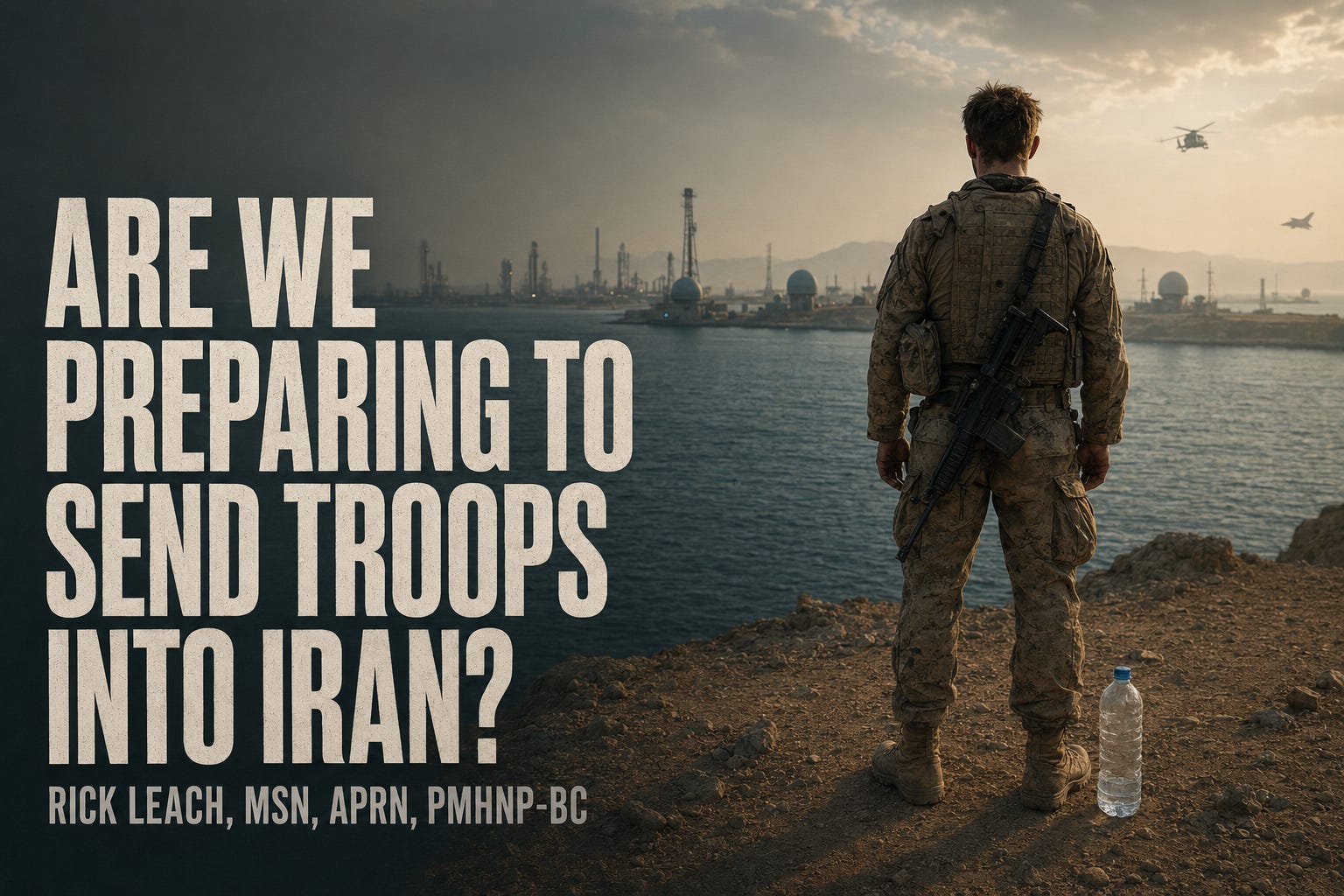
Who has to wear the boots?
I was twenty when I went into Iraq without enough water, food, or even flak vests. I’m afraid Iran could be worse.
Before we get into this, I know your time is precious, and I appreciate you choosing to spend some of it here. These articles stay free. Paid subscriptions help keep PsychiatRick independent.
I keep hearing people talk about putting “boots on the ground” in Iran.
Every time I hear that, I picture the kid standing inside those boots.
In 2003, that kid was me.
I was twenty years old when the US Army sent me into Iraq at the beginning of the invasion. I was an infantryman, and I believed the people making the big decisions probably knew more than I did.
I sure as hell hoped they did.
When we arrived in Iraq, we discovered that we didn’t have everything we needed to fight an effective war. Water and food weren’t always available when they should’ve been. Some soldiers didn’t even have flak vests.
I wish that were an exaggeration.
The United States had supposedly spent months preparing to invade Iraq. Politicians spoke confidently about the mission and American military power. Meanwhile, some of the young Americans carrying out their plan were fighting without all the equipment they needed to stay alive.
It blew my fucking mind, and it has never left me.
Now I’m watching the war with Iran grow. American forces are striking Iranian islands and coastal positions around the Strait of Hormuz. Ground operations have been discussed, and Iran may soon receive hundreds of Chinese-made shoulder-fired missiles.
People in Washington can call these developments whatever they want. From where I’m sitting, we’re getting dangerously close to asking another group of nineteen, twenty, and twenty-one-year-olds to do what my generation did.
That scares me because this war could be worse.
Iran Is Getting More Weapons
Reuters reported that Iran is expected to receive an initial shipment from a contract covering between 300 and 400 Chinese-made shoulder-fired air-defense systems. The reported deal includes QW-12 and FN-16 missiles and is worth an estimated $60 million to $70 million (Irish & Saul, 2026).
They’re known as MANPADS, or man-portable air-defense systems. A person can carry one, and a small team can use it against helicopters, drones, and low-flying aircraft.
A large air-defense installation can be found and bombed. A man carrying a missile can hide, move, wait, and fire when an aircraft comes within range.
Reuters reported that a Hong Kong-based company acted as the middleman. The plan calls for the weapons to leave western China and travel through Pakistan before reaching Iran.
China says the report is groundless. Pakistan denies helping transfer the weapons. The sources who spoke with Reuters also warned that quantities and delivery dates could change.
I don’t know whether every part of this reported deal will happen exactly as described. Nobody outside the deal does.
What I do know is that American pilots are already flying over Iran. A few hundred portable missiles would give Iranian forces more chances to shoot at them.
Months of American and Israeli strikes have damaged Iran’s military sites, missile facilities, and air-defense network. These systems would allow Iran to scatter replacement defenses among small teams instead of concentrating them at large installations.
We already know what one downed aircraft can do to a mission.
In April, an American F-15E was shot down over Iran. One crew member was recovered, another was reported missing, and two Black Hawk helicopters involved in the rescue effort were hit by Iranian fire while escaping Iranian airspace (Reuters, 2026).
No infantryman I served with would’ve said, “Leave him there.”
I wouldn’t say it now.
You go get him.
But then somebody has to protect the helicopters, suppress the Iranian fire, and cover the route back out. That’s how one missile can put Americans on Iranian soil before Washington admits we have entered a ground war.
The Island Strikes Are Making Me Nervous
The United States has already struck military targets on Kharg Island, an Iranian island in the Persian Gulf that handles most of Iran’s oil exports.
In March, Reuters reported that the Trump administration had discussed sending American ground forces to Kharg Island. Other options reportedly included placing troops along Iran’s shoreline and sending forces to secure highly enriched uranium.
The sources didn’t believe a ground deployment was imminent. Still, these weren’t ideas being tossed around by random people on social media. They were military options under discussion inside the administration (Stewart et al., 2026).
American forces had already bombed military targets on Kharg Island on March 13. The United States later struck radar and drone command sites at Goruk and on Qeshm Island, which sits along the Strait of Hormuz. CENTCOM said the strikes destroyed Iranian air defenses, a ground-control station, and drones threatening vessels in the area (U.S. Central Command, 2026c).
Then, on July 29, American forces conducted another two-hour round of strikes against Iranian military command centers, missile and drone facilities, coastal surveillance positions, maritime defenses, and other Revolutionary Guard targets (Singh & Ward, 2026).
The United States has also cleared mines from the Strait of Hormuz and established a blockade covering ships entering or leaving Iranian ports (U.S. Central Command, 2026a; U.S. Central Command, 2026b).
There’s no public order to invade Iran. I want to be clear about that.
There are, however, more pieces being put into place than I’m comfortable ignoring.
We’re bombing island targets and coastal defenses. We’re clearing the Strait and blockading Iranian ports. Officials have discussed sending American forces to Kharg Island and other parts of Iran’s shoreline.
Maybe it remains an air and naval operation.
I hope it does.
But these missions rarely grow because somebody announces a new war from a podium. They grow because an aircraft goes down, a missile hits a base, or troops already in danger need more troops to protect them.
One thing leads to another, and suddenly the mission bears little resemblance to the one Americans were first promised.
I watched it happen in Iraq.
Being Twenty in a Foreign War
At twenty, I thought twenty was grown.
It wasn’t.
Most people that age are still figuring out who they are. A twenty-year-old in the military may be sent halfway around the world, handed a rifle, and ordered to make decisions that will stay with him for the rest of his life.
When you’re deployed, nearly everything familiar disappears. You’re away from your family, your normal routine, and whatever privacy you used to have. You sleep where you’re told and eat whatever happens to be there.
You miss small things. Sitting on your own couch. Opening your refrigerator. Driving somewhere without watching the side of the road. Hearing a loud noise without immediately trying to figure out where it came from.
Nobody tells you how much of deployment is spent waiting.
You wait for orders, equipment, transportation, or word about where you’re going next. Sometimes you wait so long that boredom starts to feel normal.
Then everything changes in seconds.
At twenty, I knew how to carry my weapon, move with my unit, and react when things went bad. I wasn’t thinking about how combat might affect my marriage, sleep, health, or ability to feel safe twenty years later.
I was trying to survive the day and keep the people beside me alive.
That’s what young service members do. They adjust because other people are counting on them.
Americans see the uniform and forget how young the person wearing it may be. The Army can teach a kid how to react to enemy fire. It can’t make him older. It can’t remove his fear, and it can’t promise his family that he’ll come home.
We Didn’t Have What We Needed in Iraq
The supply problems in Iraq weren’t an abstract lesson in military logistics for me.
I lived through them.
We needed water. We needed food. We needed flak vests.
But even that doesn’t explain what it looked like from day to day.
For my first three months in Iraq, I was allotted one one-liter bottle of water each day.
That was it.
That one bottle was supposed to cover everything. Drinking. Brushing my teeth. Washing clothes. Any other hygiene I could manage.
We didn’t have showers for those three months.
I was outside fighting, rucking, and carrying all the shit an infantryman carries through the Iraqi heat. My choices were limited. I could use some of that liter trying to clean myself, or I could drink it.
I drank it.
One liter is barely more than one quart. Reporting published during the invasion showed just how inadequate that was. Army researchers told The Washington Post that active soldiers were drinking five to six quarts per day while the weather was still relatively mild. They expected active troops to need seven to nine quarts as the temperature increased. Those estimates covered drinking alone, not bathing, laundry, or brushing your teeth (Squires, 2003).
The Army’s own desert-operations doctrine was even more revealing. One planning example called for four gallons of drinking water and another 2.5 gallons for personal hygiene per soldier each day. The manual estimated that shaving, brushing teeth, and basic field bathing could require almost two gallons by themselves (U.S. Department of the Army & U.S. Marine Corps, 1993).
I had one liter for all of it.
This wasn’t happening because the military didn’t understand what soldiers needed in desert conditions. The Army had written the requirements down years before sending us there.
The water simply wasn’t reaching all of us.
Contemporary reporting confirms that supply lines were stretched dangerously thin during the opening invasion. In April 2003, The Washington Post reported that commanders feared frontline units could run out of food and water. At one point, Army officials were concerned the 3rd Infantry Division might run out of water, while some units were “black” on food, meaning they were within a day or two of exhausting what they had (Atkinson et al., 2003).
The lack of showers wasn’t unique either. A Reuters report from Baghdad described Marines receiving their first shower in almost a month. Even then, each Marine was given one minute to get wet, one minute to soap, and one minute to rinse (Reuters, 2003).
They waited almost a month.
We waited three.
Body armor was another documented failure. By October 2003, nearly one-quarter of the approximately 130,000 American troops in Iraq still hadn’t received the newer ceramic-plated armor capable of stopping assault-rifle rounds. Families back home were buying armor themselves and mailing it to their soldiers because the military couldn’t deliver it fast enough (Associated Press, 2003).
The soldiers and leaders closest to us did what they could. People shared what was available and tried to solve problems with whatever they had.
The larger failure had already happened farther up the chain.
Washington knew how it wanted to invade Iraq. It didn’t understand everything that would happen after American troops crossed the border, and it hadn’t built a supply system capable of keeping up with the plan.
We paid for the distance between its confidence and our reality.
People hear “the United States military” and picture an endless supply of weapons, equipment, food, fuel, and technology. They don’t picture a twenty-year-old infantryman deciding whether to brush his teeth or save that water for the next ruck.
They don’t picture soldiers entering a war without the body armor they were supposed to have.
They should.
Iraq’s government fell quickly. That part went about how Washington expected.
What came afterward was a mess.
The explanation for why we were there changed. The goals grew. The end moved farther away, and the troops kept fighting.
So when somebody tells me that a ground operation in Iran would be limited, I need more than that word.
Limited to taking Kharg Island?
Limited to securing nuclear material?
Limited until Iran attacks the troops carrying out the limited mission?
We’ve heard this shit before.
Iran Could Be Worse Than Iraq
Iran is much larger than Iraq, with more people and far more difficult terrain. It has mountains, deserts, long coastlines, major cities, hardened military facilities, and an enormous amount of ground that American forces would have to cross or hold.
Iran can also strike beyond its borders. Its missiles and drones can reach American bases across the region. Mines and coastal weapons threaten ships around the Strait of Hormuz. Armed groups aligned with Iran can attack American forces and allies from other countries.
The reported Chinese shoulder-fired systems would create one more threat for our pilots and helicopters.
Reuters has also reported that Iran explored purchasing Chinese anti-ship cruise missiles (Irish & Saul, 2026).
Could the American military defeat Iran’s conventional forces? I believe it could.
We crushed Iraq’s conventional forces too.
That wasn’t the part that broke us.
Iran has had more than twenty years to study what happened in Iraq and Afghanistan. Its military doesn’t have to beat us in a conventional fight. It can hide weapons, attack supply lines, and make every place occupied by Americans dangerous.
Taking Kharg Island would be one problem. Holding it and supplying the Americans stationed there while Iran fires missiles and drones at them would be another.
Washington can call that limited if it wants.
I won’t.
Who Pays for This Later?
Eighteen American service members have already been killed in this war. More than six hundred have been wounded (Stewart, 2026).
Some have already returned to duty. Others will be dealing with their injuries for years.
I’ve spent years in therapy for what Iraq did to me. Some of these troops may eventually spend years trying to understand what Iran did to them.
We just don’t know which ones yet.
Tell Us the Truth Before They Go
Iran has attacked American troops. Our military has every right to defend them.
Defending troops already in danger is not the same as sending thousands more into Iran without telling the country what they’re being sent to accomplish.
If Trump is considering occupying Kharg Island, putting forces along Iran’s shoreline, or sending Americans to secure nuclear material, he needs to say so.
Tell us how many Americans may have to go. Tell us how they’ll be supplied. Most importantly, tell us what must happen before they’re allowed to come home.
I went to Iraq at twenty because those were my orders. I trusted that the people sending us understood the war and would give us what we needed.
That trust was misplaced.
If troops enter Iran, the politicians discussing “boots” won’t be the people wearing them. Some nineteen- or twenty-year-old will carry the rifle and live with whatever happens next.
I already had my turn inside those boots.
I don’t want another generation sent into a worse war because nobody in Washington was willing to tell them the truth.
References
Associated Press. (2003, October 13). U.S. troops’ body armor delayed. The Washington Post.
Atkinson, R., Baker, P., & Ricks, T. E. (2003, April 12). Confused start, decisive end: Invasion shaped by miscues, bold risks and unexpected successes. The Washington Post.
Irish, J., & Saul, J. (2026, July 29). Iran to get Chinese shoulder-launched missile systems in weeks, sources say. Reuters.
Reuters. (2003, April 16). Marines’ Operation Scrubdown. Los Angeles Times.
Reuters. (2026, April 3). U.S. fighter jet shot down over Iran, search underway for crew member, U.S. officials say.
Singh, K., & Ward, J. (2026, July 30). U.S. military says latest strikes on Iran lasted two hours, hitting dozens of targets. Reuters.
Squires, S. (2003, April 7). In Iraq, a mighty thirst: War or no, the need for water is uncompromising. The Washington Post.
Stewart, P. (2026, July 29). U.S. military may require some troops in Mideast to surrender cell phones, sources say. Reuters.
Stewart, P., Ali, I., Banco, E., & Slattery, G. (2026, March 18). U.S. weighs military reinforcements as Iran war enters possible new phase. Reuters.
U.S. Central Command. (2026a, April 11). U.S. forces start mine clearance mission in Strait of Hormuz.
U.S. Central Command. (2026b, April 12). U.S. to blockade ships entering or exiting Iranian ports.
U.S. Central Command. (2026c, May 31). U.S. defends, disables threats in response to Iranian aggression.
U.S. Department of the Army, & U.S. Marine Corps. (1993, August 24). Desert operations: Water requirements (FM 90-3/FMFM 7-27, Appendix G).
Comments
Nothing yet. Say the first thing.
Sign in to join the conversation.