
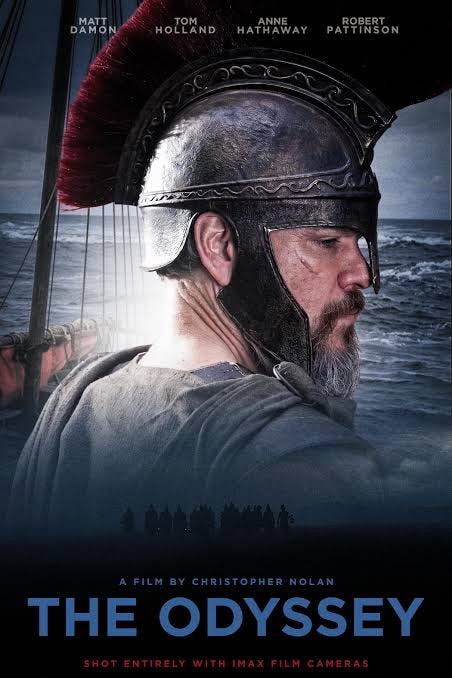
This is a tale of PTSD with events from 3,000 years ago.
I saw Nolan’s fittingly gargantuan iteration of The Odyssey Friday, and want to publish my analysis while it’s fresh. The film is told in characteristic Nolan fashion, where it’s somewhat nonlinear, but it isn’t hard to follow. It’s not Memento after all, where the movie goes completely backwards.
My first exposure to the Odyssey was the child’s education TV show Wishbone. The titular character was a Jack Russell Terrier on PBS who played the lead in different classic works of fiction, dressed up in the hat and coat as Sherlock Holmes, for example, or as Odysseus. This is a millennial thing: the show taught you about the classics, and it was cute because it had a dog. Fine. Now that’s out of the way, let’s get to the traumatology.
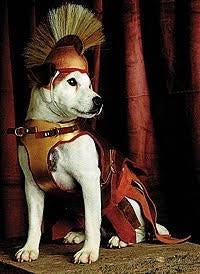
This is Wishbone the dog, as the great Odysseus.
Martin Seager and John Barry have identified three masculine aspects replicated across world cultures: fighting and winning, providing and protecting, and maintaining mastery and control of emotion (Seager & Barry, 2019). Odysseus fails on all three in a specific order, and that order is the story.
I would propose Odysseus was so focused on fighting and winning the Trojan War that he neglected the protecting and providing of his own wife and son, Telemachus, which caused him a great deal of shame. He also felt conflicted, because as the Sirens told him, he didn’t want to return home. First things first though: let’s dive into the beginning of the store.
The movie opens with a quote on the screen: “in a time of apparent magic,” and in the hall with the suitors, with Travis Scott as a storyteller slamming down his staff, announcing the exploits of Odysseus to a hall of men seeking to replace him . It was a cool opening with sufficient buildup to even seeing Odysseus. You don’t get to see him right away, which was a great decision. You see the bitter aftermath of him leaving, aka, the departure of a father who was providing and protecting his family.
You see the absence of this strong father figure depicted very clearly in a bereft wife and a lost son.
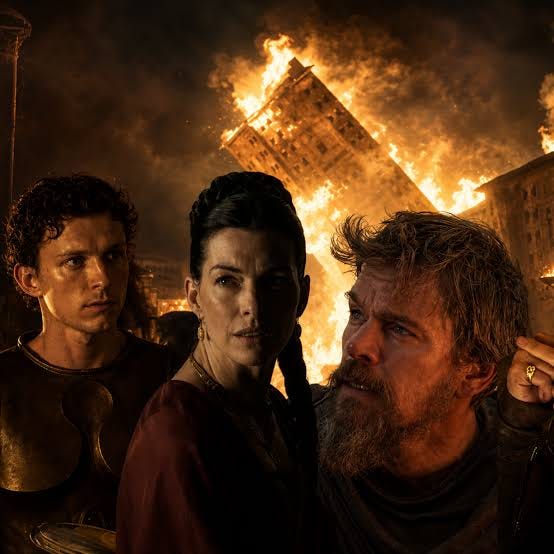
From right to left: Telemachus, Penelope, and Odysseus
The whole movie is about Odysseus attempting to return home after being drafted into a war that wasn’t his, over a woman who wasn’t his wife.
What kicks off this war? Helen, wife to king of Sparta, Menelaus, and most beautiful woman alive, is kidnapped and whisked to Troy. Agamemnon, Menelaus’s brother and the king of Mycenae, initiates war with all of Troy. The two are a formidable team. To win the war, Odysseus makes a clever decision to utilize hospitality, the “law of Zeus,” against the enemy. More on that soon. This becomes a significant motif of the film. It becomes his greatest pain point and feeling of guilt, to which he has flashbacks, which is a very modern aspect to depict. PTSD was only put in the DSM in the eighties. That’s a blink of time in human history, especially compared to 3,000 years ago.
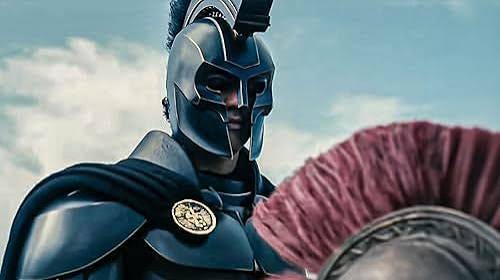
Here we see Agamemnon in his imposing, dark knight-esque armor.
Then there’s Antinous, the very slimy character played against type by Robert Pattinson, who was of course the heartthrob in Twilight. It shows great range that he could play a convincing villain. His plan: “I want to come in and take this wealth, and pretend to be a stepdad, but I’m really going to have this stepson disposed. I’m going to have Telemachus offed because he’s not my genetic offspring. He’s not my concern.”
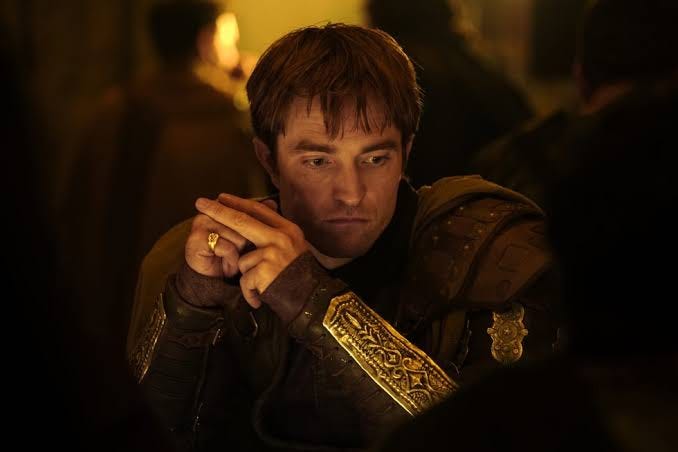
That’s a very primal, animalistic thing, and it’s where evolutionary psychology earns its keep in this film.
Unconsciously, the abuser knows it’s not their offspring. Consciously, they do not have the investment from oxytocin and early bonding, and primal things that are selfish and basically just hormonally and instinctually driven. Wilson and Daly (1985) introduced the Cinderella effect, proposing that because step-parents don’t share genetic material with stepchildren, the deep-seated unconscious emotional buffers that usually prevent parents from lashing out at offspring do not activate as fully.
Well, so that’s not fun. But we could correlate that with the divorce and mixed-family research of our own era, and say we have to figure out a way to deal with it, because it hasn’t gone away and I don’t think it’s going away in this generation of step-family and blended family.
That disdain toward stepkids is 3,000 years old, played on screen for us.
Tom Holland (Telemachus) is 30 in real life. Anne Hathaway (who plays his mother) is 43. A thirteen-year age gap. Was it realistic for women to have kids at thirteen, three thousand years ago? Yes. It’s even thought that Mary, the mother of Jesus, was probably around that age. I’m not saying it’s inaccurate. I do wonder what Telemachus’s age was actually supposed to be in the epic poem.
For our audience today, it probably is more realistic at 30 to be finding out who you are. You don’t have to fight a war. You don’t have to go survive the elements and produce lots of children to be your farmhands. You don’t have the struggle. There is no urgency to pair-bond now, so you can be as choosy as you want and even pass away alone, with no mate or heir. You just don’t have to do anything social, if you so choose.
The fact that Tom Holland is portraying a wide-eyed 15-year-old at twice that age is very apt for our time, and it plays very well. “Who am I, getting my first job, took a while to finish college, didn’t have to, was kind of comfortable lounging around, didn’t really have a goal, parents said I’m the best boy ever, don’t really care to settle down.”
Truly, it’s common stuff for our world. I don’t know that was Nolan’s intention, but it works anyway.
Erikson’s stages line up with Telemachus struggle to carve out his identity and assert himself as a warrior and ruler, the son of the illustrious Odysseus. Industry versus inferiority, autonomy versus shame and doubt, identity versus role confusion in the teen years (Erikson, 1968). Initiating is something you feel comfortable doing or supported in doing, which is an attachment idea as much as a developmental one. Attachment and development are so closely related it’s tough to delineate them.
Polyvagal theory undergirds all of it. There’s shutdown, there’s fight and flight, and there’s also social engagement, the myelinated ventral vagal response (Porges, 2011). That’s what you would want, and you would want to be able to engage it, as a ruler, warrior, and diplomat. Telemachus experiences 20 years of fatherlessness and lack of male role modeling, apart from that of his mentor (named literally Mentor, from where we receive the word), and Eumaeus, the blind swine farmer and loyal servant to Odysseus, even in the latter’s 20 year absence. Still though; the lack of fatherly example is clear in Telemachus’ lack of cunning and absence of capacity for clever strategy of clearing the hall of suiters.
Here’s where the film earns its traumatology stripes.
You get to see the Trojan horse appear, and you wonder what that is, but we know the story, we know what that’s going to be. The Greeks, including Agamemnon, Menelaus, and Odysseus, have been at a stalemate for 10 years in the Trojan war, and something has to give. Odysseus concocts a plan to hide the Grecian troops inside a sizable wooden horse that a soldier, who poses as a deserter to the cause, then presents as a prize for the temple of Athena. The plan works, and leads to a slaughter of those inside the walls of Troy, and not just troops. Civilians are also put to the sword.
Odysseus made a clever decision to utilize hospitality against the enemy, and the Trojan horse is the vehicle for it. He lied to one of the troops (Sinon) so he wouldn’t know what was actually in the horse, but to simply pose as a deserter and offer the giant statue. That detail matters clinically, because it implies the deception ran downward as well as outward. in other words, Odysseus deceived his own men to make deception of the enemy work better. Sinon was sacrificed so a deception could succeed.
Odysseus profaned Zeus’s law of hospitality. Even that word literally originates in the Latin profanus, meaning outside the temple, or not holy. He used something righteous, the honoring of a guest, in an evil way. Exploiting empathy as a way to destroy is very sociopathic, psychopathic. It’s profane. And Odysseus is not, we’re shown, by character a profane person. He does not employ ruthlessness in his own administration of his home. He’s kind to servants, as we see in his close relationship with Eumaeus. Zeus’s law, or Xenia, is the concept that hosts should show mercy to, feed and honor guests, who may be gods in disguise, while in return, guests should respect the hosts’ hospitality. It is a charitable, civil concept, and one which a horse filled with enemy combatants, using the guise of an offering to the god Athena, greatly profanes.
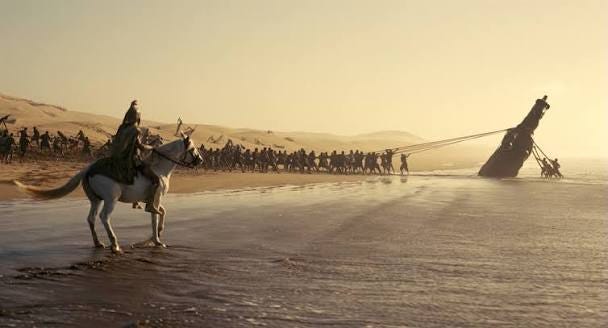
The Trojan horse tempts the Trojans.
The usage of something sacred in that way was a mockery. The idea of something satanic is an inversion, making fun of something that God created that was good. So you can apply this Christian terminology to this ancient context.
The idea of righteousness, of honoring a guest, used in an evil way. Exploiting empathy as a way to destroy.
The Trojan horse is emblematic for cultural decline and the replacement of a high-trust society with a low-trust one. That’s the thread that runs all the way to the song at the end of the film. Odysseus kicks off the end of a great era of honor and dignity with his use of hospitality for evil.
Odysseus just goes too far.That is, the Trojan horse going too far. Odysseus is by all counts a righteous person. But in the context of trying to choose a decisive victory, he makes a choice he can’t undo.
Moral injury can cause this horrible incapacity to live with yourself. Litz et al. (2009) defined moral injury as the lasting psychological harm that follows perpetrating or failing to prevent acts that transgress deeply held moral beliefs. Odysseus is morally injured. He doesn’t want to remember his profane deception. His actions would be against the Geneva Convention in our world today. They would be against goodwill and decency. His Trojan Horse ploy embodied the very word indecent.
He washes up after all of his misdeeds onto the sea nymph Calypso’s shore. None of his other men survived, due to the decisions they made along the way, like eating Apollo’s sacred herd of sheep out of starvation. They failed these tests, and you could call them “tests of masculinity,” of suppressing your appetite (sexually or hunger-wise).
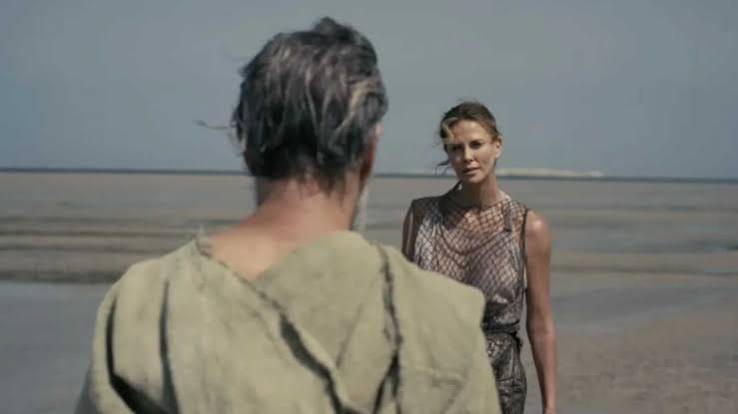
Calypso approaches Odysseus
We see Odysseus now has a long, whitish beard, almost like he’s gone grey from trauma, he’s on an island, and he’s forgotten who he is. He’s eating the lotus of forgetfulness. It’s like Xanax, except more amnesia.
Trauma is, of course, a major risk factor for addiction. Traumatic, overwhelming experience can cause you to turn to something to quell that experience is seen everywhere in traumatology. We know that moral injury can lead veterans struggling with how to cope and reprocess the traumatic memories. In fact, PTSD and substance use (tobacco, alcohol, and cannabis) are highly comorbid (co-occuring in patients) (Garrison-Desany, 2024).
Odysseus is so ashamed of what he’s done, of unleashing the Trojan horse on the Trojans, that he wants to forget it.
Calypso plays this nurturing, motherly figure who goes too far in protecting Odysseus from the truth. The people in your life who care for you and enable you love you, but they’re not handling your growth well. They’re insulating you from the growth and the actions and the restitution you need to perform, in order to grow further. Calypso is a coddling figure.
Calypso offers Odysseus the chance to forget his bad transgressions, through simply losing his identity and selfhood. You cannot choose amnesia and avoidance without losing what makes you “you.” It’s always a faustian bargain, where you lose more in abandoning your character and autonomy than you gain in peace of mind.
I’ll commend Calypso’s character, because she eventually relents. She essentially says, “okay, I’ll tell you who you are. Here you go. Stop eating this sedative, because it’s been causing you to forget. Let’s talk about what you remember about your men.”
That’s where we learn more of what happened through Odysseus’s eyes. The horse, the journey, not following Agamemnon home after the victory at Troy, and instead following Athena and getting lost.
In a Christian sense: how do you atone for denying Christ three times, as Peter did? Whatever your value system, when you completely betray it as a man, you’ve betrayed your purpose. So how do you get out of that?
Jonah does not want to work to convert Nineveh, because he hates the population there and wants them to go to hell. God says, no, you need to preach to them. Jonah gets swallowed by a fish, repents, and then goes and preaches.
Christians get messed up on this, and I can say that because I’m Christian. Humans are creatures of extremes. You don’t earn your salvation, and you also don’t need to act like you’re ungrateful for it. When you sin, you do need to grow as a person.
The Jonah analogue here is not, even though it would be a nice image, the belly of the horse. It’s actually Calypso’s island. That’s Odysseus’s belly-of-the-beast experience, of fleeing accountability and destiny. When he gains his wits to travel home, his story of redemption really starts.
The prison we then see in the movie is one of the mind: of isolation, one of self-medication with Calypso. When Telemachus reaches Sparta, Menelaus’s kingdom, to ask what happened to his father, in and after the Trojan War, he’s told that Menelaus doesn’t know what happened after Odysseus unleashed the Trojan horse and proved instrumental in victory. Odysseus set off, parted ways from Agamemnon (which I think was a bad move) to get home on his own course, not following another. Menelaus says that Odysseus could be imprisoned, dead, or could be coming home.
Menelaus asks: “what kind of prison could hold a man like that [meaning Odysseus]?”What kind of prison could hold him? One of his own making.
A prison of the mind. Traumatic dissociation and avoidance, the desire to avoid thinking about your past regrets and moral failures.
Eurylochus, Odysseus’s bearded lieutenant, keeps functioning as a voice of reason. He said the men needed to leave the Cyclops’s cave before the Cyclops came back. “We don’t know whose cave this is.” They should have listened to him, should have left, didn’t. I blame Odysseus.
Eurylochus asks whether Odysseus couldn’t have “shown some mercy,” after Odysseus shoots the Cyclops in the eye after the soldiers have already escaped, which causes the Cyclops to go even more wild and take out just a few more men, in the chaos.
Odysseus just goes too far. That is his flaw in this film. He uses his cleverness in a way that proves taboo, with the Trojan horse, and he invades the home of a cyclops (one of Poseidon’s children).
There’s a moral gray area, and I want to be fair to him. Entering someone’s cave to try to plunder it is extremely fraught. If you’re starving and it’s like Aladdin and you need some bread and you go to the market, you risk reprisal. What if you and your men are starving? I get it. Regarding the Trojan horse, this war had been going for ten years. Odysseus wanted to be done with it and to win.
So he did something profane, and used one of culture’s sacred laws to do so. The Greeks and Trojans both shared the law of Zeus, and Odysseus manipulated this to his advance.
Athena chides him for trying to control fate and the men’s actions. He is ovverly responsible, taking responsibility for other men’s decisions, even when he cannot possibly control the outcomes. Odysseus wanting to control everything, wanting that sense of control and power, is a highly human impulse, something people struggle with to this day, especially those who are very high in conscientiousness, who want to do a good job, want everything around them to measure up, and want to help everyone else reach their potential.
When he speaks with the dead in Hades, it’s revealed that Odysseus’s troops will give in to their appetites, eat Apollo’s sheep, and die. Odysseus tries to save them anyway. He wants to escape fate, defying the gods. The theme that you can’t take accountability for anyone but yourself is big here, and it’s one that many trauma survivors know all too well.
These men are starving on an island. The wind blows so they can’t leave. And when they eat the forbidden sheep, at that point they get judged. What are you going to do? What is the way out? How can you make a better decision? That’s the question the movie leaves us with, and it’s a fascinating conundrum.
We’ve discussed the “fighting and winning” element of masculinity as Odysseus going to war and going too far. We talked about the “providing and protecting” facet of manhood being “on hold,” which is why Odysseus’s home in Ithaca could be sacked and disrespected by the greedy suiters.
Odysseus gets an A, to an extent, on fighting and winning, and going too far is his flaw. On providing and protecting, he gets a B minus. Not everybody has a castle to give their wife and son, let’s face it. He did provide the raw materials, apparently enough for a decade’s worth of wine that Antinous drank through while complaining that the quality of it got too low. Well, sir, because you’ve been drinking it for ten years.
Then there’s emotional regulation. Where does that come in? Odysseus choose emotional over-correction. He pivots into addiction, and blunts out the memory of his own choices and past.
The masculine tendency toward emotional concealment is not a modern invention. Roger Kingerlee (2012) describes a transdiagnostic model of male distress in which men disregard memories that imply vulnerability in order to gain or maintain social status, with aversion to vulnerability producing avoidance behaviors. I’ve written elsewhere about whatKimberlee calls the “reflection abandonment mechanism,” or RAM: the reflexive turn away from interior states under distress, which shows up as substance use, externalizing anger, or humor. Odysseus deploys the first two, to great personal denial and destruction. He grows angry at the gods, seeks to defy them, and when that doesn’t work, turns to the numbing power of lotus and Calypso.
His journey to Hades is where he learns how to get home. It’s where he faces his demons in the form of the horrible mistakes he made, the trickery used in the Trojan War. He faces that down. He risks emotional terror and undergoes it and says, “okay, fine, I’ll go into that instead of blunting it out and ignoring it.”
We get to see Odysseus’s flashbacks, in which he witnesses flashes of key details from the Trojan war, from hiding in the claustrophobia-inducing close quarters of a giant horse, to then surveying the utter destruction rained down on Troy.
Right before these visions, a female figure speaks to Odysseus in the words and wisdom of Athena, so we are initially led to believe this is her, but then recognize her later as a victim of Greek cruelty that is haunting Odysseus.
That relates to the fact that some people with trauma will have traumatic flashbacks or visions. Odysseus is seeing Athena, and it’s played off that she is a relic, a sort of remembrance and an artifact of his trauma, in the same way that people with trauma can have hallucinations that seem very vivid. That’s not the same thing as psychotic or schizophrenic hallucinations. The work of Putnam (1989) and Kluft (1985) in delineating dissociative identity disorder from schizophrenia comes to mind. Advanced stuff, and the film handles it deftly, without announcing it.
I saw Odysseus’ return to his kingdom of Ithaca as a beggar as him returning as a ghost of himself. He’s too shamed to show his face. He has to move through this shame and indignity to reclaim his former identity.
It’s also, of course, very sly and clever, so he won’t be overpowered by dastardly suiters right away, in contrast to his inexperienced son going around announcing that he’s Telemachus and looking for his father.
Every time someone is told to leave their weapons behind in this film, they’re at risk of harm.
First this happens with Circe. She represents this trauma of masculinity. I think she was physically assaulted by men who found her because she lives alone. She learned to hate men and learned to harm men. With Odysseus, he’s able to negotiate with her, get out of the situation, and show that not all men are the same. But she tells Odysseus and his men to leave their weapons behind. That’s dangerous. Same thing at the Temple of Athena.
And then in Odysseus’s own home, the weapons are locked up while he performs the test of shooting the arrow through the row of axes.
Anytime people are told to leave their weapons aside in this film, it’s bad news. It’s basically saying “leave your wits behind, and blindly trust me.”
It’s like being gaslit. “No, that’s silly, you don’t need to test what I say or listen to me or ask anyone else or have any kind of verification. If you feel creeped out by something, if you feel at risk, you don’t need to follow that.” It’s very much saying “you need to rely on me as the full arbiter of everything. I can do what I want. And it’s an insult if you don’t.”
That’s very dangerous. Anyone who has good motives will be able to understand why someone could be hesitant, and they’re able to navigate that. The other extreme is someone who’s never okay with any verification, who’s aggressively skeptical to the point of cynicism. Funny, using other Greek terms to define the scenarios in this Greek film.
For regular interactions, a handshake evolved because you’re showing your hands and there’s no weapon concealed there.
Odysseus wanted to spare his son from the battle against the suitors. This fatherly instinct of “I want to protect my kid from everything.” Again, it’s about control.
Telemachus gets roped into it anyway and has to have his own moment of fear and his own moment of testing. He gets tested in a way that only he can respond to.
Gen Z has had parents go with them to job interviews. You can’t do that. You have to be able to face some things about your competency. You have to be competent for some things on your own.
I found that the sirens are the call to stagnation. The call to be sucked into addiction. And it’s a bit selfish that Odysseus wants to be the sole person to hear the song, while everyone else blocks their ears. The film handles that in a very interesting way, I will say.
He wants too much, some of the time. Being too clever, trying to be clever enough in a Tom Sawyer way, is generally too far in most literature. To some degree cleverness is great, but it will catch up to you if you are too greedy with it. That seems to be a virtue even from the days of the ancient Greeks.
Here’s the part I didn’t have in my notes from the film, and it’s the reason I wanted to write this up.
Trauma processing has three phases according to Pierre Janet, and this is from over a hundred years ago (Janet, 1889; see van der Hart, Brown, & van der Kolk, 1989).
Stabilization: building your safety. We see that through Calypso, and also through going to Hades and Odysseus learning what he has to do, to get home.
Trauma processing: confronting the memories, which he does in Hades, seeing the troop he lied to. He lied to one of the troops so they wouldn’t know what was actually in the Trojan horse, so they could sell it better and not panic. Odysseus also had to regain, reprocess, and reinterpret his memories of the Trojan war, including his part in the atrocities. Avoidance is the enemy of positive change.
Integration: reconnecting with life and finding new meaning.
That is what happens at the end of the Odyssey. That is what happens with the reunification and the reconnection to your own community. It’s about atonement, in the case of moral injury.
I found the reunification fascinating. It goes back around to a mingling of the instinctual: here’s how we honor the desire to escape and also do our duty and our honor.
The suitors, if you want to go psychoanalytic, represent the male insecurity of literally a roster of men waiting in the wings if you don’t do the right thing. Some of that is authentic and some isn’t, because you see the moral character of Penelope waiting and believing in this man that she selected.
I really wonder if Janet was at all thinking about the Odyssey, during his pioneering work with trauma treatment. I doubt he was. That’s what’s amazing. These are such universal human themes, they transcend time and space.
The Trojan horse is emblematic for cultural decline and the replacement of a high-trust society with a low-trust one. There’s a monologue at the end of the movie about how we have to make our story a song. Why a song, Penelope asks? For people who can’t read, in the future.
It’s seeing the decline of culture, and the people of the sea coming with no honor, as the end of a great era of honor and dignity, which Odysseus kicks off with his use of hospitality for evil. In tragic fashion, Odysseus abuses hospitality with the Trojan horse just as the suiters abuse Penelope’s hospitality. The film shows desperation and decline in ethics.
So for our culture today: what kind of society do you want to live in? Do you want to live in one where you’re shunned if you don’t live up to an imaginary expectation, instead of someone telling you what they expect? Do you want to live in a world where you could be cut off for anything, because your replacement’s always around the corner with the next swipe?
That’s why I adore this movie. It asks you what culture you want to live in.
This is a poem turned movie about a wife who waits 20 years, released in 2026 into a culture where it’s considered long-distance dating if you have to drive an hour to meet someone. We are so far beyond waiting years for your love that it’s not even something people would relate to now. Penelope’s character is superb. Her moral character, waiting and believing in this man she selected, is expertly portrayed. Odysseus needed to hear “I’m proud of you,” as respect is acknowledged in this film as the currency for men.
Odysseus’s failure to honor what was lost to win the war is what kept him buried, almost literally, in the sand with Calypso. Honoring the dead is another theme. To his credit, he was willing to allow himself to endure the terrible memories, and that was his escape.
Go see the movie.
References
Daly, M., & Wilson, M. (1985). Child abuse and other risks of not living with both parents. Ethology and Sociobiology, 6(4), 197–210. https://doi.org/10.1016/0162-3095(85)90012-3
Daly, M., & Wilson, M. (1988). Homicide. Aldine de Gruyter.
Erikson, E. H. (1968). Identity: Youth and crisis. W. W. Norton.
Felitti, V. J., Anda, R. F., Nordenberg, D., Williamson, D. F., Spitz, A. M., Edwards, V., Koss, M. P., & Marks, J. S. (1998). Relationship of childhood abuse and household dysfunction to many of the leading causes of death in adults: The Adverse Childhood Experiences (ACE) study. American Journal of Preventive Medicine, 14(4), 245–258. https://doi.org/10.1016/S0749-3797(98)00017-8
Fox, J. G. (2020). Recovery, interrupted: The Zeigarnik effect in EMDR therapy and the adaptive information processing model. Journal of EMDR Practice and Research, 14(3), 175–185. https://doi.org/10.1891/EMDR-D-20-00011
Garrison-Desany, H. M., et al. (2024). Post-traumatic stress and future substance use outcomes. Frontiers in Psychiatry.
Herman, J. L. (1992). Trauma and recovery: The aftermath of violence from domestic abuse to political terror. Basic Books.
Kingerlee, R. (2012). Conceptualizing men: A transdiagnostic model of male distress. Psychology and Psychotherapy: Theory, Research and Practice, 85(1), 83–99. https://doi.org/10.1111/j.2044-8341.2011.02014.x
Kluft, R. P. (Ed.). (1985). Childhood antecedents of multiple personality. American Psychiatric Press.
Litz, B. T., Stein, N., Delaney, E., Lebowitz, L., Nash, W. P., Silva, C., & Maguen, S. (2009). Moral injury and moral repair in war veterans: A preliminary model and intervention strategy. Clinical Psychology Review, 29(8), 695–706. https://doi.org/10.1016/j.cpr.2009.07.003
Porges, S. W. (2011). The polyvagal theory: Neurophysiological foundations of emotions, attachment, communication, and self-regulation. W. W. Norton.
Putnam, F. W. (1989). Diagnosis and treatment of multiple personality disorder. Guilford Press.
Seager, M., & Barry, J. A. (2019). Positive masculinity: Including masculinity as a valued aspect of humanity. In J. A. Barry, R. Kingerlee, M. Seager, & L. Sullivan (Eds.), The Palgrave handbook of male psychology and mental health (pp. 105–122). Palgrave Macmillan.
van der Hart, O., Brown, P., & van der Kolk, B. A. (1989). Pierre Janet’s treatment of post-traumatic stress. Journal of Traumatic Stress, 2(4), 379–395. https://doi.org/10.1002/jts.2490020403
No posts
Comments
Nothing yet. Say the first thing.
Sign in to join the conversation.